Renewable energy use rises in Germany

solar_PV_Gerrmany
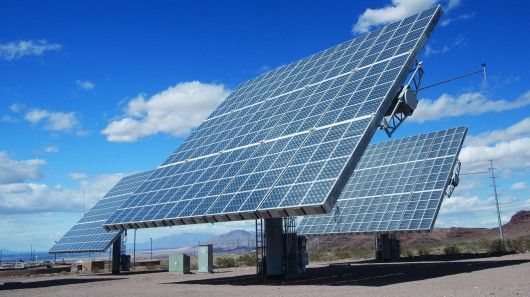
Lessened FIT, feed-in tariffs, high wattage potential and the increasing opportunities of energy deposit define renewable energy systems and make it a more appealing choice for German solar manufacturers. Solar power is being used by an increasing number of households and they utilize personalized plant designation, energy administration and cache.

Consumers of solar energy are more and more implicated in the consumption of high proportions of renewable solar electricity. A growth in electricity costs plus the lowering of prices in photovoltaic systems and the reducing of flaws in solar power have made these systems a fashion.

A new analysis made by the German Solar Industry Association (BSW-Solar) displays the fact that the interest of self-generating users has increased among entrepreneurs and households.

Carsten Körnig, CEO of BSW-Solar declared “Private electricity prices are now almost twice as high as the cost of self-generated solar electricity from the roof of a house.” The survey also displays that installers are facing more and more necessities. “The planning is challenging and advising potential investors is more complex,” said Körnig. Four out of five installers report expanded effort and time for the marketing of PV systems.

The production of solar electricity with its costs and feed-in tariffs as low as €0.15/ kilowatt hour and the fact that electricity rates €0.27/ kilowatt hour, if now higher, renewable energy has become a quite more appealing option instead of  grid-based production.

This fashion is also noticeable among an increasing number of entrepreneurs, who are cutting down their electricity bills by the use of company-owned PV systems.

Such entrepreneurs with proper roof surfaces can usually reach greater consumption rates even if they don’t have the ability to store the energy, declared BSW-Solar. Companies that are based on solar energy production and have a higher base capacity in daytime can widely cover their power utilization through the energy output of their PV systems.

Roxana Moraru

Negotiations are continuing in regard with import taxes between China and EU

Thorough bargaining continue to take place between the EU and China in the discussion of the PV market. Chinese Minister solar_PV_anti_dumping

Gao Hugheng and the EU trade commissioner Karel De Guchy will confront each other on this concern by the end of the week, being said that it will consist in long telephone conversation between the two. Additonaly, a compromise was offered to China by the EU, EU awaits a response.

The member states of the EU are to be aknowledged by the European Commission in the negotiation-related matters by the end of the week. China was seemingly given concessions by the EC, as reported earlier this week by the German news agency DPA.

An import tax cut was proposed by the EU for crystalline substrates, cells and arrays by 15%, but the reduction is not known on which base. Although it is said that the EU made a minimum import value proposal of  €0.65 per watt for Chinese arrays, given to us by well informed sources, China had a proposal of the minimum price of €0.50 per watt on imported arrays.

Import duties on Chinese crystalline substrate,cells and arrays will rise from 11.8% to an average of 47.6% if no compromise is achieved by Aug. 5.

Jochen Endle, spokesman of Hanwha Q CELLS Germany tells us that some 200 MW of high-efficiency cells and 120 MW of high-efficiency modules are currently produced in Thalheim annually. The cells are mainly used in the company’s own arrays. In Malaysia, the company produces 900 MW of standard cells, some of which are exported to Europe.

Roxana Moraru

Standards for large scale solar are to be prepared by the UK government

UK_large_sale_solar
The concern of loosing agricultural land may not be put apart by commitments to sustainability. The problems may be determined by incentives that can not stir rooftop and mid-size schemes.

The irresponsible installers from the UK are causing problems for large scale solar farms that are supported by the UK government who wants to introduce guidelines to increase their development.

A debate regarding the details was organized by Sarah Wollaston. The worries about visual impact of large scale solar farms, named hard-pressed farmers try to diversify their businesses, were summarized by Wollaston. Those who do not support solar farms also pointed out the loss of agricultural land.

Solar Trade Association, the UK trade body, is choosing 10 commitments responsible planning and development of solar farms but the UK government is planning further restrictions.

According to the STA, the problem seems to be a solar policy that doesn’t reward enough the mid-size installations.

“We’d all like to see more roof-mounted, community and mid-sized schemes and that came over loud and clear in the (parliamentary) debate. But the fact is the UK FIT scheme is failing these important applications. If that’s what the minister and MPs want to see – and they say they do – that situation must now also be addressed”, in term of Leonie Greene, STA’s head of external communications.

Roxana Moraru

Berlin-Beijing’s argue about polysilicon is to be resolved

China_denies_anti_dumping_duties_for_Berlin

China denied punitive tariffs on EU polysilicon imports as a sign of conciliation with Germany. 

The German Federal Ministry of Economics approved a report by German financial daily Handelsblatt that shows that German economics minister Philipp Rösler and Chinese minister of commerce Gao Hucheng came to an understanding regarding polysilicon imports.

In spite of the fact the everyone expected another move from China, for instance to deny European polysilicon imports, the two countries reached a settlement. This could be a first step up regarding a resolution of the trade dispute that grew in Europe’s PV industry.

In this year’s June, the European Commission, imposed anti-dumping tariffs of 11.8% on Chinese PV imports to Europe even though a large amount of EU states din not agree and neither did the European PV industry.

China has been thinking about imposing EU and U.S duties on polysilicon as well, but the new settlement shows that China has reached out towards Germany, Europe’s biggest polysilicon producer, which would have had a lot to suffer from the tariffs.
.

 Roxana Moraru

New inverters designed by Sungow, present at Intersolar 2013

New_Pv_inverters
A new set of inverters were presented by Sungrow in this year’s Intersolar.

Sungrow brings three brand new inverters at the exposition after enjoying a great success with the launching of 5-30kW string inverters and the releasing of SG500MX at SNEC 2013 in Shanghai. The new products are: SG800MX, the veiled central PV inverter; SG8/10/12KTL-EC-series string inverter, intelligent residential PV system, and SH10KTL, residential energy storage systems.

The outdoor inverter unit with an 800kW capacity, SG800MX, is one of world’s greatest single-machine power PV inverters. Throughout the stunning surprise elements are the SVG function during night, operation temperature ranges -25℃~+55℃. Moreover, it met German BDEW directives and obtained the certificates for grid-connection in America and Canada. The series to which it belongs have a great deal of amazing features such as: natural cooling function, higher conversion efficiency and lower cost and built-in monitoring system. To sum up, SG800MX is an intelligent residential PV system solution designed for Europe and America.

As for SH10KTL, Sungrow’s newest product for energy storage system of residential PV plant, it has an energy storage function integrated and it can switch seamlessly between grid-connected mode and off-grid mode

And last but not least, SG30KTL, is a wall-mounted string inverter with the largest single-machine power that can be found. This solution was the choice of many Europeans since its launch in 2012. The inverter remarks itself through the granted double “A” results from Photon’s test and VDE-ASIG reliability certificate.

Roxana Moraru

Three PV solar parks were constructed in Romania

Romanian_sola_parks

Romania’s solar capacity increased after the contraction of three PV solar parks was finished by Et Solar group. The parks have the combined capacity of 28 MW. So, an increase of 48 MW was made over the last eight months, after the company installed a total of 50 MW this year.

The solar parks are owned by Romania’s top electricity supplier and trader. The new PV systems are located in Targu Carbunesti, Gorjcounty, and Simnicu de Sus, Dolj county.

The PV modules were provided by ET Solar Group and the engineering procurement and construction services and the financing also were supplied by ET Solutions AG, its Munich-based subsidiary to be precise. The ET Solutions’ Romanian branch will be in charge of operations and maintenance.

ET Solar Group president and CEO Dennis She says that “the achievement of grid connection for these three photovoltaic plants is a result of seamless coordinated work among our team in Munich and Bucharest”. “It further demonstrates that we are transforming ourselves into a global EPC company. We are committed to further growing our project solutions business to other emerging markets.”

Romania had only 2 MW PV capacity in the last October, so the industry has come a long way in this country. However it was not easy. The Romanian government imposed new measures in June which were meant to frighten foreign investors. Between them is one ordinance that is meant to disapprove two out of six six green certificates given to photovoltaic energy producers per megawatt hour fed into the national grid. The Romanian energy regulatory Authority will still assign PV solar plants plants six green certificates but repress two of them until March 2017.

Roxana Moraru

Siemens solar division will close down

Siemes_solar_division

The solar division from Siemens will shut down after they failed to sell the unit that has not been functioning for nine months.

The company would be shut down production and the division according to sources from the company. Yet still, current ongoing projects will be completed and warranty obligations will be fulfilled, as announced by a company spokesperson.

As a result, 280 people will loose their jobs. The majority of them are located in in Israel, where the solar thermal subsidiary Solel Solar Systems, a Munich-based group operates.

Siemens spokesman To


Wolf also claims that “the current and future market for solar receivers remains low. As a result, it was difficult to agree on a business plan for a sale that took into sufficient account the interests of both the buyer and seller.”
rsten Wolf said that „After seven months of intensive sales efforts for the solar thermal business, it’s clear that due to the increasingly difficult market situation, no investor could be found for the business.” He also announced that the company was unable to reach an agreement that “provided due consideration for the interests of customers, employees, investors and Siemens.”

The latest engineering company, Siemens, purchased Solei in 2009 with $418 million. The group has reported $1 billion losts and Siemens put its solar unit on the block.

Roxana Moraru

New 4.5 MW solar park accomplished by the german Conergy in France

New_solar park_completed_in_France

Today’s Conergy realization is a solar park for the financier UEM, the local energy producer and framework operant, sheltered on an area of 9.5 hectares with the capacity of 4.5 MW.
This project holds 18,000 Conergy “P Series” units, it is situated in La Fare-les-Oliviers of Southern France, and will provide about 6,500 MWh annually, or plenty electricity to sustain about 1,800 homes.
Although the market is difficult and the price competition is forceful, the german provider Conergy continues to accomplish and provide for projects in European investors from Greece, Spain and Portugal. It also remains active in Southeast Asian markets like Thailand.
Conergy did not only provide PV units, but also brought to operation the design and installment for the entire project. In addition, it will carry on its involvement in sustenance and functional administration for the solar park.
Along with this project, Conergy backed up Sunlap in the building of two carport plants in La Fare-les-Oliviers with “P-Series” units and IPG15T inverters. It will sustain almost 127 MWh annually.

Conergy’s Managing Director Philippe Pflieger revealed a positive point of view. “With its decision to increase both, market volume and subsidies, the government has given a boost to the solar sector. Although the economic situation in this country remains tense, we believe that these steps will restore a good outlook for solar energy in our country.”

Roxana Moraru

Solar modules will have new switch-off solutions produced by Bosch

new_solar module_switch-offBosch is in the process of developing new switch off solutions design for solar modules. The new products will be presented at the Intersolar trade fair. 

The new solutions for both commercial and residential applications are optimizes for module electronics, particularly module junction boxes and control units.

The automatic switch-off is very useful in hazardous situations. Another advantage is the voltage-free state, meaning that the owners can have the modules installed and not risk electric shocks.

In case of main supply shutdown, intelligent electronics in every junction box guarantee the self-regulated switch-off of the entire system and its distinctive modules. This function can also be called up with a control signal from an exterior emergency switch. The new Bosch idea is distinct by initializing an automatic following restart as soon as the problematic situation has stopped. By this, the production is ensured once the situation ended.

After passing a large number of tests and being used in the field, prototypes have affirmed their strong capability.

All basic solar module types can benefit from the innovative solutions. In fact, the automatic switch –off can be installed without rebuilding the machines, in most cases. Moreover, the new product designed by Bosch Solar Energy matches with a handful of industrial standards and codes that where formerly introduced.

At the Intersolar trade fair, where the new concept will be promoted, Bosch will also showcase new black premium solar module, the white high-performance module and the new frame concept.

Roxana Moraru


Polysilicon prices are to go up a little

Solar_photovoltaic_prices

The price rising is happening because of the anti-dumping tariffs China is set to establish on the polysilicon from the EU, U.S.A. and South Korea. According to IHS the new prices will not affect the industry.

The last IHS Polysilicon Price Tracker report also shows that the weight of the increase will be limited by market factors.

The stratagem could bring the global solar polysilicon pricing up to $19.50 per kilogram in June and July, while in May the price was $16.50.

The flood was unexpected in the market as the prices were going down in the last 10 months.

Despite all this, the report shows only an 18% increase, “falling short of the 30% indicator that would represent a major market correction. Prices also would remain below the key $20-per-kilogram mark.”

China was “likely to impose anti-dumping tariffs with rates ranging from 30 to 50% on polysilicon imported from the European Union, the United States and South Korea. However, the impact of the duties will be mitigated by factors including long-term agreements that stabilize pricing as well as efforts by buyers and sellers to bypass the tariffs”, announced Glenn Gu, senior analyst, photovoltaics, at IHS.

The report also predicts that global manufacturing overcapacity of solar-grade polysilicon will not allow sustainable local price spikes, although the local production us protected.

Roxana Moraru