Photovoltaics manufacturing is growing fast in India

India_photovoltaic_manufacturingIndia – PV manufacturing capacity in growing fast, upto an incredible 2GW for both fotovoltaic cells and modules!

From India’s Ministry of New and Renewable Energy (MNRE), domestic manufacturing capacity of photovoltaic cells and modules has grown to 2 GW. It estimates India’s potential solar power per square kilometer to be 30 to 50 MW.

Since Jawaharlal Nehru National Solar Mission (JNNSM) in 2010 was lunched, which aims to install 20 GW of solar power by 2022, India’s manufacturing capacity of photovoltaic cells and modules has increased from around 200 MW to 2 GW.

Among other benefits for local manufacturers, while domestic content requirements have been stipulated under the first phase of the mission – and more stringent rules are being considered under the second – there have been complaints by some in India that imported photovoltaic goods, particularly from the U.S., for India’s manufacturers is causing problems.

In response, the government launched an anti-dumping investigation into solar cells from the U.S., China, Taiwan and Malaysia. It also, however, offers concessional customs duties to imports of finished solar products and equipment, in its bid to reduce solar power costs.

Solar power

In related news, MNRE has estimated that the solar power potential per square km in most of India is between 30 and 50 MW, in shadow-free areas.

Overall, MNRE states that 27 GW of renewable energy has been installed in India. It aims to install a further 30 GW of new capacity between 2012 and 2017.

The total capacity installed, solar is said to account for just over 1 GW. At the end of 2012, Mercom Capital Group stated that around 1.1 GW of projects are due to be installed in the next six months. Meanwhile, the MNRE has allocated 1.172 GW worth of solar projects via various programs over the past three years, of which 369 MW have already been commissioned.

This year, 4.4 GW of new solar projects have been announced in India, however, Bridge to India predicts that only around 1.1 GW will be online by the end of the year. Mercom is slightly more optimistic, with forecasts of between 1.3 to 1.4 GW.

There are, however, concerns that Phase II will be “indefinitely delayed” due to a lack of funds. Despite this, it seems likely that when funds are available, a Viability Gap Funding (VGF) model will be adopted, as opposed to reverse auctions.

Using Solar Energy to Create Wind Power

solar_energyA new type of wind power plant is in the works, and it is claimed to be able to produce clean energy from the sun and the wind with virtually no carbon footprint, fuel consumption, or waste production.

And not only that, it purportedly uses heat from the sun to produce its own wind, which would make this new type of plant desirable in areas with low or inconsistent winds.

The Clean Wind Energy Downdraft Tower is a skyscraper-sized hollow cylinder that uses the natural downdraft tendencies of air by spraying water (as a fine mist) across the top opening of the tower to cool the hot dry incoming air. As the water evaporates and cools the air, it becomes denser and heavier than the outside air, and then falls through the tower at speeds up to (and above) 50 mph. Once the faster moving air reaches the bottom of the tower, it is channeled through wind turbines in the base of the tower, generating electricity.

In addition, if the Tower is located in areas conducive to direct wind harvesting, the exterior of the Tower could be covered with “vertical wind vanes” to help  capture prevailing winds to produce supplemental power.

“One tower is equivalent is to at least one nuclear power plant. But here’s the big difference of course. You don’t have nuclear issues, you don’t have the safety issues, you don’t have spent nuclear rods, you don’t have the storage issue. These towers apparently they last forever. All you’re using is water, evaporation, wind gradients and presto! You do have the energy that’s produced through turbines and generators. So what we’re talking about is water and wind at free will.” – George Elliott, scientist and consultant for the Wind Energy Tower.

Clean Wind Energy, Inc. (soon to Solar Wind Energy Tower, Inc.), also plans to build a pair of demo towers, up to 2,250 feet tall, near Yuma Arizona, potentially powering up to 1.6 million homes in California and Arizona.

“The first Tower in Arizona has a projected output capacity, on an hourly basis, of up to 1000 megawatt hours, gross. Using a 70% capacity factor the Tower’s potential hourly yield would be 700 megawatt hours from which, approximately 17% will be used to power its operations, yielding approximately 600 megawatt hours available for sale to the power grid.” – Clean Wind Energy, Inc.

Underground greenhouse for year-round gardening

greenhouse_gardeningGrowers in colder climates often utilize various approaches to extend the growing season or to give their crops a boost, whether it’s coldframes, hoop houses or greenhouses.

Greenhouses are usually glazed structures, but are typically expensive to construct and heat throughout the winter. A much more affordable and effective alternative to glass greenhouses is the walipini (an Aymara Indian word for a “place of warmth”), also known as an underground or pit greenhouse. First developed over 20 years ago for the cold mountainous regions of South America, this method allows growers to maintain a productive garden year-round, even in the coldest of climates.

It’s a pretty intriguing set-up that combines the principles of passive solar heating with earth-sheltered building. But how to make one?From American sustainable agriculture non-profit Benson Institute comes this enlightening manual on how a walipini works, and how to build it.

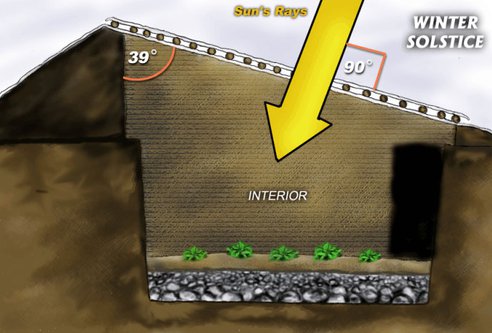
gardening_greenhouseThe Walipini utilizes nature’s resources to provide a warm, stable, well-lit environment for year-round vegetable production. Locating the growing area 6’- 8’ underground and capturing and storing daytime solar radiation are the most important principles in building a successful Walipini.

The Walipini, in simplest terms, is a rectangular hole in the ground 6 ‛ to 8’ deep covered by plastic sheeting. The longest area of the rectangle faces the winter sun — to the north in the Southern Hemisphere and to the south in the Northern Hemisphere. A thick wall of rammed earth at the back of the building and a much lower wall at the front provide the needed angle for the plastic sheet roof. This roof seals the hole, provides an insulating airspace between the two layers of plastic (a sheet on the top and another on the bottom of the roof/poles) and allows the sun’s rays to penetrate creating a warm, stable environment for plant growth.

walpini_greenhouseThis earth-sheltered greenhouse taps into the thermal mass of the earth, so that much less energy is needed to heat up the walipini’s interior than an aboveground greenhouse. Of course, there are precautions to take in waterproofing, drainage and ventilating the walipini, while aligning it properly to the sun — which the manual covers in detail.

Best of all, according to the Benson Institute, their 20-foot by 74-foot walipni field model out in La Paz cost around $250 to $300 only, thanks to the use of free labour provided by owners and neighbours, and the use of cheaper materials like plastic ultraviolet (UV) protective sheeting and PVC piping.