This power station can harvest kinetic wave energy and turn it into electricity

wave star energy

Wavestar, 4 years of continuous operation in the North Sea. Image source.

The Wavestar machine draws energy from wave power with floats that rise and fall with the up and down motion of waves. The floats are attached by arms to a platform that stands on legs secured to the sea floor. The motion of the floats is transferred via hydraulics into the rotation of a generator, producing electricity.

According to wavestarenergy.com, waves run the length of the machine, lifting 20 floats in turn. Powering the motor and generator in this way enables continuous energy production and a smooth output. This is a radical new standard and a unique concept in wave energy; it’s one of the few ways to convert fluctuating wave power into the high-speed rotation necessary to generate electricity.

“Environmental and climate issues, as well as uncertainty about energy supply, demand that we diversify our energy supply to multiple renewable and clean sources. With enough space for wave energy machines but little exploitation thus far, Wavestar is not just developing a wave power device, but energizing a whole movement.

Energy production with wave energy is more predictable than wind because waves come and go slowly and can be forecast 24 hours ahead. The Wavestar machine could also be installed together with a wind turbine which would further increase efficiency and reduce set-up costs. Wavestar understand that we need many renewable energy solutions, not just one, so it makes sense to harness the power of waves”, the team said.

Unique sea survivability

Survivability at sea is a big problem for wave energy devices. But unlike any other wave energy concept, the Wavestar’s sea survivability is guaranteed, and the concept has been proved during many years of continuous operation at sea. It can continue production in strong wind and waves, and automatically raises the floats out of the sea when the conditions become too stormy.

Award winning design

The Wavestar machine’s efficiency is being continually increased. The design was recently modified to reduce the cost by 40 per cent, while energy harvesting capacity and other aspects of the machine are being constantly improved for better efficiency. The Wavestar machine is less visible and quieter than wind turbines, and it also has a positive impact on wildlife below the machine, creating a sanctuary enhanced by the limits on nearby fishing.

The aesthetic profile of the machine won the prestigious Biennale Prize at the Biennial of Crafts and Design in 2009. The machine was nominated for the “highly original and striking sculptural design of a wave power machine, which in one single image symbolizes and clarifies the huge potential of this renewable energy resource … the wave power machine constitutes a beautiful counterpart to the clear form expression of the modern windmill.”

With the 500 kW machine in development, the company has claimed a position among the leading alternative energy developers in the world. Wave Star aim to make it the first series-produced 1 MW machine for big oceans, ready for sale in 2017. Wave Star is not stopping there though. The machine will then be doubled in size, capable of handling twice the wave height. This will increase each machine’s output to 6 MW, enabling a single machine to provide energy for 4,000 homes.

More info and details below:
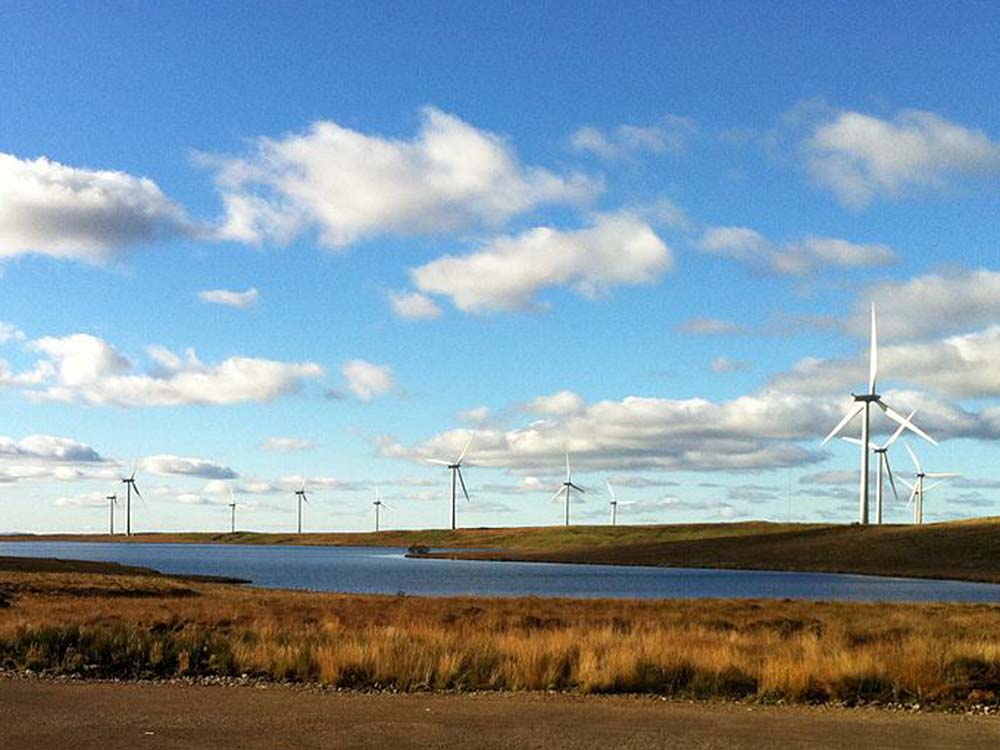
Scotland generated more than half its electricity from renewables last year

clean energy Scotland

Whitelee Wind Farm, Scotland. Image source.

Scotland has reached an ambitious renewable energy milestone by generating 57.7 percent of its gross electricity consumption. It also made up about 26 percent of total UK renewable generation last year.

According to Ars Technica UK, the government’s department of energy and climate change has released provisional numbers of renewable energy generation in 2015, which revealed that renewable electricity generated in Scotland last year totalled 21,983 GWh, with around 64 percent of that figure coming from wind turbines, and another 27 percent from hydro generators. Both sources showed a year-to-year increase in generation—of 21 percent and 7 percent, respectively.

Scotland now appears to be on track to fulfil its 2020 goal of having all of the country’s electricity consumption supplied by renewables. However, plans for the next four years might prove more difficult, given the significant cuts in renewable energy subsidies announced by the UK government in late 2015.

Scottish clean energy campaigners are predictably unhappy and have attacked UK prime minister David Cameron about the reductions to renewable energy subsidies.

“This is great news and an important step in creating a fossil-free Scotland,” said Dr. Richard Dixon, Friends of the Earth Scotland director. “Despite the UK government’s ideological assault on renewable energy Scotland is storming ahead, smashing through our 50 percent target for 2015. Well done to all those in this vital industry who have helped produced a big increase from the 2014 figures.”

“Clean, green energy is essential in the fight against climate change, and Scotland needs to continue to be a champion of renewables while David Cameron continues to chase the nuclear dream in England.”

New world record set in renewable energy investments

renewable energy global investments

Record renewable energy investment in 2015. Image source.

All investments in renewables, including early-stage technology and R&D (Research and Development) as well as spending on new capacity, totalled $286 billion in 2015, some 3 per cent higher than the previous record in 2011, said the 10th edition of United Nations Environment Programme’s (UNEP) annual report — Global Trends in Renewable Energy Investment 2016.

According to Gulf News, a total of 134 gigawatts (GW) of renewable power was added worldwide in 2015 compared to 106GW in 2014 and 87GW in 2013, the report said.

It highlighted that the green investments had broadened out to a wider and wider array of developing countries, helped by sharply reduced costs and by the benefits of local power production over-reliance on imported commodities.

“Renewables are becoming ever more central to our low-carbon lifestyles, and the record-setting investments in 2015 are further proof of this trend. Importantly, for the first time in 2015, renewables in investments were higher in developing countries than developed,” said Achim Steiner, executive director at UNEP, in an official statement.

In 2015, for the first time, investments in renewable energy in developing and emerging economy nations ($156 billion, up 19 per cent compared to 2014) surpassed those in developed countries ($130 billion, down eight per cent from 2014).

Much of these record-breaking developing world investments took place in China (up 17 per cent to $102.9 billion, or 36 per cent of the world total).

Other developing countries showing increased investment included India (up 22 per cent to $10.2 billion), South Africa (up 329 per cent to $4.5 billion), Mexico (up 105 per cent to $4 billion) and Chile (up 151 per cent to $3.4 billion).

Among developed countries, investment in Europe was down 21 per cent, from $62 billion in 2014 to $48.8 billion in 2015, the continent’s lowest figure for nine years despite record investments in offshore wind projects.

Investments in the US were up by 19 per cent to $44.1 billion, and in Japan investment was much the same as the previous year at $36.2 billion.

The report was launched by the Frankfurt School-UNEP Collaborating Centre for Climate & amp; Sustainable Energy Finance and Bloomberg New Energy Finance (BNEF).

Utilizing sea wave to generate electricity

Researchers Dr Ismail, Dr Muhammad Murtadha and Baharin Abu Bakar from Universiti Teknologi MARA, Malaysia have carried out a conceptual study on mathematical modelling for sea wave in electricity generation.

This conceptual study focused on using Oscillating Wave Column (OWC) which is considered as the most efficient way to utilize sea waves, the largest power source on earth, to generate electricity. Previous studies have revealed that global wave power is estimated to be 1TW (1 terrawatt=1012W).

Countries where numerous seafronts surround the country could tap into an alternative source of power generation which could be generated by the waves during the different seasons of the year. In addition, the findings of this study could be adapted to evaluate the capability to produce electricity on shore such as from lakes and rivers with undulated waves.

Researchers began the study with the derivation of mathematical equations for each component in the electrical generation system after taking into consideration the sea wave as the input to facilitate the workability of the entire system. The team of researchers verified the validity of the developed mathematical equations for each stage of the research.

This was done to establish its workability. Electrical and mechanical relationships were derived to relate the workability of each component in the system for the purpose of electricity generation. Numerous experiments were conducted to optimize the results in this study which would eventually lead to the generation of electricity. The results obtained from the experiments indicated that the proposed model appears practical could be implemented.

Underwater turbine tested to harness tidal power in Scotland

Scottish Power Renewables (SPR) has conducted a test on an immersed turbine which can be utilized to harness tidal power to produce electricity.

The test has successfully completed in northern isles of Orkney,in the island of Eday. The turbine known as Hammerfest Strom HS1000, is already a source of electricity for many homes and businesses on Eday.

Hammerfest can be monitored underwater, with help of engineers based out of the European Marine Energy Center.

This HS1000 comes with integrated blades that spin in the direction and flow of tides which helps generate power.The structure of Hammerfest has been inspired from a tri-pod.

Scotland is exploiting all modes of clean energy which will help in generating electricity and reducing their carbon footprint share.

The new Wave Power Device

Ocean Power Technologies Inc. has announced that it has completed the first of its new generation utility-scale PowerBuoy device, the PB150. The PB150 Powerbuoy has a peak-rated power output of 150 Kw and is the largest, most powerful wave power device build by the company.
Ocean Power Technologies Inc. is a leader in wave energy technology. The PB150 PowerBuoy will have the equivalent to the energy consumption of approximately 150 homes – the PB150 is designed for use in arrays for grid-connected power generation projects worldwide, according to a press release.
The device is currently being prepared for ocean trials at a site approximately 33 nautical miles from Invergordon, off Scotland’s northeast coast. These sea trials are expected to commence as soon as weather conditions permit. The company is seeking additional financing for the commercial utilization of the buoy after the trial phase is completed, including its possible deployment at various potential sites.
A second PB150 is already under construction in the US for a proposed utility-scale project in Oregon, and the company is involved in other planned projects in Australia, Japan and Europe that may utilize the PB150.
Source: http://www.tomorrowisgreener.com/the-next-generation-wave-power-device/

The first wave power farm sets sail

Wave energy is among the impressive list of renewable energy resources that is being developed in the United States. New Jersey-based developer, Ocean Power Technologies has launched a project that features the nation’s first commercial wave power farm off the coast of Reedsport, Oregon.Once the project is completed, wave energy will generate power for several hundred homes in Oregon. The wave power farm operates on the wave energy that is created when a float on a buoy flows with the natural up and down movement of the waves.
This action subsequently causes an attached plunger to follow the same kind of ebb and flow movement. The plunger is attached to a hydraulic pump that changes the vertical movement to a circular motion, which drives an electric generator to produce electricity that is sent to shore through submerged cables.
When the initial project is finished, the first $4 million dollar buoy will measure 150 feet tall by 40 feet wide, weighing 200 tons. Nine more of these crafts will be set in motion by the year 2012 for a total cost of $60 million dollars. About four hundred homes will receive electricity from Oregon’s wave power farm by the completion of the project.
Solar: www.alternative-energy-news.info/wave-power-farm-sets-sail/

Using wing waves to produce electricity

Just like wind mills and wind turbines that generate power and electricity from the wind, scientists are now working to generate power from the sea. Stephen Wood, an assistant professor of marine and environmental systems at Florida Institute of Technology’s College of Engineering is working on this technology for its advance and proper use. This technology will use Wing waves in a very efficient way to generate electricity and power from the sea.
The wing waves technology to produce electricity and power from sea is a project initiated by a renewable energy firm from Tallahassee called the Clean and Green Enterprises. This firm has been working in this area since the past five years.
According Wood, about 200,000 houses can be lit with the help of one square miles of wings that produce around 1000 units of electric power. Power is generated by changing elliptical motion wave into mechanical energy after trapping it 30 feet to 60 feet below the sea.
To use Wing waves to produce electricity from the sea, there are two basic requirements: depth of 40 to 50 feet and a sandy bottom. Sea fans are placed on the sandy base. Though, bigger wings can be used to tap water to make electricity but for that the plant to make these wings has to be situated near the ocean. Till then, the fans having trapezoid-shaped wings that are 8 feet tall and 15 feet wide will continue to be used and they will be transported through road. The height and the width of the wings are carefully made so that they can be transported by the road and can be easily placed under the sea.The chief executive with Clean and Green Enterprises Inc., Terence Bolden says that the wings sway 30 degrees from side to side. They take 8 to 10 seconds to complete every arc. In this process, they produce electricity.
Source: www.alternative-energy-news.info/electricity-from-wing-waves/