Solartab: the premium solar charger

Solartab, solar charger

Clean power for your gadgets with Solartab. Image credit: mysolartab.com

The Solartab is unlike any other power bank or solar charger. A truly unique product featuring great design, a high-capacity internal battery and a built-in cover that ensures maximum sun exposure at all times. And a solar panel large and powerful enough to charge even your tablet.

Acccording to its Kickstarter Campaign, the Solartab was born out of the idea of creating a high quality solar charger with attractive design and a truly efficient solar panel.

“Solar power should never be a mere gimmick – on the contrary, we believe it’s the future of power consumption! A tablet-sized solar charger makes for a powerful and essential asset that truly liberates you from the power outlets of your home. Every day.”

Thanks to the Solartab’s large solar panel you can always charge your device directly from the sun. Even while listening to your favorite summer tune or phoning your friends at the same time!

With two USB ports and a micro USB port, the Solartab is ready to keep any of your mobile devices going at all times. An environmentally friendly, portable and never-ending source of energy, always ready for use.

Taking care of your garden with this unique solar-powered soil sensor

Solar-powered soil sensor

A Solar-Powered soil sensor for serious gardeners

The Edyn Wi-Fi garden sensor will monitor soil and weather, alert your iPhone and trigger a wireless water valve for irrigation.

Accordng to The Next Web, Edyn’s creator, Jason Aramburu, worked as a soil scientist prior to inventing the company’s devices. The product is designed to help both expert and novice gardeners. Fuse Project contributed to the hardware.

The Edyn sensor runs off solar power and connects to your WiFi network. It uses electrical impulses to monitor the state of your soil and then combines that info with other sensors (temperature, light, humidity) and online weather data to come up with recommendations for your garden. If you need advice on what to plant, it can suggest pairings of different crops.

The hose attachment serves as the other piece of the Edyn system. You connect it between your garden hose and a drip irrigation system to automate your watering. The Edyn sensor can adjust the amount of water your plants get if the day is rainy or especially humid.

The Edyn mobile app will act as your garden’s dashboard, serving up data on the state of your plants. You’ll get push notifications when your garden is watered, as well as alerts when you need to add fertilizer to your soil.

The compant’s sensor will cost $99 for backers, though an early-bird tier can get the device for $79. The combo pack of the sensor and the hose attachment will set you back $159. The first shipments are expected to go out in December, with the bulk of campaign rewards arriving in time for Spring 2015 planting. Edyn will also run a Toms-style buy-one-give-one tier that lets you purchase a set and donate one to growers in developing areas, such as Africa.

Kyocera’s solar-powered smartphone prototype

solar-powered smartphone

Kyocera has developed a smartphone prototype that features a display with a Wysips Crystal layer for harnessing solar power

Kyocera is showing a new solar-powered prototype that can also charge anywhere, so long as it’s not too dark or cloudy.

This week at Mobile World Congress in Barcelona, Kyocera is showing off a concept phone that uses its own display to convert the sun’s rays into juice for its battery. While we’ve previously seen devices that harness the sun’s rays via solar cells mounted on the chassis, Kyocera’s prototype employs a transparent photovoltaic layer that can be placed on top of or beneath the touchscreen.

According to Gizmag, the specific technology on display this week comes from a company named Sunpartner, which makes a power-generating display layer called the Wysips (What you see is photovoltaic surface) Crystal connected to a chip that manages and converts solar energy into power that can be stored in the device’s battery.

Sunpartner says Wysips is capable of delivering up to 5 milliWatt-peak/cm2, a figure the company expects to soon double thanks to next-generation photovoltaic materials. The layer is only 0.1 mm thick, making it easy to add to a device without impacting the aesthetic design. The company also claims that it will not impact the the display’s touch capabilities.

While today’s high-powered smartphones won’t likely be able to be self-sufficient on solar power alone, lower power devices like e-readers and more basic phones could theoretically go charger free with this kind of technology. A Tag Heuer watch sporting one of these layers is touted as having “infinite power.”

In the instance of smartphones like Kyocera’s, Sunpartner says its technology could offer infinite standby time so long as sunlight is available. Perhaps the best selling point for those who use ruggedized phones in the field is that the solar power layer can essentially offset the battery drain caused by searching for a network in more remote areas and allow for a reserve of power for emergency calls.

While Kyocera seems to be the first company we’ve heard of demonstrating solar power generated from a device’s screen, Sharp did something very similar several years ago with a solar “lid” for a smartphone, but that never really made it to any markets beyond Asia.

Sunpartner, on the other hand, says its system can work on displays ranging from three to 13 inches, including smartwatches, phones and tablets. For more on the technology, check out the promotional video below.

Kyocera’s solar-powered smartphone prototype

solar-powered smartphone

Kyocera has developed a smartphone prototype that features a display with a Wysips Crystal layer for harnessing solar power

Kyocera is showing a new solar-powered prototype that can also charge anywhere, so long as it’s not too dark or cloudy.

This week at Mobile World Congress in Barcelona, Kyocera is showing off a concept phone that uses its own display to convert the sun’s rays into juice for its battery. While we’ve previously seen devices that harness the sun’s rays via solar cells mounted on the chassis, Kyocera’s prototype employs a transparent photovoltaic layer that can be placed on top of or beneath the touchscreen.

According to Gizmag, the specific technology on display this week comes from a company named Sunpartner, which makes a power-generating display layer called the Wysips (What you see is photovoltaic surface) Crystal connected to a chip that manages and converts solar energy into power that can be stored in the device’s battery.

Sunpartner says Wysips is capable of delivering up to 5 milliWatt-peak/cm2, a figure the company expects to soon double thanks to next-generation photovoltaic materials. The layer is only 0.1 mm thick, making it easy to add to a device without impacting the aesthetic design. The company also claims that it will not impact the the display’s touch capabilities.

While today’s high-powered smartphones won’t likely be able to be self-sufficient on solar power alone, lower power devices like e-readers and more basic phones could theoretically go charger free with this kind of technology. A Tag Heuer watch sporting one of these layers is touted as having “infinite power.”

In the instance of smartphones like Kyocera’s, Sunpartner says its technology could offer infinite standby time so long as sunlight is available. Perhaps the best selling point for those who use ruggedized phones in the field is that the solar power layer can essentially offset the battery drain caused by searching for a network in more remote areas and allow for a reserve of power for emergency calls.

While Kyocera seems to be the first company we’ve heard of demonstrating solar power generated from a device’s screen, Sharp did something very similar several years ago with a solar “lid” for a smartphone, but that never really made it to any markets beyond Asia.

Sunpartner, on the other hand, says its system can work on displays ranging from three to 13 inches, including smartwatches, phones and tablets. For more on the technology, check out the promotional video below.

This unique bamboo bike uses kinetic energy to charge your phone

bamboo bike

Bambootec’s bamboo bike

Bambootec, a consortium from Yucatán, Mexico, has designed a bamboo bicycle that turns pedaling into electricity for charging mobile devices. With a navigation dashboard in the handlebars, this unique bike measures distance and time thanks to a bluetooth connection.

After all, Bambootec’s creation it’s an impressive piece of engineering—particularly if the designs are simple enough to be built by hand by individuals in areas where rolling blackouts are a part of daily life.

Cristina Espinosa López, founder of Bambootec, said to inhabitat.com that the energy transfer is made possible thanks to a converter made of a circuit starting on the rim and proceeding through the system core under the seat, which captures and converts the kinetic energy into electricity. A regulator was also added to the converter, in order to assure that the electricity generated by the bike isn’t unevenly distributed due to variations in speed or quick braking.

The frame itself is assembled with bamboo sticks and resin, instead of metal, making the bike sturdier, lighter and more resistant to heat.

In all, the device sounds like an excellent instance of appropriate technology. The bikes could easily be assembled in the developing world since bamboo is cheap, though certainly not the cheapest material in the world. And the bike could be used both for transport and for charging devices when faulty power grids go out, which can be an hourly occurrence in many parts of the world. Electricity-generating bikes are certainly nothing new, but used it that context, this one could do the world some good.

World’s First Solar-Powered Wearable

World's First Solar-Powered Wearable

Solar-powered Activity Tracking Jewelry

Tech startup Misfit Wearables and 120-year-old Austrian jewelry maker Swarovski have come together to put out the Swarovski Shine, a collection of accessories for women paired with two new fitness and sleep trackers. The trackers include a clear crystal face and a violet crystal face.

According to Forbes, the violet tracker is the one that is solar powered by making the crystal bend the light onto the tiny solar cell lying underneath the crystal. And the solar harvesting will only work with the violet crystal tracker because the violet color makes the light more intense, said Joan Ng, a senior vice president at Swarovski–the clear crystal doesn’t produce enough intensity. It takes 10-15 minutes of sun exposure to power the wearable for a few days.

Misfit’s wearable tech already has extremely low energy requirements. “We are looking obsessively at energy at Misfit,” said Misfit cofounder and CEO Sonny Vu in an interview. “We pushed the envelope to make Shine last six months on a single coin cell battery. We tried solar but it was very hard. You need direct sunlight. The crystal bends the light in the Swarovski Shine. That’s how we got it to work.”

The new trackers are being offered in a set along with different accessories, like a pendant or sports bracelet. Prices range from $169 to $249. All of the new accessories, which can be purchased separately, can also be used with the Shine tracker.


The first real Google self-driving car

google electric car

Google reveals their first real self-driving car

Google introduced its own, built-from-the-ground-up, electric self-driving cars earlier this year. This has got to be one of the biggest tech stories of the year. However, at that launch, the self-driving mockup vehicle, as Google noted in a Google+ post recently, “didn’t even have real headlights!” It has surely made a lot of progress since then, as the announcement was that the “first real build” of the cute little electric vehicle has arrived.

According to Clean Technica, briefly summarizing what has gone on since the first announcement on May, the Google+ post states: “Since then, we’ve been working on different prototypes-of-prototypes, each designed to test different systems of a self-driving car—for example, the typical ‘car’ parts like steering and braking, as well as the ‘self-driving’ parts like the computer and sensors. We’ve now put all those systems together in this fully functional vehicle—our first complete prototype for fully autonomous driving.”

The Google+ post went on to note that people in Northern California would be able to spot the self-driving car on public streets in 2015. For now, the team behind the self-driving car is “spending the holidays zipping around our test track.”

California is planning on solving the green energy storage solution

energy storage in california

Tehachapi Energy Storage Project

We all know the benefits of green energy. It is free, it’s becoming more and more accessible and it is environmentally friendly. Still, it is not perfect yet. And one of the most challenging issues of green energy sources is identifying a storage solution for the power excess. Although it does not sound as a difficult thing when it comes to home panels, when we speak of utility companies, the situation changes.

But there is still hope as Southern California Edison is prepared to accept that challenge. They have launched the Tehachapi Energy Storage Project, a large-scale project that uses lithium-ion batteries (608,832 of them, to be precise), in order to save electricity. So, in the two couple of years, the 32 megawatt-hours array will gather leftover energy for the close sources and also from a wind turbine area. SCE will study what happens and pay attention to the lithium-ion packs, in order to improve their efficiency.

Even if this will not happen overnight, it is good to know there is a chance of improvement in the green energy field. So don’t expect to see this type of batteries soon, even if the test is a success. The batteries are only working in s small city. It will take a while until they can work a larger city, and even China’s record-setting storage system tops out at 36 megawatt-hours. But this doesn’t make it a less important step for the renewable energy field. SO this will make it easier for those who want to benefit from green enegy.

SMA Launches the Sunny Boy Smart Energy

Niestetal, April 25, 2014—SMA Solar Technology AG (SMA) launches the new Sunny Boy Smart Energy in Germany. The first wall-mountable, mass-produced PV inverter with an integrated lithium-ion battery is immediately available for delivery.
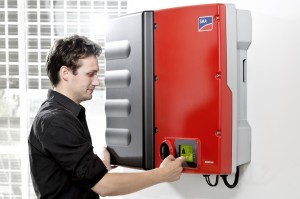
The new inverter Sunny Boy

The new inverter Sunny Boy


This new product awarded the Product Innovation Prize at Intersolar 2013 is currently the simplest storage solution available for typical residential PV applications. Furthermore, it can also be used as part of the SMA Integrated Storage System Solution.

Using solar electricity even longer

With the Sunny Boy Smart Energy, owner-operators can now use solar power even after sunset. Thanks to the integrated battery with a capacity of approximately 2 kWh, generated PV electricity that is not needed in the home can be stored for later use. This increases self-consumption—which makes a positive contribution to the environment and great sense financially—and therefore independence from rising electricity prices. “When combined with the Sunny Home Manager, self-sufficiency quotas of 50% are common on an annual average basis,” said Product Manager Thomas Thierschmidt.

Optimized battery capacity

The VDE-certified lithium-ion battery integrated in the Sunny Boy Smart Energy has an effective, application-oriented capacity of approximately 2 kWh. This value is crucial because it enables ideal economical operation of the battery. Because the increase in self-consumption levels off with increasing storage capacity, the battery utilization factor decreases. In addition, thanks to the battery, virtually all generated PV energy can be used, even with active power limitation. “Our long-standing expertise in storage systems shows us time and again that the small storage battery is not only extremely viable but also affordable,” said Thierschmidt.

A core component in the SMA Integrated Storage System

The Sunny Boy Smart Energy, which is available in power ranges of 3.6 kW and 5 kW, is one of the core components of the SMA Integrated Storage System alongside the Sunny Home Manager. As the first wall-mountable, mass-produced PV inverter with an integrated lithium-ion battery, this new product awarded the Product Innovation Prize at Intersolar 2013 is currently the simplest storage solution available for typical residential PV applications.

For greater independence, for the success of the energy transition

The Sunny Boy Smart Energy fosters greater independence in the scope of the intelligent energy management of SMA Smart Home. It is also perfectly designed to help fuel the energy transition, thanks to its storage function. “The future Smart Grid for the decentralized and renewable electricity supply must rely on electrical storage systems. To be able to establish a system-appropriate storage capacity within the utility grid capacity, an easy-to-install and affordable product is needed. In this respect, the Sunny Boy Smart Energy supports the energy transition unlike virtually any other device,” said Thierschmidt.

About SMA

The SMA Group generated sales of €932.5 million in 2013 and is the global market leader for solar inverters, a key component of all PV plants. As an energy management group, SMA offers innovative key technologies for future powersupply structures. It is headquartered in Niestetal, near Kassel, Germany, and is represented in 21 countries.


Aggie Bus- the wirelessly charged electric bus

Wireless charging is the way ahead, and we’ve been proclaiming it to be so since quite a while now. Using this concept, Utah State University’s Wireless Power Transfer team came up with a feasible way to mass transportation that could soon give cities a cleaner way to move commuters around.

Called the Aggie Bus, this one functions just like a regular gas-powered bus. The difference is its electricity-powered insides and the way it charges up!

The Aggie Bus uses wireless power transfer (WPT) pads that charge the bus at stops. These wireless transfer pads were created by Professor Hunter Wu and his team at the Utah Science Technology and Research (USTAR) initiative’s Advanced Transportation Institute and can give 5 kilowatts across a 10 inch air-gap!