Clean energy can lift African GDP

solar energy Africa

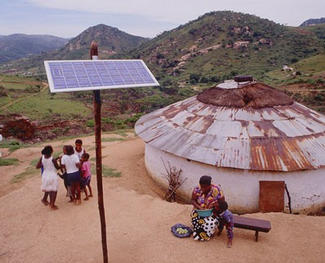
Solar energy in Africa. Image via busiweek.com

The African continent could generate nearly a quarter of its energy needs using indigenous, clean, renewable energy by 2030.

“Africa holds some of the best renewable energy resources in the world in the form of biomass, geothermal, hydropower, solar and wind,” Adnan Z. Amin, the IRENA Director-General recently said.

“This, combined with the precipitous drop of renewable energy technology costs, creates a massive opportunity for African countries to both transform and expand their energy systems while providing a pathway for low-carbon economic growth,” he said.

According to busiweek.com, IRENA offers a comprehensive roadmap for Africa’s energy transition, insisting that a combination of modern renewable technology could realistically meet 22% of Africa’s energy needs by 2030. This is more than a four-fold increase from just five per cent in 2013.

The report also finds that scaling up modern renewables in Africa is an affordable means to help meet fast-growing energy demand while increasing energy access, improving health and achieving sustainability goals.

The report identifies nearly 10 exajoules (the equivalent of more than 341 megatonnes of coal) of options for sustainable development through renewable energy.

Roughly 40% of this energy would be in the power sector. Solar resources are abundant across the continent, while biomass and hydropower potential are more plentiful in the central and southern regions.

Wind resources are strongest in the north, east, and southern regions, and geothermal energy is strong in the Great Rift Valley.

Renewable energy capacity additions could increase the share of modern renewables in the power sector to 50% by 2030, reducing carbon dioxide emissions by more than 310 megatonnes.

Developing these projects is more cost-effective than ever before, with solar and wind projects across Africa now producing record-low electricity prices.

Roughly 50% of the energy from the recommended options would be through biomass-based heat applications. Half of all energy use in Africa today involves traditional biomass consumption.

The report estimates that a shift to modern renewable energy cooking solutions would reduce the use of traditional cook stoves by more than 60%, saving $20 billion to $30 billion annually by 2030 through the reduction of health complications from poor indoor air quality.

“Tapping into renewable energy resources is the only way African nations can fuel economic growth, maximise socio-economic development and enhance energy security with limited environmental impact,” Amin said

“The technologies are available, reliable and increasingly cost-competitive.

“The onus is now on Africa’s governments to create conditions to accelerate deployment, paving the way for Africa’s unfettered, sustainable development,” he said.

The report recommends 14 actions to speed the uptake of renewables on the continent, including enabling policies and a regulatory framework to catalyse investment, adopting investment promotion measures, and off-grid renewable energy solutions to increase energy access and reduce poverty.

Traffic cops in Kinshasa? No, they now have solar-powered robocops!

solar-powered robocop

Solar-powered robocops in Kinshasa. Foto: AFP

In Kinshasa, the teeming capital of the Democratic Republic of Congo, where drivers often flout traffic rules, five chunky, arm-waving robots equipped with cameras, lights and solar panels have been set up to watch over the roads.

According to South China Morning Post, the solar-powered aluminium robots are huge, towering over the jammed streets, as cars and motorcycles jostle for road room, their horns blasting.

Each hand on the odd-looking machines – built to withstand the year-round tropical climate – is fitted with green and red lights that regulate the flow of traffic in the sprawling city of nine million.

The robots are also equipped with rotating chests and surveillance cameras that send real-time images to the police station.

Although the humanoids look more like giant toys than real policemen, motorists have given them a thumbs-up.

“There are certain drivers who don’t respect the traffic police. But with the robot it will be different. We should respect the robot,” taxi driver Poro Zidane said.

“We’re very happy about it,” he said, his taxi packed with passengers as drivers around him honked their horns in a desperate bid to cut through the traffic jam.

Of the five robots set up across the capital, two have been regulating traffic since 2013.

On Tuesday, three new and improved robots developed by a Congolese association of women engineers were set up.

The newcomers even have names: Tamuke, Mwaluke and Kisanga. Each cost US$27,500.

Therese Izay, president of Women’s Technology, the group behind the robots, believes the invention will help make it far more difficult for motorists to get away with traffic violations.

“In our city, someone can commit an offence and run away, and say that no one saw him. But now, day or night, we’ll be able to see him in real time and he will pay his fine like in all the serious countries of the world,” she said.

But Kinshasa governor Andre Kimbuta said that while the machines could regulate traffic, they were no match for real human policemen who could chase motorists who jump red lights and raise civic awareness.

“We should congratulate our Congolese engineers, but policemen also need to do their job,” the civic leader said.

Samsung gives a Solar Powered Internet School to learners in Mpumalanga

Solar Powered Internet School

Samsung’s Solar Powered Internet School

Samsung Electronics South Africa has delivered a Solar Powered Internet School (SPIS) to the Chief SW Nhlapho Secondary School in Dundonald, Mpumalanga. The executive mayor of Chief Albert Luthuli Municipality, B.P. Shiba, attended the handover ceremony, along with the Department of Education’s acting district director, P.P. Magagula.

Head of Corporate Citizenship at Samsung Electronics South Africa, Pitso Kekana was also in attendance.
Many communities facing economic and geographic challenges often have little or no access to electricity and Samsung designed the SPIS with these issues in mind.

According to Media Update, the units come completely self-contained with solar generators and wireless communication, providing unlimited access to technology, communication and information as long as there is sunlight to power the solar panels, digital cellular network or satellite connectivity.

This initiative is part of Samsung’s Corporate Citizenship programme, which seeks to provide educational material and connected classrooms to disadvantaged communities.

Chief SW Nhlapo Secondary School was established in 1994 and currently has 643 learners. In 2014 the school obtained an 81.03% pass rate, producing the highest number of matric passes in Dundonald.

The pupils of this school possess an incredible amount of dedication and perseverance and the school is geared towards advancing the surrounding community. The secondary school was crowned as the proud winners of a national competition called the ‘2012 Youth Citizens Action Programme’, where learners were challenged to demonstrate empowered active citizenship.

The Chief SW Nhlapo High School presented a road safety campaign which tackled a number of challenges they faced outside their school. The campaign generated awareness for learners to make use of the pedestrian crossings and have the boundaries of their roads fixed.

In addition, the learners approached local traffic police to assist with taking non-roadworthy vehicles off the road, which is one of the main contributing factors to road accidents. This school demonstrated that hard work and persistence is a reward on its own.

“The school’s drive and enthusiasm displayed in their zeal to make the road safety campaign a collective achievement, further gives us faith that they will indeed make a success of the SPIS,” concludes Kekana.

Solarcentury will construct the biggest solar carport in Africa at Garden City, Nairobi

solar carport

The biggest solar PV carport at a car park

Solarcentury (London, UK) will build the biggest solar PV carport at a car park at Garden City Mall, that is sittuated on 32-acre retail park, residential area and office development Nairobi’s Thika Superhighway. Solar energy harvested by the 858 kWp PV system will go to the retail tenants.

“We are incredibly proud to be bringing our second dual-mode solar system to Kenya, this time to build East Africa’s largest rooftop system,” commented Dr. Dan Davies, Director for Solarcentury in East Africa.

The new carport is going to be designed with the financial help of NVI Energy’s Solar4Africa, a 12 year financed solution that enables Garden City to harness the power of renewable energy, overcoming many of the barriers that can frequently beset commercial solar projects.

Besides helping with the shading, over 3000 solar panels will bring 1.256 MWh of solar energy every year and reduce carbon emissions by 745 tonnes every year.

The solution they came up with is a new one as it brings solar energy during the day and when the grid is down at night, the system also diminishes the need of diacutting the bills of Garden City’s retail tenants.

This is ideal for cities as there is few space left and the energy needs grow. The panels are useful because they are situated on an unused space. The technology also works in East Africa, on the biggest ground mount system for Williamson Tea in Kenya.

The solar system will also contribute to Garden City’s achievements in Leadership in Energy and Environmental Design (LEED) certification.

Green energy the new source of power for villages?

Clean energy in villages

Clean energy for villages

Villages could be powered with Cheap solar, wind or hydroelectricity

There are quite a few countries where energy infrastructure is not doing great. As a fallow-up, 1.4 billion people can’t enjoy the benefits of electric power. For example, in sub-Saharan Africa, just 8% of the population in villages are connected to electricity. All that could become a past problem as mini-grids – localised generation, transmission and distribution of power can resolve that.

The good news is the fact that solar power in the African continent and parts of India are incredibly low nowadays. So, a mini-grid is a cheap way to go.

The International Renewable Energy Agency (Irena) has just been awarded a $5m low-cost loan to the government of Mauritania, a place where only 1% of rural locations are powered. This loan can pay for four powered fishing communities in Mauritania’s northern coast.

The people of Bellewakh, Lemcid, Loubeir and Lemhaijratt are now lighten by candles, kerosene lamps and car batteries. Moreover, in order to power their power refrigeration units, they use canisters of butane which are not safe. The recently developed mini-grid will be made of 18 wind turbines of 15kW and will provide electricity for households, schools, health facilities, civic buildings, a desalination plant to produce drinking water and an ice-making plant.

Frank Wouters, director of Irena believes that a project like this is always welcomed. His company has $50m a year to invest in low cost loans but the last year was an exception and reached a billion. Irena was able to help six projects and refuse 80.

If mini-grids are a fact but are now powered by diesel Wouters says it is now a no-brainer for them to switch to turn green: “Where people are using diesel to generate electricity any renewable source of energy is at the moment more cost effective.”

Hydroelectricty is by far the cheapest – where it is available – followed by windpower, and only then solar panels. A report by the Alliance for Rural Electrification says that towns could save up to 60% of their costs if they turned to hydroelectricity or 16% if they turned to solar.

The low costs of green power made a change in the marketplace. Until now, Wouter says the people believed “solar is nice for [communities that are] off-grid, but it’s expensive, but that is not true anymore. It’s now cheap as well as being reliable, clean and low maintenance.”

So what is the problem with green mini-grids?

Wouters thinks that the first challenge the awareness of the low prices “When something halves in price every two years it’s hard to catch up, but I think that we’ve reached the point where people understand. “There is a big focus by the Asia Development Bank on mini-grids and the Islamic Development Bank; all the development banks are looking at this as a very interesting, scalable opportunity for them to put their money to work.”

Moreover, there is no infrastructure in some places.

Still, African savings are growing. And as Wouters says, every issue that comes together with the development will not disappear just like that, but the solutions are not so expensive anymore.

CG is going to embrace a complete presence in Dubai

CG will comercialize electrical products for the Middle east and Africa

A new regional office opened in Dubai

CG , the previous Pauwels and Crompton Greaves unit of Avantha Group, will comercialize electrical products and solutions in the Middle East and Africa.

Avantha Group Company CG has launched a fully-fledged office in the free trade zone of Dubai Silicon Oasis (DSO).

The new regional office will promote and distribute the full CG contribution for the future costumers.

The office also enjoys a state-of-the-art IT infrastructure and a tier 3 data centre and will supply utilities, oil and gas, power, metals and mining, industrial and original equipment manufacturers.

CG, previously known as Pauwels and Crompton Greaves, was giving its service for the Middle East for more than a quarter of century. Moreover, the newly installed office has got a fully-supported multi business platform.

After the finalization of the project the customers in the region could benefit from a lot of things they couldn’t before, things such as CG’s experts in motors and drives, T&D equipment, automation and services. This regions only is a big potential market for CG that values approximately $10 billion.

About the inauguration, Mr. Laurent Demortier, Avantha Group Company CG’s CEO and managing director reported: “I thank all our customers from Africa and Middle East who joined us for the event. This office is another step in our effort to promote our portfolio in the region and has put us at the heart of two of the fastest growing regions – Africa and Middle East.”

Scatec Solar in charge of South Africa’s first solar independent power project connected to the grid

First independent renewable project was conected to the grid

A new PV plant in Africa was conected to the grid

Scatec Solar, an European PV professional, connected a 75 MW solar plant to South Africa’s grid with three months in advance of the deadline. This connection is the first green energy independent power procurement program (REIPPPP) in the country.

The PV system is situated in Kalkbut in South Africa’s Northern Cape region. The project will create over 500 jobs for the locals. Because of the good location, the project is said to produce 135 kWh extra per year. This amount is more that enough for 30,000 houses. Moreover the plant will save 115, 000 tons of carbon emissions per year.

The bank the provided the finances for the project is Standard Bank, South Africa’s biggest commercial bank. Scatec Solar will sell the energy eith the help of South Africa’s national utility company, Eskom with the help of Power Purchase Agreement.

”I am very proud of our staff and contractors who have been able to complete this substantial project three months ahead of schedule, demonstrating how swiftly utility-scale solar energy plants could be built and put into operation” announced Scatec Solar’s CEO, Rayond Carlsen.

The before schedule construction is responsible for a major boom in the local job market. The over 500 employees were trained by the company. 16% of them are women.

”South African authorities are committed to implementing an ambitious renewable energy program, and we find great satisfaction in being able to contribute to its success through our own projects which we have actively been developing in South Africa over the last four years. This country boasts some of the best conditions for solar power in the world and the annual output of 135 million kWh produced at the Kalkbult plant will benefit both the region and the local community in which we operate” in Carlsen’s words.

A boom in PV is predicted for Middle East and North Africa

renewables are growing in the MENA region

Solar energy is growing in the MENA region

The latest report regarding the examination of green energy in the Middle East and North Africa region shows that “PV is experiencing rapid growth due to its tremendous potential and continuously decreasing technology costs,” with a current pipeline of 2.3 GW.

The report was written by The International Renewable Energy Agency (IRENA), the Renewable Energy Policy Network for the 21st Century (REN21) and the United Arab Emirates’ Directorate of Energy and Climate Change.

A project pipeline to exploit the MENA region’s unconventional energy resources rises. Also the renewable power investment is growing.

To be precise the report shows that the total primary energy supply increased until 3.3 % of the total of 1200 TWH total power generation given that, from 2007 to 2010 represented only 1% of the energy supply.

Moreover, the non-hydropower renewable more than doubled and almost reached 3TWH, but the hydropower is still dominating.

The biggest non-hydro renewable remains wind, but solar power generation grew the most in the past years. This is due to “a significant increase in photovoltaic installed capacity and production from a low-starting base, and to the recent introduction of concentrating solar power,” the report says. Solar water heating technologies are also becoming bigger.

The report also says that investment in renewable energy in the MENA region is said to continue to grow in the near future. Precisely, is says that since this year’s April , there were 106 non-hydro renewable energy projects in the pipeline in the region summing up a total of over 7.5 GW of new electric generation capacity.

 Roxana Moraru

Solar ORC systems providing hot water and electricity in Africa seted up by STG International

Electricity isn’t really an energy source that can be yet be taken for granted in certain isolated parts of Africa where more often than not, a regular supply is considered a luxury.

STG International, an MIT non-profit has come up with a feasible way to power up clinics and schools in such parts of Africa using alternative energy sources instead of complete grid reliance.

Using a new hybrid power and heat solar system that’s capable of providing electricity, hot water and space heating, STG International is currently drawing plans to set up five such units in Africa.

With MIT graduate PHDs Matthew Orosz and Amy Mueller leading the way, these units will be tested for viability and will use ORC Engine instead of solar electric panels.

Capable of providing up to 18-24kW-hr of energy and 200-300 gallons of hot water daily, this system could prove to be a boon for rural development, not just in Africa but also other far-flung areas disconnected from the grid around the globe.

Solar energy powers telecommunication infrastructure

IHS Africa powers telecommunication infrastructure with solar energy.

IHS Africa is one of the biggest telecommunications infrastructure of Africa.

The company has recently unveiled the largest solar-powered cell site in Africa.

This is an attempt to reduce diesel consumption at least 40% to 50%.

Only in West Africa, HIS Africa have 4,000 generator powered cellular communications towers.

Most telecommunication towers are located off-grid and powering these with electricity makes it all easier.

This solar powered system could prove to be a boon to rural mobile-phone users.