San Francisco Bay Bridge Celebrates 75 Years With LED Light Up

To commemorate 75 years of the San Francisco Bay Bridge, an $8 million public art installation will light up the iconic structure for the next two years.

Conceived by creative agency head, Ben Davis, and designed by New York-based artist Leo Villareal, Bay Lights will see the San Fran bridge illuminated by 25,000 white LED lights. The lights are programmable, so that different animations and abstract patterns can be created and will be visible from afar.

They will cover a massive 1.5 miles along the length of the bridge, and 500 feet in height.

The installation is scheduled for light up on March 5th 2013, until some time in 2015

Japan planning world’s largest offshore wind farm

Nearly two years after a massive offshore earthquake and the tsunami which devastated the Fukushima Daiichi nuclear reactor and the mostly agricultural communities that surrounded it, the Japanese Agency for Natural Resources and Energy has unveiled plans to build the world’s largest offshore wind farm adjacent to the disaster zone.

The initiative comes part of a plan to reconstruct the area stricken by the disaster in March 2011.

By 2020, the government said, a total of 143 wind turbines on platforms 16 kilometres off the coast of Fukushima. The wind farm will generate 1 GW of power once completed, officials said.

Following the disaster at the Fukushima plant, all 54 of Japan’s reactors were shut down, and only two have been brought back online in the 21 months since as the government has tried to move closer to fulfilling its pledge to increase the use of renewable energy across the nation.

Among the unique features of the plan is Japan’s intention to rely on massive floating turbines which will be stabilised with ballast and anchored to the 200-metre-deep continental shelf that surrounds the Japanese coast via mooring lines, according to an analysis of the project by New Scientist.

The magazine also reported the wind farm will supply electricity to the powerful grid which Fukushima’s two nuclear power plants were connected to, reducing transmission costs.

The project is being overseen by Takeshi Ishihara of the University of Tokyo.

Wind Powered Battery Storage Pilots in Texas

Duke Energy Renewables has developed a way of saving extra power generated by batteries at its Notrees Windpower Project in Texas.

The $44 million battery-storage system holds excess energy from the 153-megawatt Notrees farm and releases it when power supplies dip. This innovation is particularly helpful because winds often blow more strongly at night, when power needs are less, and more gently during the day, when power demands are higher.

With this battery storage system, wind generated power can be kept and used, as and when needed, thus stablising the grid. Data from the project is being collected and analysed for scale-up by the US Department of Energy, who helped fund Duke Energy Renewables’ wind power, storage battery.

Fonroche Energie collaborates on Indian solar PV project

The French clean energy company Fonroche Energie will be working with the $15.9 billion Indian company Mahindra Group to develop the 5MW solar PV project in Gajner Village, Bikaner, Rajasthan under the country’s National Solar Mission Phase 1, Batch II.

It will be the first two projects with a total capacity of 20MWp and was awarded to the French company in 2011 under the Jawaharlal Nehru National Solar Mission (JNNSM). Altogether 22 companies were selected for this stage of the programme of which Fonroche is the first to commence operations.

The project will deliver more than 9 million units of clean green energy displacing an expected total of nearly 7200 MT of carbon dioxide annually. The plant consists of more than 67,200 high output thin film solar PV modules supplied by First Solar USA with four power transformers. The entire site covers 40 acres.

Mahindra’s responsibility includes design, engineering, procurement and construction of the solar plant which includes the construction of a 2.7Km, 33kV double circuit transmission line to export generated power to the national grid.

“Fonroche is pleased to partner with PR Clean Energy and Mahindra EPC on this project” said Thierry Carcel, CEO of Fonroche. “We have delivered a great result on time and on budget. We combine our experience, technical expertise and our solid know-how to finance, develop and build efficient solar plants and enable our utility partners to secure high-quality renewable generation assets in India.”

Tarun Kapoor, the Joint Secretary of India’s Ministry of New & Renewable Energy congratulated Fonroche for early commissioning of the project and expressed hopes that it would be the start of several more such installations.

France starts the second offshore round

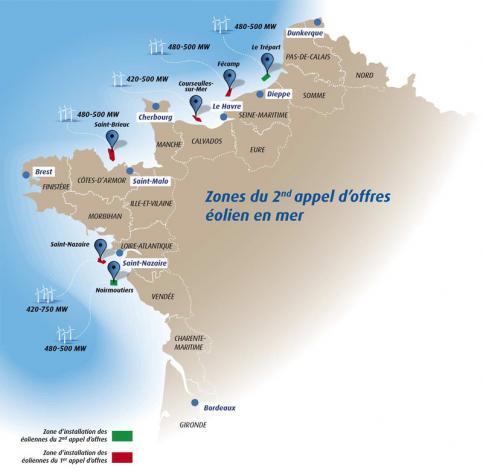
On 8 January, the French government declared the second bidding round for offshore wind farms off the French coast. This time a total of 1,000 MW are up for tender, divided into two farms.

These are the sites Le Tréport in the English Channel and the newly added area Noirmoutier south of the Saint-Nazaire project in the Atlantic, which were left empty-handed in the first bidding round. In both areas, there will be between 480 and 500 MW generated.

France expects investments of approximately 3.5 billion € through the projects for tender and to create 10,000 promising jobs through industrial development of this sector. The costs for the public will amount to 500 million € per year.

In the first round of bidding, approximately 2,000 MW were contracted at the beginning of 2012. That capacity is divided into four projects. The area Le Tréport was already tendered at the time. However, GDF Suez was the sole bidder – and was turned down by the French government due to the high price. To prevent this from happening in the second round, the price of the projects will gain more relevance. Overpriced offers will be excluded immediately.

In March, the second bidding round will open officially; applications must be submitted by September. The French government will award the contracts by January 2014.

First Solar begins construction of new California solar plant

The Campo Verde solar project will create 250 construction jobs and generate $230 million dollars for the local economy.

The plant will have a generation capacity of around 139MW and is located near El Centro in Imperial County, California. The project is expected to be completed sometime this year. A county study estimates its value to the economy as being over $230 million and predicts it will generate around 250 construction jobs.

Construction of the plant was finally approved on December 18th last year having received permission from the Imperial Irrigation District (IID) for easements required to carry transmission lines across IID’s Westside Main Canal. Earlier approvals were given by the US Bureau of Land Management (BLM) for a Right of Way grant and a Conditional Use Permit from Imperial County.

County of Imperial Board President Ray Castillo said the county is very pleased to see commencement of the construction on the project which will bring numerous benefits to the area and its citizens.

“First Solar’s project brings much needed jobs and economic development to the Valley at a time when it is sorely needed” he added. “The project also pays added tax revenue, funds for agricultural benefits and community benefits while helping the County diversify its economy. We’ve been working to attract projects like this for the past five or six years and are glad to see it’s finally happening. These projects are really our legacy for the Imperial Valley.”

James F. Cook, Project Development Director at First Solar, said that the company is grateful to IID, Imperial County and the BLM for their support, adding that he believed the project would create badly needed jobs and will help the county and the state to reach their respective renewable energy goals.

First Solar will deploy its advanced thin film PV modules at the plant which will generate enough renewable energy to power around 50,000 average homes while displacing 80,000 metric tons of CO2 per year. This is approximately equivalent to taking 15,000 cars off the road.

European Investment Bank finances EnBW Baltic 2 wind farm

EnBW Baltic 2 is being developed by German company EnBW Erneuerbare Energien GmbH and the funding deal was signed this week in Karlsruhe.

The wind farm consists of 80 wind turbines installed within an area of 27 square kilometres, 32 km north of the island of Rügen. This is a particularly demanding location for an offshore wind farm because the sea in this area can be as much as 44 metres deep in some places requiring the use of special foundation structures called ‘jackets’.

Nevertheless, EnBW Baltic 2 has a capacity of some 288 megawatts and will generate an annual output of 1.2 billion kWh, enough to supply 340,000 households while achieving emissions savings of around 900,000 tonnes of carbon.

“Demanding projects are required so that Germany can implement its ambitious energy aims” said Wilhelm Molterer, the Vice President of the European Investment Bank.

“EnBW Baltic 2 sets standards. It will be exemplary for future projects of this magnitude. With the financing that has now been agreed, it will be possible to implement the extensive project quickly and make a decisive contribution to the success of the energy transition.”

The turbines used in the project are Siemens SWT-3,6-120, 39 of them erected on monopoles with another 41 using jackets.

“The commitment of EIB to a project like EnBW Baltic 2 makes a very essential contribution towards the energy transition” said Thomas Kusterer, the Financial Chairman of EnBW Energie Baden-Württemberg AG. “Participation of the EIB in such projects represents a decisive element in structuring and financing.”

Aggie Bus- the wirelessly charged electric bus

Wireless charging is the way ahead, and we’ve been proclaiming it to be so since quite a while now. Using this concept, Utah State University’s Wireless Power Transfer team came up with a feasible way to mass transportation that could soon give cities a cleaner way to move commuters around.

Called the Aggie Bus, this one functions just like a regular gas-powered bus. The difference is its electricity-powered insides and the way it charges up!

The Aggie Bus uses wireless power transfer (WPT) pads that charge the bus at stops. These wireless transfer pads were created by Professor Hunter Wu and his team at the Utah Science Technology and Research (USTAR) initiative’s Advanced Transportation Institute and can give 5 kilowatts across a 10 inch air-gap!