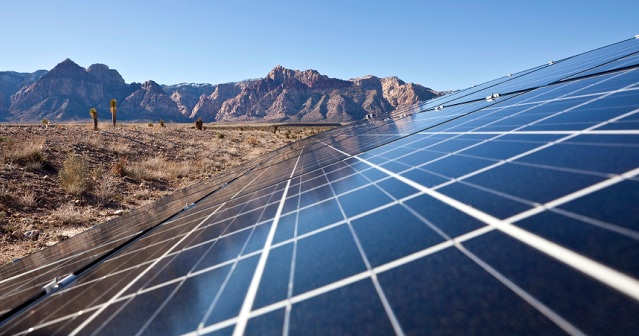
Powerway will generate a 30MW PV program in Thailand

30 MW will be instaled by Powerway

Powerway will install 100,000 Pv modules in Thailand

A field of over 60 Acres in the north of Thailand is said to be covered by 100,000 PV systems that are said to be distribute to the PV project.

As the current figures report, until 2016 the entire installation of photovoltaic solar energy in Southeast Asia is said too reach 5 GW. The request for energy is developing and Thailand is to turn into Asia’s most prosper renewable energy market. The Thailandese government gives to the solar industry a great deal of attention. Moreover, as Asia’s first implementation of one of the countries FIT projects, has a strategy of reaching the goal of installing a 2GW PV plant until 2022.

If the last year’s success, when the Thai 18MW solar farm project was completed, is taken into account, you can say this is the second biggest success for Powerway. A professional aspect and design and a vast solar farm construction background is what defines Powerway, so the company again worked together with a renowned French EPC company. The project was formally launched in May, but the final steps are programmed by the end of the year. The project will install 100, 000 PV solar panels in an area of over 60 acres. The resulted power can provide for 90,000 people.

The project is situated in Northeast Thailand where the weather conditions are not easy to predict. Still, Powerway engineers have designed a ground mounting system that has a embedded foundation said to be reliable, cost effective and easy to install. Moreover, the company has sent an experienced project team to the job site that can offer technical support and train the local teams.

Global microinverter market will be four times bigger until 2017

Commercial systems are expected to account for nearly 30% of global microinverter shipments in 2017 compared with 9% in 2012

Micro inverter market will quatruple by 2017

The microinverter sales will quadruple in the upcoming four years because of the external market requirement increase, as the latest report by market research firm HIS, announced.

Microinverters are being bought in a bigger number besides the United States borders. The reason? The new markets are in a hurry to take advantage of the gadget’s updated efficiencies and features which are increasingly better than in the classic inverters, as the report says.

Global photovoltaic microinverter market are said to merger till 2.1 GW in 2017, whereas in 2013 there were around 500 MW. This means a rate of 306% as IHS presents in its latest report, “The World Market for PV Microinverters and Power Optimizers – 2013 Edition.”

Microinverters convert direct current (DC) electricity from a single solar module into alternating current (AC). Although they are more costly than conventional inverters, microinverters can increase the energy harvest of a system compared to conventional string or central inverter devices, which convert power from multiple solar panels,” IHS reports.

Until this moment , microinverter request has widely been limited to the U.S. residential market. Still, the strength is moving on to commercial solar systems and other regions.

Microinverters have reached very high adoption rates in the United States, particularly in the residential market, where penetration will reach more than 40% in 2013,” says Cormac Gilligan, PV market analyst at IHS. “However, in order to grow or maintain market share, microinverter suppliers now are striving to expand to new regions that at present don’t use the technology. Meanwhile, the advantages of microinverters — including their higher energy yields, enhanced safety and module-level monitoring capabilities — are making them more attractive in commercial systems, especially in small-scale projects”, IHS adds.

Roxana MORARU


The Energy sell-off in Brazil postponed for November

energy seill off was postponed for a moth

The A-3 auction in Brazil has been postponed for a month

The renewable energy sell-off A-3 is programmed for November 18. The event is a premiere for the solar energy, for which is the first edition.. The auction was supposed to happen on the 25th of October. 

The A-3 energy sell-off, the first sell-off in Brazil in the regulated market, that has been available to solar projects, was postponed for a month from the initial date set last July by the government. Still, this is the only modification announced by the government in Brazil, in the past week. This sell-off is announced to be opened to numerous technologies. The projects which win a prize in this competition need to function in 20116.

A number of companies have entered their solar project for the A-3 sell-off, in the past week. An example is renewable energy developer Bioenergy that as the local media reports, presented nine PV projects summing up 171 MW.

People also expect that solar photovoltaic applications will be a part of a different energy auction, the A5, which is to take place in December. The projects which will succeed there in the A-5, need to be functional in a 5 years period. Until now it was not announced if solar energy projects are allowed in this sell-off.

Until today, there has been no official announcement for a specific sell-off for solar energy, although there were signs from the government in that past showing that this is possible.

Roxana MORARU

Solar Junction rises above its own record with 44.1% cell efficiency

cell eficiency improved

Solar Junction breaks its own record with 44.1% cell efficiency

Solar Junction has exceeded its old World-Record with recognition 44.1% cell efficiency on IQE’s production qualified wafers.

IQE plc reports that its high-volume, production qualified material has been individually guaranteed as reaching 44.1% cell efficiency by the National Renewable Energy Laboratory (NREL), outdistancing Solar Junctions previous World Record for a standard triple junction CPV cell.

The wafers were made applying IQE’s high-volume MBE devices, were prepared by, a manufacturer of high efficiency multi-junction solar energy cells for the concentrated photovoltaic market (CPV), IQE’s strategic partner Solar Junction Corporation (“Solar Junction”). The classic three-junction solar are said to set a new world record for manufacturing scale CPV wafer technology and prove the upgraded performance over Solar Junction’s previous World Record announced in October 2012.

“Breaking a World Record is a major achievement, but improving on our most recent record using high-volume production equipment produced in conjunction with our manufacturing partner IQE, and Solar Junction’s fabrication line in Sunnyvale, CA, is dramatically more significant. This result is a testament to our close partnership with IQE, Solar Junction’s dilute nitride technology and our exceptional team. We continue to be the benchmark for multi-junction solar cell production efficiency to assist our customers in driving CPV costs down”, Vijit Sabnis, CEO at Solar Junction announced.

“Following our recent announcement of full qualification of our high volume 4 and 6 CPV technology, surpassing Solar Junction’s previous cell efficiency record is a massive achievement”, are the word of Dr. Drew Nelson, IQE Chief Executive

“Improvements in CPV cell efficiencies translate to highly significant overall cost reduction in terms of installation and energy generation in utility scale solar farms. The fact that this has been achieved on production-qualified platforms is a major milestone. Furthermore, the transfer of wafer production to IQE’s manufacturing tools enables the Solar Junction team to focus on further improving efficiencies on lattice-matched, multi-junction CPV solar cells using a combination of their unique dilute nitride technology, combined with pre existing IQE IP. This will facilitate seamless technology transfer into high volume manufacture of ultra efficient CPV cells as the conversion efficiency improves further”, he added.


The Japanese government said yes to 19 GW of non-residential PV

19 GW were aproved in Japans non residental Pv

Japanese government approves 19 GW in non-residential PV

Japan’s Ministry of Economy Trade and Industry (METI), as yesterday’s figure’s report says, has shown its approval of about 19 GW of commercial rooftop or ground mounted solar applications from July 2012 until April 2013.

Clear figures that are proof of Japan’s increase in the solar industry is under the feed in tariff (FIT) were reported yesterday by the administrative authority responsible for the photovoltaic installation scheme, METI. The tariff was brought into effect in July 2012.

Though the fact that solar is growing in the country, some details about the time when 18,681 GW approved installations have to be completed and grid connected is not exactly clarified. Bloomberg New Energy Finance believes that between 6.9 GW and 9.4 GW of capacity is going to be added to the grid in the country calendar year of 3013.

Monthly applications are waiting for approval under the FIT scheme, the follow-ups of the reduction of the FIT rate, programmed for applications approved after March 2013 is clear. Installations for non-residential photovoltaic applications summed 7.669 GW in March, as to 5.263 GW in February and 1.892 GW in January.

Installations approved from April 1 receive 37.8 yen/kWH (USD$0.39/kWh).

METI believes that some projects could have been approved, still construction and installations were late, and said that the projects will be looked over.
Almost one forth of PV installations have been proposed on Japan’s second biggest Nordic island, but it totals only 3% of the electricity request. So vast grid improvements could be asked for and some are doubtful that it will happen leaving the photovoltaic installations stranded.

The white House will have a new PV system

The White House's new photovoltaic system is expected to generate 19,700 kWh a year

Obama reported the instalation of new PV on the White House

The president of the U.S, Barack Obama has announced he will commit to his arrangement on installing solar PV on the White House. This step is seen as a big one for the industry, although he is not the first U.S president doing so.

Ronald Reagan was the first president to do that, 30 years ago. It was then when he took down the ones his predecessor, Jimmy Carter, installed.

The new solar panels are a little late, as the president announced his intention of purchasing new American-made solar panels at 1600 Pennsylvania Avenue in 2010

To “improve the overall energy efficiency of the building”, the White house reported the installing begin this week.

The manufacturer, the supplier, or the costs were not revealed. Still, it is known that the PV system is an American one. One of the purposes of this project is to demonstrate the fact that historic buildings can incorporate solar energy an energy efficiency solutions. The cost will be amortized in eight years.

Three years ago, the Energy Secretary Steven Chu reported a plan to install solar panels on the White House.

“This project reflects President Obama’s strong commitment to U.S. leadership in solar energy and the jobs it will create here at home,” Chu announced at the time. “Deploying solar energy technologies across the country will help America lead the global economy for years to come.”

“Installing solar panels on the First Family’s official residence, arguably the most famous building in America, underscores the growing popularity of solar energy nationwide,” reported Rhone Resch, CEO of the Solar Energy Industries Association (SEIA).

“We applaud President Obama for, once again, leading by example. Today, solar is generating enough electricity to power more than 1.3 million American homes, and we’re extraordinarily proud to be adding the White House to this constantly-growing list,” Resch added.

The new PV system is said to generate 19,700 kWh in a year.

Roxana Moraru

The taiwanese group, Foxcon is considering to enlarge solar operations


Flexcon will enter solar industry

Fexcon to built 6 PV plants

Foxcon, a taiwanese electronics group, which is willing to diminish its dependence upon Apple, is said to decide by the end of the year if it would enlarge it’s solar operations.

The producer of Apple iPhones and iPads, Foxcon, is preparing an entrance into a solar sector.

The taiwanese electronic giant administrates a little solar panel factory in the east of China. In April, the factory signed a deal with SunEdison to produce 350 MW of solar modules for the company in Juarez, Mexico, at a manufacturing facility.

In spite of the arrangement, Foxcon it still considered to be testing the solar waters and yet to commit to an industry hit hard by overcapacity and falling prices. Still, if the timing is right, Foxcon could profit from this entrance into the sector, as market analysts predict.

The electronic group is willing to decide about it’s entrance by the end of the year, as Reuters announced. The company has the opinion that “renewable energy is a potentially good trend” but also that it was “an industry we probably need to know more about”, in Foxconn’s spokesman words, Simon Hsing.

Foxconn didn’t report its investment in solar, but Reuters disclosed the fact that that with $22.7 billion in cash on its balance sheet as of March, the firm could easily expand in into the field.

Moreover, Foxconn has a preliminary agreement with solar silicon producer GCL-Poly Energy Holdings to set up solar-related ventures in northern China, but the deal hasn’t paid off yet.

The company is said to be eager to diminish its trustworthiness on Apple, which accounted for aproximatly 60% of its revenue in the past year.


New solar mounting system to be launched by Schletter

new mounting system for PV released by Schletter

New PV mountig system released by Schletter

Schletter has been working on a PVMini ballasted ground PV mount system with proprietary rails for long spans and bigger levels of system efficiency.

A world wide manufacturer of solar mounting systems, Schletter, reports the launching of PvMini a lightweight, ballasted ground mount system for landfills, brownfields, and areas with rocky terrain. Bigger spans and less ballast weight are some of the fact that make the system’s system’s triangle supports and proprietary new ProfiPlus XT™ to be an excellent system.

The ProfiPlus XT rail is designed to optimize the system’s efficiency to nearly 100% in most cases by letting more lightweight components and increased spans between foundations. The newest system is created especially for single-row vertical or two-row horizontal module configurations and it comes partly pre-assembled for faster installation and no using of heavy machinery necessary.

The PvMini combines elements from two of our most popular systems: The PvMax and Windsafe,” announced Dr. Wolfgang Fritz, VP of Engineering for Schletter Inc. “Our engineering department continually evaluates systems to determine where we can be more efficient; to drive down costs while maintaining a high standard of quality. The PvMini is the latest innovation to come as a result of this commitment”, added Fritz

As the company says, the new system has a standard 20-year warranty, PE stamped drawings, and features integrated, ETL-listed grounding with the Rapid2+ module clamp. The PvMini is currently accessible and it’s been produces in the United States of America and in Canada.


PV could consist o third of the US energy until 2050

PV will deliver a third of US energy

Two computers developed by the NREL were upgraded

Computer moddelers consider that $1/W can replace gas, nuclear and CCS and pay the price of introducing a carbon cap.

A computer model was designed by scientists of the University of California, Berkeley. The computer proves that solar PV power produced for US$1/W could supply one-third of the electricity needs in the western US.

The Department of Energy’s SunShot Initiative plans to lower the costs of PV energy until to $1/W and the creators of the SWITCH computer model calculated if the purpose is achieved, solar power could replace gas as the provider of electricity generation in the ‘medium term’ and nuclear and carbon capture and storage technology by 2050.

The computer looks at the electricity grid of the western U.S. and predicts that solar will conquer even more if gigawatt-scale storage is used.

The Berkeley modellers also calculated the costs of introducing a cap or tax on carbon could be mitigated by the energy cost savings of $1/W solar supplying one-third of western U.S. electricity.

After SunShot Initiative’s calculations, $1/W solar energy can lower energy costs until 14% , leading to annual saving of up to $20 billion by 2050.

Furthermore, the Department of Energy also reports that the beta of two popular online solar tools developed by the National Renewable Energy Laboratory (NREL) will be launced.

Visitors can enjoy an upgraded version of launch- that can estimate the cost of of energy production and grid connected PV energy costs globally, and the System Advisor Tool (SAM) that developers use to estimate the performance and financial modelling of planned solar projects.

A boom in PV is predicted for Middle East and North Africa

renewables are growing in the MENA region

Solar energy is growing in the MENA region

The latest report regarding the examination of green energy in the Middle East and North Africa region shows that “PV is experiencing rapid growth due to its tremendous potential and continuously decreasing technology costs,” with a current pipeline of 2.3 GW.

The report was written by The International Renewable Energy Agency (IRENA), the Renewable Energy Policy Network for the 21st Century (REN21) and the United Arab Emirates’ Directorate of Energy and Climate Change.

A project pipeline to exploit the MENA region’s unconventional energy resources rises. Also the renewable power investment is growing.

To be precise the report shows that the total primary energy supply increased until 3.3 % of the total of 1200 TWH total power generation given that, from 2007 to 2010 represented only 1% of the energy supply.

Moreover, the non-hydropower renewable more than doubled and almost reached 3TWH, but the hydropower is still dominating.

The biggest non-hydro renewable remains wind, but solar power generation grew the most in the past years. This is due to “a significant increase in photovoltaic installed capacity and production from a low-starting base, and to the recent introduction of concentrating solar power,” the report says. Solar water heating technologies are also becoming bigger.

The report also says that investment in renewable energy in the MENA region is said to continue to grow in the near future. Precisely, is says that since this year’s April , there were 106 non-hydro renewable energy projects in the pipeline in the region summing up a total of over 7.5 GW of new electric generation capacity.

 Roxana Moraru