Germany to fund 125 million euros for renewable energy projects in India

Merkel in India

Renewable energy is one of the key areas of Indo-German partnership mentioned in the Joint Statement of Hannover in April 2015. Image via The Financial Express

Germany and India on Tuesday signed two loan agreements worth 125 million Euros for the Green Energy Corridors’ project in Andhra Pradesh and Himachal Pradesh.

Germany’s development bank, KFW, will fund 57 million Euro for the project at Himachal Pradesh, and 68 million Euro for the Andhra Pradesh project, a press statement from the government said.

According to The Financial Express, the agreements were signed at a time when Germany’s chancellor Angela Merkel is on a state visit in India.

Renewable Energy is one of the key areas of India-German partnership. The financing of the transmission infrastructure of renewable energy projects, the Centre and State grids will be strengthened to evacuate more green energy, the statement said.

“With the Green Energy Corridors, the intra-State network will feed the renewable energy to the respective State grids and the high capacity transmission corridors and inter-State network will connect major renewable energy pockets with the national grid,” it added.

Japan is turning its abandoned golf courses into solar farms

golf course in Japan

Solar energy plants on abandoned golf courses in Japan

Faced with too many abandoned golf courses, Japan has now turned to transforming them into solar energy plants.

Back in the 1980s, golf courses were huge in Japan. So huge that memberships cost millions of dollars. Not surprisingly, a boom followed in the 1990s and early 2000s, and now…there are just too many of them not being used.

The solution? Well, thanks to Japan’s energy strategy post-Fukushima that now calls for roughly doubling the amount of renewable power sources in the country by 2030, Kyocera and its partners announced they had started construction on a 23-megawatt solar plant project located on an old golf course in the Kyoto area.

According to ecorazzi.com, the project, which is scheduled to be operational in September 2017, will generate a little over 26,000 megawatt hours per year, or enough electricity to power approximately 8,100 typical local households.

And Kyocera is not stopping there. They have plans for a larger project in the Kagoshima area on land that had been designated for a golf course more than 30 years ago but was ultimately abandoned. That project is expected to generate nearly 100,000 megawatt hours per year, or enough to power about 30,500 households.

Apparently Kyocera isn’t alone with this bright idea, and is facing competition from Tokyo-based Pacifico Energy, which is building a 42-megawatt solar plant on an old golf course in Okayama.

But the idea for using solar power plants on abandoned golf courses isn’t remaining in Japan. Plans for similar projects are already underway in the U.S., including New York and Minnesota. And with golf courses already wrecking havoc on the environment, this could very well be their redemption.

Fund solar panels for Gaza hospitals

solar panels on the roof of Gaza's hospital

Solar panels on the roof of Gaza’s hospital. Photo via middleeastmonitor.com

A group of Canadian doctors hope to make blackouts a thing of the past for Gaza’s hospitals by installing solar panels to provide energy 24/7 for emergency rooms and operating theatres.

The “EmpowerGAZA” project has launched a fundraising drive on Indiegogo to secure the $200,000 required to fund the first hospital, with the ultimate goal being to supply a further three hospitals with the life-saving solar panels.

Power outages are a daily reality in the Gaza Strip, and can last more than 16 hours per day. Hospital patients are especially vulnerable, and insufficient power can be the difference between life and death.

According to Dr Tarek Loubani, an emergency physician and collaborator on the project: “Doctors in Gaza were asking for reliable and green power, and the United Nations Development Programme (UNDP) came on board immediately when they heard about the project.”

“Everyone agreed, this project is urgent. We believe people world over will understand the impact and help its success.”

According to Middle East Monitor, EmpowerGAZA is a joint initiative of the United Nations Development Programme (UNDP) and Islamic Relief Canada to provide a renewable, reliable source of energy for intensive care units (ICUs), operating rooms and emergency departments.

A crowd-funding campaign began on 28 April and will run through to 26 June.

China plans massive solar power plant in space by 2050

solar energy from space

The Chinese solar space station is planned to be much more massive than the International Space Station. Photo: NASA via Instagram

China wants to put up a solar power station bigger than the International Space Station in orbit at 36,000 kms above the ground by 2050.

According to International Bussiness Times, the project would solve the energy crisis on Earth, the Chinese scientists behind the vision say.

An experimental space solar power station is planned to be in place by 2030, with a commercially viable one to be ready by 2050.

Wang Xiji, the 93-year-old academician of the Chinese Academy of Sciences and an International Academy of Astronautics member, who has devoted over 50 years to space technology research, is an advocate for the station.

“An economically viable space power station would be really huge, with the total area of the solar panels reaching 5 to 6 sq km,” he told official media.

Being in orbit the station would be able to harness solar energy 99% of the time.

Space-based solar panels can generate ten times as much electricity as ground-based panels per unit area, say the experts.

The electricity generated would be converted to microwaves or lasers and transmitted to a collector on Earth. The efficiency of the transmission will have to cross 50% before the project becomes economically viable.

The idea was first mooted back in the last century by science fiction writer Isaac Asimov in a short story titled “Reason”.

However, one of the chief hurdles in the realisation of the massive project is the need for a cheap heavy-lift launch vehicle, says Wang, who designed China’s first carrier rocket more than 40 years ago. “We also need to make very thin and light solar panels.”

Chinese space scientists believe the space station planned to be placed in orbit by 2020 will aid the solar project.

China is also expected to develop a new generation heavy-lift launch vehicle.

Besides avoiding the smog and pollution generated by its many fossil fuel power plants, the demand for energy is expected to be met by the space station. China is the world’s largest energy consumer as also the world’s top carbon emitter.

Israel installs solar panels at parliament to save energy

solar panels

Israel’s Knesset unveils world’s largest parliament rooftop solar field. Photo: Courtesy Knesset

Israel has installed solar panels on the roof of its parliament building, creating what it calls the largest solar field of any national assembly in the world.

According to phys.org, the office of the parliament speaker says energy generated from some 1,500 solar panels will provide 10 percent of the electricity used at the Knesset, Israel’s parliament.

The Knesset is also advancing other energy-saving projects, like installing energy-saving lights, automatically shutting down lawmakers’ computers at the end of each workday, and using air conditioning systems to help irrigate the gardens surrounding the building.

The statement says the measures will reduce the Knesset’s energy use by a third.

Scientists will also conduct ecological research on the parliament roof.

Natural silk can boost the performance of lithium-ion batteries

natural silk can boost lithium-ion batteries

Natural silk to improve lithium-ion batteries

A green material derived from natural silk can boost the performance of lithium-ion batteries used in portable gadgets and electric cars, scientists say.

Carbon is a key component in commercial lithium-ion energy storage devices including batteries and supercapacitors.

Most commonly, graphite fills that role, but it has a limited energy capacity, researchers said.

To improve the energy storage, manufacturers are looking for an alternative material to replace graphite.

According to Tech First Post, Chuanbao Cao and colleagues at the Beijing Institute of Technology wanted to see if they could develop such a material using a sustainable source.

The researchers found a way to process natural silk to create carbon-based nanosheets that could potentially be used in energy storage devices.

Their material stores five times more lithium than graphite can – a capacity that is critical to improving battery performance.

It also worked for over 10,000 cycles with only a 9 per cent loss in stability.

The researchers successfully incorporated their material in prototype batteries and supercapacitors in a one-step method that could easily be scaled up.

The study is published in the journal ACS Nano.

Japan looks to ocean for renewable energy

clean power Japan

Marine power generation plan

As an island nation, Japan controls large swaths of ocean territory, about the sixth-greatest expanse of any country in the world, according to government data. That is stark contrast to its relatively meagre land area, which ranks near the middle of list, in 60th place. So it makes sense for Japan to look to the seas for renewable energy — something it hasn’t done so far.

That is about to change, as the government is teaming up with two major industrial conglomerates, IHI Corp. and Toshiba Corp., to start field testing marine power generation in the near future.

“Our goal is to enable large-scale marine energy farms,” said a Toshiba spokeswoman, noting that the nearest site for testing is the area off Japan’s southern Pacific coast, where the Kuroshio current flows northward.

According to The Wall Street Journal, the initiative is an effort to develop new technologies to harness renewable energy and nurture future businesses opportunities as the need for renewable energy grows world-wide amid stricter regulations on coal in the U.S. and Western Europe. The Japanese government’s energy plan put forward in April 2014 called for an increase in use of renewable energy “to the greatest extent possible.”

IHI and Toshiba will spend about two years collecting data on currents at various locations to select the most promising ones. They will then conduct field tests by setting up a power generation system similar to an underwater kite anchored to the ocean floor that “flies” in the current.

The budget for the program is ¥2.75 billion ($23 million) for the current fiscal year through March. The government will subsidize part of the costs, but doesn’t disclose how much.

Marine current power generation technologies have already been developed and used in Europe, although they aren’t widespread. Japan wants to create its own technologies, say officials with the government-financed New Energy and Industrial Technology Development Organization, or NEDO, which works with the private sector on new energy technologies, and chose the two companies for financial support.

“Our marine environment is not the same as Europe’s,” said Yoshinari Takayanagi, an offshore wind and ocean energy project coordinator at NEDO. “There can be more suitable technologies.”

Nepal finally goes solar

solar panels in Nepal

Clean power for Nepal

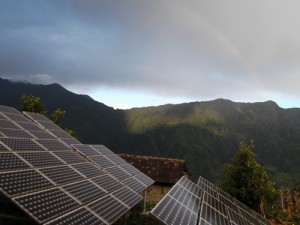
Sales of solar power systems have grown significantly in the past few years with load-shedding hours ever increasing. The government of Nepal has helped to boost the business further by providing subsidies to promote renewable energy in the country.

According to ekantipur.com, the surge in demand for renewable energy systems has led many companies to enter this niche market. Many companies have been launching various promotional campaigns and educating people on the benefits of installing solar panels for long-lasting energy supply.

More than 70 companies are competing for a share of the market in this segment in the Kathmandu valley, traders said.

“More and more residential houses and official buildings have been turning to alternative energy in recent years as load-shedding has been hampering people’s lives severely,” said Alok Kumar Gupta, head of marketing at Sipradi Energy. Sipradi, which entered this segment in 2010, has been witnessing a 40-50 percent growth in business annually, Gupta added. The company offers solar power systems with capacities starting at 80 watt and prices starting at Rs 45,000.

According to him, solar panels in the range of 120-150 watts and priced between Rs 45,000 and Rs 60,000 are in high demanded among households. “We recently installed a 40 KW solar panel at the Alternative Energy Promotion Office,” said Gupta.

“We are also focusing on expanding our sales and service network to make it easier for customers to avail of our products and services.” The company has 140 dealers across the country.

Meanwhile, an American solar energy equipment supplier Renogy has entered the Nepali market with a wide range of solar panels. “Today’s generation which has a busy schedule and uses technology a lot has been discouraged by the long power cuts. So we see a great market potential,” said Sudeep Chhetri, managing director of Suyash International, the authorised distributor of Renogy solar systems in Nepal.

Renogy solar panels come in the range of 35 to 200 watt and have a starting price of Rs 15,000. “We have sold Rs 700,000 worth of solar panels since launching a month ago,” he said.

Pratik Karki, sales manager of Lotus Energy, said that the government’s subsidy scheme to promote renewable energy was also helping business to grow.

“People have started realising that despite the higher initial cost compared to inverters, the solar panel system is more beneficial in the long run,” he said.

Corporate houses and banks and financial institutions, among other organizations, have been buying solar power systems instead of spending money on generators and inverters, he added.

Solar Powered 3D Printers Building Desert Skyscrapers With Sand

Solar-powered Sand Babel Towers

Solar-powered Sand Babel Towers

Sustainable, green construction in areas where people would never dream about living, is something that 3D printers could one day make possible.

According to 3dprint.com, a Chinese team designed the Sand Babel Towers, which are a unique concept group of buildings that can be constructed in the desert, with cranes, and 3D printers.

The actual design was submitted to eVolo’s 9th Annual Skyscraper Competition, and received an honorable mention. The competition challenged artists, architects, and designers worldwide, to imagine future towers that address a dense, energy and water-scarce world.

The technology to build such a set of structures is already available in its infant state. A man named Markus Kayser unveiled a solar powered 3d sand printer last year. This technology would need to be scaled up, of course, and undergo significant testing before it could be used for the construction of large skyscrapers, however that day may not be very far off.

The Sand Babel Towers are constructed in two main sections. The first section is the area above the ground in which people live, or work in. The design of this upper part of the structure mimics the natural phenomena called “tornadoes and mushroom rocks.” It is a duel funnel structure which helps with cross-ventilation, and allows for the condensation of water at the top because by taking advantage of the varying temperature differences.

The second section is a whole array of underground tunnels connecting each tower, as well as acting as a mechanism to slow down the flowing sand dunes. The tunnels also help facilitate communication between each building, and act as a root system for added structural integrity.

Although we are likely a decade or more away from seeing buildings like this actually constructed, the technology is progressing rapidly, and 3D printing will soon become a very important part of large scale construction projects. Discuss Sand Babel at 3D print Board.

World highest solar parking space is situated in Tibet. The Solar Mounting System is secured by Schletter

solar parking space

Lhasa, known as the “city of sunshine” has a special solar parking space

The area enjoys over 3,000 hours of sun every year. No wonder Lhasa is also known as the “city of sunshine” or “sun city”. As you can imagine, there you can find the finest setting for harvesting solar energy.

The project belongs to Beijing Corona, a company that chose the modular parking space Park@Sol, that can host a 1-row vehicle in this area. It is said that the solar power plant will start functioning this month. The exact location of the parking lot is in the north of Himalaya, Lhasa, also named capital of the Autonomous Territory of Tibet in the People´s Republic of China.

The spots altitude is 3,650 meters over the sea level, a number that gives Lhasa the title of the highest capital in the world. Still, because of this aspect, the people involved in the project, often had respiratory problems. Even considering this, the project for BEIJING CORONA SCIENCE & TECHNOLOGY CO., LTD will be finished as announced. The solar parking space can keep safe 54 vehicles and measures 103 kWp.

Another interesting fact about Lhasa is the fact that it hosts the Tibet Museum since 1996, one of the main attractions of the country. Here tourists can find artefacts from the beautiful history of Tibet, culture and Tibetan Buddhism. The museum will also enjoy the benefits of solar power, as the energy harvested by the carport will also provide for it.

At present, Lhasa can be proud of hosting the highest railroad, the highest brewery and the highest carport in the world. This couldn’t have been possible without Schletter.