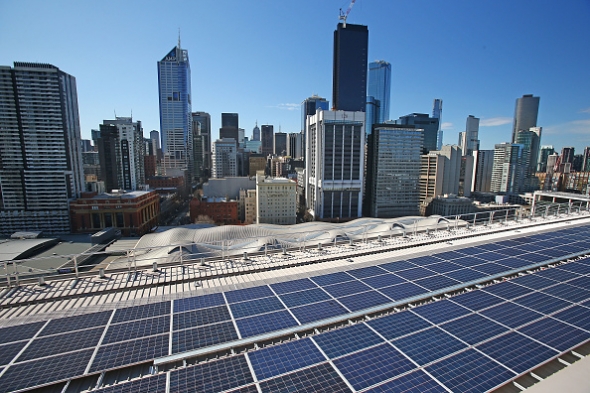
New world record set in renewable energy investments

renewable energy global investments

Record renewable energy investment in 2015. Image source.

All investments in renewables, including early-stage technology and R&D (Research and Development) as well as spending on new capacity, totalled $286 billion in 2015, some 3 per cent higher than the previous record in 2011, said the 10th edition of United Nations Environment Programme’s (UNEP) annual report — Global Trends in Renewable Energy Investment 2016.

According to Gulf News, a total of 134 gigawatts (GW) of renewable power was added worldwide in 2015 compared to 106GW in 2014 and 87GW in 2013, the report said.

It highlighted that the green investments had broadened out to a wider and wider array of developing countries, helped by sharply reduced costs and by the benefits of local power production over-reliance on imported commodities.

“Renewables are becoming ever more central to our low-carbon lifestyles, and the record-setting investments in 2015 are further proof of this trend. Importantly, for the first time in 2015, renewables in investments were higher in developing countries than developed,” said Achim Steiner, executive director at UNEP, in an official statement.

In 2015, for the first time, investments in renewable energy in developing and emerging economy nations ($156 billion, up 19 per cent compared to 2014) surpassed those in developed countries ($130 billion, down eight per cent from 2014).

Much of these record-breaking developing world investments took place in China (up 17 per cent to $102.9 billion, or 36 per cent of the world total).

Other developing countries showing increased investment included India (up 22 per cent to $10.2 billion), South Africa (up 329 per cent to $4.5 billion), Mexico (up 105 per cent to $4 billion) and Chile (up 151 per cent to $3.4 billion).

Among developed countries, investment in Europe was down 21 per cent, from $62 billion in 2014 to $48.8 billion in 2015, the continent’s lowest figure for nine years despite record investments in offshore wind projects.

Investments in the US were up by 19 per cent to $44.1 billion, and in Japan investment was much the same as the previous year at $36.2 billion.

The report was launched by the Frankfurt School-UNEP Collaborating Centre for Climate & amp; Sustainable Energy Finance and Bloomberg New Energy Finance (BNEF).

An entire airport pays nothing for electricity thanks to solar panels

solar-powered airport

Kochi, world’s first fully solar operated airport. Image source.

Day by day, solar power is becoming a more viable source of energy for homes and businesses. If you need further proof of this, look no further than the Cochin International Airport in India that is now entirely powered by solar energy and pays nothing for electricity.

The airport last year installed a solar power system with a 12-megawatt peak (MWp) capacity that added to its previous installation that had a capacity of 1.1 MWp, thus giving it enough solar energy to run the entire airport.

According to Yahoo! Tech, the whole project cost roughly USD$ 9.3 million and it was built on a 45-acre piece of unused land near the airport. While the airport obviously can’t rely on solar power to meet all its needs at night, it doesn’t pay anything for electricity because during the day its 46,000 solar panels push all excess power back onto the grid.

The airport estimates it will take under six years for it to recoup its initial investment costs from the project. It also announced plans to double its solar generation capacity in the coming years to 26.50 MWp.

Whether this sort of installation can serve as a model for other airports, of course, is open to debate. Cochin International Airport is only the seventh busiest in India and it was also fortunate to have 45 acres of unused land nearby that it could use for solar power. Major airports in the United States would likely need to have even more open land available to generate the necessary power to keep them running at all times.

Nonetheless, this is a really amazing accomplishment that shows just how much potential solar power offers to both reduce carbon emissions and deliver energy.

Europe’s largest floating solar plant to open in London

floating solar plant London

Thames Water and Lightsource Renewable Energy have nearly completed Europe’s largest floating solar plant, built on top of Queen Elizabeth II Reservoir in London. PHOTO: Lightsource

Lightsource’s 6.3 megawatt project will become biggest floating array outside of land-strapped Japan

England may be known for its dreary weather and oft-overcast skies, but that hasn’t deterred a group of businesses from wading forward with a solar energy project that will see Europe’s largest floating solar array installed on Queen Elizabeth II Reservoir in Greater London near Walton-on-Thames.

According to Cleantech Canada, Lightsource Renewable Energy and Thames Water expect to complete work on the 23,000-panel project later this month. With a nameplate capacity of 6.3 megawatts, the project remains relatively small when compared to larger land-based solar farms, but is large enough to snatch the title of largest marine solar plant in Europe.

“Becoming a more sustainable business is integral to our long term strategy and this innovative new project brings us one step closer to achieving our goal—this is the right thing for our customers, the right thing for our stakeholders and most importantly the right thing for the environment,” Angus Berry, energy manager for utility firm, Thames Water, said when the project began.

Power from the renewable project will help power Thames Water’s nearby water treatment works, contributing to the utility’s goal of self-generating one-third of its energy by 2020.

Responsible for constructing and operating the plant, solar energy firm, Lightsource, expects to connect the array to the grid by the end of the month. Designers will keep the plant’s panels above water using a platform consisting of 61,000 floats and 177 anchors. The solar installation will cover about one-tenth of the reservoir—the equivalent of about eight football pitches.

As in many urban centres, land is at a premium in London, and the floating plant takes advantage of an area that would normally be off-limits to developers.

Japan is another country actively pursuing marine solar to boost renewable generation without impacting residents. Electronics conglomerate Kyocera Corp. recently broke ground on the world’s largest solar plant outside Tokyo. With a 13.7 MW capacity, the project can pump out more than twice the power of the Thames project.