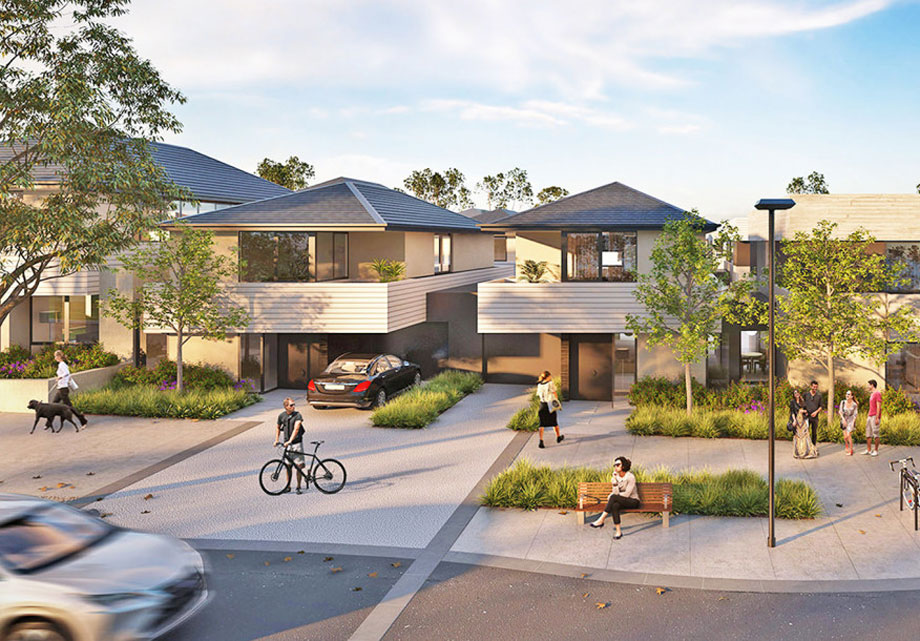
The world’s first “Tesla Town”: solar roofs and Powerwalls

Tesla town

The world’s first ‘Tesla Town’ is coming to Australia. Image source.

It’s been less than 6 months since Australia received its first shipment of the highly anticipated Tesla Powerwalls, but the country’s developers are already gearing up for big changes, announcing plans to build the world’s first Telsa-powered town in Melbourne.

According to D’Marge, the mini-suburb located on the outskirts of Melbourne’s CBD, has been dubbed “YarraBend” after the river that runs through it and will feature brand new houses, all fitted out with a solar roof and built-in Tesla Powerwall.

Hailed as one of the most environmentally sustainable developments in Australia, YarraBend’s 2500 houses will apparently see water use reduced by 43%, landfill contributions reduced by 80%, and will give residents the ability to recharge their electric cars for free.

The homes, designed, developed and built by property group Glenvill, will be made up of a combination of single-family homes, townhouses, and apartments, solar powered and containing energy efficient lighting and appliances.

If you’re interested in jumping on the Tesla bandwagon and minimising your impact on the environment you better be quick with the first 60 homes going on sale this week at prices between $1.48 million and $2.1 million.

Tesla’s new ‘Master Plan’: Big trucks, solar chargers, ride sharing

tesla master plan

Elon Musk delivered the long-awaited plan on the company’s website to explain why the integration of Tesla and SolarCity Corp. is necessary and to show his vision for the two companies. Image source.

Elon Musk unveiled his “master plan” for Tesla Motors Inc., delivering a long-term plan that includes making an integrated solar and battery storage system and building a freight truck and a bus. He even has a plan for a ride-sharing business.

According to IndustryWeek, Musk delivered the long-awaited plan on the company’s website to explain why the integration of Tesla and SolarCity Corp. is necessary and to show his vision for the two companies. He wants to use SolarCity, a rooftop solar panel installer, to generate electricity and charge an expanding range of Tesla models that address personal and public transport as well as cargo shipping.

“There are two other types of electric vehicles needed: heavy-duty trucks and high passenger-density urban transport,” the Tesla chief executive officer said in the blog post. “Both are in the early stages of development and should be ready for unveiling next year.”

Musk reiterated his call for acquiring SolarCity even as he outlined a significant expansion of Tesla’s products and ambitions for ride-sharing. Besides the Tesla Semi truck and the bus, he said the company will continue to pursue autonomy so that Tesla customers will be able to use their cars to “make money for you when you aren’t using it.”

Analysts were skeptical about Tesla’s ability to add more products to its lineup.

“As is typical, Elon Musk has laid out a grandiose plan for the future with no timeframes and few specifics, and no mention of how and when Tesla will be profitable,” Michelle Krebs, an analyst for Autotrader.com Inc., said in a email. “Tesla’s latest Master Plan includes expanding its electric vehicle product line to cover all major segments, when it hasn’t been meeting production targets with the limited product line it has now and in the next couple of years.”

Solar energy will be mainstream by 2020, says new report

solar panels

Analysis predicts the cost of solar cells is to fall dramatically over next five years but the loss of subsidies will be a setback for the technology in Europe. Image source.

Solar power is reaching maturity as a global energy source, with solar power systems for both residential and utilities in line to reach grid parity by 2020, at which point the cost of electricity generated by the sun will be the same as that from other sources, according to new research from industry analysts Frost & Sullivan.

“Pro-solar incentives and the recently made pledges at the COP 21 summit will ensure that the market for solar [photovoltaic cells] continues to grow exponentially over the next five years,” said Frost & Sullivan energy and environment research analyst Pritil Gunjan.

Raw material suppliers, solar cell manufacturers, solar module manufacturers, and equipment suppliers and installers are all positioned to benefit, says the report.

According to Science Business, the growth will happen mainly in China, India and Japan, which together will account for more than 80 per cent of all solar installations planned over the next five years.

It will be a less prosperous period for Europe’s solar industry which, “will suffer a setback due to withdrawal of subsidies and incentives,” the analysis says.

Huge overcapacity, coupled with a fall in the price of solar components, will see European suppliers struggling to turn a profit.

By contrast, solar panel manufactures will see strong growth in North America, largely thanks to the extension of investment tax credit eligibility for solar generators until 2019.

Solar panel revenues stood at $113.75 billion in 2015 and will grow to $179.13 billion in 2020.