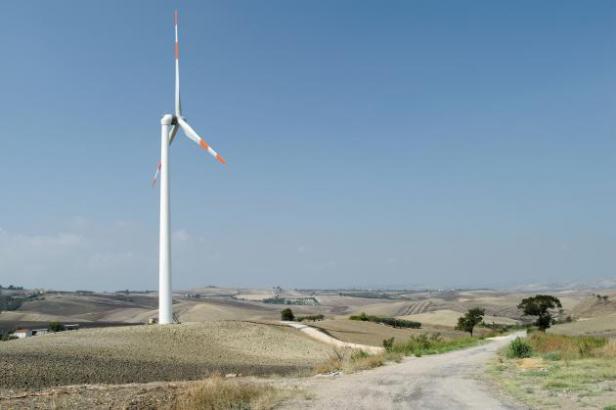
Wind farm in the Southern Italy

The South Tyrolean wind turbine manufacturer Leitwind will put up a 16 turbine wind farm in the region Apulia in Southern Italy by the end of this year.

Together, the turbines of the type LTW80 (1.5 MW) will produce an estimated 57 GWh of electricity annually.

The wind farm “Deliceto” in the province of Foggia will be operated by the company Elce Energia, which will invest a total of € 45 million in the project. The delivery of the turbines from Sterzing in South Tyrol, Italy, is scheduled for September 2012, and the wind farm will be completed before the end of the year.

“Leitwind is responsible for the transport, installation and commissioning of the wind park. Furthermore, a full-service contract for 15 years has been finalized,  which guarantees efficient production and optimum technical availability”, says Leitwind CEO Anton Seeber.

By the end of 2012, a total of 54 Leitwind turbines in Apulia and 82 in Italy as a whole will be generating electricity .Within a period of just five years up to the  end of 2011, Leitwind had managed to install a total of 200 turbines worldwide. Half of these were delivered in 2011, when 691 members of staff generated a turnover of € 163 million (+19%). For 2012, the management expects a turnover of € 200 million.

The largest biaxial photovoltaic system in Italy realized by REGRAN

With over 1.17 MW, 74 dual-axis, high efficiency solar trackers  each with 168 Concentrix ™ photovoltaic modules, together with two central inverters of 500 kW each to  guarantee a reliable power grid; these will produce enough electricity for 300 houses and should compensate the emission of more than 125 tonnes of carbon dioxide per year.

These are the numbers of the photovoltaic system of Santa Lucia, Belpasso, in the province of Catania, installed by REGRAN, the Sicilian company and a leader in both engineering services for large PV systems and the construction of (all inclusive) systems to generate energy from renewable sources.

The realization of the Belpasso plant is, as a matter of fact, the largest biaxial photovoltaic system in Italy, and its installment was carried out by REGRAN. The plant was built using the system of the French company Soitec, who also owns the utility.

“With the installation in Belpasso, REGRAN has confirmed its achievement of important development objectives and partnerships with leading European businesses,” said Marco Anfuso, CEO of the Sicilian company,confirming that the choice of  Soitec for REGRAN represents a starting point.

“The technology in the renewable energy field is evolving rapidly. For this reason, in order to maintain our leadership
position in southern Italy, we must continue to invest in research and development and strengthen partnerships with key players in the market.

Q-Cells sells Solibro

The insolvent German PV manufacturer Q-Cells is selling Solibro, its CIGS module manufacturing subsidiary, to Hanergy of Beijing.

This was announced by Q-Cells on June 5th. Solibro produces CIGS thin-film modules. According to Q-Cells, Hanergy plans to maintain the 430 jobs at Solibro and keep the existing management.

Operations and the Solibro customer service are also to be continued. After completion of this transaction, production in Thalheim will be increased to 100 MW per year “in order to serve Hanergy’s European customers”, it was announced.

In their company reports for 2011, Q-Cells quoted the Solibro capacity as 135 MW per year.

“This takeover is not only about strengthening our position on an international and competitive market. We would like to achieve synergies between the two companies in order to offer added value to our customers”, said Li Hejun, Chairman of Hanergy.

According to the Mitteldeutsche Zeitung (MZ), group CEO Nedim Chen initiated this sale at the end of 2011, i. e. before the insolvency. By selling Solibro, the Thalheim manufacturer is also selling 25 years of thin-film technology development. According to a spokesperson, the sale does not affect the insolvency proceedings, but provides liquidity to the company.

A sale price has not been revealed. By the end of 2012, Hanergy wants to build up 3 GW of PV production capacity, reports the MZ.

Solar powered Siberian Tiger camper unveiled by Tiger Adventures

Tiger Adventures a bespoke firm that turns normal everyday vehicles into campers, has just unveiled its latest discover.

Called the Siberian Tiger, named after the animal hailed to be the largest cat in the world, this camper uses the back of a Ford F450 and uses a three-point mounting system.

It is powered up by solar energy and it has also AMG batteries used to store the juice!

The camper has a stainless steel sink, three-burner recessed stove, convection microwave, refrigerator and freezer along with a porcelain toilet, full-length mirror, bamboo vanity, exhaust fan and separate shower area with a modified king bed to top it off.

The solar system is about 200 watt and it uses LED lighting indoors. The price is $163,000.

Russia launched the first industrial biogas plant

An industrial biogas plant was recently launched in the Belgorod Region in Central Russia.

The new station “Baytsury” is one of the first large scale industrial plants in Russia.

The station owned by the Regional Centre for Biotechnology, one of Russia’s largest companies, specializing in projects in the field of biogas energy.

It is located at a pig complex and is designed to process 38,690 m3 of organic waste and the production of 19,100 m3 of organic fertilizer.

The annual electric power output is estimated at 7.4 million kWh, while heat energy is 3,200 Gcal.

Now, in Russia, the potential of biogas production is estimated at 70 billion m3 per year.The southern regions of Russia have the biggest potential of biogas production and can produce 24.4 billion m³ of biogas from agricultural waste.

The Rostov Region and the Krasnodar Territory are among the most promising regions for the development of biogas technologies in Russia.

A floating luxury resort, powered by solar cells was conceptualized

A luxury floating hotel conception that would use low cost, dye sensitized solar cells it is for sure something innovative.

An italian designer named Michele Puzzolante has conceptualized his floating masterpiece with exclusive self sustaining capacity in terms of power.

This invention is a fusion of both a cruise ship and an underwater platform. Also allows passengers to see the wild marine life forms.

The Solar Floating Resort will have a 20m long deck with a myriad of spatial denominations. two double and two single bedrooms with their private bathrooms, a kitchen, a dining room, lounge area and bridge will be included.

This underwater platform can be used for exhilarating views into the deep mysteries of the ocean.Also a observation pod will be built into the hull of the craft.

The Solar Floating Resort will be constructed from dual layers of fiberglass reinforced balsa wood.

Energy-efficient LED lighting used for Tower Bridge decorations

As the Queen celebrates her Diamond Jubilee, a team of electricians and   lighting-designers decided to commemorate the memorable day.

They set he iconic Tower Bridge in London aglow, in a green and responsible fashion that has left us awe-struck.

The team used ,500 feet of energy-efficient LED linear lights, 1,800 LED lamps, 1,000 junction boxes and 16,500 feet of cable GE. So they managed to give the Tower Bridge a glittering diamond-like appearance in night.

The Tower Bridge will continue to gleam through the weekend as celebrations continue and will be adorned for the 2012 Olympic Games.

This lighting system used for the Queen’s Diamond Jubilee uses 40% less energy than traditional lighting used earlier for similar occasions.