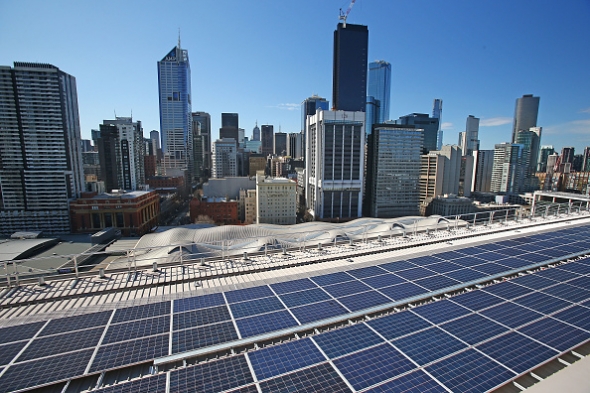
The world’s first “Tesla Town”: solar roofs and Powerwalls

Tesla town

The world’s first ‘Tesla Town’ is coming to Australia. Image source.

It’s been less than 6 months since Australia received its first shipment of the highly anticipated Tesla Powerwalls, but the country’s developers are already gearing up for big changes, announcing plans to build the world’s first Telsa-powered town in Melbourne.

According to D’Marge, the mini-suburb located on the outskirts of Melbourne’s CBD, has been dubbed “YarraBend” after the river that runs through it and will feature brand new houses, all fitted out with a solar roof and built-in Tesla Powerwall.

Hailed as one of the most environmentally sustainable developments in Australia, YarraBend’s 2500 houses will apparently see water use reduced by 43%, landfill contributions reduced by 80%, and will give residents the ability to recharge their electric cars for free.

The homes, designed, developed and built by property group Glenvill, will be made up of a combination of single-family homes, townhouses, and apartments, solar powered and containing energy efficient lighting and appliances.

If you’re interested in jumping on the Tesla bandwagon and minimising your impact on the environment you better be quick with the first 60 homes going on sale this week at prices between $1.48 million and $2.1 million.

Solar energy will be mainstream by 2020, says new report

solar panels

Analysis predicts the cost of solar cells is to fall dramatically over next five years but the loss of subsidies will be a setback for the technology in Europe. Image source.

Solar power is reaching maturity as a global energy source, with solar power systems for both residential and utilities in line to reach grid parity by 2020, at which point the cost of electricity generated by the sun will be the same as that from other sources, according to new research from industry analysts Frost & Sullivan.

“Pro-solar incentives and the recently made pledges at the COP 21 summit will ensure that the market for solar [photovoltaic cells] continues to grow exponentially over the next five years,” said Frost & Sullivan energy and environment research analyst Pritil Gunjan.

Raw material suppliers, solar cell manufacturers, solar module manufacturers, and equipment suppliers and installers are all positioned to benefit, says the report.

According to Science Business, the growth will happen mainly in China, India and Japan, which together will account for more than 80 per cent of all solar installations planned over the next five years.

It will be a less prosperous period for Europe’s solar industry which, “will suffer a setback due to withdrawal of subsidies and incentives,” the analysis says.

Huge overcapacity, coupled with a fall in the price of solar components, will see European suppliers struggling to turn a profit.

By contrast, solar panel manufactures will see strong growth in North America, largely thanks to the extension of investment tax credit eligibility for solar generators until 2019.

Solar panel revenues stood at $113.75 billion in 2015 and will grow to $179.13 billion in 2020.

IRENA: Solar energy boosts food production and fights poverty

solar irrigation pump

“Solar sharing”= agriculture and sunshine brings new prosperity to farmers around the world. Image source.

A new paper from IRENA, launched at InterSolar Europe in Munich, highlights the way solar technology is being used to power food production and empower communities to escape poverty.

Solar Pumping for Irrigation: Improving livelihoods and sustainability, details how solar technology is being used to improve farming efficiency and agricultural output, highlighting successful examples from across Africa and Asia.

A growing need for change

According to the United Nations, more than 40% of the world’s population makes a living in the agriculture sector — many of whom live in poverty. Socio-economic development is strongly linked to agricultural productivity, and as climate change continues to disrupt rainfall patterns, developing irrigation is becoming a vital tool to combat poverty. Given that only 5% of sub-Saharan African farmland irrigated, and that the continent is home to one of the fastest growing populations on the planet, the need to produce more food and energy is becoming critical.

Some countries are now exploring solar-based solutions (e.g. water pumps powered by solar panels), which provide reliable, cost-effective, and environmentally sustainable energy for decentralized irrigation services. These solutions are even cost-competitive with diesel powered pumps in many cases.

For example, Solar Pumping for Irrigation highlights a case in India, where diesel-powered water pumps on salt-pan farms were replaced with solar-powered pumps. The change resulted in a life-changing 161% increase in annual monetary savings for the farmers, in addition to reduced air pollution and CO2 emissions.

Solar-pumps and other solar technologies are proven to positively affect the lives of both men and women. For example, the installation of three solar-powered drip-irrigation systems in the Kalale district of northern Benin helped a co-operative of 35-45 women free themselves from four hours of labor a day. The increased time and more reliable income from the irrigation system helps the women to feed, educate, and provide medical care for their families.

Adopting a ‘Nexus Approach’

Water, energy, and food are intimately interlinked. Within this nexus, actions taken in any areas affects the others. In Solar Pumping for Irrigation, IRENA calls for a holistic approach with regards to policy, which recommends to:

  • foster innovation and flexibility when delivering solar pumping solutions;
  • take into account target groups and the long-term sustainability of markets when considering financial instruments to support solar pumping;
  • focus on after-sales support and capacity building: providing support for regular operation and maintenance;
  • package energy and water-efficient solutions in water-stressed areas;
  • assess the direct and indirect impacts on water resources;
  • monitor performance and gather data;
  • consider the influence of availability and cost of energy on the choice of crops grown;
  • and adopt an integrated approach to programme design: solar pumps can also bring electricity to poorly connected communities and contribute to the achievement of multiple Sustainable Development Goals.

IRENA: Solar energy boosts food production and fights poverty

solar irrigation pump

“Solar sharing”= agriculture and sunshine brings new prosperity to farmers around the world. Image source.

A new paper from IRENA, launched at InterSolar Europe in Munich, highlights the way solar technology is being used to power food production and empower communities to escape poverty.

Solar Pumping for Irrigation: Improving livelihoods and sustainability, details how solar technology is being used to improve farming efficiency and agricultural output, highlighting successful examples from across Africa and Asia.

A growing need for change

According to the United Nations, more than 40% of the world’s population makes a living in the agriculture sector — many of whom live in poverty. Socio-economic development is strongly linked to agricultural productivity, and as climate change continues to disrupt rainfall patterns, developing irrigation is becoming a vital tool to combat poverty. Given that only 5% of sub-Saharan African farmland irrigated, and that the continent is home to one of the fastest growing populations on the planet, the need to produce more food and energy is becoming critical.

Some countries are now exploring solar-based solutions (e.g. water pumps powered by solar panels), which provide reliable, cost-effective, and environmentally sustainable energy for decentralized irrigation services. These solutions are even cost-competitive with diesel powered pumps in many cases.

For example, Solar Pumping for Irrigation highlights a case in India, where diesel-powered water pumps on salt-pan farms were replaced with solar-powered pumps. The change resulted in a life-changing 161% increase in annual monetary savings for the farmers, in addition to reduced air pollution and CO2 emissions.

Solar-pumps and other solar technologies are proven to positively affect the lives of both men and women. For example, the installation of three solar-powered drip-irrigation systems in the Kalale district of northern Benin helped a co-operative of 35-45 women free themselves from four hours of labor a day. The increased time and more reliable income from the irrigation system helps the women to feed, educate, and provide medical care for their families.

Adopting a ‘Nexus Approach’

Water, energy, and food are intimately interlinked. Within this nexus, actions taken in any areas affects the others. In Solar Pumping for Irrigation, IRENA calls for a holistic approach with regards to policy, which recommends to:

  • foster innovation and flexibility when delivering solar pumping solutions;
  • take into account target groups and the long-term sustainability of markets when considering financial instruments to support solar pumping;
  • focus on after-sales support and capacity building: providing support for regular operation and maintenance;
  • package energy and water-efficient solutions in water-stressed areas;
  • assess the direct and indirect impacts on water resources;
  • monitor performance and gather data;
  • consider the influence of availability and cost of energy on the choice of crops grown;
  • and adopt an integrated approach to programme design: solar pumps can also bring electricity to poorly connected communities and contribute to the achievement of multiple Sustainable Development Goals.

Alta Devices achieves 31.6% solar energy efficiency record

Alta Devices solar cells

Alta Devices solar cells. Image source.

With its most recent solar efficiency record of 31.6%, Alta Devices continues to achieve solar efficiencies that are substantially higher than all other commercially available solar technologies.

According to Business Wire, this breakthrough, combined with its unique thinness and flexibility, redefines how solar technology can be used. In particular, Alta’s solar technology is of great interest in the UAV (unmanned aerial vehicle) market. The increased power-to-weight ratio of Alta’s technology enables dramatically different possibilities for an aircraft using this technology versus any of the other solar power options.

As an example, on a typical HALE (high altitude long endurance) UAV aircraft, Alta’s solar material requires less than half of the surface area and weighs one-fourth as much while providing the same amount of power as competing thin film technologies. These savings open UAV designers to a variety of alternative design options. Additional batteries can be installed on the vehicle, providing longer operational life spans and flight times than originally considered. Alternatively, payload functionality can be tailored for higher speed or longer distance wireless communications. Either of these design optimizations translate into a considerable increase in economic value to the aircraft operator.

Our goal has always been to enable solar power to be useful in configurations and applications that have never before been possible,” said Rich Kapusta, Alta Devices Chief Marketing Officer. “The UAV application is an important example of how this happens.”

Alta Devices also provides solar technology for a variety of other applications including wearable devices and the Internet of Things (IoT) in order to eliminate the need for battery replacement or recharging.

31.6% efficiency certified by the NREL

Solar efficiency is measured and certified by the Energy Department’s National Renewable Energy Laboratory (NREL). According to NREL’s testing, Alta Devices’ new dual-junction solar cell is the world’s most efficient 1-sun cell at 31.6% efficiency. This is the seventh overall solar efficiency record that Alta Devices has set since 2010.

Alta has achieved this breakthrough by modifying its basic “single-junction” gallium arsenide (GaAs) material. The company’s dual junction technology builds on the basic GaAs approach but implements a second junction (or layer) with Indium Gallium Phosphide (InGaP). Because InGaP uses high-energy photons more efficiently, the new dual-junction cell generates more electricity from the same amount of light than a single-junction device. With this breakthrough, Alta currently holds both the dual-junction and single-junction records at 31.6% and 28.8%, respectively.

New world record set in renewable energy investments

renewable energy global investments

Record renewable energy investment in 2015. Image source.

All investments in renewables, including early-stage technology and R&D (Research and Development) as well as spending on new capacity, totalled $286 billion in 2015, some 3 per cent higher than the previous record in 2011, said the 10th edition of United Nations Environment Programme’s (UNEP) annual report — Global Trends in Renewable Energy Investment 2016.

According to Gulf News, a total of 134 gigawatts (GW) of renewable power was added worldwide in 2015 compared to 106GW in 2014 and 87GW in 2013, the report said.

It highlighted that the green investments had broadened out to a wider and wider array of developing countries, helped by sharply reduced costs and by the benefits of local power production over-reliance on imported commodities.

“Renewables are becoming ever more central to our low-carbon lifestyles, and the record-setting investments in 2015 are further proof of this trend. Importantly, for the first time in 2015, renewables in investments were higher in developing countries than developed,” said Achim Steiner, executive director at UNEP, in an official statement.

In 2015, for the first time, investments in renewable energy in developing and emerging economy nations ($156 billion, up 19 per cent compared to 2014) surpassed those in developed countries ($130 billion, down eight per cent from 2014).

Much of these record-breaking developing world investments took place in China (up 17 per cent to $102.9 billion, or 36 per cent of the world total).

Other developing countries showing increased investment included India (up 22 per cent to $10.2 billion), South Africa (up 329 per cent to $4.5 billion), Mexico (up 105 per cent to $4 billion) and Chile (up 151 per cent to $3.4 billion).

Among developed countries, investment in Europe was down 21 per cent, from $62 billion in 2014 to $48.8 billion in 2015, the continent’s lowest figure for nine years despite record investments in offshore wind projects.

Investments in the US were up by 19 per cent to $44.1 billion, and in Japan investment was much the same as the previous year at $36.2 billion.

The report was launched by the Frankfurt School-UNEP Collaborating Centre for Climate & amp; Sustainable Energy Finance and Bloomberg New Energy Finance (BNEF).

An entire airport pays nothing for electricity thanks to solar panels

solar-powered airport

Kochi, world’s first fully solar operated airport. Image source.

Day by day, solar power is becoming a more viable source of energy for homes and businesses. If you need further proof of this, look no further than the Cochin International Airport in India that is now entirely powered by solar energy and pays nothing for electricity.

The airport last year installed a solar power system with a 12-megawatt peak (MWp) capacity that added to its previous installation that had a capacity of 1.1 MWp, thus giving it enough solar energy to run the entire airport.

According to Yahoo! Tech, the whole project cost roughly USD$ 9.3 million and it was built on a 45-acre piece of unused land near the airport. While the airport obviously can’t rely on solar power to meet all its needs at night, it doesn’t pay anything for electricity because during the day its 46,000 solar panels push all excess power back onto the grid.

The airport estimates it will take under six years for it to recoup its initial investment costs from the project. It also announced plans to double its solar generation capacity in the coming years to 26.50 MWp.

Whether this sort of installation can serve as a model for other airports, of course, is open to debate. Cochin International Airport is only the seventh busiest in India and it was also fortunate to have 45 acres of unused land nearby that it could use for solar power. Major airports in the United States would likely need to have even more open land available to generate the necessary power to keep them running at all times.

Nonetheless, this is a really amazing accomplishment that shows just how much potential solar power offers to both reduce carbon emissions and deliver energy.

Europe’s largest floating solar plant to open in London

floating solar plant London

Thames Water and Lightsource Renewable Energy have nearly completed Europe’s largest floating solar plant, built on top of Queen Elizabeth II Reservoir in London. PHOTO: Lightsource

Lightsource’s 6.3 megawatt project will become biggest floating array outside of land-strapped Japan

England may be known for its dreary weather and oft-overcast skies, but that hasn’t deterred a group of businesses from wading forward with a solar energy project that will see Europe’s largest floating solar array installed on Queen Elizabeth II Reservoir in Greater London near Walton-on-Thames.

According to Cleantech Canada, Lightsource Renewable Energy and Thames Water expect to complete work on the 23,000-panel project later this month. With a nameplate capacity of 6.3 megawatts, the project remains relatively small when compared to larger land-based solar farms, but is large enough to snatch the title of largest marine solar plant in Europe.

“Becoming a more sustainable business is integral to our long term strategy and this innovative new project brings us one step closer to achieving our goal—this is the right thing for our customers, the right thing for our stakeholders and most importantly the right thing for the environment,” Angus Berry, energy manager for utility firm, Thames Water, said when the project began.

Power from the renewable project will help power Thames Water’s nearby water treatment works, contributing to the utility’s goal of self-generating one-third of its energy by 2020.

Responsible for constructing and operating the plant, solar energy firm, Lightsource, expects to connect the array to the grid by the end of the month. Designers will keep the plant’s panels above water using a platform consisting of 61,000 floats and 177 anchors. The solar installation will cover about one-tenth of the reservoir—the equivalent of about eight football pitches.

As in many urban centres, land is at a premium in London, and the floating plant takes advantage of an area that would normally be off-limits to developers.

Japan is another country actively pursuing marine solar to boost renewable generation without impacting residents. Electronics conglomerate Kyocera Corp. recently broke ground on the world’s largest solar plant outside Tokyo. With a 13.7 MW capacity, the project can pump out more than twice the power of the Thames project.

European solar market grows 15% in 2015

solar market Europe

Nottingham, UK: A panoramic picture shows the changing face of an estate after 600 homes had solar panels fitted. Image source.

In 2015, European countries connected around 8 GW of solar power systems to electrical networks, according to estimates by SolarPower Europe.

According to Renewable Energy Focus, demand for solar power systems in European countries increased by around 15% year-on-year, compared to 6.95 GW of new grid-connected solar power capacity in 2014.

“It is good to see the European solar power sector again on the growth path in 2015,” says James Watson, CEO of SolarPower Europe. Peaking in 2011, demand for solar power installations in Europe declined for 3 consecutive years.

Europe’s solar growth in 2015, however, is primarily based on the strong UK market, demand for solar systems in most other countries stayed flat or declined. Watson added, “Solar needs clear signals from policy makers in Europe to be able to contribute to achieving the climate goals agreed in Paris. With solar being competitive for residential and commercial applications in most European countries today, investors need a secure political framework for generation, self-consumption and storage of solar energy.”

The company’s findings show that annual global grid-connected solar rose by over 25% to more than 50 GW in 2015, from 40.1 GW in 2014.

Final numbers for 2015 will be presented in a new report in March. Estimates for 2016, including market forecasts until 2020, will be published in SolarPower Europe’s ‘Global Market Outlook For Solar Power 2016 – 2020,’ which will be launched at Intersolar Europe in June.

The world installed 59 GW of solar PV capacity in 2015

solar PV

GTM: Global solar added 59 GW in 2015. Image source.

The world added 59 GW of solar photovoltaic capacity last year for a 34% growth compared to 2014, preliminary figures from GTM Research showed.

According to See News Renewables, in 2016, global installations are expected to be 64 GW, bringing the world’s cumulative installed PV capacity to 321 GW.

“The fourth quarter of 2015 showed that global PV demand is very much at the mercy of government support, which can often be unpredictable and idiosyncratic, leading to often negative but sometimes positive outcomes,” said GTM Research senior solar analyst Mohit Anand.

After the US extended the federal Investment Tax Credit (ITC) in December, its share of expected global PV demand between 2015 and 2020 has increased from an average of 10% to 15%, even as substantial growth in demand is projected for the Asia-Pacific region (apart from China) this year and beyond.

Japan, the UK and China have on the other hand pulled back feed-in tariff (FiT) support, which has reduced expectations.

Global installations in 2016 are expected to be led by the US and China. According GTM Research, emerging markets will play a key role as India will become a reliable multi-gigawatt market this year, while Brazil and Mexico will have their ambitions tested against actual project execution. A number of other markets in Asia and Latin America like the Philippines, Pakistan, Bangladesh, Uruguay, Guatemala and Panama will make progress and try to break through to 100 MW.