Alta Devices achieves 31.6% solar energy efficiency record

Alta Devices solar cells

Alta Devices solar cells. Image source.

With its most recent solar efficiency record of 31.6%, Alta Devices continues to achieve solar efficiencies that are substantially higher than all other commercially available solar technologies.

According to Business Wire, this breakthrough, combined with its unique thinness and flexibility, redefines how solar technology can be used. In particular, Alta’s solar technology is of great interest in the UAV (unmanned aerial vehicle) market. The increased power-to-weight ratio of Alta’s technology enables dramatically different possibilities for an aircraft using this technology versus any of the other solar power options.

As an example, on a typical HALE (high altitude long endurance) UAV aircraft, Alta’s solar material requires less than half of the surface area and weighs one-fourth as much while providing the same amount of power as competing thin film technologies. These savings open UAV designers to a variety of alternative design options. Additional batteries can be installed on the vehicle, providing longer operational life spans and flight times than originally considered. Alternatively, payload functionality can be tailored for higher speed or longer distance wireless communications. Either of these design optimizations translate into a considerable increase in economic value to the aircraft operator.

Our goal has always been to enable solar power to be useful in configurations and applications that have never before been possible,” said Rich Kapusta, Alta Devices Chief Marketing Officer. “The UAV application is an important example of how this happens.”

Alta Devices also provides solar technology for a variety of other applications including wearable devices and the Internet of Things (IoT) in order to eliminate the need for battery replacement or recharging.

31.6% efficiency certified by the NREL

Solar efficiency is measured and certified by the Energy Department’s National Renewable Energy Laboratory (NREL). According to NREL’s testing, Alta Devices’ new dual-junction solar cell is the world’s most efficient 1-sun cell at 31.6% efficiency. This is the seventh overall solar efficiency record that Alta Devices has set since 2010.

Alta has achieved this breakthrough by modifying its basic “single-junction” gallium arsenide (GaAs) material. The company’s dual junction technology builds on the basic GaAs approach but implements a second junction (or layer) with Indium Gallium Phosphide (InGaP). Because InGaP uses high-energy photons more efficiently, the new dual-junction cell generates more electricity from the same amount of light than a single-junction device. With this breakthrough, Alta currently holds both the dual-junction and single-junction records at 31.6% and 28.8%, respectively.

This power station can harvest kinetic wave energy and turn it into electricity

wave star energy

Wavestar, 4 years of continuous operation in the North Sea. Image source.

The Wavestar machine draws energy from wave power with floats that rise and fall with the up and down motion of waves. The floats are attached by arms to a platform that stands on legs secured to the sea floor. The motion of the floats is transferred via hydraulics into the rotation of a generator, producing electricity.

According to wavestarenergy.com, waves run the length of the machine, lifting 20 floats in turn. Powering the motor and generator in this way enables continuous energy production and a smooth output. This is a radical new standard and a unique concept in wave energy; it’s one of the few ways to convert fluctuating wave power into the high-speed rotation necessary to generate electricity.

“Environmental and climate issues, as well as uncertainty about energy supply, demand that we diversify our energy supply to multiple renewable and clean sources. With enough space for wave energy machines but little exploitation thus far, Wavestar is not just developing a wave power device, but energizing a whole movement.

Energy production with wave energy is more predictable than wind because waves come and go slowly and can be forecast 24 hours ahead. The Wavestar machine could also be installed together with a wind turbine which would further increase efficiency and reduce set-up costs. Wavestar understand that we need many renewable energy solutions, not just one, so it makes sense to harness the power of waves”, the team said.

Unique sea survivability

Survivability at sea is a big problem for wave energy devices. But unlike any other wave energy concept, the Wavestar’s sea survivability is guaranteed, and the concept has been proved during many years of continuous operation at sea. It can continue production in strong wind and waves, and automatically raises the floats out of the sea when the conditions become too stormy.

Award winning design

The Wavestar machine’s efficiency is being continually increased. The design was recently modified to reduce the cost by 40 per cent, while energy harvesting capacity and other aspects of the machine are being constantly improved for better efficiency. The Wavestar machine is less visible and quieter than wind turbines, and it also has a positive impact on wildlife below the machine, creating a sanctuary enhanced by the limits on nearby fishing.

The aesthetic profile of the machine won the prestigious Biennale Prize at the Biennial of Crafts and Design in 2009. The machine was nominated for the “highly original and striking sculptural design of a wave power machine, which in one single image symbolizes and clarifies the huge potential of this renewable energy resource … the wave power machine constitutes a beautiful counterpart to the clear form expression of the modern windmill.”

With the 500 kW machine in development, the company has claimed a position among the leading alternative energy developers in the world. Wave Star aim to make it the first series-produced 1 MW machine for big oceans, ready for sale in 2017. Wave Star is not stopping there though. The machine will then be doubled in size, capable of handling twice the wave height. This will increase each machine’s output to 6 MW, enabling a single machine to provide energy for 4,000 homes.

More info and details below:

This floating UFO home is powered by solar, wind and water

Jet Capsule UFO home

The UFO floating home concept from mini yacht-maker Jet Capsule offers a completely off-grid existence. Image source.

Known for its exquisite cuisine, prominent fashion scene, and storied football clubs, Italy will soon have the ability to add yet another notable notch to its esteemed culture belt: manufacturer of UFOs. Also known as Unidentified Floating Objects, the UFOs coming to Italian shores in the near future aren’t exactly alien but rather an innovative solution for fighting the high costs of rent and the impending rise of the world’s sea levels.

According to Digital Trends, artistically designed by the Italy-based company Jet Capsule, the floating concept is a small autonomous vessel that’s essentially a studio apartment on water. If you get seasick easy, we don’t recommend hopping on board to invest.

Structurally, Jet Capsule’s UFOs measure just over 40 feet in diameter, with much of the vessel’s surface area taken up by a circular ring surrounding the living quarters. As seen in image renderings released by the Italian company, the outer ring could feasibly be used as a track for riding a bike, walking your dog or simply catching some rays. The mock-ups also show bits of grassy areas in sections surrounding the ring that appear to facilitate vegetable gardens and various trees.

Once inside the capsule, each floating home contains two moderately sized livable areas. The upstairs houses the concept’s kitchen area, outfitted with a table and small seating area, as well as an access point to a short staircase leading to the bottom floor. Aside from a large window giving owners a front row seat for some gorgeous underwater viewing, the downstairs quarters also house a small bathroom and bedroom. If the renderings are indicative of a final product, privacy for those in the shower is extremely limited, though, only passing fish (or the occasional scuba diver) would actually be able to see inside.

Aside from a large window giving owners a front row seat for some gorgeous underwater viewing, the downstairs quarters also house a small bathroom and bedroom. If the renderings are indicative of a final product, privacy for those in the shower is extremely limited, though, only passing fish (or the occasional scuba diver) would actually be able to see inside.

Jet Capsule’s livable UFOs are also designed to utilize the surrounding environment to produce and store energy. For instance, the company intends to install wind and water turbines to generate power while also installing solar panels on the vessel to harness solar energy. If the vessel takes in more energy than it uses, the excess is simply sent to an internal battery fitted in the base of the UFO. Owners will also have the ability to control an electric anchor from inside the ship, which is used to keep the UFO in one position. While changing locations, the vessel has the ability to travel at speeds of up to 3.5 miles per hour — not exactly a blistering pace.

If the vessel takes in more energy than it uses, the excess is simply sent to an internal battery fitted in the base of the UFO. Owners will also have the ability to control an electric anchor from inside the ship, which is used to keep the UFO in one position. While changing locations, the vessel has the ability to travel at speeds of up to 3.5 miles per hour — not exactly a blistering pace.

As of now, Jet Capsule is currently seeking investors to help it develop the first working prototypes of its aquatic UFO. Like any concept, however, the likelihood of these vessels seeing the light of day remains scarce., but if rent prices continue to skyrocket (and water levels continue to rise), living in an aquatic house might not be all that strange.

This 18-Rotor helicopter runs entirely on electricity

electric helicopter

The Volocopter uses 18 rotors, which its inventors say make it ‘safer simpler and cleaner’ that current designs. Image source.

Developed by the German company e-volo, the Volocopter VC200, a 18-rotor rotor electric helicopter (aka multicopter) completed its first official manned test flight without a hitch, and documented the whole thing on camera. The video shows the managing director Alexander Zosel of the company of E-Volo piloting the maiden manned emission-free aircraft over an airfield in southern Germany.

According to TechWorm, e-volo’s Volocopter is built from fiber composite material with a 450 kg (992 lb) take-off weight, and nine individual batteries power the all-electric motors and 18 rotors to make for a top speed of 100 km/h (62 mph).

Best described as a drone-helicopter hybrid, the Volocopter has two seats available on it, while it runs on an electric engine with precision control being manned by a single joystick that is accompanied by a handful of buttons. Despite its complex shape and strange appearance, the Volocopter is designed to bring personal flight to the masses by being easy to fly.

“It is definitely a sublime feeling to lift off, fly the first few meters, and then actually take my hand off the joystick and think that, yeah, it’s really as if I’m standing on the ground, and then I look down and there are 20-25 meters beneath me,” Zosel said. “So it’s definitely unbelievable what we’ve achieved here. It’s seriously unbelievable!”

e-volo has tested its design with over 100 unmanned flights, but now that a human has actually piloted one, it’s on to a whole new round of testing. e-volo’s first test flight program saw the Volocopter hit speeds of 25 km/h (15 mph) at only low altitudes. The second phase will test the aircraft at speeds of 50 km/h and a medium altitude, with the final phase to raise that to higher altitudes and its top speed of 100 km/h.

If things continue to happen as planned by e-volo, the company has ambitions to produce the Volocopter in “large quantities” for the air sports market. It’s also looking at the possibility of air taxi services initially for “predetermined routes as airport shuttles or at sensible traffic nodes such as bridges.”

It may be a while before we see drone-helicopter hybrids like the Volocopter hovering overhead, but if it does happen, e-volo is keen to lead the way.

Watch Zosel take-off in the Volocopter in the video below:

Global renewable energy generation capacity up by 152GW

global renewable energy

Global renewable energy capacity soared In 2015. Image source.

The renewable energy generation capacity increased by 152 gigawatts (GW), which is equivalent to 8.3% last year, the highest annual growth rate on record, according to new data released by the International Renewable Energy Agency (IRENA).

According to utilities-me.com, the Renewable Capacity Statistics 2016 found that as of the end of 2015, 1,985 GW of renewable generation capacity existed globally.

Adnan Z Amin, Irena director-general, said: “Renewable energy deployment continues to surge in markets around the globe, even in an era of low oil and gas prices. Falling costs for renewable energy technologies, and a host of economic, social and environmental drivers are favoring renewables over conventional power sources.

“This impressive growth, coupled with a record $286 billion invested in renewables in 2015, sends a strong signal to investors and policymakers that renewable energy is now the preferred option for new power generation capacity around the world.”

It was a record year for both wind and solar due in large part to a continued decline in technology costs.

Meanwhile, wind power grew 63 GW (17 per cent) driven by declines in onshore turbine prices of up to 45 per cent since 2010.

Solar capacity increased 47 GW (37 per cent) owing to price drops of up to 80 per cent for solar photovoltaic modules in the same time period.

Hydropower capacity increased by 35 GW (three per cent) while both bioenergy and geothermal energy capacity increased five per cent each (5 GW and 1 GW respectively).

Overall, capacity has increased by roughly one-third over the last five years, with most of this growth coming from new installations of wind and solar energy.

In terms of regional distribution, the fastest growth in renewable generation capacity came in developing countries.

“The significant growth rates for renewable generation capacity in developing economies are a testament to the strong business case for renewable energy,” said Amin.

“Renewables are not just a solution for industrialized countries, they are also powering economic growth in the fastest growing economies in the developing world.”

At the end of the year, hydropower accounted for the largest share of the global total renewable power generation capacity with an installed capacity of 1,209 GW, the majority of which are large-scale plants.

Wind and solar energy accounted for most of the remainder, with an installed capacity of 432 GW and 227 GW respectively. Other renewables included 104 GW of bioenergy, 13 GW of geothermal energy and about 500 MW of marine energy (tide, wave and ocean), he added.

Scotland generated more than half its electricity from renewables last year

clean energy Scotland

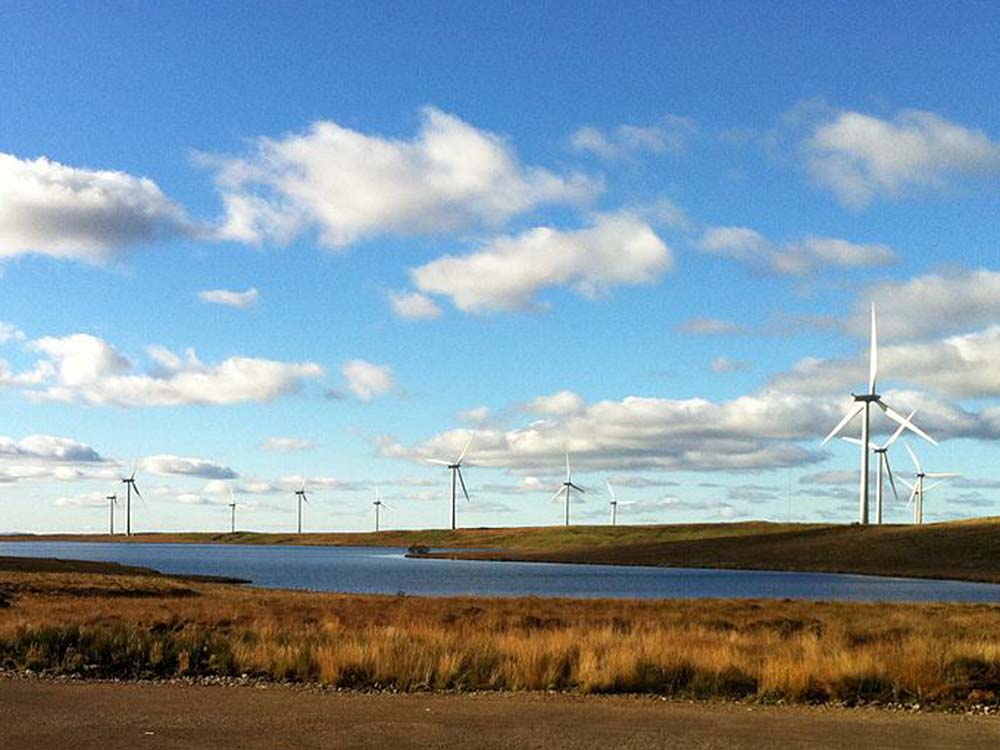
Whitelee Wind Farm, Scotland. Image source.

Scotland has reached an ambitious renewable energy milestone by generating 57.7 percent of its gross electricity consumption. It also made up about 26 percent of total UK renewable generation last year.

According to Ars Technica UK, the government’s department of energy and climate change has released provisional numbers of renewable energy generation in 2015, which revealed that renewable electricity generated in Scotland last year totalled 21,983 GWh, with around 64 percent of that figure coming from wind turbines, and another 27 percent from hydro generators. Both sources showed a year-to-year increase in generation—of 21 percent and 7 percent, respectively.

Scotland now appears to be on track to fulfil its 2020 goal of having all of the country’s electricity consumption supplied by renewables. However, plans for the next four years might prove more difficult, given the significant cuts in renewable energy subsidies announced by the UK government in late 2015.

Scottish clean energy campaigners are predictably unhappy and have attacked UK prime minister David Cameron about the reductions to renewable energy subsidies.

“This is great news and an important step in creating a fossil-free Scotland,” said Dr. Richard Dixon, Friends of the Earth Scotland director. “Despite the UK government’s ideological assault on renewable energy Scotland is storming ahead, smashing through our 50 percent target for 2015. Well done to all those in this vital industry who have helped produced a big increase from the 2014 figures.”

“Clean, green energy is essential in the fight against climate change, and Scotland needs to continue to be a champion of renewables while David Cameron continues to chase the nuclear dream in England.”