From now on, we can cook without harming the environment

solar-powerd oven

British students made a special oven

A cheap Solar-Powered Oven could take wood’s or coal fuel’s place all over the world.

Nowadays, even with all the technology in our hands, people still cook with the help of wood and coal. Well that has got to change. These fuels are often expensive, produce carbon and lead to health issues. Moreover, they are not sustainable at all as they use wood and we all know we are not planting as many trees as we should.

The newly discovered solar over, developed by four British students, plans to change all this. It is made of 16 foot parabolic dish that harvests solar energy and conduscts it to a cooking box. “It’s a like a greenhouse,” as a student, Keno Mario-Ghae, says. “We have glass around the outside, then a box in the center. That allows us to get the heat in and get it nice and hot, but not let the heat leave.”

The good part of it is the fact that the dish is fixed on a wooden platform that permits it to fallow the sun rays. There are two tubes of water on both sides. One with the counterbalance role and the other leaks at a uniform rate, allowing the dish tilt at about 15 degrees per hour.

When tested, the oven went up to 400 degrees Fahrenheit in 45 minutes, as Mario-Ghae reports. Just enough to bake some bread rolls in not more than an hour.

The purpose of the whole project is to lower the costs and use materials from the area such as old oil-drums. The costs of the device would reach no more than $350 dollars. So a lot cheaper than the existing solar-ovens. The letter reach thousands of dollars when imported to developing countries.” There are a lot of costs you don’t have to deal with if you’re building it in the country where it’s needed,” the student says.

The developers of the project just finished the third year of a manufacturing engineering degree at Cambridge University. They wish to invest in more prototypes and maybe contribute to private projects for people in need. Their project also entered the 2014 Dyson Awards, due in the 7th of August.

iPhone 6 goes solar

solar smartphone

iPhone 6 will be manufactured with solar energy

The technology giant that in the past drew fire from campaigners for the fossil fuel dependence, is nowadays the leaders of companies for taking control of its own energy resources. Even if the solar farm owned by Apple is not doing great, the people in control of the environmental areas make use of the power harvested by the panels and place Apple on the green power-friendly companies map.

As we can remember, all the data centers were converted to clean energy and Apple is obliged to use solar power, the sapphire screens for the iPhone 6 will be manufactured with solar energy, in a factory in Arizona.

To minimize carbon footprints

In the past year, the telegenic Jackson was the front woman for Barack Obama’s environmental plans as the administrator of the Environmental Protection Agency. At present, she is responsible with the needs of minimizing the carbon footprint that Apple is causing. She also needs to be certain that the company does what it takes to decarbonize its products.

Big amounts of electricity are required by the data centers in order to preserve climatic conditions and keep the servers running and supplying all the electronic transactions on a daily basis.

Thanks to this new initiatives, users can be sure that when they need to download something or chat with somebody they will not be responsible for contributing to the carbon pollution, as Jackson reports.

“If you are using your iPhone, iPad, Siri or downloading a song, you don’t have to worry if you are contributing to the climate change problem in the world because Apple has already thought about that for you. We’ve taken care of that. We’re using clean energy,” she added.

Apple is also planning to use solar and geothermal energy for a manufacturing site in the U.S., a plant in Mesa, Arizona that produces sapphire glass.

“We are aware that almost 70% of our carbon footprint is in our supply chain,” Jackson said. “We are actively working right now on the facilities that we have here in the United States”.

This new investments represent a reversal for the company that faced a lot of critics for the working environment and the toxic chemicals dependence especially in Chinese factories and for the use of carbon-based sources as coal.

Self-cooling solar cells are now possible with the help of tiny glass pyramids

solar cells

Solar cell efficiency increases

When solar panels are used to give away power, are using small solar cells that need to have direct sunlight a long time. This is not a very difficult task, but can rise problems from time to time. As the solar cells heat up, their efficiency level is going down and the age quickly. Taking all this into account, the solar energy is not as cheap as we might think.

There are many ways the can get cooler in an active way, but this ways are generally not as cheap as we wish and they can also be problematic from the efficiency point of view. So, we might want to develop passive methods to cool the cells. In order to do this, a team of researchers from Stanford University developed a solution.

The highest level of efficiency reaches only conversion rates for the solar power they harvest, even if we are getting closer to a 50% rate. The remaining heat can be considered waste, as it brings the cells to 55 degrees Celsius. Every Celsius degree means a 0.5% cell efficiency decrease. This means that an efficiency levels at 30% is only bringing approximately 21% solar power.

The Stanford researchers brought a passive cooling solution by making use of the wavelengths of light. In order to do this, they use a thin sheet of silica glass among with the pyramids and shapes only a few microns thick. This means that visible light can enter through the glass unimpeded, but it also refracts away the infrared wavelengths that can be the cause of the extra heat.

In conclusion, with just a little extra cost, the additional glass layer can passively cools down the cells and the efficiency level can remain the same. Moreover, the live of the cells is longer, and an ideal efficiency level is to be reached. So far, this theory has been tested in a lab, but some outdoor test will be run in the near future. If these are successful, it might become a standard procedure for the next solar panel production, thanks to the big efficiency advantages.

Google to give $1 Million in Portable Renewable Energy Source Challenge

Google clean energy

More clean energy from Google

Search engine is giving a $1 Million prize for the construction of a compact idea for turning green energy into a power source that can be utilized in the house.

Google, together with the Institute of Electrical and Electronic Engineers (IEEE), has begun a ‘Little Box Challenge’ to come up with and construct a kW-scale power inverter, that can be useful to transform in renewable energy, meaning solar and wind, until turning it into convenient current for houses and automobiles.

The competition is challenging because the new object needs to not be bigger than a little laptop, meaning maximum roughly 1/10th of the current size.

“We are looking for someone to build a kW-scale inverter with a power density greater than 50W per cubic inch. Do it best and we will give you a million bucks,” Google said in a blog post.

Google is certain that this will help “change the future of electricity”.

“We believe that inverters will become increasingly important to our economy and environment as solar PV, batteries, and similar power sources continue their rapid growth,” Google added.

It added that the innovation coming in will have wide applicability across areas, will increase the performance drive down price tags and open up new use cases.

Google announced the construction of a smaller power inverter could provide a bigger number of hoses that function with green energy, more practical electrical grids distributed wisely and could also bring a benefits to the isolated areas on earth.

“A smaller inverter could help create low-cost microgrids in remote parts of the world. Or allow you to keep the lights on during a blackout via your electric car’s battery. Or enable advances we haven’t even thought of yet,” Eric Raymond from Google’s Green Team reports.

The due date for the competition is this year’s September and the winner of the contest will be unveiled in the first month of 2016.

The European Union approves the new German Renewable Energy Law

energy in germany

EU approves the new German Renewable Energy Law

EU said yes to the Approval of Germany’s New BRUSSELS, fact that took place on Wednesday. The recent law was made with the purpose of helping Germany to not depend on nuclear and fossil fuel-generated power.

A few weeks ago, the European Commission reported that it had given backing to the plans after Berlin agreed to make some amendments to the law.

Earlier this month, the European Commission said The new law “paves the way for more market integration of renewables,” words belonging to Joaquín Almunia, the European Union’s antitrust commissioner.

“In the medium term, this should lead to lower costs for consumers. Also the progressive opening up of tenders to operators located in other member states is a very positive development for the internal energy market.”

The EU was worried that some companies from Germany in the green energy industry could have taken advantage of subsides. Moreover, the also think that a surcharge necessary for imported electricity equated to a customs duty and violated the bloc’s internal market regulations.

As a fallow-up, the German country was on board with letting foreign companies that import green power to benefit from the same advantages as Germany-based companies that deliver power domestically.

Germany’s energy and economics minister, Sigmar Gabriel, accepted the EU decision Wednesday, believing it will represent a beginning for further development of green energies and implementation of the “energy revolution,” an alternative to nuclear and conventional power sources.

“Companies in Germany are also being provided with the framework conditions to maintain our jobs and serve to strengthen industry in Europe,” Mr. Gabriel reports.

The German bill trims subsidies for new renewable power plants that vary from big wind farms to little solar panels situated on homeowner’s roofs. In addition to this, the power-price surcharge is booming as it has funded these subsidies more equally among businesses. The majority of firms had previously been exempt for reasons like operating energy-hungry industries or decided to put together their own power plants.

This law is valid starting next month and the yearly support can reach €20 billion.

New sponge-like material generates steam with the help of a small concentration of solar energy

solar energy

New sponge-like material from MIT

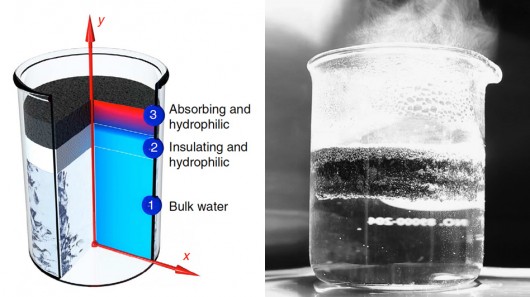
Scientist from the MIT’s Department of Mechanical Engineering report that they have found a way to make a sponge similar substance that is useful for transforming water into steam with the help of sun rays one-hundredth as bright as that requested by classic steam-producing solar power plants. Made of graphite flakes layered on a bed of carbon, the new substance is said to transform 85% of the harvested solar power into steam.

From the practical point of view, researchers believe that the graphite flakes and carbon foam combination they made can insulate a material structure that can float on water. They have developed several experiments and believe they discovered a method to raise the heat withholding properties in the upper layer by expanding its volume. They experimented this in a microwave. The outcome is exceedingly permeable top layer able increase absorption and withholding of solar energy.

The layer on the bottom is designed from carbon and it contains hundreds of tiny pockets of air that helps the material floating, and meanwhile it is insulating in order to prevent the heat from going out. The essential fact is that for the steam generation, the foam is also perforated with small pores the give permission to the water to go back up.

So, when the light from the sun illuminates and heats the material it gives pressure to the foam and air and helps the water to get pass the carbon and go into the graphite layer. As this takes place, the heat on the materials turn water into steam. As a result, if the light is more intense, the quantity of water absorbed is higher and more steam is generated.

“Steam is important for desalination, hygiene systems, and sterilization,” says Hadi Ghasemi, a postdoctoral MIT student who ran the material development. “Especially in remote areas where the sun is the only source of energy, if you can generate steam with solar energy, it would be very useful.”

Scientists also say that the sponge-like material can be made from cheaper material and can be the beginning of a new type of compact, steam-powered applications, especially as this method gives a significant improvement over classic solar-powered steam generation methods.

World highest solar parking space is situated in Tibet. The Solar Mounting System is secured by Schletter

solar parking space

Lhasa, known as the “city of sunshine” has a special solar parking space

The area enjoys over 3,000 hours of sun every year. No wonder Lhasa is also known as the “city of sunshine” or “sun city”. As you can imagine, there you can find the finest setting for harvesting solar energy.

The project belongs to Beijing Corona, a company that chose the modular parking space Park@Sol, that can host a 1-row vehicle in this area. It is said that the solar power plant will start functioning this month. The exact location of the parking lot is in the north of Himalaya, Lhasa, also named capital of the Autonomous Territory of Tibet in the People´s Republic of China.

The spots altitude is 3,650 meters over the sea level, a number that gives Lhasa the title of the highest capital in the world. Still, because of this aspect, the people involved in the project, often had respiratory problems. Even considering this, the project for BEIJING CORONA SCIENCE & TECHNOLOGY CO., LTD will be finished as announced. The solar parking space can keep safe 54 vehicles and measures 103 kWp.

Another interesting fact about Lhasa is the fact that it hosts the Tibet Museum since 1996, one of the main attractions of the country. Here tourists can find artefacts from the beautiful history of Tibet, culture and Tibetan Buddhism. The museum will also enjoy the benefits of solar power, as the energy harvested by the carport will also provide for it.

At present, Lhasa can be proud of hosting the highest railroad, the highest brewery and the highest carport in the world. This couldn’t have been possible without Schletter.

UK renewables embraced by foreign investors

UK green energy

Foreing investments in UK

61 green energy projects in the UK were targeted by foreign investors in 2013, fact that come as a confirmation that this domain is considered one of the most attractive ones for abroad investments, as the latest government report shows.

UK Trade and Industry yesterday announced that 2013/14 was a cosmic one for away investment. This was confirmed by the last report in the country, report that also says the biggest number of inbound was recorded in the 1980s.

The new report focuses on green energy through the first 12 sectors for inward investment, counting over 60 projects that were supported last year and 46 a year before that.

Offshore wind reveals a surprisingly tempting sector as the British countries carries on as the market leader and has wants to produce at least 10GW of capacity until 2020. In 2013 saw Canadian pension fund La Caisse plough £644m in London Array, the world’s biggest offshore wind farm.

In the meantime, Swedish utility Vattenfall put £400m Peny Cymoedd onshore wind farm located in the Wales, that is said to generate 300 jobs.

BP, AB Sugar and DuPont also last year opened up the £350m Vivergo bioethanol plant in Hull, that can generate 420 million liters of the renewable transport fuel every year at full capacity.

The report was opened in front of the Commonwealth Games Business Conference in Glasgow, that begins tomorrow, and wants to attract more investors to the UK. It reveals that through the economy, the British country captivates support for 14% more projects that in the years before, and help the country with 66,390 new jobs, a number overcomed only in 2001.

Still, the report also tells us that the oil and gas sector also became an important part of the investments as contributions were made by foreigners for 52 projects in the past year. Software and computer services are still the most attractive area, even if investment fell slightly from 261 projects in 2012 to 229 projects last year.

“Part of our long-term economic plan for the UK is about promoting every part of our country to the world and Glasgow’s Commonwealth Games will give us another fantastic platform to do this. I promise this government will continue to work on behalf of every hardworking business in the UK to drum up trade, encourage investment and pave the way for growth so we can generate jobs, pay our way in the world, and create stability, security and a brighter future for our country,” said Prime Minister David Cameron in a statement.

Microsoft announces they will power their datacenters with green energy

Microsoft wind farm

Green energy for Microsoft

The soft giant said they will power a number of datacenters with wind power. In order to do that, they signed a 20-year contract with a wind farm from Illinois.

The deal with EDF Renewable Energy is very much alike with the one the company signed last fall for a wind farm from Texax.

This Pilot Hill Wind Project is among the company’s biggest wind investment until now since it is 60% larger than the one in Texas, Keechi Wind Project

The leas with EDF Renewable Energy will see Microsoft assets up to an approximately 675,000 MWh of green energy from the 175MW wind farm every year.

Robert Bernard, Microsoft chief environmental strategist, reports in a blog post that the company is “committed to reducing our environmental footprint, and over the past two years we continue to meet our goal of becoming carbon neutral”.

“By purchasing wind, we will reduce the overall amount of emissions associated with operating Microsoft facilities and hopefully spur additional investment in renewable energy. Because the Chicago datacentre draws power from the Illinois power grid, projects like Pilot Hill help provide a non-polluting source of energy that displaces greenhouse gas emissions from conventional power.” he added.

The site construction has already begun at will be finished next year.

The senior energy campaigner at Greenpeace, David Pomerantz, believes Microsoft’s wind energy acquisition reveals that they are willing to compete with other cloud computing companies on the renewable front.

“Microsoft‘s large purchases of wind energy in Illinois and Texas, taken alongside the commitments by cloud competitors Rackspace and Google to power their respective operations with 100 per cent renewable energy, highlight the failure by Amazon Web Services to reach even the starting line in the race to build a clean cloud and green internet. As other companies move to embrace solar and wind, AWS risks losing business from customers that are beginning to expect their cloud to be powered by renewable energy” he also said.

Solar transforms desert sand into art: glass bowls and sculptures with a 3D printer

solar invention

Markus Kayser and his amazing invention

If we collect the sun’s rays we have a way through which we can freely power electronic devices. Nothing new so far. Sill, a student discovered a extraordinary use of the sun’s energy. Markus Kayser claims he can use the sun to develop a super-printer that can build glassware.

The student discovered this while working at his graduate project for which he worked in the the Sahara in Egypt. It was there where his ingenious idea, ‘Solar Sinter’, caught life. This is an object designed to transform the sand into unbelievably beautiful glass bowls and sculptures uing only sun rays.

The new invention is working with the help of : a photovoltaic panel, the focal point for drawing the sun’s rays, a sun tracker, fresnel lens (for magnifying the rays), a battery, controlling electronics, and lst but not least, a silver tent dubbed the “office”, a place that Kayser can use to protect himself from the hot sun and, at the same time, monitor the whole process. Taking the mini-station in a deserted location the student uses only natural free power.

This new Solar Sinter’ is capable of conceiving any form starting from bowls, sculptures and and, why not, furniture. This machinery can also transform a desert into a a high-tech production facility for high-end design.

The interior of the new solar based 3D printer the sands from the desert substitutes traditional resin in the production process. The sands are disintegrated ad transformed into different shapes using the 3D printer. The whole procedure process is as wonderful as the objects themselves, delightfully glittering and turning as the sands melt together, recalling footage of the birth of stars in space.

Keyser devotes himself to develop strategies that search for ways to confirm that there is a probability that with the help desert sands we can discover an endless supply of a pure solar power. His former program, Sun Cutter, also involved the sun’s rays, but this time he utilized them to make gently cut the wood, an object similar to a fine laser.

Markus Kayser – Solar Sinter Project from Markus Kayser on Vimeo.