IRENA: Solar energy boosts food production and fights poverty

solar irrigation pump

“Solar sharing”= agriculture and sunshine brings new prosperity to farmers around the world. Image source.

A new paper from IRENA, launched at InterSolar Europe in Munich, highlights the way solar technology is being used to power food production and empower communities to escape poverty.

Solar Pumping for Irrigation: Improving livelihoods and sustainability, details how solar technology is being used to improve farming efficiency and agricultural output, highlighting successful examples from across Africa and Asia.

A growing need for change

According to the United Nations, more than 40% of the world’s population makes a living in the agriculture sector — many of whom live in poverty. Socio-economic development is strongly linked to agricultural productivity, and as climate change continues to disrupt rainfall patterns, developing irrigation is becoming a vital tool to combat poverty. Given that only 5% of sub-Saharan African farmland irrigated, and that the continent is home to one of the fastest growing populations on the planet, the need to produce more food and energy is becoming critical.

Some countries are now exploring solar-based solutions (e.g. water pumps powered by solar panels), which provide reliable, cost-effective, and environmentally sustainable energy for decentralized irrigation services. These solutions are even cost-competitive with diesel powered pumps in many cases.

For example, Solar Pumping for Irrigation highlights a case in India, where diesel-powered water pumps on salt-pan farms were replaced with solar-powered pumps. The change resulted in a life-changing 161% increase in annual monetary savings for the farmers, in addition to reduced air pollution and CO2 emissions.

Solar-pumps and other solar technologies are proven to positively affect the lives of both men and women. For example, the installation of three solar-powered drip-irrigation systems in the Kalale district of northern Benin helped a co-operative of 35-45 women free themselves from four hours of labor a day. The increased time and more reliable income from the irrigation system helps the women to feed, educate, and provide medical care for their families.

Adopting a ‘Nexus Approach’

Water, energy, and food are intimately interlinked. Within this nexus, actions taken in any areas affects the others. In Solar Pumping for Irrigation, IRENA calls for a holistic approach with regards to policy, which recommends to:

  • foster innovation and flexibility when delivering solar pumping solutions;
  • take into account target groups and the long-term sustainability of markets when considering financial instruments to support solar pumping;
  • focus on after-sales support and capacity building: providing support for regular operation and maintenance;
  • package energy and water-efficient solutions in water-stressed areas;
  • assess the direct and indirect impacts on water resources;
  • monitor performance and gather data;
  • consider the influence of availability and cost of energy on the choice of crops grown;
  • and adopt an integrated approach to programme design: solar pumps can also bring electricity to poorly connected communities and contribute to the achievement of multiple Sustainable Development Goals.

IRENA: Solar energy boosts food production and fights poverty

solar irrigation pump

“Solar sharing”= agriculture and sunshine brings new prosperity to farmers around the world. Image source.

A new paper from IRENA, launched at InterSolar Europe in Munich, highlights the way solar technology is being used to power food production and empower communities to escape poverty.

Solar Pumping for Irrigation: Improving livelihoods and sustainability, details how solar technology is being used to improve farming efficiency and agricultural output, highlighting successful examples from across Africa and Asia.

A growing need for change

According to the United Nations, more than 40% of the world’s population makes a living in the agriculture sector — many of whom live in poverty. Socio-economic development is strongly linked to agricultural productivity, and as climate change continues to disrupt rainfall patterns, developing irrigation is becoming a vital tool to combat poverty. Given that only 5% of sub-Saharan African farmland irrigated, and that the continent is home to one of the fastest growing populations on the planet, the need to produce more food and energy is becoming critical.

Some countries are now exploring solar-based solutions (e.g. water pumps powered by solar panels), which provide reliable, cost-effective, and environmentally sustainable energy for decentralized irrigation services. These solutions are even cost-competitive with diesel powered pumps in many cases.

For example, Solar Pumping for Irrigation highlights a case in India, where diesel-powered water pumps on salt-pan farms were replaced with solar-powered pumps. The change resulted in a life-changing 161% increase in annual monetary savings for the farmers, in addition to reduced air pollution and CO2 emissions.

Solar-pumps and other solar technologies are proven to positively affect the lives of both men and women. For example, the installation of three solar-powered drip-irrigation systems in the Kalale district of northern Benin helped a co-operative of 35-45 women free themselves from four hours of labor a day. The increased time and more reliable income from the irrigation system helps the women to feed, educate, and provide medical care for their families.

Adopting a ‘Nexus Approach’

Water, energy, and food are intimately interlinked. Within this nexus, actions taken in any areas affects the others. In Solar Pumping for Irrigation, IRENA calls for a holistic approach with regards to policy, which recommends to:

  • foster innovation and flexibility when delivering solar pumping solutions;
  • take into account target groups and the long-term sustainability of markets when considering financial instruments to support solar pumping;
  • focus on after-sales support and capacity building: providing support for regular operation and maintenance;
  • package energy and water-efficient solutions in water-stressed areas;
  • assess the direct and indirect impacts on water resources;
  • monitor performance and gather data;
  • consider the influence of availability and cost of energy on the choice of crops grown;
  • and adopt an integrated approach to programme design: solar pumps can also bring electricity to poorly connected communities and contribute to the achievement of multiple Sustainable Development Goals.

World’s largest coal supplier to build one of world’s largest solar power plants

massive solar plant

SolarReserve is building one of the world’s largest solar thermal power plants. Image source.

SolarReserve has signed an agreement with the Shenhua Group of China to build one of the world’s largest solar thermal 24-hour a day power plants. This contract is part of the 13th Plan of Five-year National Development by China that outlines installing 10,000MW of Concentrated Solar Power.

According to electrek.co, SolarReserve’s technology is unique in the solar power industry because it offers electricity from the sun at night. The Crescent Dunes Solar Energy Plant in Nevada is SolarReserve’s largest power plant and offers 10 hours of full-load energy storage, making it the world’s first utility-scale facility to feature advanced molten salt power tower energy storage capabilities.

More importantly though, with China now emitting close to 30% of the world’s CO2 emissions, China’s total coal use is falling – by 3.7% in 2015 and 2.9% in 2014 (it is a controversial claim in some corners). Just one month ago China made an emergency ruling:

“The National Development and Reform Commission (NDRC) and the National Energy Administration (NEA) have ordered a halt to construction of coal-fired plants in 13 provinces where capacity is already in surplus, including major coal producers such as Inner Mongolia, Shanxi, and Shaanxi. A further 15 provinces will be required to delay construction of already-approved plants.”

This ruling probably has something to do to The China Central Television Headquarters in Beijing constantly being hidden with smog and an estimated 1.2 to 2 million deaths a year from air pollution. It also has to do with China pledging to be a player in the Paris Climate Agreement.

Energy Minister, Piyush Goyal, said in a recent press conference, “I think a new coal plant would give you costlier power than a solar plant. Of course, there are challenges of 24/7 power. We accept all of that – but we have been able to come up with a solar-based long-term vision that is not subsidy based.” Yesterday, from Dubai, we see an 800MW Solar PV plant being bid at $.0299/kWh – this price is very similar to the cheapest coal-based electricity in the world. Is coal starting to lose steam as the most prominent source of energy for the earth as a result of competitive pricing from Solar Power?

From the press release on SolarReserve’s website:

“SolarReserve, LLC, a leading global developer of utility-scale solar power projects with proprietary advanced solar thermal energy storage technology, and Shenhua Group Corporation, Ltd., a key state-owned enterprise in the People’s Republic of China, announced the companies have signed a Memorandum of Understanding (MOU) to build 1,000 megawatts of solar thermal projects in China. SolarReserve’s solar storage technology solves the intermittency issues experienced with other renewable energy sources, enabling the delivery of 100% renewable baseload and dispatchable power with operational capabilities comparable to traditional fossil-fired and nuclear electricity generation methods.”

50,000 battery packs to power Israeli thermal solar plant

solar thermal plant in Israel

BrightSource heliostat fields generate solar thermal energy. Image via israel21c.org

50,000 lithium-ion rechargeable battery packs will be supplied by Tadiran Batteries to BrightSource’s 121 MW Shalim Thermal Solar Power Station in Israel. These batteries have been designed to last 25 years, even in harsh environments. Tadiran is a subsidiary of the better-known Saft Group.

According to solarlove.org, BrightSource Energy, Alstom, and NOY Infrastructure & Energy Investment Fund are partners in the thermal solar station project. Oakland, CA–based BrightSource will be the provider of the concentrating solar power technology that some call a “solar power tower.”

Over 50,000 computer-controlled heliostats — which function like mirrors — will be combined with the tower that is over 200 meters tall to generate electricity. The Tadiran battery packs will be used to help manage these controllable mirrors, which track the sun on two axes. Using batteries instead of expensive cabling reduces the overall project cost.

This CSP plant will generate copious amounts of steam to turn turbines that generate electricity. It has been estimated that when the thermal solar plant is operational, it will generate enough electricity to power about 120,000 homes in the area. The construction site is the Negev desert, and up to 1,000 jobs will be created by the project.

Igal Carmi, President and CEO at Tadiran Batteries, explained, “We are proud to have been selected by BrightSource Energy to supply our state-of-the-art range of rechargeable lithium-ion battery systems for this innovative project. Awarded by a new client in a new sub-segment of energy harvesting, this order represents a significant commercial breakthrough for Tadiran and highlights the recognition by the industry for the excellence of its batteries.”

This project is exciting for a number of reasons. You can imagine how much sunlight is available in an Israeli desert, so it makes no sense not to utilize some of it. Secondly, battery technology is being used and this type of technology is beginning to emerge as a clean energy solution in a number of settings. Thirdly, the potential to provide electricity to well over 100,000 homes from one clean energy source is remarkable. Israel is also considered to be a technology leader, so it “makes sense” that clean energy technology would take root there.

Emirates Insolaire Installs World’s First Coloured Solar Panels in Switzerland

world's first coloured solar panels in switzerland

Dubai firm installs Kromatix panels on building. Photo via Business Wire

Emirates Insolaire LLC, a pioneer in the development and application of unique solar technologies and a joint venture of Dubai Investments PJSC [DI] and SwissINSO Holding Inc., has created history with the successful installation of the world’s first KromatixTM coloured solar panels on a building façade in Lausanne, Switzerland.

According to Blackbird PR News, the entire installation, worth AED 850,000, is capable of generating sufficient electric power annually for two families of four people each. The building, boasting of its unique blue façade – thanks to the Emirates Insolaire glass panels, thus has the unique recognition of having the first coloured, photovoltaic solar panel façade in the world.

Two other projects in Basel, Switzerland, and Austria have also been completed. Emirates Insolaire continues to receive enquiries for its solar panels from UAE, Qatar, Saudi Arabia, Kuwait, Egypt, Bahrain, Lebanon, as well as from Europe, Asia, the US and Brazil.

Going by the projects on hand, demand and enquiries across the globe, Emirates Insolaire expects sales over 50,000 square metres for coloured solar panels in 2015 alone. Each coloured solar panel can generate above 150 watts electric power per square meter on roofs, or above 110 watts per square meter on façades.

Globally, the photovoltaic market has grown 40% year-on-year and the number of installations foreseen for 2015 is 160 GW – approximately 800 million square meters of glass. The share of Building Integrated Photovoltaic for rooftops and facades is witnessing one of the fastest growth rates.

Rafic Hanbali, Managing Partner of Emirates Insolaire, said: “The completion of Emirates Insolaire’s first project in Lausanne is a major milestone for the company. With the KromatixTM technology, the company has ushered in a paradigm shift in solar applications because of its aesthetic appeal to any building façade and efficiency due to its power generating attributes. The company sees significant growth opportunities going forward not only in the Europe but across the globe.”

KromatixTM solar panels can supply between 20% and 60% of the needed energy for a building. For certain industries with large roofs and façades, this can go up to 100%. Coming in virtually any colour, the Emirates Insolaire solar panels are optimised for both photovoltaic modules and solar thermal collectors.

Study says abandoned coal mines can produce clean energy

clean energy from abandonated mines

Abandoned coal mines to produce renewable energy. Image via abandonedplaces.livejournal.com

New technology could heat 45,000 homes in the UK, says team at Nottingham Trent University. In a novel example of the transition from high to low carbon infrastructure, researchers in Nottingham have discovered how abandoned coal mines could produce renewable heating for tens of thousands of homes and offices in the UK.

According to Business Green, as part of a two-year project, researchers at Nottingham Trent University worked with renewable energy firm Alkane Energy to explore how water at the former Markham Colliery in NortEast Derbyshire could be condensed in a heat pump and fed through a district heating network.

The team took naturally lukewarm water from the mineshaft and pumped it to the surface, where a heat exchanger extracted its thermal energy. The energy was then condensed through a heat pump to increase the temperature further while the water was returned to the mine where it becomes lukewarm again.

The team explored a series of old mines in the UK, which they estimate could provide enough heat for around 45,000 homes.

Professor Amin Al-Habaibeh of Nottingham Trent’s School of Architecture, Design and the Built Environment, who led the study, said he hoped the breakthrough would provide a new lease of life to abandoned mines.

“In a way we may never have previously envisaged, coalmines could once again be used to provide warmth to thousands of homes across the UK,” he said in a statement.

“But the key difference between yesteryear and tomorrow is that we now have the ability to harness their energy potential in a completely sustainable way.”

Alkane says it hopes to use the research findings to support a new business venture. The company already uses gas from disused mines to produce electricity, and it reckons harnessing heat from old mines could provide an additional source of clean energy.

New sponge-like material generates steam with the help of a small concentration of solar energy

solar energy

New sponge-like material from MIT

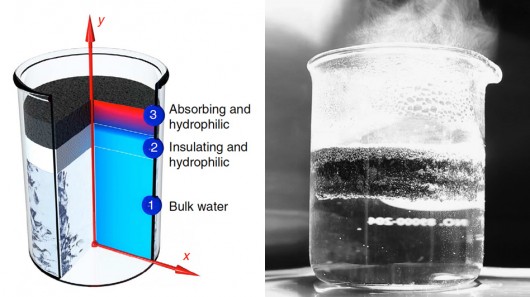
Scientist from the MIT’s Department of Mechanical Engineering report that they have found a way to make a sponge similar substance that is useful for transforming water into steam with the help of sun rays one-hundredth as bright as that requested by classic steam-producing solar power plants. Made of graphite flakes layered on a bed of carbon, the new substance is said to transform 85% of the harvested solar power into steam.

From the practical point of view, researchers believe that the graphite flakes and carbon foam combination they made can insulate a material structure that can float on water. They have developed several experiments and believe they discovered a method to raise the heat withholding properties in the upper layer by expanding its volume. They experimented this in a microwave. The outcome is exceedingly permeable top layer able increase absorption and withholding of solar energy.

The layer on the bottom is designed from carbon and it contains hundreds of tiny pockets of air that helps the material floating, and meanwhile it is insulating in order to prevent the heat from going out. The essential fact is that for the steam generation, the foam is also perforated with small pores the give permission to the water to go back up.

So, when the light from the sun illuminates and heats the material it gives pressure to the foam and air and helps the water to get pass the carbon and go into the graphite layer. As this takes place, the heat on the materials turn water into steam. As a result, if the light is more intense, the quantity of water absorbed is higher and more steam is generated.

“Steam is important for desalination, hygiene systems, and sterilization,” says Hadi Ghasemi, a postdoctoral MIT student who ran the material development. “Especially in remote areas where the sun is the only source of energy, if you can generate steam with solar energy, it would be very useful.”

Scientists also say that the sponge-like material can be made from cheaper material and can be the beginning of a new type of compact, steam-powered applications, especially as this method gives a significant improvement over classic solar-powered steam generation methods.

Nevada hosts the largest solar power plant

World's lagest solar thermal project is completed

The biggest solar power plant is in Nevada

The solar industry  has found a way to make the Mojave Desert a place that people could benefit from with the help of hundreds of thousands of panels. These panels helped to reach a milestone in the industry as the Ivanpah Solar Electric Generating System represents the largest solar thermal power project in the world.

The project is now officially generating solar electricity for Californian users. The 450 high towers gathering produce enough green energy to be delivered to 140,000 houses. Moreover, this way the emission of 400,000 metric tons of carbon dioxide per year is avoided, the equivalent of the disappearance of 72, 000 cars.

A project this big, spread on 5 square miles of land in California couldn’t have been accomplished without a well-defined team work of NRG, Google and BrightSource Energy. The investment was not a small one either as the project stands for $2.2 billion dollars. Still, the project meant a boost in the economic field of the area as thousands of jobs were created. 3,000 site workers were employed and they completed more than 8.35 million man-hours. Nearly $650 million in salaries were paid and more will be paid over the next years.

The West American power plant project was supported by President Barack Obama that aims to put an end the country’s coal dependence and build a cleaner, greener country supported by solar power, nuclear energy and natural gas.

The president of NRG Solar, Tom Doyle, believes that “Cleantech innovations such as Ivanpah are critical to establishing America’s leadership in large-scale, clean-energy technology that will keep our economy globally competitive over the next several decades.”

An EU report with worldwide restrictions does not mention Chinese solar manufactures

EU_report_on_China_subsidy

None of the Chinese solar manufacturers are mentioned in the almost 200 page report. Taking care of the green energy industry from 2011 onwards is the closest form of criticism in the report.

The EU has an ongoing anti-subsidy investigation related to Chinese solar projects, but a report made by the European Commission’s directorate-general for trade into restrictive trade measures worldwide does not mention explicitly any pleas for the Chinese government who has dishonest subsidies for its solar manufacturers.

The Tenth EU report on potentially possibly prohibitory trade measures was made before the G20 summit of world leaders in St Petersburg, Russia.

The almost 200-page report shows some possibilities of maybe restrictive measures that include also ‘behind-the-border’ restrictions such as measures “to stimulate domestic industry or exports at the expense of competing foreign economic players.”

Inceptive measures condemned hold subsidized interest rates about export credits in India, US$1.5bn of state grants by the G20’s Russian host for luxury goods retailers, preferential government loans and insurance for South Korean retailers and a JPY200bn (US$2bn) Japanese subsidy to cover up to half the costs of retail firms. Still, China is noticeable by absenting from the recap of displayed stimulus measures applied this year until May 31.

The closest approach of the EU to the mentioning of the pleas by solar manufacturers of subsidized loans from Chinese-state-owned banks is in a mention of China’s 12th five-year plan – to govern industrial policy from 2011 to 2015 – that reported an intention to take care of seven strategic industries that ‘green energy.’

EU journal gives details on the trade case

There was a settlement in the Eu-China trade

The EC published details of the China trade, some questions are still unanswered.

The trade dispute over Chinese modules and cells regarding the minimum import price was approved on Friday. Still, some questions have not been answered.

Some details about the EC’s trade dispute have been published in the 6th of August edition of the Official Journal. The EU reported that it agreed with the compromise.

The decision reveals details about the way that the negotiation lead to a minimum price for the freely imported PV. The first step the commission took was to verify whether a minimum price could be associated with the indexes of some commodities. PV modules do not permit an easy correlation between the commodity prices and retail prices. It is implied the the EC used indexes compiled by Bloomberg and pvXchange.

The Commission says the following aboutthe impact of the minimum prices: “In order to assess whether that price undertaking removes the injurious effect of dumping, the Commission has analysed, inter alia, the current export prices and the level of provisional duty. On that basis, it was concluded that the price undertaking removes the injurious effect of dumping.”

However details about the specific minimum prices will nor be revealed. But, accordind to the media reports the price range is between €0.56 and €0.57 per watt with the ceiling on imports from China set at 7 GW.

The pertinent questions the have not been answered are:
-Imports of participating companies will reflect current annual levels. But what is the correct annual level in such a fast changing market?
-What happens if the targeted annual level is exceeded, and how will individual producers, in this context, be coordinated?
-Price indexes compiled by Bloomberg and pvXchange were used for the negotiated minimum price. The document does not explain how changes in the minimum price will be negotiated.

-How will modules be treated that are not manufactured in China nor the EU, but that contain Chinese cells?

Roxana Moraru