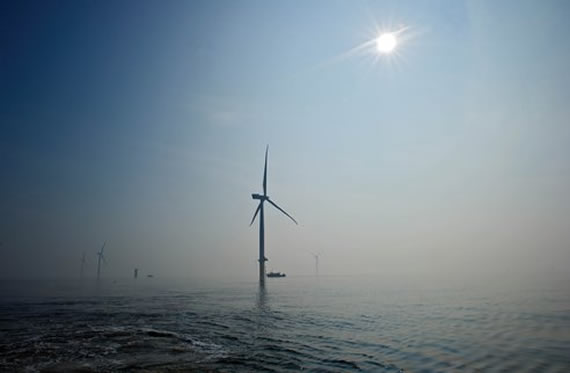
European Investment Bank finances EnBW Baltic 2 wind farm

EnBW Baltic 2 is being developed by German company EnBW Erneuerbare Energien GmbH and the funding deal was signed this week in Karlsruhe.

The wind farm consists of 80 wind turbines installed within an area of 27 square kilometres, 32 km north of the island of Rügen. This is a particularly demanding location for an offshore wind farm because the sea in this area can be as much as 44 metres deep in some places requiring the use of special foundation structures called ‘jackets’.

Nevertheless, EnBW Baltic 2 has a capacity of some 288 megawatts and will generate an annual output of 1.2 billion kWh, enough to supply 340,000 households while achieving emissions savings of around 900,000 tonnes of carbon.

“Demanding projects are required so that Germany can implement its ambitious energy aims” said Wilhelm Molterer, the Vice President of the European Investment Bank.

“EnBW Baltic 2 sets standards. It will be exemplary for future projects of this magnitude. With the financing that has now been agreed, it will be possible to implement the extensive project quickly and make a decisive contribution to the success of the energy transition.”

The turbines used in the project are Siemens SWT-3,6-120, 39 of them erected on monopoles with another 41 using jackets.

“The commitment of EIB to a project like EnBW Baltic 2 makes a very essential contribution towards the energy transition” said Thomas Kusterer, the Financial Chairman of EnBW Energie Baden-Württemberg AG. “Participation of the EIB in such projects represents a decisive element in structuring and financing.”

600 MW wind farm in Romania finalised

The final wind turbine for Fantanele/Cogealac wind farm in Romania was connected to the regional grid in late November.

CEZ Group´s 600 MW wind farm thus is now in full operation and is producing enough cleaner energy to power more than one million Romanian households each year. The project utilizes 240 GE 2.5 MW wind turbines, including the 1,000th 2.5 MW class machine installed by GE worldwide.

The new wind park is located in Dobrogea, Constanta County, which is one of the most promising wind power regions in Romania. The individual wind turbine components for the Fantanele/Cogealac wind farm were produced all over the world. The turbine nacelles were supplied from GE’s facility in Germany. The rotor blades and towers came – apart from Germany – from Brazil, the Czech Republic, Denmark, Poland and China.

The size of the components – one rotor blade measures nearly 50 m in length – and the number of units required comprehensive planning. Twelve modes of transportationwere needed to move all of the components for each wind turbine from the port of Constanta on the Black Sea to the project construction site. At peak times, 25 cranes were in action at once at one of the largest building sites in Europe.

The project owner, CEZ Romania, is part of CEZ Group, the largest utility in Central Europe. “We chose GE because of its proven technology and the extensive experience of its project teams. The 2.5 MW technology offers the efficiency, availability and energy performance that will safeguard our success,” said Ondřej Šafář, CEZ project manager. “Thanks to the Fantanele-Cogealac wind farm, CEZ is making a major contribution to increasing Romania’s renewable energy generation. Before this project, Romania’s installed wind capacity was only 14 megawatts.”

GE sells 230 turbines to Renova Energia

GE and Renova Energia, a wind developer leader in Brazil with 1 GW installed, have signed a contract worth US$ 394 million for 230 GE 1.68-82.5 wind turbines.

All 230 turbines have a 10-year operating contract, which will be managed from GE’s services centre.The purchase is part of Renova’s expansion plans that began in November 2011 with the construction of the Alto Sertão 2 Wind Farm, comprising 15 parks with a total installed capacity of 386 MW.

The contract is to supply energy sold by Renova in the Reserve Energy Auctions (LER) in 2010 and 2011. The Alto Sertão 2 Wind Farm is in the cities of Caetité, Guanambim and Igaporã, in the southeast of Bahia state, in Brazil.

“Scale and efficiency are increasingly important factors in the wind power segment and they have created a new scenario, which is more complex and which requires internationally recognised partners such as GE,” says Luiz Freitas, Legal and Purchasing Director at Renova. “This contract is the result of the value generated by a joint Renova and GE team in the pursuit of the state of the art in wind power technology in Bahia.”

The partnership between the two companies began in Brazil’s first exclusively wind energy auction in December 2009. “Renova built the largest wind farm in and we are proud to take part in this project and to help boost wind power generation in Bahia,” says Jean-Claude Robert, leader of GE’s Renewable Energy business in Latin America.

The farm, opened in July 2012, has 184 GE wind turbines producing a total of 294 MW.

Wind power is growing in Italy

The installation of small wind turbines is growing rapidly in Italy since the introduction of feed-in tariffs.

Since the introduction of feed-in tariffs for small wind turbines in 2008, installations have grown exponentially, says the University’s Wind Energy Report. Yet installed capacity of small wind turbines doubled from 2008 to 2009 and again in 2010 and 2011.

More than 90 % of the small wind turbines are less than 80 kW in size. 70 % of the capacity is installed in the southern provinces, 25 % in the central region, and only 5 % in the mountainous north.

Up to 10 MW may be installed in 2012, says the report. Nevertheless, in absolute terms, installed capacity of small wind turbines in Italy remains a fraction of that of commercial-scale turbines. By the end of 2011 cumulative capacity of small wind turbines in Italy was 13 MW – 2 % of the 6,700 MW of wind generating capacity in the country.

Italian feed-in tariffs for small wind turbines are quite lucrative, effectively double that of total payments for commercial wind under Italy’s Green Certificate (Certificati Verdi) system. Yet, Italian small wind tariffs are comparable to those in Britain, e.g. new tariffs go into effect at the end of the year.

Italy will differentiate small wind into two size tranches: <20 kW, and 20 kW to 200 kW. While the tariffs have been cut modestly, the contract term has been extended from 15 years to 20 years.

According to the University’s Wind Energy Report, 3 % of Italy’s land area has average wind speeds of greater than 6 m/s or good to excellent wind, 37 % has average wind speeds from 4 m/s to 6 m/s or sites with good wind. The report quotes the Italian wind energy association (Associazone Nazionale Energia del Vento), that Italy has the potential for 1,000 MW of small wind turbines capable of generating 1.5 to 2 TWh per year.

Vestas and Mitsubishi can become partners on world’s largest offshore turbine

Vestas Wind Systems A/S and Mitsubishi Heavy Industries Ltd. are in talks which could lead to them building the world’s largest offshore wind turbine.

The report by Stefan Nicola and Gelu Sulugiuc says the envisioned 8 MW turbine would be about 30 percent more powerful than the prevailing market leaders.

The report comes just hours after Vestas, the world’s largest manufacturer of wind turbines, announced it had received €900 million (About $1.17 billion) in financing from nine international banks.The financing period extends through 2015.

The funding should also help shore up its competition with rival Siemens AG, which has been regularly announcing deals for turbines with offshore wind farm developers in Denmark, Germany and the United Kingdom.

Bloomberg reports that Siemens is currently testing a 6 MW turbine, and quotes a company spokeswoman as saying a 10 MW turbine may be in the offing.

Samsung opens Korea’s first offshore wind farm

Samsung has been leading the world of technology and has turned into one of the world’s largest consumer electronics giants lately.

The Samsung Heavy Industries has now moved towards the greener horizon and has announced plans for an 84-megawatt offshore wind farm. This will be Korea’s first and will be built jointly with Korea Southern Power Co in Jeju Island.

To be built with a depth of about 30 meters and 2 kilometers away from the coast of Daejeong-eup in Seoguipo in Jeju Island, Samsung plans to have this one up and running by 2015. The wind farm will generate enough energy to power up 100,000 households with clean and green juice.

The world’s largest wind farm, London Array

The world’s largest wind-farm, the London Array has finally begun generating energy.

Located in the Thames Estuary, the project will be worth 630 MW when completed. Currently, just 15 of the total 175 turbines have been installed, with the rest being set up.

The remaining turbines are expected to be constructed by the end of this year.

Once completed entirely, the London Array will generate enough juice to power nearly 470,000 UK homes. And this is just the first phase.

The second phase of the project will increase the capacity to 870 MW, slightly off the previously planned 1 GW capacity.

Warrant Buffet’s MidAmerican purchases two wind-farms

Warrant Buffet’s MidAmerican purchases two wind-farms capable of generating 300 megawatts.

American business magnate, investor, and philanthropist better known as the “Wizard of Omaha”, Warren Buffet has now shown his greener side. The billionaire’s Berkshire Hathaway’s subsidiary, MidAmerican, has recently purchased to massive wind farms in California.

Generating a total of 300 megawatts of electricity, these wind farms will be part of the Wind Energy Center located in Tehachapi. The energy generated will be sold to Southern California Edison as part of a long-term power purchase agreement.

That apart, the project is expected to generate just about enough energy to power up nearly 80,000 American homes.

Also, the move could help Warren Buffet offset the pollution his coal trains have been spewing in the environment!

The European Union has passed the milestone of 100 GW

EU reaches 100 GW wind power milestone.

It took the European wind energy sector some twenty years to get the first 10 GW grid connected. It needed 13 years to add an additional 90 GW. And half of the actual total European wind power capacity has been installed over the past six years.

100 GW of wind power can generate electricity over a year to meet the total consumption of 57 million households, equivalent to the power production of 39 nuclear power plants, 52 gas power plants or 62 coal power plants. Or: “It would require burning 72 million tons of coal annually in coal fired power plants to match Europe’s annual wind energy production. Loading that amount of coal on trains would require 750,000 wagons with a combined length of 11,500 kilometres – the distance from Brussels to Buenos Aires, Argentina,” said Christian Kjaer, CEO of EWEA.

“Despite only utilising a tiny fraction of Europe’s vast domestic wind energy resources, wind power is having a substantial impact on Europe’s energy security and environment, and benefits us hugely in creating green jobs and technology exports”, he added.

Google Purchases 48 MW of Wind Power

Google Purchases 48 MW of Wind Power for Its Oklahoma Data Center.

That’s a very large amount of electricity, enough to power a small city.The recent announcement shows that with a forward-thinking approach, large companies can make significant contributions to the transition to a renewable energy economy.

“To power its Oklahoma data centre – one of the facilities responsible for bringing you your Gmail, Docs, and Google search results – Google faced a local electricity mix of over 50% coal power,” Greenpeace writes. “But as one of the major electricity customers in the state, Google worked with the local utility to secure a new supply of renewable wind energy.”

Google’s decision to source the electricity for its data center entirely from renewable energy should send a message to other large “internet companies and electric utilities around the world that renewable energy is not only possible, but is simply smart business in the 21st-century economy,” Greenpeace adds.