Harvard comes with a new type of battery for cheaper Energy Storage

Storing energy can be cheaper

Hardvard researchers discovered a cheaper way to store energy

There is always a good news when someone announces that renewable energy could be cheaper.

The last institution that gave this news is Harvard University that says they invented a new “flow battery” that can find its utility in large-scales, such as within electricity grids, for storing intermittent renewable energy from green sources such as wind and solar. The research describing the new “metal free organic-inorganic aqueous flow battery”, was released in the journal Nature on 9 January.

The Harvard researchers report that for the creation of this battery they made use of a previously unnoticed group of organic compounds named quinones. They have many advantages and the main one is that they can help with the production of cheap batteries that are able to charge and discharge green energy quicker than available batteries can do it.

Those who made the investigation possible say that it can functions as good as the batteries that already exist and are made of way more expensive metals. The new invented battery doesn’t use a precious metal catalyst, but it has a metal free underlying chemistry that uses the naturally abundant quinones.

Quinones are water-soluble compounds that are able to store energy in plants and animals. They can be found in every green vegetable, and the molecule used by the researchers is almost identical to the one in rhubarb. Quinones are naturally abundant and water-soluble, large, inexpensive tanks could replace the traditional and more expensive solid-state batteries.

This is good news for the green world and a renewable energy expands it is crucial that inexpensive, large-scale renewable energy storage will develop.

UK wind farm subsidies are to be cut off by Europe

Europe will oblige UK to cut wind power subsidies

U.K will cut off wind energy subsidies

The European Commission is going to request the British country to put an end to wind farm subsidies.

Ministers have been told that the present degree of state support for renewable energy sources have to be eliminated until 2020. Moreover, solar energy is not escaping either, as taxpayer support will also be phased out.

The European Commission that supervises the European single market is ready to try and convince that onshore wind in UK and solar power industries are developed enough to function even if taxpayers do not contribute.

A Government source announced that European officials have privately ordered ministers that they have to lower public support for onshore wind and solar generators.

Even if Conservative ministers don’t always agree with the Commission’s sometimes criticize the EC for its intervention in domestic matters, they are understood to be keen to cooperate in the case of renewable energy subsidies. A Conservative minister’s words are: “It’s absurd that taxpayers are being made to subsidies wind technology.”

The operators of onshore wind turbines get subsidies that make the power they generate more expensive. Ministers begun to cut off those subsidies, reducing tariffs that are applied to household bills and withering guaranteed prices for onshore wind. But the EC is pressuring him Coalition to impose a less supportive system for onshore wind and solar power. This new regime will take care of the fact that there will be a competition between wind farm operators and that there will be a share of a reduced pool of public subsidies.

The Energy Secretary, Ed Davey, announced that onshore wind and solar farm developers would be obliged to compete to secure government subsidies. The commission will announce the results of a review of support for renewable energy this month.
Although UK is happy with this cut off, other EU states do not want to reduce public support for renewables.

The EU’s climate action commissioner, Connie Hedegaard , said “One of the things Europe has to do better is how we subsidies renewables. That is why the commission is reviewing state aid guidelines for energy, including renewables. My view is that if you have mature technologies, renewables or not, they should not have state aid. If they can manage themselves why have state aid?”


President Obama demands federal buildings to rise clean energy use

U.S government to triple the use of green energy until 2020

Obama oreders federal agencies to triple the use of renewable

Obama announced that the U.S government must be an example for the people and he set a goal for all 500,000 federal buildings and ordered them to use three times more clean energy until 2020.

The U.S. government has been obliged to set an example for everybody and use 20% more renewable energy, as the President of the country announces.

Barack Obama asked the federal government to rise up their use of green energy and to reach a 2020 target of 20% renewable energy use.

As part of his decision to minimize the U.S dependence of fossil fuels, the President signed a memorandum Thursday stating that a greener future would also help minimizing pollution, put climate change on hold, and last but not least, promote American energy independence and boost domestic employment opportunities regarding solar and wind energy.

“In order to create a clean energy economy that will increase our nation’s prosperity, promote energy security, combat climate change, protect the interests of taxpayers, and safeguard the health of our environment, the federal government must lead by example,” are Obama’s word in the memorandum.

“During my administration, federal agencies have reduced their annual greenhouse gas emissions by more than 15% (7.8 million metric tons) – the equivalent of removing 1.5 million cars from the road. Today I am establishing new goals for renewable energy as well as new energy-management practices.”

The federal government occupies more than 500,000 buildings and uses about 600,000 vehicles in the U.S.A. Moreover, it also consuming goods of $500 billion every year meaning that any progress regarding a more renewable future made by the government it is possible to be felt heavily.

New photovoltaic plants are going to give energy in Romania

The Colibasi plant brings up PV energy in Romania

Romania solar potential is building up

The energy supplier, Enel Green Power has connected to the  PV plant situated in Colibaşi, located south-eastern Romanian county of Giurgiu, to the grid.

More capacity was accepted to the grid by Romania during this week when Rome-based Enel Green Power wired its 6.5 MW Colibasi PV plant.

This plant is situated in the south-east of the country, in Giurgiu county to be precise, and it is said to be responsible for generating nearly eight million kWh of power per year. This supply is said to be able to provide green energy for 7,000 Romanian households and minimize carbon emissions in the region by as much as 4,000 tones each and every year.

The plant from Colibaşi is the third solar installation in Romania from Enel Green Power, an institution that now has have 26 MW of solar PV capacity in the country. The other two Photovoltaic plants owned by them are Berceni 1 and Berceni 2.

Still, the company manages to go all the way until its solar output matches the 498 MW wind capacity they currently boast in the country.

As a recent IHS reports shows, Romania is said to be situated within the fastest-growing solar markets in Europe, considering the 175.5 of solar power available since the first half of 2013 and the 2.7 GW about to be installed in the next couple of years.

EIB will help Indian renewable energy project by loaning EUR 80 million


EIB loans India  €80 milion for renewable pojects

India gets a €80 milion loan for renewable energy

The European Investment Bank (EIB), helped Italian export credit agency SACE S.p.A, signs EUR 40 million loans as first instalment to SREI Infrastructure Finance Limited (SREI) for financing green energy programs in India.

The EIB and Italy’s SACE S.p.A signed a €40 million long-term loan agreement with India’s SREI for helping with the finance of some investments which have the role of mitigating climate changes in the country.

This triplet cooperation is the first movement within an €80 million pledge and it was created to promote Italian exports, help with India’s renewable energy objectives and benefit economies in the European Union.

Some parts of the loan is dedicated to renewable energy projects in India, that are mostly under the wing of private sector companies. To be precise, the loan will help electricity and heat generation schemes, meaning photovoltaic energy and wind power.

The loan is a bid made by all the parts to help India with it’s struggle for environmentally sustainable power. Moreover, it will help stimulate portions of the Indian economy although there is a development of domestic energy resources, improved energy efficiency and a reduction in airborne pollutants and carbon emissions.

This loan is a part of the EIB’s largest nergy Sustainability and Security of Supply Facility (ESF) fund, that has, until now contributed with more that €4.9 billion regarding a long term investments programs in the Asian continent, and €2.2 billion of that has been ploughed into the energy sector.


The solar development in Japan may be limited by the gird capacity

Japan lacks grid capacity

Japan could have problems with the grid capacity

The southern Japanese may have less than 1 GW of grid capacity left for upcoming solar and wind projects. This statement results from the new analysis from Bloomberg New Energy Finance (BNEF).

“Grid congestion” appears to be an important layoff in going on with the renewable energy market, in Japan’s blooming solar industry. Still, in the north of the country, on the island of Hokkaido, there is a well know shortage of grid capacity, and now the new BNEF report says that related issues may appear in the south of the country also.

Although a 22.4 GW of new green energy capacity have been accepted as part of the FIT program that emerged in last year’s July, BNEF analysis reports that the Chugoku Electric Power Co. and Kyushu Electric Power Co. posses a little under of 1 GW of accessible grid capacity in the south of the country.

BNEF also shows that the report reveals an estimated grid capacity of 34 GW as being usable for upcoming wind projects all over the country.

The rehabilitation of Japan’s energy market are on going at this moment and Bloomberg is announcing that a bill is said to be introduced into Japan’s parliament in the fall. BNEF believes that a free trade could bring grid development.

Japan’s utility market continues to be partially closed having regional monopolies as a feature. These monopolies have been under pressure since the Fukushima Daiichi nuclear power plant disaster in 2011.

Telecommunications entrepreneur Masayoshi Son, the billionaire Chairman and CEO of Softbank Corp., has been involved in marching for increased electricity market reregulation. Softbank is already known as being active in expanding photovoltaic projects in the country.

Roxana MORARU

Using Solar Energy to Create Wind Power

solar_energyA new type of wind power plant is in the works, and it is claimed to be able to produce clean energy from the sun and the wind with virtually no carbon footprint, fuel consumption, or waste production.

And not only that, it purportedly uses heat from the sun to produce its own wind, which would make this new type of plant desirable in areas with low or inconsistent winds.

The Clean Wind Energy Downdraft Tower is a skyscraper-sized hollow cylinder that uses the natural downdraft tendencies of air by spraying water (as a fine mist) across the top opening of the tower to cool the hot dry incoming air. As the water evaporates and cools the air, it becomes denser and heavier than the outside air, and then falls through the tower at speeds up to (and above) 50 mph. Once the faster moving air reaches the bottom of the tower, it is channeled through wind turbines in the base of the tower, generating electricity.

In addition, if the Tower is located in areas conducive to direct wind harvesting, the exterior of the Tower could be covered with “vertical wind vanes” to help  capture prevailing winds to produce supplemental power.

“One tower is equivalent is to at least one nuclear power plant. But here’s the big difference of course. You don’t have nuclear issues, you don’t have the safety issues, you don’t have spent nuclear rods, you don’t have the storage issue. These towers apparently they last forever. All you’re using is water, evaporation, wind gradients and presto! You do have the energy that’s produced through turbines and generators. So what we’re talking about is water and wind at free will.” – George Elliott, scientist and consultant for the Wind Energy Tower.

Clean Wind Energy, Inc. (soon to Solar Wind Energy Tower, Inc.), also plans to build a pair of demo towers, up to 2,250 feet tall, near Yuma Arizona, potentially powering up to 1.6 million homes in California and Arizona.

“The first Tower in Arizona has a projected output capacity, on an hourly basis, of up to 1000 megawatt hours, gross. Using a 70% capacity factor the Tower’s potential hourly yield would be 700 megawatt hours from which, approximately 17% will be used to power its operations, yielding approximately 600 megawatt hours available for sale to the power grid.” – Clean Wind Energy, Inc.

Japan planning world’s largest offshore wind farm

Nearly two years after a massive offshore earthquake and the tsunami which devastated the Fukushima Daiichi nuclear reactor and the mostly agricultural communities that surrounded it, the Japanese Agency for Natural Resources and Energy has unveiled plans to build the world’s largest offshore wind farm adjacent to the disaster zone.

The initiative comes part of a plan to reconstruct the area stricken by the disaster in March 2011.

By 2020, the government said, a total of 143 wind turbines on platforms 16 kilometres off the coast of Fukushima. The wind farm will generate 1 GW of power once completed, officials said.

Following the disaster at the Fukushima plant, all 54 of Japan’s reactors were shut down, and only two have been brought back online in the 21 months since as the government has tried to move closer to fulfilling its pledge to increase the use of renewable energy across the nation.

Among the unique features of the plan is Japan’s intention to rely on massive floating turbines which will be stabilised with ballast and anchored to the 200-metre-deep continental shelf that surrounds the Japanese coast via mooring lines, according to an analysis of the project by New Scientist.

The magazine also reported the wind farm will supply electricity to the powerful grid which Fukushima’s two nuclear power plants were connected to, reducing transmission costs.

The project is being overseen by Takeshi Ishihara of the University of Tokyo.

Wind Powered Battery Storage Pilots in Texas

Duke Energy Renewables has developed a way of saving extra power generated by batteries at its Notrees Windpower Project in Texas.

The $44 million battery-storage system holds excess energy from the 153-megawatt Notrees farm and releases it when power supplies dip. This innovation is particularly helpful because winds often blow more strongly at night, when power needs are less, and more gently during the day, when power demands are higher.

With this battery storage system, wind generated power can be kept and used, as and when needed, thus stablising the grid. Data from the project is being collected and analysed for scale-up by the US Department of Energy, who helped fund Duke Energy Renewables’ wind power, storage battery.

France starts the second offshore round

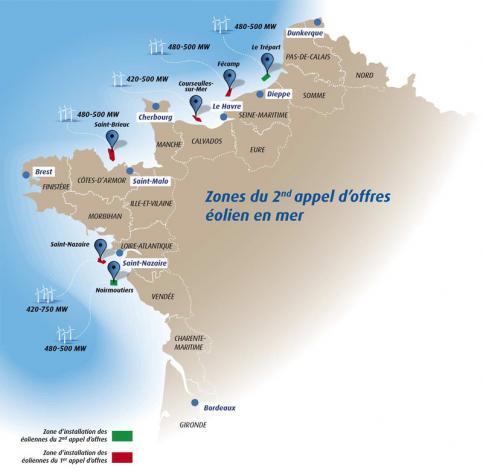
On 8 January, the French government declared the second bidding round for offshore wind farms off the French coast. This time a total of 1,000 MW are up for tender, divided into two farms.

These are the sites Le Tréport in the English Channel and the newly added area Noirmoutier south of the Saint-Nazaire project in the Atlantic, which were left empty-handed in the first bidding round. In both areas, there will be between 480 and 500 MW generated.

France expects investments of approximately 3.5 billion € through the projects for tender and to create 10,000 promising jobs through industrial development of this sector. The costs for the public will amount to 500 million € per year.

In the first round of bidding, approximately 2,000 MW were contracted at the beginning of 2012. That capacity is divided into four projects. The area Le Tréport was already tendered at the time. However, GDF Suez was the sole bidder – and was turned down by the French government due to the high price. To prevent this from happening in the second round, the price of the projects will gain more relevance. Overpriced offers will be excluded immediately.

In March, the second bidding round will open officially; applications must be submitted by September. The French government will award the contracts by January 2014.