How is the world’s first solar powered airport faring?

solar-powered-airport

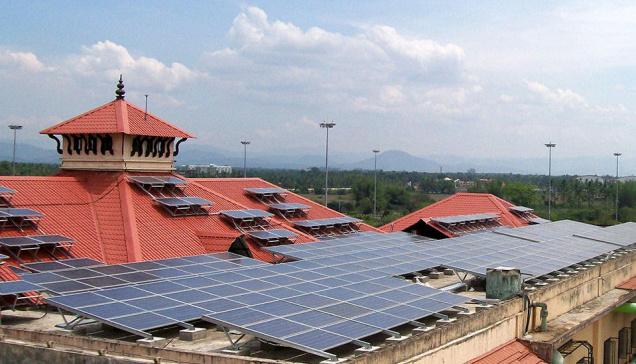
Cochin International Airport. Image via thehindubusinessline.com

As an airplane hovers over Cochin International Airport, one is struck by the dazzling array of reflective panels near the runway.

Standing out in a field of green are more than 46,000 solar panels tapping the power of the bright sunlight and converting it into energy.

Located in the southern state of Kerala, Cochin is now the first airport in the world to run completely on solar power.

According to BBC News, the airport started with a small pilot project by installing a solar energy plant with 400 panels on its rooftop in 2013. When that experiment succeeded, it decided to go all the way.

In August this year, the airport became totally self sufficient in meeting its energy needs after it installed a 12 megawatt solar plant close to the cargo terminal.

The airport’s managing director VJ Kurian says it was the huge power bills that prompted them to look at greener solutions.

Challenge

The airport, which is the seventh busiest in India handling more than 1,000 flights a week, consumes nearly 48,000 units costing 336,000 rupees ($5,160; £3,364) every day.

Today, with its solar power plant it produces more energy than it needs and banks the rest with the state power grid for rainy days and night-time requirements.

Mr Kurian says airports across the country have approached him to learn more about the “Cochin model”. A team from Liberia is also interested to learn more about harnessing the sun’s energy.

The installation of the solar plant cost nearly $9.5m (£6.27m) and took around six months to complete. The company is hopeful of recouping the costs in less than six years. So far it has been a smooth journey for the airport, says Mr Kurian.

The challenge though is just around the corner.

The airport is looking to inaugurate a new international wing in January comprising nearly 1.5m sq ft which will require more energy than what the existing plant is generating.

Additional solar panels will have to be set up if the authorities wants to hang onto the “first fully solar powered airport” tag.

Cochin may have shown the way forward but the rest of India is not far behind in tapping the vast potential of the sun. As most parts of the country receive sunshine for over 300 days a year, the possibilities are plenty.

Recognising this, Prime Minister Narendra Modi has outlined his vision of increasing the country’s solar power capacity to 100,000 megawatts by 2022.

This is a dream that can be realised by having photovoltaic panels on the rooftop of every home in India, generating enough power to reduce the country’s massive fuel bill and dependence on fossil fuels.

Solar energy is also a much cleaner source of energy than conventional forms of energy like thermal and nuclear. Considering the global debate on climate change, developing economies like India with its ever increasing need for energy to fuel growth can turn to the sun to power ahead.

Concerns

But it is not a simple process, despite the presence of abundant sunshine.

As Ashish Khanna, chief of Tata Power Solar points out, “We don’t have the [electricity] grid stability which can take the kind of power we are talking about. Also the quality of power is important.”

“We in India are very cost conscious and when we are talking about rooftop power, people may take decisions involving inexpensive pieces of equipment that may not contribute to the kind of quality we are talking about. The challenge right now is that there are no standards in place.”

Meanwhile, the solar plant at Cochin airport will produce 18 million units of power from the sun annually which is enough to meet the energy needs of 10,000 homes for one year.

The bonus is the environmental benefit of reducing carbon dioxide emissions by more than 300,000 metric tonnes which is equal to planting three million trees or not driving 750 million miles.

In a country where more than 300 million people still have no access to power, going solar may just be the solution that is needed to light up their lives.

September – a great month for wind and solar energy in Scotland

scotland solar panels and wind turbine

Wind and solar power in Scotland. Image via c1cleantechnicacom.wpengine.netdna-cdn.com

According to a WWF Scotland analysis, wind energy capacity in the country generated enough electricity to power all Scottish homes on five out of the 30 days of September.

Based on wind and solar electricity data provided by WeatherEnergy, WWF Scotland says wind turbines generated 563,835MWh of electricity, an increase of 82% compared to September 2014. Wind power alone generated around 28% of Scotland’s electricity needs for the month.

” Given the big jump in renewables output during September it’s very likely we’ll be breaking even more records this year,” said WWF Scotland’s director, Lang Banks.

According to energymatters.com, for homes with solar panels installed, there was enough sunshine to generate an estimated 65- 70% or more of the electricity needs of an average household in some of Scotland’s regions.

“Despite being well in to autumn, for the tens of thousands of homes that have installed solar panels to generate electricity or heat water, around three-fifths of their electricity or hot water needs could have been met by the sun during the month. This all helped Scotland to further reduce its reliance on polluting fossil fuels during September,” said Mr. Banks.

WeatherEnergy says as the country moves toward winter, solar output will drop off to a degree, but wind power output will start to ramp up.

In November last year, wind power generated 126% of the electricity needs of every home in Scotland. 2014 was the first time clean energy produced more power in Scotland than nuclear, coal or gas.

Scotland has set a target to generate the equivalent of 100 per cent of its gross annual electricity demand by 2020 – a goal it appears it will have no problems in reaching. Just in practical offshore renewables resources, the country has an estimated 206 GW capacity potential.

At the end Q3 2014, 7,112 megawatts of renewable electricity capacity was installed in Scotland, an increase of 10.5% from the end of the second quarter in 2013.

Last week it was reported Scotland surpassed its target of generating 500 MW of locally and community owned renewable energy five years ahead of schedule.

Scotland’s renewable energy sector is also a major employer, supporting more than 11,000 jobs (January 2014).

Broken Hill mega-plant solar panels lift the roof

solar plant

The Broken Hill plant will work in conjunction with the AGL solar plant in Nyngan in NSW. Image via theaustralian.com.au

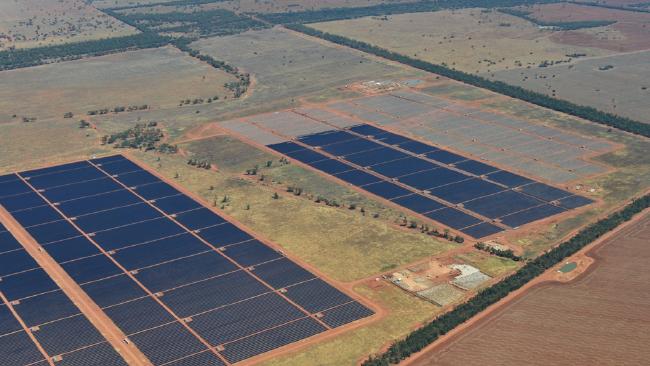
The final panels on the biggest solar power station in the southern hemisphere will be installed at Broken Hill this week, paving the way for the plant to be fully operational by year’s end.

The 53-megawatt solar plant, a partnership between AGL and First Solar, will work in conjunction with the 102MW Nyngan solar plant to produce enough electricity to power about 50,000 average Australian homes. The Nyngan plant began operating six months ago.

“There is a real sense of momentum driving large-scale solar in Australia today,’’ Australian Renewable Energy Agency acting chief executive Ian Kay said.

According to The Australian, The large-scale solar plant begins operation as more than 1.4 million households in Australia have solar panels on their roofs, providing the highest penetration at the household level in the world.

However, the government is trying to drive more solar uptake at the commercial level as part of the 23.5 per cent renewable energy target.

Environment Minister Greg Hunt has set a priority of increasing the uptake of utility- scale solar as part of the government’s renewable energy mix.

The government through ARENA had provided $166.7 million towards the $440m AGL Solar Project.

“As well as powering Australian homes with renewable energy, this project is also assisting AGL to transition towards a decarbonised economy. It’s a win-win scenario,’’ Mr Hunt said.

Mr Kay said there was $350m available through ARENA and the Clean Energy Finance Corporation to further accelerate growth in the sector.

ARENA has a $100m large-scale solar round that could double the capacity of large-scale solar.

AGL executive general manager group operations Doug Jackson said the Broken Hill Solar Plant was already generating up to 27MW of renewable energy into the grid and the remaining 26MW was expected to be brought online this month.

First Solar’s regional manager for the Asia Pacific, Jack Kay, said the project combined industry-leading thin film modules and construction techniques.

He said the Broken Hill plant contained 677,760 of First Solar’s advanced PV modules. The Cadmium Telluride modules offered significant efficiency and reliability advantages over typical crystalline silicon modules, Mr Curtis said.

Solar module efficiency: Panasonic says they topped SolarCity at 22.5%

panasonic solar panels

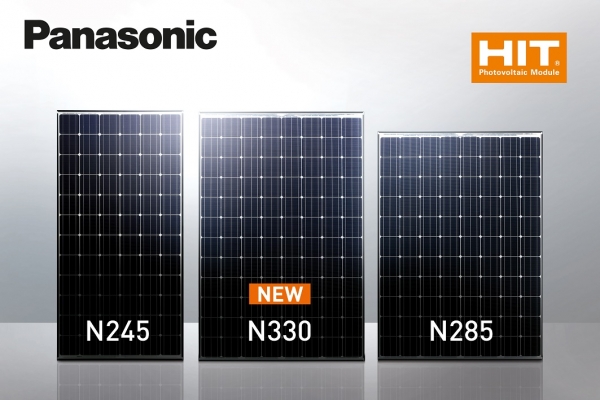
Panasonic’s new N330 module will be on show at SEUK next week, alongside the company’s record-setting prototype. Image: Panasonic.

Panasonic claims to have toppled a world record for module efficiency announced a few days ago by SolarCity and will be demonstrating the new module at next week’s Solar Energy UK exhibition organised by PV Tech’s publisher, Solar Media.

Last Friday SolarCity announced it had recorded 22.04% efficiency in a rooftop module from its pilot line, however this morning Panasonic has revealed its recorded module conversion efficiency of 22.5% on a commercial-sized prototype module, verified by the Japanese National Institute of Advanced Industrial Science and Technology.

According to pv-tech.org, Panasonic said the new record built on cell-level efficiencies of 25.6% recorded last year. “The new panel efficiency record demonstrates once again Panasonic’s proven leadership in photovoltaics and our ongoing commitment to move the needle in advanced solar technology,” said Daniel Roca, senior business developer at Panasonic Eco Solutions Europe.

The technology manufacturer has also announced the launch of its new HIT N330 module, a 96-cell, 330W panel which features 19.7% module-level efficiency and claims to deliver 27% more peak power compared to mainstream 260W multicrystalline modules.

Both products will be on show at next week’s SEUK expo, held at Birmingham’s NEC.

SolarCity says it has created the world’s most efficient solar panel

solarcity solar panels

Solar panels created by SolarCity. Image via cdn.zmescience.com

SolarCity, the sun-powered startup founded by Elon Musk’s cousins Lyndon and Peter Rive, announced that it has created the world’s most efficient solar panel, with a 22 percent module-level efficiency.

Bright, a startup out of Y Combinator that installs solar panels in Mexico, agreed that if SolarCity’s new panel is indeed producing a 22 percent module-level efficiency, it would make the panels the most efficient. At least on the surface.

“The big caveat is that once you use more expensive materials, such as GaAs, the efficiency for modules can go way up (north of 40 percent),” Bright founder Jonah Greenberger told TechCrunch.

According to techcrunch.com, SolarCity created its new panel via a proprietary process that it claims not only ups the performance, but also significantly reduces the manufacturing cost relative to other high-efficiency technologies at the same size as other solar panels, adding an additional 30 to 40 percent more power per panel.

The percentages of overall energy production and module-level can be confusing but don’t get lost in them. The gist is these panels promise to have a higher output at a lower production cost – and SolarCity says it is the most efficient solar panel at the moment, reducing waste – cuttings costs for both consumer and company and adding an attractive amount of power performance.

SolarCity backs up the claim with third-party, independent testing from the Renewable Energy Test Center, an energy services and certification testing facility for solar panel products.

The sun-powered provider expects to install these new panels on rooftops and carports, initially and then move to commercial installations.

SolarCity plans to produce a small batch of the new modules out of its 100 MW pilot facility in Fremont, California this month and then will move production to SolarCity’s 1 GW facility in Buffalo, N.Y. The company expects to produce 9,000 to 10,000 solar panels per day when production is in full swing.

The company recently announced an initiative to lower the cost of sun power for lower-income families. In a partnership with solar panel installation firm Everyday Energy, SolarCity will work with affordable-housing developers to install its solar systems in California.

Clean energy outdoes coal in the UK

renewable energy UK

Anti-coal protests across London. Image via energypage.eu

According to the data released by the Department of Energy and Climate Change, renewables produced more power than coal plants for full three-month period for the first time in the United Kingdom.

The government statistics reveal that over the second quarter of 2015 the total share of electricity generation that came from renewable sources increased to a record high of 25%, Wired.co.uk has reported.

Experts believe this is due to an increase in wind turbines and solar panels being installed over the past 12 months, as well as more favourable weather conditions.

But although on the surface these statistics appear to be promising, according to projections from the European Commission, the UK continues to be one of the lowest ranking countries in the European Union when it comes to the percentage of energy consumed that is produced by renewables.

In 2013 the UK produced 8,400,000 TOE’s (tonne of oil equivalent) through renewables, compared to more than 33,680,000 in Germany, 17,377,000 in Spain and 23,073 in France.

Most of the UK’s renewable energy is produced with biomass and waste systems (61.7%) and wind energy (29.1%), with hydropower and solar energy still lagging far behind several other countries in northern Europe.

The new data has also come at a time when the future of renewable energy funding in the UK is facing considerable uncertainty; there has been growing concern in recent months that the UK’s renewable energy efforts are likely to be cut short after Conservative ministers called for subsidies to be redistributed.

Butterflies inspire new technology for better solar panels

cabbage white butterfly inspire solar technology

How butterflies are revolutionizing solar power. Image via gillianplummerphotography.co.uk

The Cabbage White Butterfly, also known as the Cabbage Moth, is the bane of farmers and vegetable garden ownerers. However, some of its attributes may lead to more efficient solar panels.

Cabbage Whites are able take flight before other butterflies on cloudy days – and it’s all in the unique way they use their wings.

According to Energy Matters, a team of researchers from the University of Exeter found the optimal angle for the butterfly to hold its wings to increase its body temperature (known as reflectance basking) was around 17 degrees, which increased the moth’s body temperature by 7.3 degrees Celsius compared to horizontal.

The team have demonstrated that by mimicking the v-shaped posture assumed by Cabbage White butterflies to heat up their flight muscles, the amount of electricity by solar panels can increase by almost 50 per cent.

The researchers also state by replicating the simple mono-layer of scale cells found in the butterfly’s wings, it could dramatically improve the power-to-weight ratios of future solar concentrators – up to 17-fold – making them much lighter and consequently more efficient.

“This proves that the lowly Cabbage White is not just a pest of your cabbages but actually an insect that is an expert at harvesting solar energy,” said Professor Richard Ffrench-Constant, an expert in butterfly mimicry.

The team, from the Environment and Sustainability Institute (ESI) and the Centre for Ecology and Conservation based at the University, have released a paper on their research; White Butterflies As Solar Photovoltaic Concentrators.

“Biomimicry in engineering is not new. However, this truly multidisciplinary research shows pathways to develop low cost solar power that have not been done before,” said Professor Tapas Mallick, lead author of the paper.

Butterflies and moths have inspired other solar related research. The atomic structure of a moth’s eye has played a role in creating new water-repelling, anti-reflective glass coatings that could increase the efficiency of solar panels. Moth eye structure has also been used to create anti-reflective films.

The Swallowtail Butterfly has incredibly black wings and a unique scale structure that absorb a great deal of sunlight. Its attributes have been used to extract hydrogen from water.

Two giant Israeli solar plants to provide nearly 2 percent of the country’s electricity

solar power plants Israel

Istrael to invest in 121-megawatt solar power plant. Photo via Think Progress

Las week, Israel inked a $1 billion deal to build what will become the second 121-megawatt solar power plant under construction on a swath of country’s southern Negev desert.

When completed in early 2018, the two plants, along with a smaller 30-megawatt photovoltaic plant slated for the site, will provide 2 percent of the country’s total electricity production. Israel has a target of getting 10 percent of its electricity from renewable sources by 2020.

According to Climate Progress, the Israeli Finance Ministry said the overall site, named after the nearby town of Ashalim, will be the biggest of its kind in the world, and will have electricity storage options on top of solar power generation.

The 121-megawatt Megalim Solar Power Ltd. project is already under construction and is expected to be completed by 2017. The newly financed project — to be built by Abengoa, a Spanish firm that focuses on innovative technologies in sustainability, and the Israeli global infrastructure group Shikun & Binui — is expected to break ground next month. It is being financed by the Overseas Private Investment Corporation and the European Investment Bank as well as several local commercial banks.

The newly financed solar park will produce energy for more than 69,000 households, and prevent 463,000 tons of carbon dioxide emissions annually.

“This agreement is a milestone for renewable energy projects in the country,” said Yariv Nehama, deputy accountant general for the Finance Ministry. “The project is unusual in its scope and technological innovation, which combines capacity with energy storage.”

Both of these two large solar plants are concentrating solar power (CSP) — otherwise known as thermal solar — plants. Instead of converting solar power directly into energy, as photovoltaic plants do, CSP plants focuse the sun’s rays using parabolic troughs.

The reflected sunlight then heats a fluid, such as molten salt, that runs a generator which creates electricity. The Ashalim plant in Israel will be able to use the molten salt — salt that has been turned into a liquid due to high heat — to store thermal energy for 4.5 hours.

The International Energy Agency’s (IEA) 2014 CSP Technology Roadmap determined that CSP has a promising future due to its cheap and efficient storage qualities, and that 11 percent of global electricity will be generated by concentrating solar thermal power in 2050.

While growth of CSP has been slower than expected — in many ways due to the rapid drop of the cost of PV power — CSP has started to see significant growth.

In Israel, a sun-soaked desert country, solar power has been slow to catch on in large part due to the recent proliferation of natural gas, two large offshore reserves of which were discovered in the last decade.

Since 2011, natural gas has gone from providing about a third of Israel’s electricity to around half. As the Wall Street Journal recently reported, after the offshore gas reserves were discovered, the government stopped approving the addition of new solar projects to the grid.

Right now renewable energy only makes up about 2 percent of Israel’s electricity supply, far short of the 10 percent by 2020 goal.

The Israeli government expects electricity demand to double within the next 20 years due to population growth, higher living standards, and climate change that will create a need for more air conditioning.

Israel’s Environmental Protection Ministry recently recommended that the country cut its greenhouse gas emissions by 30 percent by 2030.

“Israel has all the conditions necessary to lead to an advanced climate policy: We have gas, sun, financing and brains that know how to find solutions,” Environmental Protection Minister Avi Gabai said earlier this month. “Our plan will leverage all of these advantages to create a growth engine for the economy, and the technology developed here will provide solutions for dealing globally with climate change.”

Dubai installed solar “palm trees” that charge phones at parks and beaches

solar palm trees

Smart palms in Dubai. Image via fastcoexist.com

Dubai has recently installed “Smart palms” that store solar energy during the day and discharge power at night.

According to Fast Coexist, Smart Palm, the company, has set up two so far—one on Surf Beach, another in a park near the waterfront. It plans to plant them in 103 locations under a contract with the United Arab Emirates city.

The palms stand about 20 feet high, with solar fronds measuring 194 square feet (18 meters square). There are eight charging points and the palms have Wi-Fi range of 100 meters, according to the company. Less attractively, they also have screens and security cameras.

“For us, it was important to translate the important cultural identity of the date palm from being a plant that provided shelter, building materials, shade and sustenance, to our Smart Palm, designed to provide data, connectivity, energy and all in a sustainable manner,” says Viktor Nelepa, Smart Palm’s founder, in a press release.

In an email, spokesperson Vangel lvanov says the cost is yet to be finalized because the startup will probably be shifting to a 3-D printing manufacturing process.

Of course, you might want to avoid the palms during the day, at least in summer when temperatures get into the hundreds. But they do seem like a useful and playful addition at night, assuming they’re not too expensive.

Charge your phone in 2.5 hours with this paper thin solar charger

Solar technology is getting better and better, with a new Kickstarter campaign having been started for “Solar Paper”, which is touted as the world’s smallest solar chargers.

According to Tech Times, the chargers are available in four different models, with each offering different wattages, and the creators say that in the sun, the devices can charge an iPhone 6 in around 2.5 hours, which is a similar speed as a wall charger.

At only a little larger than a dollar bill and 0.45 inches thick at its thickest, the solar charger, built by Yolk, is only 13 percent of the size of the previous largest solar charger and only 26 percent of the weight of the main competitor.

While the charger is very small, that’s not the only selling point for it. Other solar chargers require users to unplug devices and then plug them back in when the charger gets covered by a shadow. Solar Paper, however, simply stops charging due to not getting enough sunlight and will start charging again when it does get enough.

paper thin solar charger

Types of Solar Paper by YOLK. Image via Tech Times

While the chargers are available in four models, different “models” include different numbers of panels, with each panel representing 2.5 W. Basically, the 5 W model is simply two panels, the 7.5 W model is three panels and the 10 W model is four panels.

The 2.5 W model, as the page explains, is not powerful enough to charge something like a smartphone, however, it is enough to charge an external battery. The 7.5 W model is recommended for smartphones and is able to charge an iPhone 6 in 2.5 hours. The 10 W version is recommended for things like an iPad.

This is also not the first crowdfunding campaign that Yolk has gone through. The company previously attempted to fund a solar charger called Solarade, which did not meet its funding goal. The company did, however, learn a lot through that campaign, such as one thing that users asked for after the last campaign being LED lights that indicate the charging status of the device. Yolk, however, took things a step further by offering an LCD display showing how much electrical current is being passed through the solar panel. This will give users a better understanding of solar technology and how it works.

“We would not put [an] LCD if we do not have [confidence] about our technology and the product,” says the company on its Kickstarter page. “We can display the power output because we are confident about our product and do not over advertise.”

For those interested in donating to the cause and getting their own Solar Paper charger, there are prizes between $49 for a 2.5 W model to $10,000 for a customized solar panel.