South Korea ingeniously uses solar panels to cover bike lane and shade bikers

Solar-Powered-Bike-Lane

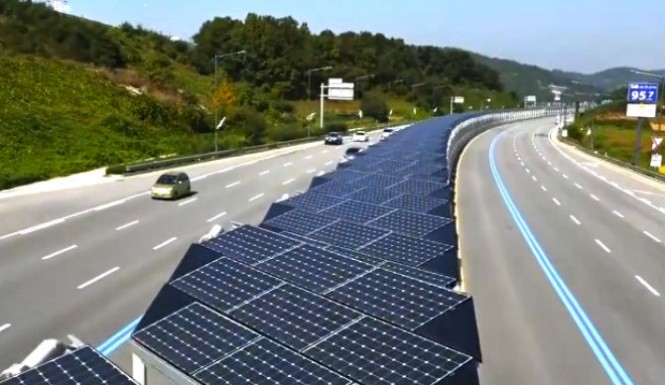
Solar-powered bike lane. Photo via inquisitr.com

Over the past five years, the solar energy community has seen major innovation in solar panels. First, the new solar panels are efficiently made to look like windows. As a result of the new design, there’s been a dramatic decrease in solar panel sludge, a waste pollutant left behind from solar panel creation that solar panel companies had issues with. Also, solar panels are becoming more versatile. This can be seen by having them incorporated into everyday items, like bicycles and water distillers, to improve efficiency.

Now there are reports of solar panels actually providing something else most people wouldn’t think about: shade. That is the case for a bike lane in South Korea which is topped with solar panels.

According to Inquisitr, a stretch of highway in South Korea features a solar-powered bike lane running down the median. It is offset from traffic, protected by barriers, and sheltered by solar panels. The bike lane is about a few hours’ drive away from Seoul and runs 20 miles from Daejeon to Sejong. All 20 miles of it is solar panel covered.

Just to give an idea how efficiently innovative this idea is, we’ll provide the scenario: the solar panels are five feet by two feet, short side aligned with the length of the bike lane, and are offset by one foot each.

That means over 13 miles of the bike lane is covered by solar panels totaling 35,200 panels. Now let’s assume the solar panels are set at producing 250 kW per year without fluctuation. That is exactly 8,800,000 kW of electricity, which is about 80 percent of the power used in New York City annually.

That’s a lot of electricity.

If you want to see what the solar-powered bike lane looks like, Inhabitat provided a video by a drone displaying it from above in their follow-up. It is attached below for viewing.

Emirates Insolaire Installs World’s First Coloured Solar Panels in Switzerland

world's first coloured solar panels in switzerland

Dubai firm installs Kromatix panels on building. Photo via Business Wire

Emirates Insolaire LLC, a pioneer in the development and application of unique solar technologies and a joint venture of Dubai Investments PJSC [DI] and SwissINSO Holding Inc., has created history with the successful installation of the world’s first KromatixTM coloured solar panels on a building façade in Lausanne, Switzerland.

According to Blackbird PR News, the entire installation, worth AED 850,000, is capable of generating sufficient electric power annually for two families of four people each. The building, boasting of its unique blue façade – thanks to the Emirates Insolaire glass panels, thus has the unique recognition of having the first coloured, photovoltaic solar panel façade in the world.

Two other projects in Basel, Switzerland, and Austria have also been completed. Emirates Insolaire continues to receive enquiries for its solar panels from UAE, Qatar, Saudi Arabia, Kuwait, Egypt, Bahrain, Lebanon, as well as from Europe, Asia, the US and Brazil.

Going by the projects on hand, demand and enquiries across the globe, Emirates Insolaire expects sales over 50,000 square metres for coloured solar panels in 2015 alone. Each coloured solar panel can generate above 150 watts electric power per square meter on roofs, or above 110 watts per square meter on façades.

Globally, the photovoltaic market has grown 40% year-on-year and the number of installations foreseen for 2015 is 160 GW – approximately 800 million square meters of glass. The share of Building Integrated Photovoltaic for rooftops and facades is witnessing one of the fastest growth rates.

Rafic Hanbali, Managing Partner of Emirates Insolaire, said: “The completion of Emirates Insolaire’s first project in Lausanne is a major milestone for the company. With the KromatixTM technology, the company has ushered in a paradigm shift in solar applications because of its aesthetic appeal to any building façade and efficiency due to its power generating attributes. The company sees significant growth opportunities going forward not only in the Europe but across the globe.”

KromatixTM solar panels can supply between 20% and 60% of the needed energy for a building. For certain industries with large roofs and façades, this can go up to 100%. Coming in virtually any colour, the Emirates Insolaire solar panels are optimised for both photovoltaic modules and solar thermal collectors.

New ultralow-power circuit improves efficiency of energy harvesting to more than 80 percent

solar-powered sensors

The MIT researchers’ prototype for a chip measuring 3 millimeters by 3 millimeters. Image via Nanotechnology Now

The latest buzz in the information technology industry regards “the Internet of things” — the idea that vehicles, appliances, civil-engineering structures, manufacturing equipment, and even livestock would have their own embedded sensors that report information directly to networked servers, aiding with maintenance and the coordination of tasks.

Realizing that vision, however, will require extremely low-power sensors that can run for months without battery changes — or, even better, that can extract energy from the environment to recharge.

Last week, at the Symposia on VLSI Technology and Circuits, MIT researchers presented a new power converter chip that can harvest more than 80 percent of the energy trickling into it, even at the extremely low power levels characteristic of tiny solar cells. Previous experimental ultralow-power converters had efficiencies of only 40 or 50 percent.

Moreover, the researchers’ chip achieves those efficiency improvements while assuming additional responsibilities. Where its predecessors could use a solar cell to either charge a battery or directly power a device, this new chip can do both, and it can power the device directly from the battery.

All of those operations also share a single inductor — the chip’s main electrical component — which saves on circuit board space but increases the circuit complexity even further. Nonetheless, the chip’s power consumption remains low.

“We still want to have battery-charging capability, and we still want to provide a regulated output voltage,” says Dina Reda El-Damak, an MIT graduate student in electrical engineering and computer science and first author on the new paper.

“We need to regulate the input to extract the maximum power, and we really want to do all these tasks with inductor sharing and see which operational mode is the best. And we want to do it without compromising the performance, at very limited input power levels — 10 nanowatts to 1 microwatt — for the Internet of things.”

Ups and downs

The circuit’s chief function is to regulate the voltages between the solar cell, the battery, and the device the cell is powering. If the battery operates for too long at a voltage that’s either too high or too low, for instance, its chemical reactants break down, and it loses the ability to hold a charge.

To control the current flow across their chip, El-Damak and her advisor, Anantha Chandrakasan, the Joseph F. and Nancy P. Keithley Professor in Electrical Engineering, use an inductor, which is a wire wound into a coil. When a current passes through an inductor, it generates a magnetic field, which in turn resists any change in the current.

Throwing switches in the inductor’s path causes it to alternately charge and discharge, so that the current flowing through it continuously ramps up and then drops back down to zero. Keeping a lid on the current improves the circuit’s efficiency, since the rate at which it dissipates energy as heat is proportional to the square of the current.

Once the current drops to zero, however, the switches in the inductor’s path need to be thrown immediately; otherwise, current could begin to flow through the circuit in the wrong direction, which would drastically diminish its efficiency. The complication is that the rate at which the current rises and falls depends on the voltage generated by the solar cell, which is highly variable. So the timing of the switch throws has to vary, too.

Electric hourglass

To control the switches’ timing, El-Damak and Chandrakasan use an electrical component called a capacitor, which can store electrical charge. The higher the current, the more rapidly the capacitor fills. When it’s full, the circuit stops charging the inductor.

The rate at which the current drops off, however, depends on the output voltage, whose regulation is the very purpose of the chip. Since that voltage is fixed, the variation in timing has to come from variation in capacitance. El-Damak and Chandrakasan thus equip their chip with a bank of capacitors of different sizes. As the current drops, it charges a subset of those capacitors, whose selection is determined by the solar cell’s voltage. Once again, when the capacitor fills, the switches in the inductor’s path are flipped.
British naval base goes solar

Portsmouth naval base

Portsmouth naval base. Photo via mirror.co.uk

The British navy’s base at Portsmouth, England is to benefit from on-site solar energy.

According to cospp.com, the base has had 2000 solar PV panels fitted and it is estimated the facility will save £1m over the next 20 years as a result of the installation.

Ken Hobbs, head of energy solutions and services at BAE Systems Maritime Services, said: ‘‘Solar panels will generate power, transforming these buildings into clean energy producing facilities, improving efficiency and ultimately reducing costs for the Ministry of Defence (MoD).’

The naval base’s head of infrastructure, Captain Iain Greenlees, said: “This is an important step on the path to modernising the base to support the Royal Navy on global operations.”

The MoD is expecting to save more than £500,000 this financial year thanks to the panels, combined with other energy-saving initiatives at the base, which have been project-managed by BAE Systems.

Other measures have included the installation of LED lighting in offices, LED street lighting, air-source heat pumps and intelligent control systems.

The 500kW panels are part of a contract called the Maritime Support Delivery Framework.

Solar-powered LED lighting for Northern regions

solar-powered LED lighting

Danish research collaboration results in solar-powered LED lighting that operates in Northern regions. Image via ledsmagazine.com

At first glance, the best approach to make a solar powered outdoor lighting product work at winter in the far North is to go for state-of-the-art components: photovoltaic panels, batteries and super effective LEDs. However, the heart of the systems is actually what binds these components together: the power supply and the battery management system.

With a very limited amount of PV power input during the short winter days, the energy conversion efficiency and the stand-by power consumption of the management system are crucial factors. In this project, a prototype channeled the power generated in the PV panel to the battery with an extreme efficiency of 98-99%.

According to ledsmagazine.com, most commercial LED power supplies consume 8-15% of the load. Nevertheless, the same prototype discharged a 10-25W output from the battery to the LED with an impressive conversion efficiency of 97.5%.

A much smaller 10W version was prototyped as well. In this case, high efficiencies are even harder to obtain, but even this model produced similar impressive conversion efficiencies for the solar-powered LED lighting.

The results have great potential in actual solutions that are ready for the market. Both prototypes were specified in close cooperation with private companies to enable direct use in real products. Hence, the prototypes were tested in five different outdoor products with LED.

And who says it will stop here? The project generated an advanced design and dimensioning tool that can manage all of the limiting conditions. All parts are highly dependent on temperature conditions in the environment and the PV panels obviously depend on latitude and shading conditions. Hence, all local conditions as well as the dynamical and technical performance figures of potential components can be loaded into the design tool, and an optimized solution can be designed.

This design tool is valuable not only in stand-alone solar-powered LED lighting systems in the Nordic region but essentially all over the world. Furthermore, the prototyped power managements system can be applied to many other PV systems, as for instance stand-alone outdoor surveillance and intelligent parking meters.

The project was sponsored by the Danish Energy Agency (EUDP) and was managed by the DTU Fotonik (Technical University of Denmark) in close collaboration with DTU Energy and DTU Elektro. Three different private companies participated (Out-sider, AKJ Inventions and Morten Lyhne).

Efficiency record for black silicon solar cells jumps to 22.1%

black silicon solar cell

Aalto University researchers have developed black silicon solar cells that achieve a record 22.1 percent efficiency when turning the Sun’s rays into usable energy. Photo credits: Aalto University

Aalto University’s researchers have obtained the record-breaking efficiency of 22.1% on nanostructured silicon solar cells as certified by Fraunhofer ISE CalLab. An almost 4% absolute increase to their previous record is achieved by applying a thin passivating film on the nanostructures by Atomic Layer Deposition, and by integrating all metal contacts on the back side of the cell.

According to a press release, the surface recombination has long been the bottleneck of black silicon solar cells and has so far limited the cell efficiencies to only modest values.

The new record cells consists of a thick back-contacted structure that is known to be highly sensitive to the front surface recombination. The certified external quantum efficiency of 96% at 300nm wavelength demonstrates that the increased surface recombination problem no longer exists and for the first time the black silicon is not limiting the final energy conversion efficiency.

The results were published online in Nature Nanotechnology.

For Nordic conditions

“The energy conversion efficiency is not the only parameter that we should look at”, explains Professor Hele Savin from Aalto University, who coordinated the study. Due to the ability of black cells to capture solar radiation from low angles, they generate more electricity already over the duration of one day as compared to the traditional cells.

“We have demonstrated that in winter Helsinki, black cells generate considerably more electricity than traditional cells.”

This is an advantage particularly in the north, where the sun shines from a low angle for a large part of the year. “We have demonstrated that in winter Helsinki, black cells generate considerably more electricity than traditional cells even though both cells have identical efficiency values”, she adds.

In the near future, the goal of the team is to apply the technology to other cell structures – in particular, thin and multi-crystalline cells.

“Our record cells were fabricated using p-type silicon, which is known to suffer from impurity-related degradation. There is no reason why even higher efficiencies could not be reached using n-type silicon or more advanced cell structures”, Hele Savin predicts.

The development of the cells fabricated last year will continue in the upcoming “BLACK” project, supported by the European Union, in which Professor Savin together with her team will develop the technology further in cooperation with industry.

The surface area of the best cells in the study was already 9 cm2. This is a good starting point for upscaling the results to full wafers and all the way to the industrial scale.

This solar-powered floating farm will produce 20 tons of vegetables every day

solar-powered floating farm

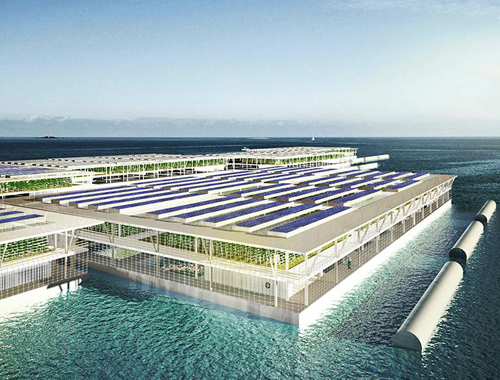
Solar-powered floating farms to provide food for world. Image via inquisitr.com

Given the fact that a community that supports green technology also supports organic growing, it is evident that its members would design clean ways to produce healthy, organic food with as little impact on the environment possible. One such farm exists in Japan. Not only is it the world’s largest indoor farm, it produces 100 times more food than conventional farming methods.

Now, an architecture company known as Forward Thinking Architecture has designed a solar-powered floating farm. What is unique about it is the fact that through its green technology, it produces 20 tons of vegetables every day.

According to inquisitr.com, there has been a concern that the world’s food supply wouldn’t be able to keep up with the world’s population growing at an exponential rate for many years. Forward Thinking Architecture provided an innovative and viable solution with their farms. The fact that it is built on water addresses the issue of decreasing supply of arable land. However, it must be noted the floating farms are, at this moment, made to supplement traditional farming, not replace it.

A follow-up by Minds provides more details to the floating farm. The farms — which were inspired by Chinese floating fish farms — are modules that measure 200 meters by 350 meters and consist of three floors. The bottom floor focuses on aquaculture and water desalination. The next floor up focuses on hydroponics crop cultivation. Finally, the roof is fitted with numerous solar panels, skylights, and rainwater collectors.

As mentioned earlier, each floating farm module can produce 20 tons of food everyday. Over the course of a year, the anticipated estimate is 8,152 tons of vegetables! Apparently, the solar farms are also fisheries as they can bring in 1,703 tons of fish a year too! Finally, the fact that the floating farm modules can be connected to form a grid (or any design allowable by its architecture as shown in the above picture), entire cities can be fed if they are scaled up to be huge farms, kind of like a floating farm metropolis.

Solar-powered spacecraft is ready for its first test launch

Solar-powered sailing space ship

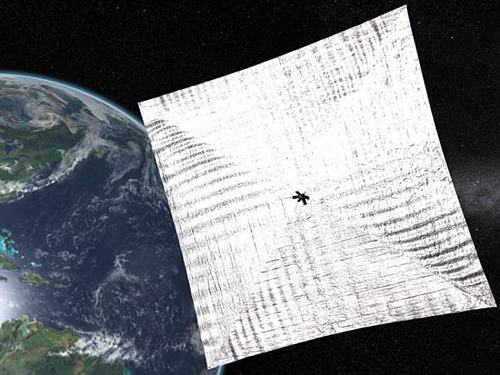
The LightSail uses sunlight for propulsion. Picture: Josh Spradling / The Planetary Society Source: Supplied

The LightSail, a spaceship with sails that relies on just sunlight for fuel is set for its first test in space when it launches on Wednesday.

According to news.com, the so-called LightSail is a privately-funded project by The Planetary Society, the world’s largest non-profit space advocacy group.

It is sending two small spacecraft into Earth orbit carrying large, reflective sails measuring 32 square metres. CEO Bill Nye says Wednesday’s test flight will pave the way for a second, full-fledged solar sailing demonstration in 2016.

Solar sails use the sun’s energy as a method of propulsion — flight by light. Light is made of packets of energy called photons. While photons have no mass, a photon travelling as a packet of light has energy and momentum.

Solar sail spacecraft capture light momentum with large, lightweight mirrored surfaces — sails. As light reflects off a sail, most of its momentum is transferred, pushing on the sail. The resulting acceleration is small, but continuous. Unlike chemical rockets that provide short bursts of thrust, solar sails thrust continuously and can reach higher speeds over time.

The LightSail is hitching a ride on a Atlas V rocket which will also carry a top-secret mini military space plane on another long orbital test flight.

The US Air Force is tight-lipped about the unmanned mission.

What is known is that this will be the fourth flight of the X-37B space plane, a secretive, experimental program run by the Air Force. The three previous missions also began with rocket launches from Cape Canaveral Air Force Station.

The mystery test vehicle — essentially a technology test bed — is designed to orbit the Earth and then land like one of NASA’s old shuttles. It is operated robotically, without anyone on board, and is reusable. It is 8.8m long — about one-quarter the size of a NASA shuttle.

The longest X-37B flight lasted about 675 days; touchdown was last October. There’s no official word on how long this one will stay up. All three previous missions ended in California.

NASA has a materials experiment aboard, while the Planetary Society is tagging along with a solar-sail demo.

Although largely mum about this X-37B flight, the Air Force has acknowledged a thruster experiment involving electric propulsion. Air Force researchers want to check design modifications to ion thrusters already flying on some advanced military communication satellites.

Solar power for the world’s largest tram network

solar-powered tram

Digital impression of a Melbourne tram as part of a pitch before the state government to power the network with solar energy. Photo: Australian Solar Group

Melbourne’s entire tram network could be powered by solar if the state government gave a bold renewable energy proposal the green light.

While the pitch may conjure up images of trams with rooftop panels on them like the family home, the power would instead be generated at two new solar farms the project proponents plan to build near Swan Hill and Mildura.

According to smh.com.au, the company behind the bid, the Australian Solar Group, have held quiet talks over four years with different arms of the government to try get the project off the ground, but has so far not got final backing.

The two solar farms would generate 80 gigawatt-hours of electricity a year, about the same amount used by Melbourne’s tram network, which is the world’s largest.

Under the proposal the government would back the project by signing Public Transport Victoria (PTV) up to a power purchase agreement with the solar farms, creating a reliable revenue source alongside the renewable energy target.

The proponents say the project has been designed to ensure the cost of tram tickets would not rise, nor would it add to PTV’s power bill. It would cut 100,000 tonnes of greenhouse gas emissions a year from running trams and give the city an obvious global selling point, according to the pitch.

The Australia Solar Group was founded by businessmen Adrian Critchlow and Dave Holland. Mr Crtichlow previously helped start companies Booking.com and AlertMe, before successful sales of both. Mr Holland was formerly the head of Solar Systems, a company that was building a large solar project in Mildura before financial collapse in 2009.

Mr Holland said Australia Solar had tried to get almost all elements of the tram project ready to go before it sought final financial backing.

“This project is virtually ready to go. We can’t see any barriers that would stop it from here,” he said.

The tram project has been supported behind the scenes by members of the Melbourne City Council, including Lord Mayor Robert Doyle. Councillor Arron Wood said it ticked many boxes, from contributing significantly towards the city’s renewable energy target to creating employment and training opportunities in rural Victoria.

“Ultimately, whether this project proceeds rests firmly with the Victorian Government. I just hope they take the action necessary to get it done,” Cr Wood said.

A spokeswoman for the Andrews government said: “We are interested in how the project progresses and will continue discussions with the group.”

Australian Solar says the solar farms would span across 80 hectares and use 130,000 panels to track the sun throughout the day. It has planning and grid connection approvals for its Swan Hill site, with permit processes underway for the second site at Red Cliffs.

MIT scientists show us the future of solar energy

the future of solar energy

MIT releases report on the future of solar energy

Solar energy holds the best potential for meeting humanity’s future long-term energy needs while cutting greenhouse gas emissions — but to realize this potential will require increased emphasis on developing lower-cost technologies and more effective deployment policy, says a comprehensive new study, titled “The Future of Solar Energy,” released by the MIT Energy Initiative (MITEI).

“Our objective has been to assess solar energy’s current and potential competitive position and to identify changes in U.S. government policies that could more efficiently and effectively support its massive deployment over the long term, which we view as necessary,” says MITEI Director Robert Armstrong, the Chevron Professor in Chemical Engineering at MIT.

According to MIT’s website, the study’s chair, Richard Schmalensee, the Howard W. Johnson Professor Emeritus of Economics and Management at the MIT Sloan School of Management, adds, “What the study shows is that our focus needs to shift toward new technologies and policies that have the potential to make solar a compelling economic option.”

The study group is presenting its findings to lawmakers and senior administration officials this week in Washington.

“The Future of Solar Energy” reflects on the technical, commercial, and policy dimensions of solar energy today and makes recommendations to policymakers regarding more effective federal and state support for research and development, technology demonstration, and solar deployment.

Among its major themes is the need to prepare our electricity systems, both technically and from a regulatory standpoint, for very large-scale deployment of solar generation — which tends to vary unpredictably throughout the day. To this end, the study emphasizes the need for federal research and development support to advance low-cost, large-scale electricity storage technologies.

The analysis finds that today’s federal and state subsidy programs designed to encourage investment in solar systems should be reconsidered, to increase their cost-effectiveness, with greater emphasis on rewarding production of solar energy.

The group also recommends that state renewable portfolio standards, which are designed to increase generation of electricity from renewable resources, be brought under a unified national program that would reduce the cost of meeting set mandates by allowing unrestricted interstate trading of credits.

The study concludes by pointing to the urgent need for an ambitious and innovative approach to technology development, with federal research and development investment focused on new technologies and systems with the potential to deliver transformative system cost reductions.

The MIT “Future of …” studies are a series of multidisciplinary reports that examine the role various energy sources could play in meeting future energy demand under carbon dioxide emissions constraints. These comprehensive reports are written by multidisciplinary teams of MIT researchers. The research is informed by an external advisory committee.