Wind and solar energy comprise 61% of 2015 capacity additions, gas contributes 35%

wind turbines USA

Wind accounted for 47% of new generation capacity, followed by natural gas (35%) and solar (14%). Image source.

In 2015, the U.S. Energy Information Administration predicted that capacity additions would begin to slow, and from 2018 to 2024 the agency believes additions will average less than 4 GW annually.

New capacity additions are slowing as efficiency and demand management techniques make new generation less necessary nationwide, and the new plants that are added are largely cleaner than in years past, SNL Energy reports.

A combination of wind, solar and natural gas made up the overwhelming majority of new capacity additions last year: Some 96%, according to SNL’s data. Coal and oil combined for less than 1%.

Those figures are similar to what EIA noted last year: that renewable power made up 70% of new generation in the first half of 2015. But SNL’s data appears to show gas additions made up some ground, ultimately consisting of more than a third of additions last year.

According to Utility Dive, in the end, gas and wind together totalled 11,848 MW of the 14,468 MW installed in the U.S. last year — 82% of the total. 2,010 MW of solar made it the third largest resource in capacity added in 2015, with 14% of the total.

Record low prices have driven a big “build cycle” for wind energy, according to a study from the Lawrence Berkeley National Laboratory. Low power purchase agreement prices and the Clean Power Plan could help spur wind’s growth in 2016, especially as the U.S. House of Representatives passed a $1.1 trillion omnibus spending bill that included extensions for the solar investment tax credit and wind’s production tax credit.

According to EIA, new power additions through 2017 will average about 17 GW annually, with about half of that being non-hydro renewable power. From 2018 to 2024 EIA estimates capacity additions will average less than 4 GW annually. That’s a large shift from the 26 GW added each year between 2000 and 2013.

Material stores solar energy, releases heat on demand

solar material

New material stores solar energy and releases it in form of heat when required. Image source

Imagine if your clothing could, on demand, release just enough heat to keep you warm and cozy, allowing you to dial back on your thermostat settings and stay comfortable in a cooler room. Or, picture a car windshield that stores the sun’s energy and then releases it as a burst of heat to melt away a layer of ice.

According to a team of researchers at MIT, both scenarios may be possible before long, thanks to a new material that can store solar energy during the day and release it later as heat, whenever it’s needed. This transparent polymer film could be applied to many different surfaces, such as window glass or clothing.

Although the sun is a virtually inexhaustible source of energy, it’s only available about half the time we need it — during daylight. For the sun to become a major power provider for human needs, there has to be an efficient way to save it up for use during nighttime and stormy days. Most such efforts have focused on storing and recovering solar energy in the form of electricity, but the new finding could provide a highly efficient method for storing the sun’s energy through a chemical reaction and releasing it later as heat.

The finding, by MIT professor Jeffrey Grossman, postdoc David Zhitomirsky, and graduate student Eugene Cho, is described in a paper in the journal Advanced Energy Materials. The key to enabling long-term, stable storage of solar heat, the team says, is to store it in the form of a chemical change rather than storing the heat itself. Whereas heat inevitably dissipates over time no matter how good the insulation around it, a chemical storage system can retain the energy indefinitely in a stable molecular configuration, until its release is triggered by a small jolt of heat (or light or electricity).

The key is a molecule that can remain stable in either of two different configurations. When exposed to sunlight, the energy of the light kicks the molecules into their “charged” configuration, and they can stay that way for long periods. Then, when triggered by a very specific temperature or other stimulus, the molecules snap back to their original shape, giving off a burst of heat in the process.

Such chemically-based storage materials, known as solar thermal fuels (STF), have been developed before, including in previous work by Grossman and his team. But those earlier efforts “had limited utility in solid-state applications” because they were designed to be used in liquid solutions and not capable of making durable solid-state films, Zhitomirsky says. The new approach is the first based on a solid-state material, in this case a polymer, and the first based on inexpensive materials and widespread manufacturing technology.

“This work presents an exciting avenue for simultaneous energy harvesting and storage within a single material,” says Ted Sargent, university professor at the University of Toronto, who was not involved in this research.

Manufacturing the new material requires just a two-step process that is “very simple and very scalable,” says Cho. The system is based on previous work that was aimed at developing a solar cooker that could store solar heat for cooking after sundown, but “there were challenges with that,” he says. The team realized that if the heat-storing material could be made in the form of a thin film, then it could be “incorporated into many different materials,” he says, including glass or even fabric.

To make the film capable of storing a useful amount of heat, and to ensure that it could be manufactured easily and reliably, the team started with materials called azobenzenes that change their molecular configuration in response to light. The azobenzenes can then can be stimulated by a tiny pulse of heat, to revert to their original configuration and release much more heat in the process. The researchers modified the material’s chemistry to improve its energy density — the amount of energy that can be stored for a given weight — its ability to form smooth, uniform layers, and its responsiveness to the activating heat pulse.

The material they ended up with is highly transparent, which could make it useful for de-icing car windshields, says Grossman, the Morton and Claire Goulder and Family Professor in Environmental Systems and a professor of materials science and engineering. While many cars already have fine heating wires embedded in rear windows for that purpose, anything that blocks the view through the front window is forbidden by law, even thin wires. But a transparent film made of the new material, sandwiched between two layers of glass — as is currently done with bonding polymers to prevent pieces of broken glass from flying around in an accident — could provide the same de-icing effect without any blockage. German auto company BMW, a sponsor of this research, is interested in that potential application, he says.

With such a window, energy would be stored in the polymer every time the car sits out in the sunlight. Then, “when you trigger it,” using just a small amount of heat that could be provided by a heating wire or puff of heated air, “you get this blast of heat,” Grossman says.“We did tests to show you could get enough heat to drop ice off a windshield.”

Accomplishing that, he explains, doesn’t require that all the ice actually be melted, just that the ice closest to the glass melts enough to provide a layer of water that releases the rest of the ice to slide off by gravity or be pushed aside by the windshield wipers.

According to Laboratory Equipment, the team is continuing to work on improving the film’s properties. The material currently has a slight yellowish tinge, so the researchers are working on improving its transparency. And it can release a burst of about 10 degrees Celsius above the surrounding temperature — sufficient for the ice-melting application — but they are trying to boost that to 20 degrees.

Already, the system as it exists now might be a significant boon for electric cars, which devote so much energy to heating and de-icing that their driving ranges can drop by 30 percent in cold conditions. The new polymer could significantly reduce that drain, Grossman says.

“The approach is innovative and distinctive,” says Sargent. “The research is a major advance towards the practical application of solid-state energy-storage/heat-release materials from both a scientific and engineering point of view.”

European Commission extends restrictions on Chinese solar panel manufacturers

solar panels made in China

Restrictions extended on Chinese solar panel imports. Image source.

The two sides were involved in a major dispute over trade measures on solar panels imported from China, before eventually reaching deals on minimum import prices and quotas on Chinese imports in 2013.

The European Commission started an expiry review of the anti-dumping duties on imports of crystalline silicon photovoltaic (PV) modules and cells from China.

According to unionoracle.com, EU ProSun, an association of solar power equipment manufacturers, says such commission reviews typically take up to 15 months, which would mean the measures will likely stay in place through the end of next year.

The EU said in the statement that the partial interim review will consider whether or not it is in the EU’s interest to maintain the measures that are now in force.

Following a request lodged by EU ProSun on September 4, 2015, the commission now will work to determine whether the expiry of the measures would result in a continuation or recurrence of dumping of China-made crystalline silicon PV modules.

In Saturday’s statement, an official with MOFCOM’s Trade Remedy and Investigation Bureau said that the implementation of the agreed measures has been relatively “smooth”.

Shen said that the booming domestic market has benefited Chinese solar-panel makers as they continue to expand into overseas markets.

According to MOFCOM, the EU’s PV installed capacity dropped significantly to 7 GW in 2014, compared with 24 GW in 2012, and its share of the world’s total capacity fell to 14.5 percent from 74 percent.

According to the ministry, solar panels and related components are vital to the development of clean energy, but the pace of growth of clean energy has been slowed in Europe after some countries cut subsidies on solar panels and set minimum import prices.

Though China’s overall exports to the EU have declined in recent months because of the sluggish economy there, “disputes” in one industry will not affect the overall trade relations between China and the EU, Lin Guijun, vice president of the University of International Business and Economics in Beijing, told the Global Times Saturday.

“The overall trade ties between China and the European Union are generally positive”, Lin said, noting that cooperation in other areas such as food, autos, and high-tech is getting stronger.

France just granted the biggest photovoltaic power plant in Europe

solar plant France

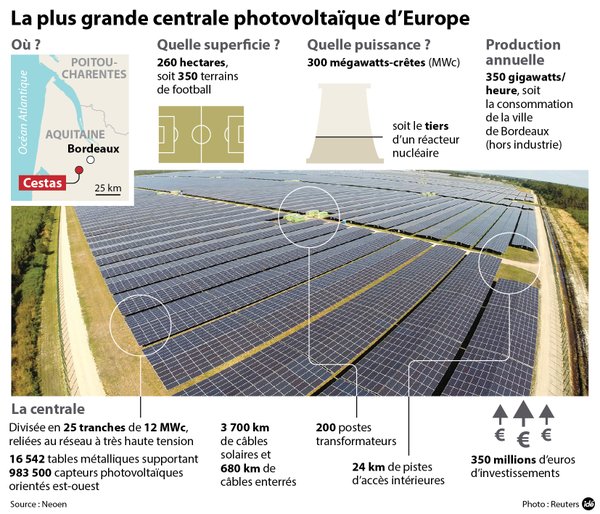
France’s 300 MW Cestas solar plant inaugurated. Image source.

The biggest photovoltaic power plant of Europe, having a power capacity of up to 300 MWp peak, which is the annual electric consumption of 300.000 people, was inaugurated on Tuesday to Cestas, near Bordeaux in France.

According to Middle East News Service, a project worth 360 million euros run by Neoen, a company which five years ago was just a start-up and today is one of the most dynamic players in the renewable energies field.

While the COP21 opened in Paris, this power plant takes up an area of roughly 250 hectares, the equivalent of about 350 soccer fields, including a million of solar panels, 5.000 km of cables and 204.000 screwed foundations, make quickly the symbol of the summit.

The 300 MW solar park started feeding energy into the grid already in late October. Developers wanted to acknowledge the importance of renewable energy to the goals of the climate talks going on in Paris (and probably to boost their media coverage as well) by holding the grand opening the same Tuesday the COP21 talks start.

“We will deliver power at an extremely competitive price, similar to wind power, and at any rate cheaper than the cost of power from new nuclear plants,” Neoen Chief Executive Xavier Barbaro told reporters on Tuesday.

Neoen opens Europe’s largest PV power plant of 300 MW. .Image source

Barbaro said the facility’s solar panels are not oriented toward the south, but on an east-west axis, which allows them to produce three to four times more power for the same surface area.

The east-west orientation also allows the panels to produce more power early in the morning and late in the afternoon, which corresponds more closely to French power demand patterns.

Barbaro said Neoen’s Bordeaux solar plant shows that solar photovoltaic can be highly economical in terms of geographical footprint.

He also said while the solar panels are Chinese made, they make up only a minority part of the investment and that the main costs are related to construction, engineering, cabling and electrical equipment, for which there are many competitive French suppliers.

Neoen has said it aims to install 1,000 MW of capacity by 2017, about half in France.

The orientation of panels also allows to produce early in the morning and late during the evening. The sale price of the produced electricity is approximately 105 euros the MWh during 20 years, what makes it one of the most rentable of France.

Costa Rica after 257 days with almost 100 percent renewable energy

wind farm Costa Rica

Wind farm in Costa Rica. Image source.

Data from the National Center for Energy Control (CENCE) showed that Costa Rica went 257 days on almost 100% renewable energy.

According to the Latin Correspondent, the Costa Rican Electricity Institute (ICE) reported that 98.82 percent of the electricity generated for domestic use came from renewable sources such as wind, geothermal, solar, biomass, and hydroelectric plants. Only 1.18 percent of generated electricity came from fossil fuels, used as a backup in the events of unfavorable weather conditions.

“The decline in oil imports has positively impacted electricity prices, as well as the expansion strategy and exchanges with the regional electricity market,” said ICE CEO Carlos Manuel Obregon. Luis Pacheco, ICE manager, added that their projections show the trend continuing in 2016.

ICE announced in March that the country’s initial target is to survive on 97.1 percent of clean energy.

Costa Rica has long been a leader in using renewable sources for electricity, prior to world leaders focusing on other sources of energy as a result of climate change.

Earlier this year, ICE announced that the country ran on 100 percent clean electricity for the first 75 days of the year. This was considered a huge feat by the international community, but more importantly, it was good news for consumers as electricity prices were cut by 7 to 15 percent.

The feat can be attributed to rainfall that Costa Rica received in the first part of the year, as the country mostly relies on the hydropower generation.

Costa Rica is committed to be carbon-neutral come 2021.

Total global solar PV capacity will increase by 27% in 2015, despite policy changes says report

global solar PV capacity

Total global solar PV capacity will increase by 27% in 2015 – Global solar PV capacity rises to 223GW despite policy changes says report. Image source.

A new report predicts that the global cumulative installed capacity for solar PV energy will hit 223.2 GW by the end of this year compared to 2014’s 175.4 GW.

And this, says the study, is despite the anticipated declines in the annual installations of several key countries.

According to Power Engineering, the report from research firm GlobalData, states that China will remain the world’s largest market for annual solar PV installations in 2015, adding around 17.6 GW this year.

The US will follow with almost 8.2 GW of additions while India will witness strong demand in its solar PV market thanks to growing policy and political support.

However, despite this overall growth, Ankit Mathur, GlobalData’s head of power, said adjustments in the government policies of Germany and Japan will see their annual solar PV installations fall this year.

“After amending its renewable energy law in August 2014, Germany is expected to attain an annual installed capacity of around 1.8 GW in 2015 and will fail to hit the annual solar PV installation target of between 2.4 and 2.6 GW. This is due to ongoing feed-in tariff digressions, along with the €0.0617 [$0.0688] surcharge on self-consumption in 2015.”

Mathur added that Germany “is implementing initial measures to move away from expensive renewable energy subsidies and towards a reverse auction system by 2017. Two rounds of auctions took place in Germany earlier in 2015, with the third round expected to take place in December.”

Similarly, Japan’s lucrative solar PV policies, which had been attracting strong investment in recent years, have seen cuts in 2015 that will mean a reduction in installed capacity additions, compared with 2014’s record-breaking figure of 10 GW.

Mathur said: “With the arrival of the first solar PV FiT cut in April 2015, Japan’s FiT level decreased from $0.27 per kilowatt hour in 2014 to $0.24 per kWh, and further to $0.22 per kWh from July 1, 2015.

“These cuts, put forward by the Ministry of Economy, Trade and Industry, ended the premium rates for solar PV, and were triggered by a maturing market that has seen the cost of solar operation and maintenance fall.”

Leonardo DiCaprio’s company is making ethical diamonds using solar energy

diamonds created with solar power

Sustainable diamonds created with solar power. Image source.

Diamond Foundry, launched last week, was founded by Leonardo DiCaprio with the goal of reinventing the $100B diamond industry from “mine to finger” by setting a new standard for social and environmental good.

“I’m proud to invest in Diamond Foundry Inc. — reducing the human and environmental toll of the diamond industry by sustainably culturing diamonds without the destructive use of mining,” says Leonardo DiCaprio

According to diamondfoundry.com, the founding team of M.I.T., Stanford, and Princeton engineers previously developed pioneering breakthroughs in solar power technology – and had a hunch that techniques used to harness the energy of the sun could also be used to make a better diamond, atom by atom.

“We started by studying the laws of nature. Diamonds are born from a fiery heat, so we set out to create a plasma of unprecedented energy density. We coded software to run tens of thousands of physics-based simulations. In a warehouse just south of San Francisco, we built novel plasma reactors with hundreds of individually precision-engineered parts. Then, we formed plasma as hot as the outer layer of the sun,” says the Diamond Foundry.

The researchers discovered a plasma by which they can attach atoms to an earth-extracted diamond and grow it in size. One by one, the atoms stack on top of a thin slice of earth diamond and extend its unique crystal structure. Layer by layer, it grows into a pure, cultured, jewelry-grade diamond of larger size. After this step, the team slice off and reuse the original any number of times.

“We are now able to produce stunning diamonds in our San Francisco foundry. Each is a unique crystal of pure diamond, just like industrially mined diamonds but morally pure as well.

We use solar power credits to reduce our carbon footprint to zero, and we guarantee the characteristics and provenance of our diamonds: each is born at our foundry in California. The ultimate diamond: 100% pure. 100% ethical. Each unique.”

Moving to renewable energy would create millions of jobs, study finds

solar industry jobs

Moving toward renewable energy would be a boon to the economy, studu says. Image source

A new report has found that transitioning to a clean energy economy would be an economic boon to the United States, increasing employment, reducing costs to consumers, and benefiting investors.

The report, from NextGen Climate America, showed that investment in efficiency, renewable sources of electricity, and fuel switching — such as moving from fossil fuel-powered cars to electric vehicles — would add a million jobs by 2030, and roughly 2 million jobs by 2050, while increasing GDP by $290 billion and improving household income. The researchers looked at scenarios that would reduce emissions by 80 percent below 1990 levels.

“While addressing climate change is one of our greatest challenges, it is one of our greatest opportunities to build the economy,” Tom Steyer, co-founder of NextGen and billionaire climate activist (and a board member of the Center for American Progress), said on a call with reporters Monday.

The construction industry, in particular, could see a huge bump in jobs — to the tune of 1.2 million more in 2050 than under the business-as-usual scenario. That’s because it will take a lot of people to build the wind farms, install the solar panels, and retrofit the buildings needed to reduce America’s dependence on fossil fuels.

Efforts to lower emissions are often subject to the criticism that they will hurt the economy, even though actual examples of programs have shown that efficiency and clean energy programs can actually boost economic factors like household disposable income.

“The go-to argument against [climate action] is that it’s bad for the economy and it’s a job killer,” Steyer said. This report shows otherwise. Steyer also pointed out that in the last few years, jobs in the solar industry have grown 20 times faster than the rest of the economy.

In addition, the so-called reference case — a general economic forecast — did not take into account the potential costs of not addressing climate change. Recent reports have shown climate change poses a significant financial risk.

According tothinkprogress.org, the report studiously stays away from telling policymakers how to get to 80 percent less emissions. Rather than policy recommendations, the researchers took a feasibility study and used it to build out the economic impacts.

The researchers used a 2014 report, Pathways to Deep Decarbonization in the United States by Energy and Environmental Economics, which looked at whether it was technologically feasible to reduce carbon emissions significantly enough to avoid 2°C warming.

Economist Jeffery Sachs told reporters it was critical to first determine where we want to go, and then tailor policies to achieve those end goals.

“Too often our national policy conversation jumps straight to the question, ‘Is it a tax? Is it this or that?’ Whereas what this report does, much better, in my opinion, is to show here’s where we want to go,” Sachs said.

Overall, the report painted an optimistic picture of the economy under a clean energy scenario. It’s worth noting, though, that the gains will not be across the board. Job growth in two of the nine regions was expected slow under the low-carbon scenarios. Those two regions — which include roughly the area from Montana to Texas, a fossil fuel heavy swath of the country — would have slower job growth.

That means that as the country does develop policies to achieve these goals, it will likely need to dedicate resources — educational and economic — to areas that will have a harder time getting off fossil fuels.

“To help them adapt we need to provide dedicated new resources for economic diversification, job creation, job training and other employment services for workers and communities affected by job losses at coal mines and coal-fired power plants,” the authors said.

Jobs notwithstanding, all regions were found to see increases in disposable income.

Moving to renewable energy would create millions of jobs, study finds

solar industry jobs

Moving toward renewable energy would be a boon to the economy, studu says. Image source

A new report has found that transitioning to a clean energy economy would be an economic boon to the United States, increasing employment, reducing costs to consumers, and benefiting investors.

The report, from NextGen Climate America, showed that investment in efficiency, renewable sources of electricity, and fuel switching — such as moving from fossil fuel-powered cars to electric vehicles — would add a million jobs by 2030, and roughly 2 million jobs by 2050, while increasing GDP by $290 billion and improving household income. The researchers looked at scenarios that would reduce emissions by 80 percent below 1990 levels.

“While addressing climate change is one of our greatest challenges, it is one of our greatest opportunities to build the economy,” Tom Steyer, co-founder of NextGen and billionaire climate activist (and a board member of the Center for American Progress), said on a call with reporters Monday.

The construction industry, in particular, could see a huge bump in jobs — to the tune of 1.2 million more in 2050 than under the business-as-usual scenario. That’s because it will take a lot of people to build the wind farms, install the solar panels, and retrofit the buildings needed to reduce America’s dependence on fossil fuels.

Efforts to lower emissions are often subject to the criticism that they will hurt the economy, even though actual examples of programs have shown that efficiency and clean energy programs can actually boost economic factors like household disposable income.

“The go-to argument against [climate action] is that it’s bad for the economy and it’s a job killer,” Steyer said. This report shows otherwise. Steyer also pointed out that in the last few years, jobs in the solar industry have grown 20 times faster than the rest of the economy.

In addition, the so-called reference case — a general economic forecast — did not take into account the potential costs of not addressing climate change. Recent reports have shown climate change poses a significant financial risk.

According tothinkprogress.org, the report studiously stays away from telling policymakers how to get to 80 percent less emissions. Rather than policy recommendations, the researchers took a feasibility study and used it to build out the economic impacts.

The researchers used a 2014 report, Pathways to Deep Decarbonization in the United States by Energy and Environmental Economics, which looked at whether it was technologically feasible to reduce carbon emissions significantly enough to avoid 2°C warming.

Economist Jeffery Sachs told reporters it was critical to first determine where we want to go, and then tailor policies to achieve those end goals.

“Too often our national policy conversation jumps straight to the question, ‘Is it a tax? Is it this or that?’ Whereas what this report does, much better, in my opinion, is to show here’s where we want to go,” Sachs said.

Overall, the report painted an optimistic picture of the economy under a clean energy scenario. It’s worth noting, though, that the gains will not be across the board. Job growth in two of the nine regions was expected slow under the low-carbon scenarios. Those two regions — which include roughly the area from Montana to Texas, a fossil fuel heavy swath of the country — would have slower job growth.

That means that as the country does develop policies to achieve these goals, it will likely need to dedicate resources — educational and economic — to areas that will have a harder time getting off fossil fuels.

“To help them adapt we need to provide dedicated new resources for economic diversification, job creation, job training and other employment services for workers and communities affected by job losses at coal mines and coal-fired power plants,” the authors said.

Jobs notwithstanding, all regions were found to see increases in disposable income.

Trina Solar announces new efficiency record of 21.25% for multi-crystalline silicon solar cell

trina solar pv record

Chinese PV producer announces new efficiency record of 21.25% efficiency for multi-crystalline silicon solar cell. Image source

Trina Solar, a global leader in photovoltaic modules, solutions and services, today announced that its State Key Laboratory of PV Science and Technology of China has set a new world record for a high-efficiency p-type multi-crystalline silicon solar cell.

According to a press release, the record-breaking p-type multi-crystalline silicon solar cell was fabricated on a high-quality mc-Si substrate with a process that integrates advanced Honey Plus technologies including back surface passivation and local back surface field.

The 156×156 mm2 solar cell reached a total area efficiency of 21.25%. The result has been independently confirmed by the Fraunhofer ISE CalLab in Germany. This efficiency record breaks the previous 20.76% efficiency world record for mc-Si solar cells also established by Trina Solar one year ago. To set this new record, only low-cost industrial processes which can be easily integrated into large-volume production were used.

“We are very pleased to announce the new efficiency results achieved by our scientists and researchers at the State Key Laboratory of PV Science and Technology. To the best of our knowledge, this is the first time ever that a multi-crystalline silicon solar cell has been able to achieve a conversion efficiency of over 21%,” said Dr. Pierre Verlinden, Vice-President and Chief Scientist of Trina Solar.

“This exciting result shows that the development path toward higher efficiencies continues to be bright, even for silicon. Our aim is to continuously integrate innovative technological developments to improve the efficiency and lower the cost of our PV products. This technology advancement in efficiency will strengthen our leadership in the PV industry and allow us to continue providing affordable solar power to the world.”