BMW will convert landfill methane in to hydrogen

BMW is one of the most eco-friendly manufacturers in the world and he make green efforts for the environment conservation.

BMW is all set to research on extracting hydrogen from methane gas found in a specified local landfill.

BMW’s North American plant in Spartanburg, South Carolina, currently has a fleet of over 100 material handling vehicles that are powered by hydrogen.

It is one of the very few automobile plants that houses majority of the systems under a single roof.

The automaker hopes to build the infrastructure needed to power the entire fleet from hydrogen.

The plant already has hydrogen storage and a distribution area, which could be integrated into a full-scale version of the new project.

The project will cost a million dollars and will go through multiple phases.

The German automaker had actually saved $5 million per year after the implementation of high efficient technology.

$14.2 billion offshore wind farm in France

The offshore wind farms are located far out into the sea; they trap winds at faster speeds than they would on land, and also, save up a lot of land space.

The French government of Nicolas Sarkozy has launched a €10 billion ($14.26 billion) tender to build about 1,200 wind turbines in 5 different offshore wind farms.

France depends mostly of nuclear energy.

France wants to diversify his energy generation with renewable sources and to have 23% of France’s energy come from renewable sources by 2020.

The offshore wind farms will be located off France’s coast on the North and West and will generate about 3.5% of France’s electricity needs.

Six Slovak solar parks on the grid

Six solar parks were putted on the grid by the german Vario green energy group in the Slovak Republic in May and June 2011.

The project planning, system configuration and the delivery of all the components were done by Vario green energy Concept GmbH from Holzgerlingen near Stuttgart, together with Vario green energy Parks GmbH from Munich.

The six solar photovoltaic power plants in Poltár, Biskupice and Ruminceparks have a power of 1 to 1.2 MW each and a total power of 6.2 MW.

The assembly time was six to eight weeks, but it worth because 70,000 solar modules will feed in an annual 7 million kilowatt hours of electricity into the local grid.

The plant operators will receive a remuneration of 38.23 Eurocents, according to the current Slovak feed-in tariff.

Since 1 July the solar electricity funding will be limited to roof-top plants with a power of 100 kilowatts maximum, but despite the cuts in financial support, Vario will remain active in Slovakia and plans to concentrate only on the roof-top market.

Schneider Electric will supply photovoltaic inverters in North America

Schneider Electric, a specialist in energy management, has been selected by a major global engineering and construction company to supply photovoltaic inverters throughout 2011 in North America.

Schneider will supply an order of 100 MW of capacity, which is the largest order in Schneider Electric’s history in North America and one of the largest ever in the North American market.

“The extensive experience we have in the field, in a broad variety of operating environments, is one of the primary reasons for our company’s continued success and the satisfaction of our customers,” said Rudy Wodrich, Commercial Vice President, Americas.

With this order Schneider proves again his leadership in PV inverters and solutions.

Solar powered charger – efficient and flexible

Solar powered chargers have the serious potentiality to defy the main electricity grids, at least for charging of small appliances.

Designer Nikolay Bastrakov has made use of existing technologies to create his own version of a solar charger, whose intrinsic system counters the conventional problems to efficiently generate higher degree of power output.

He designed one of the world’s most efficient solar powered chargers.

This device is based on the user convenience of compactness, portability, and aesthetics.

The main form can be easily attached to a backpack because it has a mobile battery.

The compact form was made from silicone with an additional coating of the polymer film to form a singular structural element.

The designer had used thin film solar cells, which were assembled on a common substrate, and this substrate was connected to the main control unit housed in a silicone cell.

The advantage of thin film solar cells is to be effective on even cloudy days.

The device has a control unit which includes a converter, a small battery, micro-processor for processing the information received from the sensors.

This display system utilizes electronic ink.

This type of display forms an image does not emit and reflect light.

The bendable control unit can be attached to bags and backpacks to accentuate upon their degree of portability.

Renewable energy from “Green Power Islands”

Green Power Islands – a great idea to generate and store renewable energy on uninhabited islands around the globe.

The Danish architectural firm Gottlieb Paludan has proposed generating power through wind or solar — depending on the climate — and then using the water surrounding the islands to store the power using pumped hydro technologies.

This new concept for producing and storing renewable energy could even provide all the power for Denmark’s population.

The idea of the architects is to create a “Green Power Island” off the coast of Copenhagen, which would become an “energy super centre” for the country.

The massive island would be accompanied by offshore wind farms, and populated with solar arrays and seawater pumps, and would produce marine biomass for biofuel.

The energy will be stored using pumped hydro facilities.

The architects from Gottlieb Paludan have suggested a few areas around the world where Green Power Islands could be built on existing islands.

These include: the Florida Keys, Jiangsu in China, Manama in Baharain and Tamil Nadu in India.

Egypt has one of the first solar-gas hybrid plants in the world

Iberdrola has started its plans to commission the 150-MW Kuraymat power plant due south of Cairo, which fuses solar energy with a combined cycle gas plant, even in Egypt was a “nightmare”.

The Integrated Solar Combined Cycle (ISCC) facility was opened this month.

The project has a total capacity of 150 megawatts (MW).

This facility incorporates technology that combines the use of gas and solar energy and  is one of the first of its kind in the world.

The power plant is located 95 kilometers south of Cairo, will supply enough power for 200,000 people while saving around 16,000 tonnes of carbon dioxide emissions into the atmosphere each year.

At Kuraymat project 1,000 people have worked over the last three years.

The Egyptian plant has been built very close to the River Nile.

The area where the plant is built has become a strategically important region for the generation and distribution of electricity in Egypt.

Having this solar-gas plant, Egypt will save 5,000 tonnes of natural gas every year.

Iberdrola Engineering built and designed this ISCC-type facility to work in two different operational modes, in order to increase efficiency: during the night it operates as a conventional natural gas combined cycle plant, while during the day it operates a normal cycle but with the added energy provided by the sun.

On one side, the Kuraymat plant is fitted with a General Electric model 6FA gas turbine and a Siemens model SST900 steam turbine, while on the other it has a solar field covering 130,800 m2, with 160 parabolic cylinder CSP collectors and 1,900 m2 of mirrors.

Kuraymat is the first solar thermal electric facility in Egypt.

Solar thermal power generation has a new research centre

A new solar research institute was established by the German Aerospace Center.

The German Aerospace Center has more than 30 years experience in solar energy and solar thermal plants.

This technology has become increasingly important during recent years in sunny regions such as Spain and the southeast of the USA.

The Concentrated Solar Power (CSP) uses sunlight to produce steam, and then generates electricity by driving a conventional steam turbine.

The German federal state of North Rhine-Westphalia will subsidize this new institute with approximately € 27 million in the next few years.

Solar thermal power plants are usually very large projects with long lead times.

The Army plans to install microgrids in Afghanistan

To reduce its energy the Army plans to install microgrids in Afghanistan.

The Army said earlier this week that they will deploy a system designed to use fuel more efficiency and pave the way solar and wind power in the field.

Now, the Army uses diesel generators to power its bases which have a significant financial and military cost as fuel convoys are often targets for attack.

The Army plans to save fuel with the new microgrids.

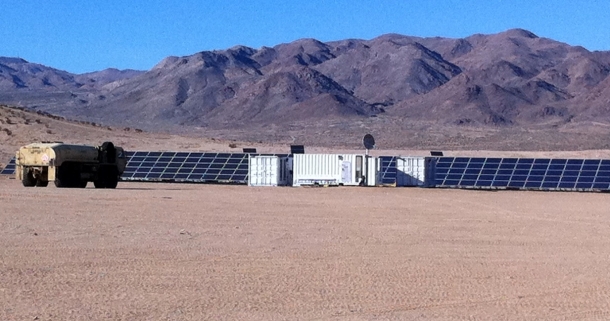
The microgrid bases will be formed from four generators able to produce one megawatt.

The microgrids will include controls to integrate power generated from solar panels and storage systems.

“They’re being designed so that a soldier can just hook them up any way and plug things in and not have to worry about doing prior analysis of how the power grid should be laid out or what load should be placed where,” said Chris Wildman, the Hybrid Intelligent Power program lead, in a statement.

The strategy of U.S Army is to minimize the amount money spent on fuel, using solar panels for diesel generators and portable solar panels for soldiers on patrol.

SolAir – a new hybrid wind/solar power generator

This new invention named SolAir is a small wind turbine combined with solar panels.

Each device has three rotating blades, a 64 radius, and weighs approximately 60 lbs.

A solar panel 40 square inches in size is integrated into the micro wind turbines.

These SolAir’s are getting quite popular in San Diego, because they can generate power in winds anywhere from 6 mph to 60 mph.

SolAirs are often installed along the roof line of residential or commercial buildings, but they can be used in a variety of locations.

SolAir product is ideal for many parts of the country because the small wind feature combined with solar panels allows for electricity generation on sunny days with little wind or windy days with/without sun.

State incentives and federal income tax credits can reportedly cover up to 50-70% of the total cost of the micro clean energy system.

SolAir ha a quick process of install and once installed you start saving money on your electric bill.