The world most efficient EV

The T.27 city car, designed by Prof. Gordon Murray is claimed to be the world’s most efficient electric car.

Also, Gordon Murray had designed McLaren F1.

He has been working on this project since a long time, and finally it has come out into the open.

Prof. Gordon Murray dreamed to make an electrically driven car ever since he unveiled McLaren F1 and he work on this project over the past three years.

The T.27 has a size that can easily fit into a single parking space.

It can accommodate three people inside, including the driver and has a massive upwards-swinging door.

The electric midget is a product of real innovation with a fully integrated electric motor, control system and battery design.

The vehicle isn’t a super car, because it has a top speed of 60mph; however the little vehicle leaves behind Mitsubishi’s i-Miev and the electric Smart Car with its efficiency.

It is 36% and 29% more efficient than i-Miev and Smart car respectively.

The vehicle can reach 100 miles on its charge and possesses a 33-horsepower electric motor charged by lithium-ion batteries.

The little T.27, it got tested under the strict Euro-NCAP safety standards and has been given” First Class” recognition.

A new type of solar cells who can harness energy from infrared spectrum

A new solar cell has been designed by researchers at the University of Toronto.

This solar cell can be useful in creating cost effective thin coatings capable of efficiently converting solar power into electricity.

The solar cell is based on colloidal quantum dots.

In search for an efficient infrastructure that would harness the potential of the sun’s visible as well as infrared spectrum, the researchers have been successful in designing a device.

“The device is a stack of two light-absorbing layers — one tuned to capture the sun’s visible rays, the other engineered to harvest the half of the sun’s power that lies in the infrared,” said lead author Dr. Xihua Wang.

The CQD solar cells are made of nanoscale materials that can readily be tuned to respond to specific wavelengths of the visible and invisible spectrum.

This new devices can function with higher efficiency when compared to the conventional solar cells.

These solar cells can in principle reach up to 42 per cent efficiencies, while the best single-junction solar cells are constrained to a maximum of 31 per cent efficiency.

The solar cells that are packed into consumer goods or those that adorn roof tops have an average efficiency of 14-18 percent.

Solar powered ATM

If you thought banknotes will be the greenest thing of an ATM, you were wrong.

Expert Group, Inc. announced that it will deploy In Miami the first solar-powered ATM.

The ATMs will be installed throughout Miami in high traffic outdoor areas, said Robert Rico, Chairmen of Expert Financing, Inc.

The ATMs will use solar energy because they are powered by solar panels installed on the top of the ATM.

Part of the collected energy is stored in the power controller for the ATM’s night operation.

The company plans to set up about a 100 of these green ATM machines in Miami soon.

1 Million Solar Water Heaters in Africa by 2015

A major green initiative will take place in Africa.

Eskom, the South African utility has announced a plan to install 1 million solar water heaters by 2015 and for many they will be free, because Eskom will offer free 110 liter capacity solar water heaters to the families who use paraffin heaters that cause air pollution.

Even for families that do not qualify for free electricity, Eskom offers rebates of up to 120% of the heater cost.

The use of solar heaters will make sense in this sunshine abundant nation.

Until now, Eskom has installed 30.000 free solar water heaters in just one township, and rebates offered to many wealthier families also.

The solar water heater consists of a water tank and a set of evacuated glass tubes that are solar collectors.

On clear sunny days, the water temperature can reach 55 degrees Celsius or higher.

South Africa is emitting 50% of the entire continent’s greenhouse gas emissions; this explains the large number of solar installations.

Another part of the country’s efforts is an ambitious plan to build a huge 5GW solar thermal power plant that could single-handedly provide 10% of the nation’s electricity needs.

The first 1GW is expected to feed into the grid in 2012.

The first solar powered netbook by Samsung

Samsung intends to introduce a solar powered netbook – Samsung NC215S in the Russian market.

The netbook is eco-friendly, has solar panels and a battery life of around 14.5 hours.

Also he has 1 GB RAM, is powered by Intel ATOM N570 (166 GHz) and has a 10 inch display.

It has LED display and has an effective anti-reflective coating on it, which is said to give very colorful and vivid images even in direct sunlight.

With only two hours spent under the sun, the eco-friendly netbook could preserve the charge for an hour.

With this solar powered netbook the carbon dioxide emission into the atmosphere could be reduced significantly when compared to other exclusively electric- powered netbooks.

The solar netbook is an excellent option for those who want to take it to parks for a picnic or such, for direct sunlight is plenty for this.

Samsung will introduce this new solar powered netbook in Russia and U.S in the first week of July and in Europe after that.

The price of the new solar powered netbook in U.S would be $399 while 13999 Rubles in Russia.

The first hybrid electric aircraft by Siemens

At the 2011 Paris Air Show, Siemens presented the first serial hybrid electric aircraft.

This is a partnership project among Siemens, aircraft manufacturer Diamond Aircraft Industries, and aerospace giant EADS.

The DA36 E-Star is consists of two-seater and uses a serial hybrid electric drive train in which a main engine is powered alternately by a gasoline-powered generator and batteries.

The aircraft has a 70-kilowatt Siemens engine and use additional EADS batteries during takeoff and ascent.

The plane’s range is limited by the number of batteries and the amount of fuel it can carry.

The public debut was at the 2011 Paris Air Show but its actual aerial debut was on June 8 in Vienna.

Water your garden automatically using solar panels

Your garden will not be thirsty of water when you’re gone.

A new concept for gardens, the Garden Sitter, is a solar powered system, programmable rain barrel irrigation system that is capable of watering a garden for months together, without any sort of human intervention.

The system was designed by Gary Lee of Edenton, North Carolina.

Gary Lee designed his very own solar rainwater harvesting irrigation system, then he turn around and makes it available to the public.

The system is powered by solar energy, which makes it more acceptable among the increasingly environment conscious population.

The system is equipped with a North Carolina Cypress box which contains 5 watt solar panel. It also has a 7 amp charge controller and battery. The LED lights attached to it, sum up the status of charging.

You can set the time according to your convenience and shoo off the nightmare of a destroyed garden.

The construction of the system, it consists of twin barrels and has a holding capacity of 2600 gallons.

It can be used throughout the growing season and is expected to save an estimated 5000 gallons.

This is a magnificent invention because uses a renewable source of energy to function and the other that Garden Sitter is save water, a bare necessity that is becoming increasingly expensive around the world.

The solar plant that can generate solar power even at night

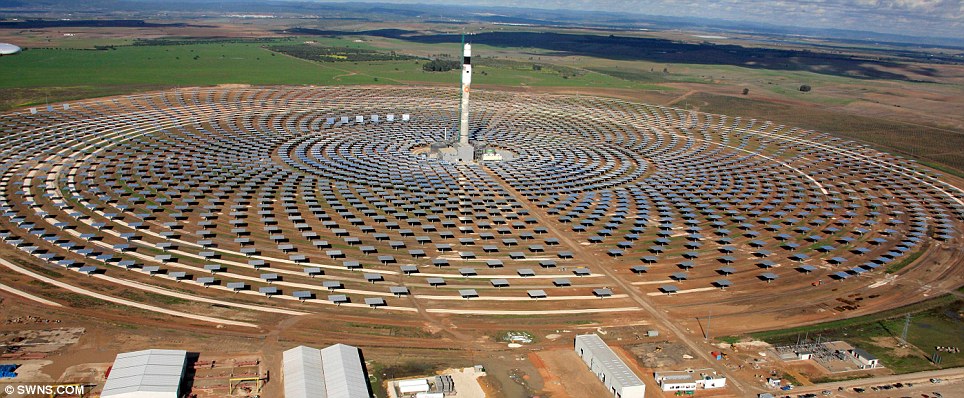
The world’s first solar power station that generates electricity at night is Gemasolar Power Plant near Seville in southern Spain which consists of an incredible 2,650 solar panels spread across 185 hectares of rural land.

The mirrors – known as heliostats – focus 95 per cent of the sun’s radiation onto a giant receiver at the centre of the plant.

This ingeniously and rather scrupulously conceived £260million ($425 million) power station is actually collaborative effort by Abu Dhabi energy company Masdar and a branch of Spanish engineering firm SENER called Torresol Energy.

Heat of up to 900C is used to warm molten salt tanks, which create steam to power the £260million station’s turbines.

But, unlike all other solar power stations, the heat stored in these tanks can be released for up to 15 hours overnight, or during periods without sunlight.

The sunny weather of southern Spain rather sustains the solar energy during most of the yearly mornings which allows the plant to generate clean and green electricity at an estimated 270 days per year, 3 times more than other renewable solar projects.

It is expected to produce 110 GWh/year – enough to power 25,000 homes in the Andalucia region.

Toyota UK car plant will use solar energy

In addition to manufacturing a number of striking eco friendly cars like Prius and Highlander, Toyota has now geared up to power entire operations of its Derbyshire production plant in the U.K. with solar panels.

The Japanese automobile giant has announced that it is going to implement the ambitious project, which will cost more than $14 million to the company.

Toyota looks set to install a £10m solar array to power operations at its Derbyshire plant.

The company has already started work to fit around 17,000 panels on 90,000 square metres of industrial land – an area slightly smaller than four and a half football pitches – within the plant’s boundaries.

The array will be capable of supplying enough energy to build around 7,000 cars a year at the plant, which produces Auris hybrid, Auris and Avensis cars, as well as saving the company 2,000 tonnes of CO2 emissions a year.

Toyota project is expected to begin producing power in July 2011.

IBM software makes green buildings

In the future our apartment homes will be a lot more efficient than they are today.

New systems like IBM’s latest software will help users keep tabs on just how much energy they’ve been using, helping cut down unnecessary electricity usage during peak hours, indirectly cutting short electricity bills by considerable lengths.

This new software from IBM monitor how much energy residents use and check the energy consumption of heating systems, cooling systems, ventilators, refrigerating systems and the HVAC-R too.

Whit these new inventions buildings will go greener and more energy-efficient.