SolarCity sees U.S. panel prices tumbling in 2011

Solar panel prices in the United States are likely to drop by 20 cents per watt this year, according to the head of SolarCity, one of the nation’s largest photovoltaic solar service companies.
That drop would put the price of the panels that convert sunlight into electricity at about $1.40 per watt on average, or about 12.5 percent below prices quoted at the beginning of 2011.
Chief Executive Officer Lyndon Rive said the decline will help privately held SolarCity, which buys the panels from manufacturers and installs them for homes and businesses, to reach its cost-cutting target of 5 to 8 percent this year.
Prices for solar panels have dropped by about 75 percent in the past decade, and make up less than half the total cost of installing a rooftop system.
Most major solar manufacturers are increasing their output capacity of solar panels this year in a bid to grow their market share, even as key markets in Europe trim spending on the subsidies that are crucial to the fast-growing industry.
That could lead to a glut of solar panels on the market, squeezing margins at companies such as Trina Solar, First Solar Inc and SolarWorld AG.
However, market experts say those price declines are necessary to help the renewable power source compete with other sources of energy such as natural gas and coal, as well as reduce its dependence on government supports.

Source:  www.reuters.com

Tibet’s largest solar power plant to become operational in May

The largest solar power plant in Southwest China’s Tibet Autonomous Region will become operational in May to help ease the plateau region’s power shortages.
The 30-megawatt solar photovoltaic generation project in Xigaze Prefecture, about 3 km northwest of Tibet’s second largest city Xigaze, is perched at 3,895 meters above sea level, the project’s steering committee said Thursday in a press release.

It said the project would cost 800 million yuan (122 million U.S. dollars), funded solely by Linuo Power Group, a leading provider of solar photovoltaic power generation systems based in east China’s Shandong Province.

Construction of the first phase, costing 249 million yuan and covering an area of 30 hectares, began in May last year. It will generate up to 20.23 million kilowatt-hours of electricity annually, the document said.

German bored piling technology was used to dig through the thick layer of perennial frozen earth on the plateau, said project manager Zhang Daobin. It was the first time such technology had been employed in Tibet.

He said the first phase of the project alone could ease some power shortages in Xigaze Prefecture, by supplying electricity for more than 100,000 farming and herding families.

The clean energy project would help save 7,600 tonnes of coal annually and reduce carbon dioxide emissions by at least 13,800 tonnes, said Zhang.

Last year, a 10-megawatt solar photovoltaic generation project was built in Yangbajing, a town 90 km northwest of Tibet’s capital Lhasa, with a designed power generation capacity of 430 million kwh during its 25-year life span.

Source: http://english.peopledaily.com.cn/90001/90776/90882/7336743.html

DIN-Y: Solar-powered mobile conference unit

DIN-Y is designed as a mobile, private, tap-proof conference mobile. It is suited for trade exhibitions as well as for events at disused industrial plants or in the countryside.
An operating company provides for transport as well as catering. Once the last conference participant has taken a seat in DIN-Y, the vehicle is raised to ensure a better view and enhanced privacy.
DIN-Y has power cells and solar cells for an operating time of 6 hours. For intensive operation, however, it must be connected to the electricity network.
DIN-Y cannot be bugged or tapped, and provides absolute protection from external noise.
Source: www.ecofriend.com/entry/din-y-solar-powered-mobile-conference-unit-for-the-uber-secret-conference/

New advance in biofuel technology

U.S. Energy Secretary Steven Chu congratulated a team of researchers at the Department’s BioEnergy Science Center who have achieved yet another advance in the drive toward next generation biofuels: using bacteria to convert plant matter directly into isobutanol, which can be burned in regular car engines with a heat value higher than ethanol and similar to gasoline. This research is part of a broad portfolio of work the Department is doing to reduce America’s dependence on foreign oil and create new economic opportunities for rural America.
BACKGROUND ON THE SCIENTIFIC ADVANCE ANNOUNCED TODAY
The work was conducted by researchers at the Department of Energy’s BioEnergy Science Center (BESC), led by Oak Ridge National Laboratory. Using consolidated bioprocessing, a research team led by James Liao of the University of California at Los Angeles for the first time produced isobutanol directly from cellulose. The team’s work, published online in Applied and Environmental Microbiology, represents across-the-board savings in processing costs and time, plus isobutanol is a higher grade of alcohol than ethanol.
“Unlike ethanol, isobutanol can be blended at any ratio with gasoline and should eliminate the need for dedicated infrastructure in tanks or vehicles,” said Liao, chancellor’s professor and vice chair of Chemical and Biomolecular Engineering at the UCLA Henry Samueli School of Engineering and Applied Science and a partner in BESC. “Plus, it may be possible to use isobutanol directly in current engines without modification.”
Source: http://energyportal.eu/latest-green-energy-news/9681-energy-department-announces-new-advance-in-biofuel-technology.html

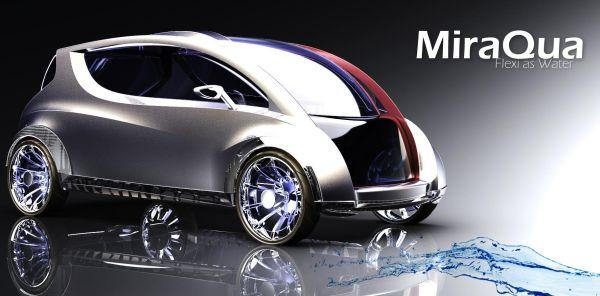
MiraQua: the green car without carbon footprint

Today there seems to be more and more and yet more vehicles on the road than ever. Everybody wants to have their own transport and a smaller car with least carbon emission seems to be an ideal solution for this inexhaustible number of cars that seem to be coming up. Tiny cars electrically driven but looking unique in design and performance may be the ideal solution, according to Chaoyi Li, designer of the MiraQua car. Though he designed this as a solution for Australia and China’s excessive traffic congestion, this car can become popular all over.
MiraQua designer, Chaoyi Li, has done a thorough job of designing this unique-designed small green concept car tailor-made for improving urban life quality. He had carried out through sketching, body storming practices, mock-up modeling in various media include styling foam, crafting clay and metal wire etc., and digital model making in Autodesk Studiotools. The name also refers to the smooth flow of the vehicle-traffic like that of a water stream.
With MiraQua being a totally electrical car, there are no carbon emissions. The very driving force behind the development of this car was the desire of its designer to reduce fossil fuel dependency and using optimally minimal road space for commuting and parking. This he has achieved with the creation of MiraQua.
It is heartening to see more and more efforts focused to contain the carbon print on our universe and reduce fossil fuel dependency. When individual transportation becoming a way of life, it is good to have a small car that will not hog road space. It is all the more better in having a green sensitive vehicle that will be eco-friendly and leave no carbon footprint.
Source: www.alternative-energy-news.info/miraqua-electric-car/

Today there seems to be more and more and yet more vehicles on the road than ever. Everybody wants to have their own transport and a smaller car with least carbon emission seems to be an ideal solution for this inexhaustible number of cars that seem to be coming up. Tiny cars electrically driven but looking unique in design and performance may be the ideal solution, according to Chaoyi Li, designer of the MiraQua car. Though he designed this as a solution for Australia and China’s excessive traffic congestion, this car can become popular all over.MiraQua designer, Chaoyi Li, has done a thorough job of designing this unique-designed small green concept car tailor-made for improving urban life quality. He had carried out through sketching, body storming practices, mock-up modeling in various media include styling foam, crafting clay and metal wire etc., and digital model making in Autodesk Studiotools. The name also refers to the smooth flow of the vehicle-traffic like that of a water stream.With MiraQua being a totally electrical car, there are no carbon emissions. The very driving force behind the development of this car was the desire of its designer to reduce fossil fuel dependency and using optimally minimal road space for commuting and parking. This he has achieved with the creation of MiraQua.It is heartening to see more and more efforts focused to contain the carbon print on our universe and reduce fossil fuel dependency. When individual transportation becoming a way of life, it is good to have a small car that will not hog road space. It is all the more better in having a green sensitive vehicle that will be eco-friendly and leave no carbon footprint.
Source: www.alternative-energy-news.info/miraqua-electric-car/

Eco-friendly seagull

This Eco Solar-Powered Flapping Seagull Kit is a great way to teach children about the abilities of the eco-friendly energy source of solar power. The flapping seagull comes in kit form, once assembled the kit is a plastic seagull that flaps its wings in the sunlight.
The Solar Powered Flapping Seagull Kit is perfect for children who have little experience in creating toys from kit form. The kit includes an illustrated instruction guide and only has 12 parts to assemble but does require you to have diagonal cutters and a pair of scissors. The flapping seagull is created from high density plastic parts, coloured to look like a seagull. The solar panel on the seagull’s back is used to provide power to flap the wings, allowing the seagull to appear to be in flight on a sunny day.
The Flapping Seagull Kit can be used as an educational aid to help teach children about solar power. Due to the model being supplied in kit form the child can get full involved with it, learning how the parts go together and visually experiencing how effectively light energy is converted into electrical power that causes the wings to flap.
The Flapping Seagull Kit is supplied with a suction cup that allows you to secure the seagull to a sunny spot. It is best to place the seagull in direct sunlight to allow it to work in optimum conditions and to help demonstrate the abilities of solar power. The kit is a great way to get a child involved with science and to help them learn about solar energy while providing them with an entertaining toy that will never require batteries.
Source: www.ecosystemdiscovery.com/2011/02/eco-solar-powered-flapping-seagull.html

The new Wave Power Device

Ocean Power Technologies Inc. has announced that it has completed the first of its new generation utility-scale PowerBuoy device, the PB150. The PB150 Powerbuoy has a peak-rated power output of 150 Kw and is the largest, most powerful wave power device build by the company.
Ocean Power Technologies Inc. is a leader in wave energy technology. The PB150 PowerBuoy will have the equivalent to the energy consumption of approximately 150 homes – the PB150 is designed for use in arrays for grid-connected power generation projects worldwide, according to a press release.
The device is currently being prepared for ocean trials at a site approximately 33 nautical miles from Invergordon, off Scotland’s northeast coast. These sea trials are expected to commence as soon as weather conditions permit. The company is seeking additional financing for the commercial utilization of the buoy after the trial phase is completed, including its possible deployment at various potential sites.
A second PB150 is already under construction in the US for a proposed utility-scale project in Oregon, and the company is involved in other planned projects in Australia, Japan and Europe that may utilize the PB150.
Source: http://www.tomorrowisgreener.com/the-next-generation-wave-power-device/

Biblio Leaf: solar-powered e-reader

Glad tidings for book lovers with green ethics! Maybe the e-reader does not consume much power. But if you love to read online and think you should do your bit towards using renewable energy, you have Toshiba and KDDI joining the ranks of LG to provide solar-powered e-readers. Biblio Leaf is the new kid in the e-reader block to match LG’s Solar eReader.
Biblio Leaf has a six-inch e-ink display and 2 GB memory that can be enhanced with a microSD card. With 3G & Wi-Fi connectivity, touch pad and buttons to turn pages etc, there is a battery onboard which can be recharged by a solar panel. Once charged fully, some 7500 pages can be read non-stop.
Biblio Leaf is to be released only in Japan presently as an add-on with the 3G wireless two-year contract at a $20 monthly cost. The smaller sized solar panel of Biblio Leaf may need more time for recharging as against the 4 hours needed by LG! The reader has to be careful not to cover the solar panel while holding the Biblio Leaf and reading from it.
Source: www.alternative-energy-news.info/e-reader-biblio-leaf/

Biblio Leaf: solar-powered e-reader

Glad tidings for book lovers with green ethics! Maybe the e-reader does not consume much power. But if you love to read online and think you should do your bit towards using renewable energy, you have Toshiba and KDDI joining the ranks of LG to provide solar-powered e-readers. Biblio Leaf is the new kid in the e-reader block to match LG’s Solar eReader.
Biblio Leaf has a six-inch e-ink display and 2 GB memory that can be enhanced with a microSD card. With 3G & Wi-Fi connectivity, touch pad and buttons to turn pages etc, there is a battery onboard which can be recharged by a solar panel. Once charged fully, some 7500 pages can be read non-stop.
Biblio Leaf is to be released only in Japan presently as an add-on with the 3G wireless two-year contract at a $20 monthly cost. The smaller sized solar panel of Biblio Leaf may need more time for recharging as against the 4 hours needed by LG! The reader has to be careful not to cover the solar panel while holding the Biblio Leaf and reading from it.
Source: www.alternative-energy-news.info/e-reader-biblio-leaf/