24 Hour Solar System

By combining a concentrated solar power system with a molten salt heat storage system, the researchers from the Massachusetts Institute, have discovered how to deliver low cost solar energy at night as well as during the day.

As you know concentrated solar and salt storage are two familiar technologies.

The researchers are focusing their system on bringing down installation, operating and maintenance costs.

This concept could help small towns and communities take themselves off the grid with a reliable, steady stream of clean energy.

Concentrated solar power means using mirrors to focus sunlight on a central tower and when is combined with molten salt in the conventional manner, the salt will be heat with solar energy, then the energy will be transferred to the water which generates steam that turns a turbine to produce electricity.
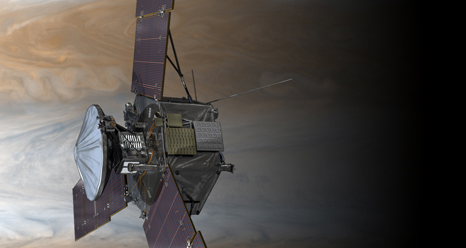
A NASA spacecraft will fly to Jupiter using solar power

NASA’s new mission to Jupiter will be undertaken by a windmill-shaped spacecraft.

The spacecraft will be powered almost entirely by solar power.

Named Juno, the spacecraft will have 2 billion mile journey ahead.

The Juno explorer will be the most distant probe ever powered by the sun.

The spacecraft is outfitted with three huge solar panels and is scheduled to lift off from the Kennedy Space Centre in the US state of Florida on Friday morning.

An unmanned Atlas V rocket will carry her into space.

Scott Bolton, Juno’s principal investigator, said the mission, coming just two weeks after the final flight of the manned space shuttle, shows that NASA is not fading into oblivion.

It will take Juno five years to reach its target, five times farther from the sun than Earth. No spacecraft has ever ventured so far, powered by solar wings.

The European Union’s solar-powered, comet-chasing Rosetta probe made it as far as the asteroid belt between the orbits of Mars and Jupiter.

The three wings of Juno are 29 feet long and 9 feet wide, necessary given that Jupiter receives 25 percent less sunlight than Earth.

Juno’s panels will provide 400 watts of power. In orbit around Earth, these panels could generate 35 times as much power.

NASA is preparing a new solar mission next month – the Grail mission during which two spacecraft will be fly to the moon – will also be solar powered.

BMW will convert landfill methane in to hydrogen

BMW is one of the most eco-friendly manufacturers in the world and he make green efforts for the environment conservation.

BMW is all set to research on extracting hydrogen from methane gas found in a specified local landfill.

BMW’s North American plant in Spartanburg, South Carolina, currently has a fleet of over 100 material handling vehicles that are powered by hydrogen.

It is one of the very few automobile plants that houses majority of the systems under a single roof.

The automaker hopes to build the infrastructure needed to power the entire fleet from hydrogen.

The plant already has hydrogen storage and a distribution area, which could be integrated into a full-scale version of the new project.

The project will cost a million dollars and will go through multiple phases.

The German automaker had actually saved $5 million per year after the implementation of high efficient technology.

An amazing solar tower in Arizona will power 150.000 homes

EnviroMission has decided to set up a solar tower with huge dimensions in the desert of Arizona.

The tower will instantly become one of the world’s tallest buildings because it measure some 2625 ft in height and 130 meters in diameter.

The structure will produce 200MW electricity, enough to power 150,000 US homes.

This project would also be a good money eater, costing a sensational US$750 million to the participants.

Arizona being a desert has an air temperature as high as 40 degrees Celsius.

As we know that air rises up making space for a cooler gush, the heated air at the bottom of the tower would rise up and the temperature at the ground level can be raised to 80 – 90 degrees.

Turbines would be integrated into the system such that when the hot air makes its upward move, it rotates the turbines and electricity is generated.

The temperature will be greater between the layers of air if the tower is planned tall and more energy would be generated.

No continuous raw feed would be required to keep the system working. Nature would take that responsibility.

This arrangement can be expected to keep working for 80 years without any maintenance need.

$14.2 billion offshore wind farm in France

The offshore wind farms are located far out into the sea; they trap winds at faster speeds than they would on land, and also, save up a lot of land space.

The French government of Nicolas Sarkozy has launched a €10 billion ($14.26 billion) tender to build about 1,200 wind turbines in 5 different offshore wind farms.

France depends mostly of nuclear energy.

France wants to diversify his energy generation with renewable sources and to have 23% of France’s energy come from renewable sources by 2020.

The offshore wind farms will be located off France’s coast on the North and West and will generate about 3.5% of France’s electricity needs.

Six Slovak solar parks on the grid

Six solar parks were putted on the grid by the german Vario green energy group in the Slovak Republic in May and June 2011.

The project planning, system configuration and the delivery of all the components were done by Vario green energy Concept GmbH from Holzgerlingen near Stuttgart, together with Vario green energy Parks GmbH from Munich.

The six solar photovoltaic power plants in Poltár, Biskupice and Ruminceparks have a power of 1 to 1.2 MW each and a total power of 6.2 MW.

The assembly time was six to eight weeks, but it worth because 70,000 solar modules will feed in an annual 7 million kilowatt hours of electricity into the local grid.

The plant operators will receive a remuneration of 38.23 Eurocents, according to the current Slovak feed-in tariff.

Since 1 July the solar electricity funding will be limited to roof-top plants with a power of 100 kilowatts maximum, but despite the cuts in financial support, Vario will remain active in Slovakia and plans to concentrate only on the roof-top market.

Wind energy market saw decreased demand in 2010

In 2010 the U.S. wind energy market took a hit with a decrease in investment compared with 2008 and 2009.

According to the Department of Energy’s, the report investment in terms of how much wind energy capacity was built and connected to the national electric grid.

In U.S. in 2010 were installed about 5 gigawatts’ worth of wind energy farms representing an $11 billion investment, according to the report.

Compare to the 10 gigawatts that were installed in 2009 in the U.S., and the 8 gigawatts in 2008, 2010 represents a decrease in wind energy installations.

“The combination of the delayed impact of the global financial crisis, relatively low natural gas and wholesale electricity prices, and slumping overall demand for energy outweighed the ongoing availability of existing federal and state incentives for wind energy deployment, resulting in a steep drop in capacity additions relative to both 2008 and 2009,” according to the
report.

China was the world’s fastest-growing market and U.S. was still the second-fastest-growing wind energy market in the world in 2010.

Wind turbine component manufacturing in the U.S. grew in 2010 and about 68 percent of components used in U.S. wind projects installed between 2009 and 2010 were made in the U.S.

Schneider Electric will supply photovoltaic inverters in North America

Schneider Electric, a specialist in energy management, has been selected by a major global engineering and construction company to supply photovoltaic inverters throughout 2011 in North America.

Schneider will supply an order of 100 MW of capacity, which is the largest order in Schneider Electric’s history in North America and one of the largest ever in the North American market.

“The extensive experience we have in the field, in a broad variety of operating environments, is one of the primary reasons for our company’s continued success and the satisfaction of our customers,” said Rudy Wodrich, Commercial Vice President, Americas.

With this order Schneider proves again his leadership in PV inverters and solutions.

Solar powered charger – efficient and flexible

Solar powered chargers have the serious potentiality to defy the main electricity grids, at least for charging of small appliances.

Designer Nikolay Bastrakov has made use of existing technologies to create his own version of a solar charger, whose intrinsic system counters the conventional problems to efficiently generate higher degree of power output.

He designed one of the world’s most efficient solar powered chargers.

This device is based on the user convenience of compactness, portability, and aesthetics.

The main form can be easily attached to a backpack because it has a mobile battery.

The compact form was made from silicone with an additional coating of the polymer film to form a singular structural element.

The designer had used thin film solar cells, which were assembled on a common substrate, and this substrate was connected to the main control unit housed in a silicone cell.

The advantage of thin film solar cells is to be effective on even cloudy days.

The device has a control unit which includes a converter, a small battery, micro-processor for processing the information received from the sensors.

This display system utilizes electronic ink.

This type of display forms an image does not emit and reflect light.

The bendable control unit can be attached to bags and backpacks to accentuate upon their degree of portability.

Spanish solar market is rising

The statistics for the PV market for 2010 released by the Spanish photovoltaic association ASIF, according to which the Spanish PV industry is moving strongly into the international market.

Thanks to the changes in the Spanish solar energy promotion policies and because a yearly cap of 500 MW was set, the international sales in 2010 increased by 130% compared to the previous year.

The total capacity of Spanish PV production was 1.000 MW in 2010, of this, 70% was exported and only 30% installed locally.

In Spain itself, 392 MW of new photovoltaic systems were installed, of which a good 60% were locally produced.

2009 was a bad year for Spanish market because subsidies were massively cut and the sales in Spain only reached 17 MW.

However, a large portion of the projects completed in 2010 were actually old projects, the completion of which was delayed by the crisis of the year before.

The ASIF predicts that Spanish solar market will increase more in the coming years, and expects only 300 MW of new capacity to be installed in 2013.