An entire airport pays nothing for electricity thanks to solar panels

solar-powered airport

Kochi, world’s first fully solar operated airport. Image source.

Day by day, solar power is becoming a more viable source of energy for homes and businesses. If you need further proof of this, look no further than the Cochin International Airport in India that is now entirely powered by solar energy and pays nothing for electricity.

The airport last year installed a solar power system with a 12-megawatt peak (MWp) capacity that added to its previous installation that had a capacity of 1.1 MWp, thus giving it enough solar energy to run the entire airport.

According to Yahoo! Tech, the whole project cost roughly USD$ 9.3 million and it was built on a 45-acre piece of unused land near the airport. While the airport obviously can’t rely on solar power to meet all its needs at night, it doesn’t pay anything for electricity because during the day its 46,000 solar panels push all excess power back onto the grid.

The airport estimates it will take under six years for it to recoup its initial investment costs from the project. It also announced plans to double its solar generation capacity in the coming years to 26.50 MWp.

Whether this sort of installation can serve as a model for other airports, of course, is open to debate. Cochin International Airport is only the seventh busiest in India and it was also fortunate to have 45 acres of unused land nearby that it could use for solar power. Major airports in the United States would likely need to have even more open land available to generate the necessary power to keep them running at all times.

Nonetheless, this is a really amazing accomplishment that shows just how much potential solar power offers to both reduce carbon emissions and deliver energy.

Europe’s largest floating solar plant to open in London

floating solar plant London

Thames Water and Lightsource Renewable Energy have nearly completed Europe’s largest floating solar plant, built on top of Queen Elizabeth II Reservoir in London. PHOTO: Lightsource

Lightsource’s 6.3 megawatt project will become biggest floating array outside of land-strapped Japan

England may be known for its dreary weather and oft-overcast skies, but that hasn’t deterred a group of businesses from wading forward with a solar energy project that will see Europe’s largest floating solar array installed on Queen Elizabeth II Reservoir in Greater London near Walton-on-Thames.

According to Cleantech Canada, Lightsource Renewable Energy and Thames Water expect to complete work on the 23,000-panel project later this month. With a nameplate capacity of 6.3 megawatts, the project remains relatively small when compared to larger land-based solar farms, but is large enough to snatch the title of largest marine solar plant in Europe.

“Becoming a more sustainable business is integral to our long term strategy and this innovative new project brings us one step closer to achieving our goal—this is the right thing for our customers, the right thing for our stakeholders and most importantly the right thing for the environment,” Angus Berry, energy manager for utility firm, Thames Water, said when the project began.

Power from the renewable project will help power Thames Water’s nearby water treatment works, contributing to the utility’s goal of self-generating one-third of its energy by 2020.

Responsible for constructing and operating the plant, solar energy firm, Lightsource, expects to connect the array to the grid by the end of the month. Designers will keep the plant’s panels above water using a platform consisting of 61,000 floats and 177 anchors. The solar installation will cover about one-tenth of the reservoir—the equivalent of about eight football pitches.

As in many urban centres, land is at a premium in London, and the floating plant takes advantage of an area that would normally be off-limits to developers.

Japan is another country actively pursuing marine solar to boost renewable generation without impacting residents. Electronics conglomerate Kyocera Corp. recently broke ground on the world’s largest solar plant outside Tokyo. With a 13.7 MW capacity, the project can pump out more than twice the power of the Thames project.

European solar market grows 15% in 2015

solar market Europe

Nottingham, UK: A panoramic picture shows the changing face of an estate after 600 homes had solar panels fitted. Image source.

In 2015, European countries connected around 8 GW of solar power systems to electrical networks, according to estimates by SolarPower Europe.

According to Renewable Energy Focus, demand for solar power systems in European countries increased by around 15% year-on-year, compared to 6.95 GW of new grid-connected solar power capacity in 2014.

“It is good to see the European solar power sector again on the growth path in 2015,” says James Watson, CEO of SolarPower Europe. Peaking in 2011, demand for solar power installations in Europe declined for 3 consecutive years.

Europe’s solar growth in 2015, however, is primarily based on the strong UK market, demand for solar systems in most other countries stayed flat or declined. Watson added, “Solar needs clear signals from policy makers in Europe to be able to contribute to achieving the climate goals agreed in Paris. With solar being competitive for residential and commercial applications in most European countries today, investors need a secure political framework for generation, self-consumption and storage of solar energy.”

The company’s findings show that annual global grid-connected solar rose by over 25% to more than 50 GW in 2015, from 40.1 GW in 2014.

Final numbers for 2015 will be presented in a new report in March. Estimates for 2016, including market forecasts until 2020, will be published in SolarPower Europe’s ‘Global Market Outlook For Solar Power 2016 – 2020,’ which will be launched at Intersolar Europe in June.

The world installed 59 GW of solar PV capacity in 2015

solar PV

GTM: Global solar added 59 GW in 2015. Image source.

The world added 59 GW of solar photovoltaic capacity last year for a 34% growth compared to 2014, preliminary figures from GTM Research showed.

According to See News Renewables, in 2016, global installations are expected to be 64 GW, bringing the world’s cumulative installed PV capacity to 321 GW.

“The fourth quarter of 2015 showed that global PV demand is very much at the mercy of government support, which can often be unpredictable and idiosyncratic, leading to often negative but sometimes positive outcomes,” said GTM Research senior solar analyst Mohit Anand.

After the US extended the federal Investment Tax Credit (ITC) in December, its share of expected global PV demand between 2015 and 2020 has increased from an average of 10% to 15%, even as substantial growth in demand is projected for the Asia-Pacific region (apart from China) this year and beyond.

Japan, the UK and China have on the other hand pulled back feed-in tariff (FiT) support, which has reduced expectations.

Global installations in 2016 are expected to be led by the US and China. According GTM Research, emerging markets will play a key role as India will become a reliable multi-gigawatt market this year, while Brazil and Mexico will have their ambitions tested against actual project execution. A number of other markets in Asia and Latin America like the Philippines, Pakistan, Bangladesh, Uruguay, Guatemala and Panama will make progress and try to break through to 100 MW.

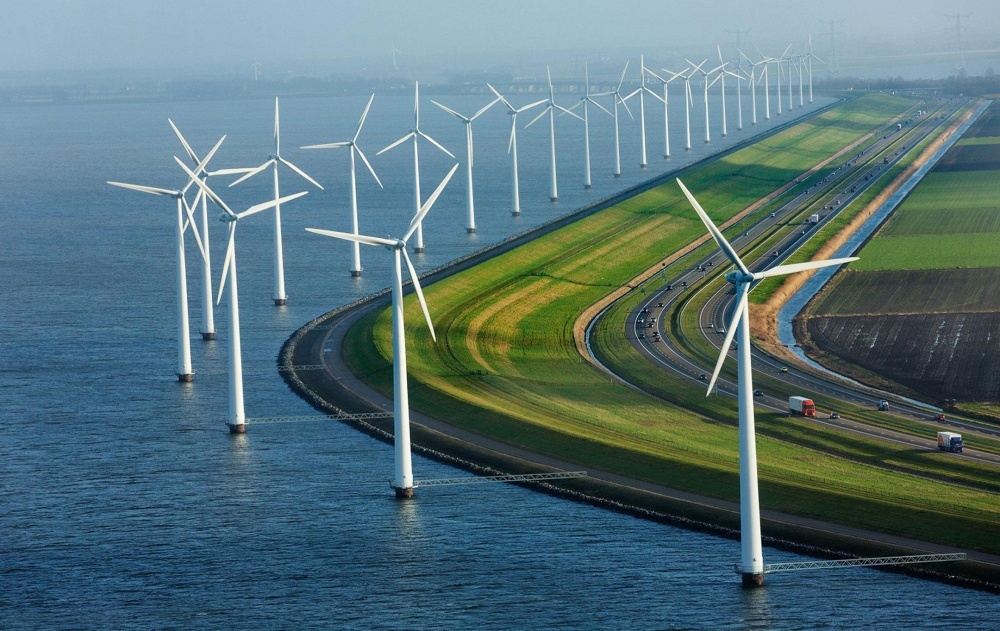
Denmark broke another world record in wind energy production

wind farm

Denmark produced 42% of its electricity from wind turbines last year. Image source.

Denmark successfully produced an astonishing 42% of its power from wind turbines in 2015, the highest proportion ever produced by any country.

According to mic.com, the figure exceeds 2014’s figure of 39%, which also set a record for national proportion of domestic energy generated via windmill. News agency Ritzau says Danish state electrical provider Energinet confirmed that in 1,460 of 8,760 hours during the year, windmill production actually exceeded the domestic power requirements of the country.

As a clean and renewable energy source, wind turbines are likely to become an important element of long-term climate and energy planning and in many countries already have.

Denmark’s successful harnessing of wind energy is the outcome of meticulous long-term investment by the country’s government. Its 7,314 miles of coastline are ideal for wind generation.

“It’s first country to build massive offshore wind parks and has an ambitious plan to run 100 percent on renewable energy by 2050: no oil, coal, or gas for electricity, heat, or even transportation,” NPR’s Lisa Desai reported in December. “The plan was set in motion in Denmark’s capital, Copenhagen, 40 years ago — not because of global warming, but because of the 1973 Arab oil embargo. With 99% of its energy then coming from the Middle East, Denmark decided to pursue energy independence.”

In the United States, wind is one of the fastest-growing energy sectors, an extended boom in U.S. wind energy may soon result in wind technology producing 4.5-5% of the country’s entire electrical supply — far behind Denmark, but significant as a measure of overall investment in a country traditionally dominated by dirty fuels.

Wind and solar energy comprise 61% of 2015 capacity additions, gas contributes 35%

wind turbines USA

Wind accounted for 47% of new generation capacity, followed by natural gas (35%) and solar (14%). Image source.

In 2015, the U.S. Energy Information Administration predicted that capacity additions would begin to slow, and from 2018 to 2024 the agency believes additions will average less than 4 GW annually.

New capacity additions are slowing as efficiency and demand management techniques make new generation less necessary nationwide, and the new plants that are added are largely cleaner than in years past, SNL Energy reports.

A combination of wind, solar and natural gas made up the overwhelming majority of new capacity additions last year: Some 96%, according to SNL’s data. Coal and oil combined for less than 1%.

Those figures are similar to what EIA noted last year: that renewable power made up 70% of new generation in the first half of 2015. But SNL’s data appears to show gas additions made up some ground, ultimately consisting of more than a third of additions last year.

According to Utility Dive, in the end, gas and wind together totalled 11,848 MW of the 14,468 MW installed in the U.S. last year — 82% of the total. 2,010 MW of solar made it the third largest resource in capacity added in 2015, with 14% of the total.

Record low prices have driven a big “build cycle” for wind energy, according to a study from the Lawrence Berkeley National Laboratory. Low power purchase agreement prices and the Clean Power Plan could help spur wind’s growth in 2016, especially as the U.S. House of Representatives passed a $1.1 trillion omnibus spending bill that included extensions for the solar investment tax credit and wind’s production tax credit.

According to EIA, new power additions through 2017 will average about 17 GW annually, with about half of that being non-hydro renewable power. From 2018 to 2024 EIA estimates capacity additions will average less than 4 GW annually. That’s a large shift from the 26 GW added each year between 2000 and 2013.

Material stores solar energy, releases heat on demand

solar material

New material stores solar energy and releases it in form of heat when required. Image source

Imagine if your clothing could, on demand, release just enough heat to keep you warm and cozy, allowing you to dial back on your thermostat settings and stay comfortable in a cooler room. Or, picture a car windshield that stores the sun’s energy and then releases it as a burst of heat to melt away a layer of ice.

According to a team of researchers at MIT, both scenarios may be possible before long, thanks to a new material that can store solar energy during the day and release it later as heat, whenever it’s needed. This transparent polymer film could be applied to many different surfaces, such as window glass or clothing.

Although the sun is a virtually inexhaustible source of energy, it’s only available about half the time we need it — during daylight. For the sun to become a major power provider for human needs, there has to be an efficient way to save it up for use during nighttime and stormy days. Most such efforts have focused on storing and recovering solar energy in the form of electricity, but the new finding could provide a highly efficient method for storing the sun’s energy through a chemical reaction and releasing it later as heat.

The finding, by MIT professor Jeffrey Grossman, postdoc David Zhitomirsky, and graduate student Eugene Cho, is described in a paper in the journal Advanced Energy Materials. The key to enabling long-term, stable storage of solar heat, the team says, is to store it in the form of a chemical change rather than storing the heat itself. Whereas heat inevitably dissipates over time no matter how good the insulation around it, a chemical storage system can retain the energy indefinitely in a stable molecular configuration, until its release is triggered by a small jolt of heat (or light or electricity).

The key is a molecule that can remain stable in either of two different configurations. When exposed to sunlight, the energy of the light kicks the molecules into their “charged” configuration, and they can stay that way for long periods. Then, when triggered by a very specific temperature or other stimulus, the molecules snap back to their original shape, giving off a burst of heat in the process.

Such chemically-based storage materials, known as solar thermal fuels (STF), have been developed before, including in previous work by Grossman and his team. But those earlier efforts “had limited utility in solid-state applications” because they were designed to be used in liquid solutions and not capable of making durable solid-state films, Zhitomirsky says. The new approach is the first based on a solid-state material, in this case a polymer, and the first based on inexpensive materials and widespread manufacturing technology.

“This work presents an exciting avenue for simultaneous energy harvesting and storage within a single material,” says Ted Sargent, university professor at the University of Toronto, who was not involved in this research.

Manufacturing the new material requires just a two-step process that is “very simple and very scalable,” says Cho. The system is based on previous work that was aimed at developing a solar cooker that could store solar heat for cooking after sundown, but “there were challenges with that,” he says. The team realized that if the heat-storing material could be made in the form of a thin film, then it could be “incorporated into many different materials,” he says, including glass or even fabric.

To make the film capable of storing a useful amount of heat, and to ensure that it could be manufactured easily and reliably, the team started with materials called azobenzenes that change their molecular configuration in response to light. The azobenzenes can then can be stimulated by a tiny pulse of heat, to revert to their original configuration and release much more heat in the process. The researchers modified the material’s chemistry to improve its energy density — the amount of energy that can be stored for a given weight — its ability to form smooth, uniform layers, and its responsiveness to the activating heat pulse.

The material they ended up with is highly transparent, which could make it useful for de-icing car windshields, says Grossman, the Morton and Claire Goulder and Family Professor in Environmental Systems and a professor of materials science and engineering. While many cars already have fine heating wires embedded in rear windows for that purpose, anything that blocks the view through the front window is forbidden by law, even thin wires. But a transparent film made of the new material, sandwiched between two layers of glass — as is currently done with bonding polymers to prevent pieces of broken glass from flying around in an accident — could provide the same de-icing effect without any blockage. German auto company BMW, a sponsor of this research, is interested in that potential application, he says.

With such a window, energy would be stored in the polymer every time the car sits out in the sunlight. Then, “when you trigger it,” using just a small amount of heat that could be provided by a heating wire or puff of heated air, “you get this blast of heat,” Grossman says.“We did tests to show you could get enough heat to drop ice off a windshield.”

Accomplishing that, he explains, doesn’t require that all the ice actually be melted, just that the ice closest to the glass melts enough to provide a layer of water that releases the rest of the ice to slide off by gravity or be pushed aside by the windshield wipers.

According to Laboratory Equipment, the team is continuing to work on improving the film’s properties. The material currently has a slight yellowish tinge, so the researchers are working on improving its transparency. And it can release a burst of about 10 degrees Celsius above the surrounding temperature — sufficient for the ice-melting application — but they are trying to boost that to 20 degrees.

Already, the system as it exists now might be a significant boon for electric cars, which devote so much energy to heating and de-icing that their driving ranges can drop by 30 percent in cold conditions. The new polymer could significantly reduce that drain, Grossman says.

“The approach is innovative and distinctive,” says Sargent. “The research is a major advance towards the practical application of solid-state energy-storage/heat-release materials from both a scientific and engineering point of view.”

European Commission extends restrictions on Chinese solar panel manufacturers

solar panels made in China

Restrictions extended on Chinese solar panel imports. Image source.

The two sides were involved in a major dispute over trade measures on solar panels imported from China, before eventually reaching deals on minimum import prices and quotas on Chinese imports in 2013.

The European Commission started an expiry review of the anti-dumping duties on imports of crystalline silicon photovoltaic (PV) modules and cells from China.

According to unionoracle.com, EU ProSun, an association of solar power equipment manufacturers, says such commission reviews typically take up to 15 months, which would mean the measures will likely stay in place through the end of next year.

The EU said in the statement that the partial interim review will consider whether or not it is in the EU’s interest to maintain the measures that are now in force.

Following a request lodged by EU ProSun on September 4, 2015, the commission now will work to determine whether the expiry of the measures would result in a continuation or recurrence of dumping of China-made crystalline silicon PV modules.

In Saturday’s statement, an official with MOFCOM’s Trade Remedy and Investigation Bureau said that the implementation of the agreed measures has been relatively “smooth”.

Shen said that the booming domestic market has benefited Chinese solar-panel makers as they continue to expand into overseas markets.

According to MOFCOM, the EU’s PV installed capacity dropped significantly to 7 GW in 2014, compared with 24 GW in 2012, and its share of the world’s total capacity fell to 14.5 percent from 74 percent.

According to the ministry, solar panels and related components are vital to the development of clean energy, but the pace of growth of clean energy has been slowed in Europe after some countries cut subsidies on solar panels and set minimum import prices.

Though China’s overall exports to the EU have declined in recent months because of the sluggish economy there, “disputes” in one industry will not affect the overall trade relations between China and the EU, Lin Guijun, vice president of the University of International Business and Economics in Beijing, told the Global Times Saturday.

“The overall trade ties between China and the European Union are generally positive”, Lin said, noting that cooperation in other areas such as food, autos, and high-tech is getting stronger.

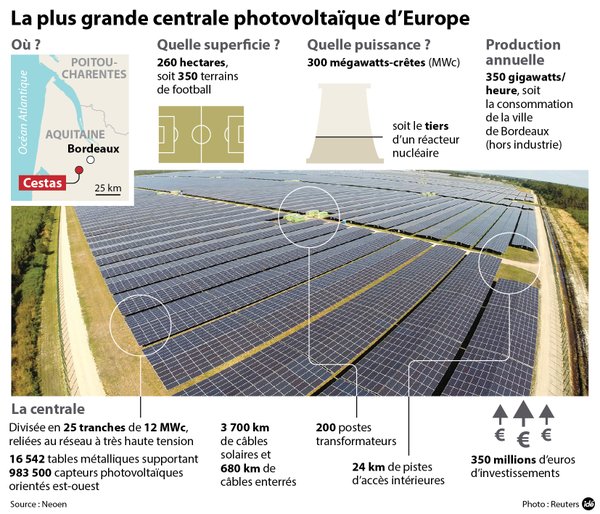
France just granted the biggest photovoltaic power plant in Europe

solar plant France

France’s 300 MW Cestas solar plant inaugurated. Image source.

The biggest photovoltaic power plant of Europe, having a power capacity of up to 300 MWp peak, which is the annual electric consumption of 300.000 people, was inaugurated on Tuesday to Cestas, near Bordeaux in France.

According to Middle East News Service, a project worth 360 million euros run by Neoen, a company which five years ago was just a start-up and today is one of the most dynamic players in the renewable energies field.

While the COP21 opened in Paris, this power plant takes up an area of roughly 250 hectares, the equivalent of about 350 soccer fields, including a million of solar panels, 5.000 km of cables and 204.000 screwed foundations, make quickly the symbol of the summit.

The 300 MW solar park started feeding energy into the grid already in late October. Developers wanted to acknowledge the importance of renewable energy to the goals of the climate talks going on in Paris (and probably to boost their media coverage as well) by holding the grand opening the same Tuesday the COP21 talks start.

“We will deliver power at an extremely competitive price, similar to wind power, and at any rate cheaper than the cost of power from new nuclear plants,” Neoen Chief Executive Xavier Barbaro told reporters on Tuesday.

Neoen opens Europe’s largest PV power plant of 300 MW. .Image source

Barbaro said the facility’s solar panels are not oriented toward the south, but on an east-west axis, which allows them to produce three to four times more power for the same surface area.

The east-west orientation also allows the panels to produce more power early in the morning and late in the afternoon, which corresponds more closely to French power demand patterns.

Barbaro said Neoen’s Bordeaux solar plant shows that solar photovoltaic can be highly economical in terms of geographical footprint.

He also said while the solar panels are Chinese made, they make up only a minority part of the investment and that the main costs are related to construction, engineering, cabling and electrical equipment, for which there are many competitive French suppliers.

Neoen has said it aims to install 1,000 MW of capacity by 2017, about half in France.

The orientation of panels also allows to produce early in the morning and late during the evening. The sale price of the produced electricity is approximately 105 euros the MWh during 20 years, what makes it one of the most rentable of France.

Costa Rica after 257 days with almost 100 percent renewable energy

wind farm Costa Rica

Wind farm in Costa Rica. Image source.

Data from the National Center for Energy Control (CENCE) showed that Costa Rica went 257 days on almost 100% renewable energy.

According to the Latin Correspondent, the Costa Rican Electricity Institute (ICE) reported that 98.82 percent of the electricity generated for domestic use came from renewable sources such as wind, geothermal, solar, biomass, and hydroelectric plants. Only 1.18 percent of generated electricity came from fossil fuels, used as a backup in the events of unfavorable weather conditions.

“The decline in oil imports has positively impacted electricity prices, as well as the expansion strategy and exchanges with the regional electricity market,” said ICE CEO Carlos Manuel Obregon. Luis Pacheco, ICE manager, added that their projections show the trend continuing in 2016.

ICE announced in March that the country’s initial target is to survive on 97.1 percent of clean energy.

Costa Rica has long been a leader in using renewable sources for electricity, prior to world leaders focusing on other sources of energy as a result of climate change.

Earlier this year, ICE announced that the country ran on 100 percent clean electricity for the first 75 days of the year. This was considered a huge feat by the international community, but more importantly, it was good news for consumers as electricity prices were cut by 7 to 15 percent.

The feat can be attributed to rainfall that Costa Rica received in the first part of the year, as the country mostly relies on the hydropower generation.

Costa Rica is committed to be carbon-neutral come 2021.