Spanish solar market is rising

The statistics for the PV market for 2010 released by the Spanish photovoltaic association ASIF, according to which the Spanish PV industry is moving strongly into the international market.

Thanks to the changes in the Spanish solar energy promotion policies and because a yearly cap of 500 MW was set, the international sales in 2010 increased by 130% compared to the previous year.

The total capacity of Spanish PV production was 1.000 MW in 2010, of this, 70% was exported and only 30% installed locally.

In Spain itself, 392 MW of new photovoltaic systems were installed, of which a good 60% were locally produced.

2009 was a bad year for Spanish market because subsidies were massively cut and the sales in Spain only reached 17 MW.

However, a large portion of the projects completed in 2010 were actually old projects, the completion of which was delayed by the crisis of the year before.

The ASIF predicts that Spanish solar market will increase more in the coming years, and expects only 300 MW of new capacity to be installed in 2013.

Gamesa a world leader in wind turbines

During 2011 Gamesa made progress in offshore strategy, technological design and development of the G11X-5.0 MW platform which will be equipped with a 128-metre rotor diameter.

Gamesa has a 15 years experience in the design, manufacture, installation and maintenance of wind turbines, having installed 21,000 MW in over 30 countries across four continents, with over 13,600 MW under maintenance.

All this makes her a world leader.

Recently, in Liverpool Gamesa showcased theG128-5.0 MW offshore wind turbine.

The first prototypes are scheduled for completion in the last quarter of 2012.

The company plans to invest over €150 million between now and 2014 in the UK wind power offshore.

Renewable energy from “Green Power Islands”

Green Power Islands – a great idea to generate and store renewable energy on uninhabited islands around the globe.

The Danish architectural firm Gottlieb Paludan has proposed generating power through wind or solar — depending on the climate — and then using the water surrounding the islands to store the power using pumped hydro technologies.

This new concept for producing and storing renewable energy could even provide all the power for Denmark’s population.

The idea of the architects is to create a “Green Power Island” off the coast of Copenhagen, which would become an “energy super centre” for the country.

The massive island would be accompanied by offshore wind farms, and populated with solar arrays and seawater pumps, and would produce marine biomass for biofuel.

The energy will be stored using pumped hydro facilities.

The architects from Gottlieb Paludan have suggested a few areas around the world where Green Power Islands could be built on existing islands.

These include: the Florida Keys, Jiangsu in China, Manama in Baharain and Tamil Nadu in India.

A solar-powered superyacht is available for charter in the Mediterranean

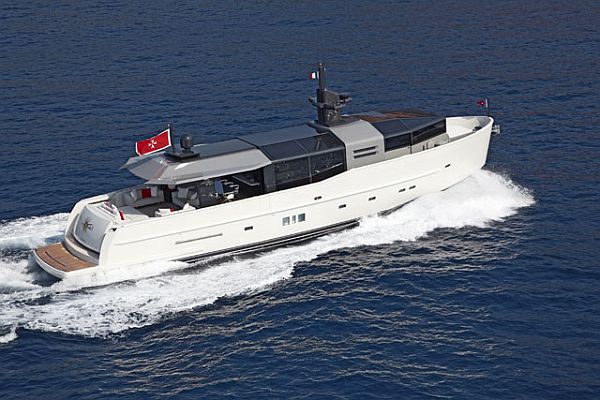
Arcadia 85, the super-yacht built with solar panels is offering charter holidays in the Mediterranean, during the summer of 2011.

The solar-powered yacht was named ‘Solar’ and from €49,000 (about $70,371) per week, up to eight people can feel confident about their carbon footprint, without losing out on luxury.

This yacht has the lowest fuel emission of any yacht in its class because it has an economical speed of 9 knots, when the diesel engines use only 30 liters per hour.

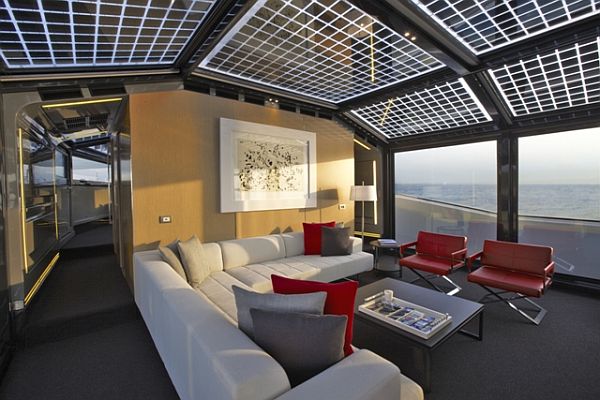
Solar’s panels run the hotel load, which it means everything from air conditioning to lighting, plus pumps and refrigeration.

The Solar yacht was built by  Edmiston & Company, it boasts a deck of 60 square meters and has  four cabins that have all necessary audio visuals, a spacious saloon in the top deck which is the entertainment area and sitting place and a huge saloon.

The super-yacht reaches a top speed of 18 knots propelled by a fuel that is organic in nature.

Also, on the yacht is a delicious cuisine where the chef uses only organic ingredients.

This is the perfect green-way to relax on your holiday.

A solar-powered superyacht is available for charter in the Mediterranean

Arcadia 85, the super-yacht built with solar panels is offering charter holidays in the Mediterranean, during the summer of 2011.

The solar-powered yacht was named ‘Solar’ and from €49,000 (about $70,371) per week, up to eight people can feel confident about their carbon footprint, without losing out on luxury.

This yacht has the lowest fuel emission of any yacht in its class because it has an economical speed of 9 knots, when the diesel engines use only 30 liters per hour.

Solar’s panels run the hotel load, which it means everything from air conditioning to lighting, plus pumps and refrigeration.

The Solar yacht was built by  Edmiston & Company, it boasts a deck of 60 square meters and has  four cabins that have all necessary audio visuals, a spacious saloon in the top deck which is the entertainment area and sitting place and a huge saloon.

The super-yacht reaches a top speed of 18 knots propelled by a fuel that is organic in nature.

Also, on the yacht is a delicious cuisine where the chef uses only organic ingredients.

This is the perfect green-way to relax on your holiday.

Solar thermal power generation has a new research centre

A new solar research institute was established by the German Aerospace Center.

The German Aerospace Center has more than 30 years experience in solar energy and solar thermal plants.

This technology has become increasingly important during recent years in sunny regions such as Spain and the southeast of the USA.

The Concentrated Solar Power (CSP) uses sunlight to produce steam, and then generates electricity by driving a conventional steam turbine.

The German federal state of North Rhine-Westphalia will subsidize this new institute with approximately € 27 million in the next few years.

Solar thermal power plants are usually very large projects with long lead times.

The world most efficient EV

The T.27 city car, designed by Prof. Gordon Murray is claimed to be the world’s most efficient electric car.

Also, Gordon Murray had designed McLaren F1.

He has been working on this project since a long time, and finally it has come out into the open.

Prof. Gordon Murray dreamed to make an electrically driven car ever since he unveiled McLaren F1 and he work on this project over the past three years.

The T.27 has a size that can easily fit into a single parking space.

It can accommodate three people inside, including the driver and has a massive upwards-swinging door.

The electric midget is a product of real innovation with a fully integrated electric motor, control system and battery design.

The vehicle isn’t a super car, because it has a top speed of 60mph; however the little vehicle leaves behind Mitsubishi’s i-Miev and the electric Smart Car with its efficiency.

It is 36% and 29% more efficient than i-Miev and Smart car respectively.

The vehicle can reach 100 miles on its charge and possesses a 33-horsepower electric motor charged by lithium-ion batteries.

The little T.27, it got tested under the strict Euro-NCAP safety standards and has been given” First Class” recognition.

You can be informed about your house energy usage with the new Interactive Carbon Calculator

If you want to know how much energy you use throughout the year, you can find now with the new Interactive Carbon Calculator House.

This little new invention use animatronics and light-up parts and two live displays that throw up information, changing according to the energy-saving systems you add and deduct from your home-grid.

The ICCH is portable and powered by rechargeable batteries and he also includes a thermostat dial, a washing machine dial, an energy saving bulbs switch and a load of similar features that you can add and remove from the home energy systems.

It has dimensions 70cm W x 60cm D by 80cm H.Weights 20kg.

The Interactive Carbon Calculator House is a great way to keep users informed and entertained, while providing education of a green life.

Solar thermal market is decreasing

A new report has been released focusing on two renewable energy technologies: solar thermal energy for hot domestic water heating and concentrating solar power (CSP) for electricity generation.

The EurObserv’ER Solar Thermal Barometer shows different fortunes for the two solar thermal technologies.

It seems the recession threw black spots over the European solar thermal market throughout 2010.

For the second year running, new installations for hot water production and space heating (collectors) decreased.

According to the EurObserv’ER survey the newly-assigned surface area was 3.8 million square meters in 2010, down from 4.2 million square meters in 2009 and 4.6 million square meters in 2008.

Total EU solar thermal collectors at the end of 2010 was 25 135.6 MWth.

Five EU countries, mostly Mediterranean, intend to develop the sector.

According to experts the solar thermal market will pick up again in 2011 because the European markets have recovered maybe except the Spanish market.

The key to future growth will be driven by future conventional energy price trends.

The first solar powered netbook by Samsung

Samsung intends to introduce a solar powered netbook – Samsung NC215S in the Russian market.

The netbook is eco-friendly, has solar panels and a battery life of around 14.5 hours.

Also he has 1 GB RAM, is powered by Intel ATOM N570 (166 GHz) and has a 10 inch display.

It has LED display and has an effective anti-reflective coating on it, which is said to give very colorful and vivid images even in direct sunlight.

With only two hours spent under the sun, the eco-friendly netbook could preserve the charge for an hour.

With this solar powered netbook the carbon dioxide emission into the atmosphere could be reduced significantly when compared to other exclusively electric- powered netbooks.

The solar netbook is an excellent option for those who want to take it to parks for a picnic or such, for direct sunlight is plenty for this.

Samsung will introduce this new solar powered netbook in Russia and U.S in the first week of July and in Europe after that.

The price of the new solar powered netbook in U.S would be $399 while 13999 Rubles in Russia.