The first hybrid electric aircraft by Siemens

At the 2011 Paris Air Show, Siemens presented the first serial hybrid electric aircraft.

This is a partnership project among Siemens, aircraft manufacturer Diamond Aircraft Industries, and aerospace giant EADS.

The DA36 E-Star is consists of two-seater and uses a serial hybrid electric drive train in which a main engine is powered alternately by a gasoline-powered generator and batteries.

The aircraft has a 70-kilowatt Siemens engine and use additional EADS batteries during takeoff and ascent.

The plane’s range is limited by the number of batteries and the amount of fuel it can carry.

The public debut was at the 2011 Paris Air Show but its actual aerial debut was on June 8 in Vienna.
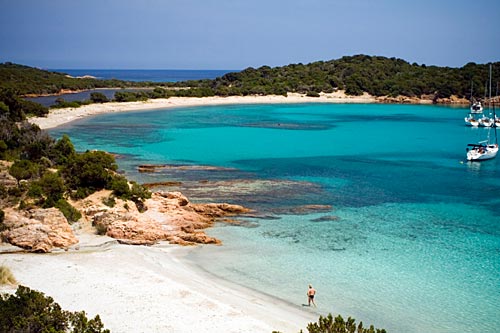
Corsica started to become attractive for the solar sector

Corsica, the fourth largest Mediterranean island enjoys a high degree of autonomy.

This island has a high solar radiation levels, between 1,750 and 1,900 kWh/m2, they are the highest in all of Europe.

Local authorities have a strong influence on the licensing of solar parks.

The island offers feed-in tariffs comparable to the French overseas departments and territories.

In France is a rule that wind or solar parks cannot feed in more than 30% of the electricity consumed in the region where they are installed.

The rule is applied to all systems with a capacity of more than 3kW.

Corsica is for most part mountainous and covered with forests, which makes it difficult to find suitable locations for solar parks.

One success story comes from White Owl Capital AG based in Berlin, Germany.

The company, which has specialized on renewable energy investments, and recently obtained licenses for the construction of two solar power plants with a total annual capacity of 5 MW.

The projects will incorporate 21.800 polycrystalline modules supplies by Trina Solar and be built on a surface of 11 hectares.

One of the first solar companies that became active in Corsica is juwi Solar.

In 2009 the company starts the construction of a new solar park on the island.

With a nominal capacity of 7, 7 MW the system was built on a surface of more than 30 hectares.

The solar plant that can generate solar power even at night

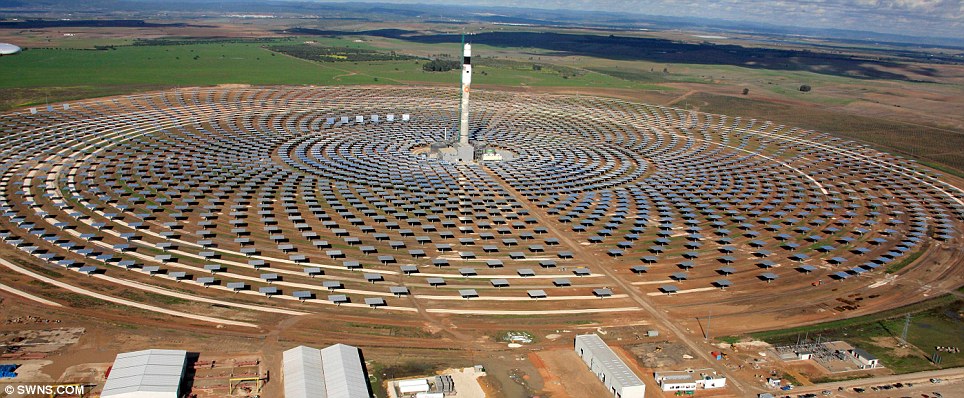
The world’s first solar power station that generates electricity at night is Gemasolar Power Plant near Seville in southern Spain which consists of an incredible 2,650 solar panels spread across 185 hectares of rural land.

The mirrors – known as heliostats – focus 95 per cent of the sun’s radiation onto a giant receiver at the centre of the plant.

This ingeniously and rather scrupulously conceived £260million ($425 million) power station is actually collaborative effort by Abu Dhabi energy company Masdar and a branch of Spanish engineering firm SENER called Torresol Energy.

Heat of up to 900C is used to warm molten salt tanks, which create steam to power the £260million station’s turbines.

But, unlike all other solar power stations, the heat stored in these tanks can be released for up to 15 hours overnight, or during periods without sunlight.

The sunny weather of southern Spain rather sustains the solar energy during most of the yearly mornings which allows the plant to generate clean and green electricity at an estimated 270 days per year, 3 times more than other renewable solar projects.

It is expected to produce 110 GWh/year – enough to power 25,000 homes in the Andalucia region.

Toyota UK car plant will use solar energy

In addition to manufacturing a number of striking eco friendly cars like Prius and Highlander, Toyota has now geared up to power entire operations of its Derbyshire production plant in the U.K. with solar panels.

The Japanese automobile giant has announced that it is going to implement the ambitious project, which will cost more than $14 million to the company.

Toyota looks set to install a £10m solar array to power operations at its Derbyshire plant.

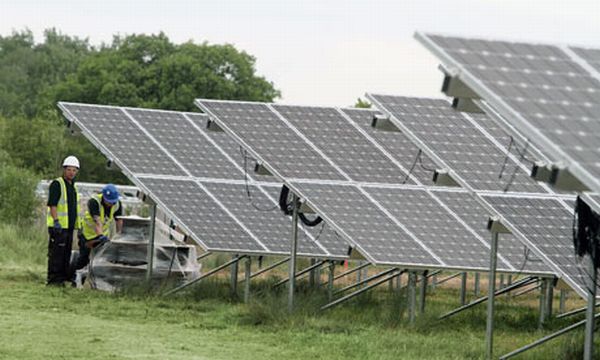
The company has already started work to fit around 17,000 panels on 90,000 square metres of industrial land – an area slightly smaller than four and a half football pitches – within the plant’s boundaries.

The array will be capable of supplying enough energy to build around 7,000 cars a year at the plant, which produces Auris hybrid, Auris and Avensis cars, as well as saving the company 2,000 tonnes of CO2 emissions a year.

Toyota project is expected to begin producing power in July 2011.

Illuminate your swimming pool with solar powered lights

There is no need to swim in the dark; you can illuminate your swimming pool perfectly well using solar energy instead.

These solar powered lights are very efficient, highly water resistant and they will keep your pool without an extensive electricity bill.

The solar powered lights have solar panels on the top that soak in the sun’s energy during the day time storing it all in internal rechargeable batteries.

During the dark hours the lights then glow, using the energy collected during the day.

These lights are using LED’s with 140 lumens capable of illuminating a space extending out to 1,000′ sq and also work as a thermometer for your pool, with an LCD on the top that shows the water temperature in the pool.

Easy to attach, this solar powered “solar pool light” is available for $180.

Switzerland stops nuclear power

We all know how dangerous nuclear power is after the disaster in Japan.

Many countries have begun protest to give up nuclear energy and Switzerland is one of them.

The last reactor in Switzerland will finally go offline in 2034 because the Swiss government just voted on Wednesday to abandon nuclear power in their country.

No reactors will be built and the last five reactors will slowly be phased out.

People’s confidence in the feasibility of nuclear energy has collapsed since the nuclear meltdown disaster in Japan.

Germany also decided to reject nuclear, and has accelerated the shuttering of a number of its aged reactors.

Over 20,000 people protested against nuclear power in Switzerland; the demonstration was the largest anti-nuclear power march since the eighties.

A new trend: Solar powered handbag

The interactive design firm, Diffus created a new innovation of solar powered handbag.

The glittering solar powered handbag use as design elements solar panels attached to it.

With the help of Swiss embroidery company Forster Rohner and the Alexandra Institute, Diffus wired 100 tiny solar panels onto the bag’s exterior , enough to generate power for your cellphone or other mobile device.

When the bag is opened, the fiber optics are activated and illuminating it during dark hours, allowing you to pick out your keys from your bag at night without fidgeting around.

A new record efficiency for solar cells

Always scientists around the world have been trying to create a low cost solar cell that is both efficient and easy to manufacture.

The purpose is to make solar energy affordable for the common people.

Swiss researchers from Swiss Federal Laboratories for Materials Science and Technology’s (EMPA) Laboratory for Thin Film and Photovoltaics have established a new world record efficiency of 18.7% for flexible copper indium gallium (di)selenide (CIGGS) solar cells on plastics.

This new discovery has the potential to lower the cost of solar energy drastically because they are cheaper to produce and this latest breakthrough brings them closer to the highest efficiency levels achieved by crystalline silicon and rigid CIGS cells.

These highly efficient solar cells will drop the cost of solar energy and make them ideal for use in demanding applications such as solar facades and portable electronic devices.

Intersolar Europe 2011

Intersolar 2011 will take place in June 8-10 in Munich, Germany.

This year Intersolar Europe expects about 2.000 international exhibitors to fill the 165.000 square meter exhibition space.

The exhibition will span a total of 15 exhibition halls, three more than last year.

The organizers expect 2.500 participants.

Special Exhibition PV Energy World, a new feature, will address the possibilities of PV grid integration.

It will also present the German energy mix of the future and the role PV is expected to play in it.

The accompanying program will complement the variety of innovations on display in the areas of photovoltaic, PV production technology and solar thermal technology.

Professionals from industry, commerce and trade, suppliers and institutions expected a larger program with conferences, seminars, workshops and lectures on the latest industry trends and teaching of practical know-how.

Intersolar Europe as a world-leading makes this a specific, personal exchange of valuable information on products, markets and services.

Wind power could be stored in water under Germany’s mountains

Germany hopes to meet the country’s electricity demands only with renewable sources by 2050.

This ambitious dream reflects on their green investment particularly in the fields of solar and wind energy.

Germany plans to store energy generated by wind turbines in water pump storage facilities under the mountains.

This first project in the world is made after a Marko Schmidt study.

The study was to build a plant in the abandoned Wiemannsbucht mine shaft in Bad Grund, a town in the western Harz Mountains.

Pumped-storage hydroelectricity plants work by using power from solar or wind turbine sources to pump water from one tank to another above it.

When the sun goes in or the wind stops blowing and electricity is needed, the water from the top is released to the bottom tank – pushing through turbines as it goes and generating power.

Six of such large scale projects have been proposed for the West Harz region.

The first one will be in Bad Grund and will have the storage capacity of 400 megawatt hours, which is sufficient to allocate power to over 40,000 households per day.

This project has a lot of advantages because such plants can be constructed in abandoned mine-shafts and also the provision of additional green jobs.