Fonroche Energie collaborates on Indian solar PV project

The French clean energy company Fonroche Energie will be working with the $15.9 billion Indian company Mahindra Group to develop the 5MW solar PV project in Gajner Village, Bikaner, Rajasthan under the country’s National Solar Mission Phase 1, Batch II.

It will be the first two projects with a total capacity of 20MWp and was awarded to the French company in 2011 under the Jawaharlal Nehru National Solar Mission (JNNSM). Altogether 22 companies were selected for this stage of the programme of which Fonroche is the first to commence operations.

The project will deliver more than 9 million units of clean green energy displacing an expected total of nearly 7200 MT of carbon dioxide annually. The plant consists of more than 67,200 high output thin film solar PV modules supplied by First Solar USA with four power transformers. The entire site covers 40 acres.

Mahindra’s responsibility includes design, engineering, procurement and construction of the solar plant which includes the construction of a 2.7Km, 33kV double circuit transmission line to export generated power to the national grid.

“Fonroche is pleased to partner with PR Clean Energy and Mahindra EPC on this project” said Thierry Carcel, CEO of Fonroche. “We have delivered a great result on time and on budget. We combine our experience, technical expertise and our solid know-how to finance, develop and build efficient solar plants and enable our utility partners to secure high-quality renewable generation assets in India.”

Tarun Kapoor, the Joint Secretary of India’s Ministry of New & Renewable Energy congratulated Fonroche for early commissioning of the project and expressed hopes that it would be the start of several more such installations.
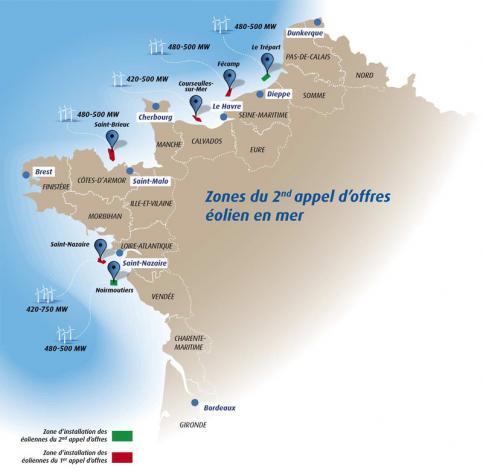
France starts the second offshore round

On 8 January, the French government declared the second bidding round for offshore wind farms off the French coast. This time a total of 1,000 MW are up for tender, divided into two farms.

These are the sites Le Tréport in the English Channel and the newly added area Noirmoutier south of the Saint-Nazaire project in the Atlantic, which were left empty-handed in the first bidding round. In both areas, there will be between 480 and 500 MW generated.

France expects investments of approximately 3.5 billion € through the projects for tender and to create 10,000 promising jobs through industrial development of this sector. The costs for the public will amount to 500 million € per year.

In the first round of bidding, approximately 2,000 MW were contracted at the beginning of 2012. That capacity is divided into four projects. The area Le Tréport was already tendered at the time. However, GDF Suez was the sole bidder – and was turned down by the French government due to the high price. To prevent this from happening in the second round, the price of the projects will gain more relevance. Overpriced offers will be excluded immediately.

In March, the second bidding round will open officially; applications must be submitted by September. The French government will award the contracts by January 2014.

First Solar begins construction of new California solar plant

The Campo Verde solar project will create 250 construction jobs and generate $230 million dollars for the local economy.

The plant will have a generation capacity of around 139MW and is located near El Centro in Imperial County, California. The project is expected to be completed sometime this year. A county study estimates its value to the economy as being over $230 million and predicts it will generate around 250 construction jobs.

Construction of the plant was finally approved on December 18th last year having received permission from the Imperial Irrigation District (IID) for easements required to carry transmission lines across IID’s Westside Main Canal. Earlier approvals were given by the US Bureau of Land Management (BLM) for a Right of Way grant and a Conditional Use Permit from Imperial County.

County of Imperial Board President Ray Castillo said the county is very pleased to see commencement of the construction on the project which will bring numerous benefits to the area and its citizens.

“First Solar’s project brings much needed jobs and economic development to the Valley at a time when it is sorely needed” he added. “The project also pays added tax revenue, funds for agricultural benefits and community benefits while helping the County diversify its economy. We’ve been working to attract projects like this for the past five or six years and are glad to see it’s finally happening. These projects are really our legacy for the Imperial Valley.”

James F. Cook, Project Development Director at First Solar, said that the company is grateful to IID, Imperial County and the BLM for their support, adding that he believed the project would create badly needed jobs and will help the county and the state to reach their respective renewable energy goals.

First Solar will deploy its advanced thin film PV modules at the plant which will generate enough renewable energy to power around 50,000 average homes while displacing 80,000 metric tons of CO2 per year. This is approximately equivalent to taking 15,000 cars off the road.

European Investment Bank finances EnBW Baltic 2 wind farm

EnBW Baltic 2 is being developed by German company EnBW Erneuerbare Energien GmbH and the funding deal was signed this week in Karlsruhe.

The wind farm consists of 80 wind turbines installed within an area of 27 square kilometres, 32 km north of the island of Rügen. This is a particularly demanding location for an offshore wind farm because the sea in this area can be as much as 44 metres deep in some places requiring the use of special foundation structures called ‘jackets’.

Nevertheless, EnBW Baltic 2 has a capacity of some 288 megawatts and will generate an annual output of 1.2 billion kWh, enough to supply 340,000 households while achieving emissions savings of around 900,000 tonnes of carbon.

“Demanding projects are required so that Germany can implement its ambitious energy aims” said Wilhelm Molterer, the Vice President of the European Investment Bank.

“EnBW Baltic 2 sets standards. It will be exemplary for future projects of this magnitude. With the financing that has now been agreed, it will be possible to implement the extensive project quickly and make a decisive contribution to the success of the energy transition.”

The turbines used in the project are Siemens SWT-3,6-120, 39 of them erected on monopoles with another 41 using jackets.

“The commitment of EIB to a project like EnBW Baltic 2 makes a very essential contribution towards the energy transition” said Thomas Kusterer, the Financial Chairman of EnBW Energie Baden-Württemberg AG. “Participation of the EIB in such projects represents a decisive element in structuring and financing.”

Aggie Bus- the wirelessly charged electric bus

Wireless charging is the way ahead, and we’ve been proclaiming it to be so since quite a while now. Using this concept, Utah State University’s Wireless Power Transfer team came up with a feasible way to mass transportation that could soon give cities a cleaner way to move commuters around.

Called the Aggie Bus, this one functions just like a regular gas-powered bus. The difference is its electricity-powered insides and the way it charges up!

The Aggie Bus uses wireless power transfer (WPT) pads that charge the bus at stops. These wireless transfer pads were created by Professor Hunter Wu and his team at the Utah Science Technology and Research (USTAR) initiative’s Advanced Transportation Institute and can give 5 kilowatts across a 10 inch air-gap!

600 MW wind farm in Romania finalised

The final wind turbine for Fantanele/Cogealac wind farm in Romania was connected to the regional grid in late November.

CEZ Group´s 600 MW wind farm thus is now in full operation and is producing enough cleaner energy to power more than one million Romanian households each year. The project utilizes 240 GE 2.5 MW wind turbines, including the 1,000th 2.5 MW class machine installed by GE worldwide.

The new wind park is located in Dobrogea, Constanta County, which is one of the most promising wind power regions in Romania. The individual wind turbine components for the Fantanele/Cogealac wind farm were produced all over the world. The turbine nacelles were supplied from GE’s facility in Germany. The rotor blades and towers came – apart from Germany – from Brazil, the Czech Republic, Denmark, Poland and China.

The size of the components – one rotor blade measures nearly 50 m in length – and the number of units required comprehensive planning. Twelve modes of transportationwere needed to move all of the components for each wind turbine from the port of Constanta on the Black Sea to the project construction site. At peak times, 25 cranes were in action at once at one of the largest building sites in Europe.

The project owner, CEZ Romania, is part of CEZ Group, the largest utility in Central Europe. “We chose GE because of its proven technology and the extensive experience of its project teams. The 2.5 MW technology offers the efficiency, availability and energy performance that will safeguard our success,” said Ondřej Šafář, CEZ project manager. “Thanks to the Fantanele-Cogealac wind farm, CEZ is making a major contribution to increasing Romania’s renewable energy generation. Before this project, Romania’s installed wind capacity was only 14 megawatts.”

200 MW of solar power projects in Rajasthan

The Rajasthan Renewable Energy Corporation Limited (RRECL) has again invited proposal from any interested company or bidding consortium for setting up 100 MW of solar PV projects and 100 MW of solar thermal projects under the Rajasthan Solar Policy 2011.

The selection of these solar power projects shall be through a tariff based competitive bidding process.

According to the press release the project sizes would be from 5 to 10 MW each. The winning bidder will be the company that offers the highest discount upon RRECL’s benchmark solar tariff of INR 8.42 (EUR 0.13) per kWh. A feed-in-tariff will be paid to the winning bidder for 25 years, who would have to supply power to the procurer in agreement with the terms and conditions of the Power Purchase Agreement (PPA). The last date for submission of bids through online form is January 11, 2013.

It may be recalled that RRECL had postponed its Request for Selection for solar power projects which was originally scheduled for March 19, 2012. Although the exact reasons for the postponement are not known, it is assumed that mounting losses of the state’s distribution company DISCOM could be the reason.

Unlike the National Solar Mission there is no compulsion for domestic contents of modules or cells and the bidder is free to choose any solar PV power generation technology – it may be crystalline silicon solar cell or thin film modules, concentrated PV or any other technology commercially established.

Also noteworthy is a mechanism through which DISCOM is not liable to make payments to the project developer, as the project developer will be signing a PPA with RRECL, that will also provide payment security to the developer. RRECL in turn will supply the procured solar power to DISCOM through a Power Sale Agreement (PSA)

German manufacturer delivers solar thermal system to Kabul

Many hours of sun at consistently low temperatures: The winter in Afghanistan is predestined for the use of solar heat.

The German collector manufacturer REM, Rottenburg/Laaber, has now delivered the first solar thermal system for a multiple dwaelling with 20 flats in Kabul – the beginning of a series of contracts for a total of 21 systems, which will be installed in Kabul and the surrounding area. Solar Sky GmbH in Kassel was in charge of project planning and construction of the system, consisting of 20 collectors and a 3,000 litre tank.

The private builder in Afghanistan hopes to find a solution to support heating during the cold season by the use of solar thermal energy. “The winters in Kabul are similar to those in Germany. There are four months in which the average temperature falls below freezing,” according to the solar expert Assghar Mahmoudi from Solar Sky. Measured in kWh/m², however, the amount of solar energy there is two or three times higher than in Germany.

“In Afghanistan there aren’t any real heating systems. Because of the frequent power failures, reliable heating for housing is quite difficult,” explains Mahmoudi.

The collector system is now being installed and, augmented by a gas fired boiler, will supply energy to heat drinking water and rooms in the future.

GE sells 230 turbines to Renova Energia

GE and Renova Energia, a wind developer leader in Brazil with 1 GW installed, have signed a contract worth US$ 394 million for 230 GE 1.68-82.5 wind turbines.

All 230 turbines have a 10-year operating contract, which will be managed from GE’s services centre.The purchase is part of Renova’s expansion plans that began in November 2011 with the construction of the Alto Sertão 2 Wind Farm, comprising 15 parks with a total installed capacity of 386 MW.

The contract is to supply energy sold by Renova in the Reserve Energy Auctions (LER) in 2010 and 2011. The Alto Sertão 2 Wind Farm is in the cities of Caetité, Guanambim and Igaporã, in the southeast of Bahia state, in Brazil.

“Scale and efficiency are increasingly important factors in the wind power segment and they have created a new scenario, which is more complex and which requires internationally recognised partners such as GE,” says Luiz Freitas, Legal and Purchasing Director at Renova. “This contract is the result of the value generated by a joint Renova and GE team in the pursuit of the state of the art in wind power technology in Bahia.”

The partnership between the two companies began in Brazil’s first exclusively wind energy auction in December 2009. “Renova built the largest wind farm in and we are proud to take part in this project and to help boost wind power generation in Bahia,” says Jean-Claude Robert, leader of GE’s Renewable Energy business in Latin America.

The farm, opened in July 2012, has 184 GE wind turbines producing a total of 294 MW.

The first kerosene free lighting state in India

The state government of Chhattisgarh in central India will become the first state of the country which is going to replace kerosene powered lanterns for lighting homes by LED based solar lanterns and solar study lamps.

On December 5, 2012, the two programmes “One child One Solar lamp” and “Solar for each family” were launched. The state government decided it will distribute free solar lighting systems to 1.3 million families as well as free solar study lamps to about 1.65 million school students. The implementation of the scheme will cost the exchequer approximately Indian Rupees INR 2.05 billion (about € 30 million).

Chhattisgarh Renewable Energy Development Agency (CREDA) will be the agency to implement the programme.

The scheme is based on findings of Census 2011 where it came to the fore that approximately 1.3 million families in Chhattisgarh are still deprived of electricity.

These families use kerosene or fire wood to illuminate their houses. The government provides a subsidy of INR 0.32 per litre of kerosene, while allocated quota for each family is about 3 to 4 litres kerosene every month. Thus the government spends approximately INR 100 to INR 120 per month per family. In addition, each family spends INR 50 to INR 60 per month. The distribution of solar lanterns to about 1.3 million families will save the government subsidies of approximately INR 1.43
billion annually and it will save family expenditure of approximately INR 0.78 billion. Solar lanterns would cost close to INR 1,200 each and solar study lamps will only cost INR 300 each.