World’s largest ships emit pollution as 760 million cars

If you’ve been under the impression that your SUV is a gas-guzzler and environment killer unlike any other, here’s a bit of respite.

Your metal-chunk-on-wheels certainly isn’t the most polluting modes of transport today. James Corbett, professor of marine policy at the University of Delaware, recently figured ships to be one of the major causes of environmental pollution, a fact we’re sure is true!

According to recent research, a single super-ship can create just as much pollution as 50 million cars. Putting together the 5 largest ships in the world, these together spew just as much nitrogen oxide and sulphur oxide as 760 million cars! And these statistics certainly aren’t surprising, given that each of these ships use 109,000-horsepower engines that run around the clock for the better part of the year.

Weltec Biopower builds 500 kW plant in France

The French project developer Methaneo agreed with Weltec Biopower to build a 500 kW biogas plant in France.

The Paris-based company has elaborated its own concept for „cooperative agricultural biogas plants“. The new biogas plant project „Cap‘Ter Methanisation SAS“ strengthens the value chains and material cycle in the vicinity of the plant location. The biogas technology is delivered by the German company Weltec.

Construction work will begin in January 2013, and the plant is to go live and starting feeding electricity into the French grid as early as July 2013. The 4,900 m³ stainless steel fermenter is to be filled with an agricultural substrate mix consisting of cattle manure, sheep manure, chicken manure and grain residue.

For Weltec it is the sixth biogas project in France. According to the French Environment and Energy Management Agency for the development of regenerative energies (ADEME) there have been twice as many project enquiries than in the prior year for biogas projects.

Wind power is growing in Italy

The installation of small wind turbines is growing rapidly in Italy since the introduction of feed-in tariffs.

Since the introduction of feed-in tariffs for small wind turbines in 2008, installations have grown exponentially, says the University’s Wind Energy Report. Yet installed capacity of small wind turbines doubled from 2008 to 2009 and again in 2010 and 2011.

More than 90 % of the small wind turbines are less than 80 kW in size. 70 % of the capacity is installed in the southern provinces, 25 % in the central region, and only 5 % in the mountainous north.

Up to 10 MW may be installed in 2012, says the report. Nevertheless, in absolute terms, installed capacity of small wind turbines in Italy remains a fraction of that of commercial-scale turbines. By the end of 2011 cumulative capacity of small wind turbines in Italy was 13 MW – 2 % of the 6,700 MW of wind generating capacity in the country.

Italian feed-in tariffs for small wind turbines are quite lucrative, effectively double that of total payments for commercial wind under Italy’s Green Certificate (Certificati Verdi) system. Yet, Italian small wind tariffs are comparable to those in Britain, e.g. new tariffs go into effect at the end of the year.

Italy will differentiate small wind into two size tranches: <20 kW, and 20 kW to 200 kW. While the tariffs have been cut modestly, the contract term has been extended from 15 years to 20 years.

According to the University’s Wind Energy Report, 3 % of Italy’s land area has average wind speeds of greater than 6 m/s or good to excellent wind, 37 % has average wind speeds from 4 m/s to 6 m/s or sites with good wind. The report quotes the Italian wind energy association (Associazone Nazionale Energia del Vento), that Italy has the potential for 1,000 MW of small wind turbines capable of generating 1.5 to 2 TWh per year.

Utilizing sea wave to generate electricity

Researchers Dr Ismail, Dr Muhammad Murtadha and Baharin Abu Bakar from Universiti Teknologi MARA, Malaysia have carried out a conceptual study on mathematical modelling for sea wave in electricity generation.

This conceptual study focused on using Oscillating Wave Column (OWC) which is considered as the most efficient way to utilize sea waves, the largest power source on earth, to generate electricity. Previous studies have revealed that global wave power is estimated to be 1TW (1 terrawatt=1012W).

Countries where numerous seafronts surround the country could tap into an alternative source of power generation which could be generated by the waves during the different seasons of the year. In addition, the findings of this study could be adapted to evaluate the capability to produce electricity on shore such as from lakes and rivers with undulated waves.

Researchers began the study with the derivation of mathematical equations for each component in the electrical generation system after taking into consideration the sea wave as the input to facilitate the workability of the entire system. The team of researchers verified the validity of the developed mathematical equations for each stage of the research.

This was done to establish its workability. Electrical and mechanical relationships were derived to relate the workability of each component in the system for the purpose of electricity generation. Numerous experiments were conducted to optimize the results in this study which would eventually lead to the generation of electricity. The results obtained from the experiments indicated that the proposed model appears practical could be implemented.

Costa Rica opens first large-scale solar facility

Costa Rica is celebrating the opening of the country’s first large-scale solar power plant.

The solar park, which was built on the slopes of Miravalles Volcano and is comprised of 4,300 solar panels, will generate 1.2 GWh per year, enough to electrify about 600 homes.

“Today we not only took another step in terms of increasing installed capacity to continue generating more electricity and meet our economy’s demands, but we also confirmed that our growth will continue to rely on renewable energy generation,” said President Laura Chinchilla in the inauguration.

The project wa originally proposed by the Instituto Costarricense de Electricidad, and developed by GeSolar, a Chinese manufacturer of solar products, and Greenersys, a Coasta Rican supplier of renewable energy products.

Environment Minister René Castro said the project is important because it marks the entry of Costa Rica to the production of large-scale electricity based on solar energy, and “also mark[s] the way to bring electricity to thousands of families across the country in the future.”

The project was financed by the Japanese Ministry of Environment, Energy and Telecommunications (MINAET), which provided a $10 million grant under the Japanese government’s Project for Introduction of Clean Energy by System Solar Electricity Generation for the Government of the Republic of Costa Rica programme.

Vestas and Mitsubishi can become partners on world’s largest offshore turbine

Vestas Wind Systems A/S and Mitsubishi Heavy Industries Ltd. are in talks which could lead to them building the world’s largest offshore wind turbine.

The report by Stefan Nicola and Gelu Sulugiuc says the envisioned 8 MW turbine would be about 30 percent more powerful than the prevailing market leaders.

The report comes just hours after Vestas, the world’s largest manufacturer of wind turbines, announced it had received €900 million (About $1.17 billion) in financing from nine international banks.The financing period extends through 2015.

The funding should also help shore up its competition with rival Siemens AG, which has been regularly announcing deals for turbines with offshore wind farm developers in Denmark, Germany and the United Kingdom.

Bloomberg reports that Siemens is currently testing a 6 MW turbine, and quotes a company spokeswoman as saying a 10 MW turbine may be in the offing.

Renault has the automotive world’s biggest solar-powered vehicle canopy

French automaker Renault has come up with a fabulously green way to shelter the cars that roll out of its assembly lines.

The company has recently installed a canopy soaked through with solar panels that has been termed as “the world’s largest photovoltaic system in the auto industry”.

The canopy generates green energy and also shelters the company’s cars beneath. Six of Renault’s production sites including Douai, Maubeuge, Flins, Batilly, Sandouville and Cléon will make use of these systems covering 40 hectares or 400,000 square meters in all.

Capable of generating 52,600 MWh of electricity a year and reducing Co2 emissions by 200-tons annually, these solar panels will prove to be a boon for Renault, helping the automaker substantially reduce its carbon footprint in France.

The world’s first country powered completely by the sun

Nestled in the South Pacific lies a paradise-on-earth, called Tokelau. In essence a group of islands, this beautiful country has now been crowned as the world’s first nation to go 100% solar-powered!

Using a one megawatt array spread across three atolls, Tokelau is capable of powering 1,400 residents’ lives with renewable energy, generating enough power to satisfy 150% of their electricity needs!

Using 4,032 solar panels and 1,344 batteries, the system was installed by New Zealand-based PowerSmart for a price of £4.7 million. The country also generates energy by burning coconut oil in case of cloudy days or emergencies.

The system has helped the country reduce its carbon emissions by nearly 950 tonnes a year, turning Tokelau into an ideal example for the rest of the world.

Samsung opens Korea’s first offshore wind farm

Samsung has been leading the world of technology and has turned into one of the world’s largest consumer electronics giants lately.

The Samsung Heavy Industries has now moved towards the greener horizon and has announced plans for an 84-megawatt offshore wind farm. This will be Korea’s first and will be built jointly with Korea Southern Power Co in Jeju Island.

To be built with a depth of about 30 meters and 2 kilometers away from the coast of Daejeong-eup in Seoguipo in Jeju Island, Samsung plans to have this one up and running by 2015. The wind farm will generate enough energy to power up 100,000 households with clean and green juice.

The world’s largest wind farm, London Array

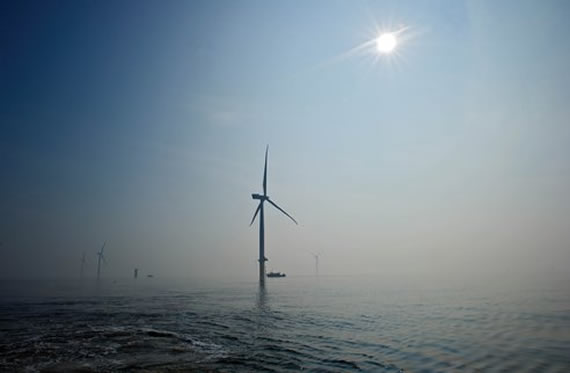
The world’s largest wind-farm, the London Array has finally begun generating energy.

Located in the Thames Estuary, the project will be worth 630 MW when completed. Currently, just 15 of the total 175 turbines have been installed, with the rest being set up.

The remaining turbines are expected to be constructed by the end of this year.

Once completed entirely, the London Array will generate enough juice to power nearly 470,000 UK homes. And this is just the first phase.

The second phase of the project will increase the capacity to 870 MW, slightly off the previously planned 1 GW capacity.