 After some time of speculations, today Bosch has confirmed that the will exit the crystalline solar sector. From 2014 they will suspend the ingot, wafer and cell productions. More than 3000 employees will be affected.
Bosch
Ending a shaky week for solar – Suntech finally entered into insolvency on Monday after mounting rumors – Robert Bosch GmbH has today confirmed it will cease its solar activities, following months of speculation. The engineering and electronics company has been investing in the industry since 2008.
In addition to ceasing production of ingots, wafers and cells, Bosch has said it will “quickly” sell off its individual business units, and end all development and marketing activities. This will include selling its 150 MW photovoltaic module plant in Vénissieux, France (which opened just last year) and scrapping its Malaysian plans for a manufacturing facility.
Aleo solar AG, of which Bosch owns 90.7%, will also be heavily affected, as Bosch seeks to sell its shares. According to aleo, Bosch has “assured aleo solar AG of financing until the end of March 2014.”
In a statement, it said, “Irrespective of the search for a buyer, aleo solar AG has already taken action: We have closed our factory in Spain, commenced the liquidation of our joint venture in China and have disposed of our shares in Bosch CISTech. We are now examining further activities for improving our earnings.”
Justifying today’s decision, Bosch said that it has been unsuccessful in achieving competitiveness in the solar industry, despite having “comprehensively examined every aspect of its solar business.”
“We have considered the latest technological advances, cost-reduction potential, and strategic alignment. And there have also been talks with potential partners. However, none of these possibilities resulted in a solution for the Solar Energy division that would be economically viable over the long term,” stated Volkmar Denner, chairman of the Bosch management board.
Stefan Hartung, chairman of the Bosch Solar Energy AG supervisory board and member of the Robert Bosch GmbH management board responsible for the Energy and Building Technology business sector, added, “Despite extensive measures to reduce manufacturing cost over the past year, we were unable to offset the drop in prices, which was as much as 40 percent.”
Despite the cutbacks, Bosch has said it will keep on Bosch Solar CISTech GmbH, located in Germany’s Brandenburg. “Its future alignment will be decided at a later date,” said Bosch in a statement released. Aleo solar sold its equity stake in CISTech to Bosch in December.
A Bosch spokesperson further told pv magazine that voltwerk electronics GmbH, Conergy’s ex-photovoltaic inverter subsidiary, which was acquired by Bosch last April, will not be affected, since it is not part of the company’s solar business.
Overall, Bosch’s solar division employs 3,000 people, of which 850 are based at aleo and 150 at CISTech. It is not yet clear how many jobs will be lost.
In the figures
In January, Bosch reported that while sales rose across all its divisions by 1.6% in 2012 to total revenues of €52.3 billion (US$69.7bn), the company forced to take an impairment of as much as €1 billion from its solar business.
Meanwhile, last August, the company announced the closure of its thin film production in Erfurt. However, it also took over Ersol and Johanna Solar, as well as a part of Aleo Solar; and acquired Voltwerk, the inverter partner of Conergy.
Category: _featured slider
Photovoltaics manufacturing is growing fast in India
 India – PV manufacturing capacity in growing fast, upto an incredible 2GW for both fotovoltaic cells and modules!
From India’s Ministry of New and Renewable Energy (MNRE), domestic manufacturing capacity of photovoltaic cells and modules has grown to 2 GW. It estimates India’s potential solar power per square kilometer to be 30 to 50 MW.
Since Jawaharlal Nehru National Solar Mission (JNNSM) in 2010 was lunched, which aims to install 20 GW of solar power by 2022, India’s manufacturing capacity of photovoltaic cells and modules has increased from around 200 MW to 2 GW.
Among other benefits for local manufacturers, while domestic content requirements have been stipulated under the first phase of the mission – and more stringent rules are being considered under the second – there have been complaints by some in India that imported photovoltaic goods, particularly from the U.S., for India’s manufacturers is causing problems.
In response, the government launched an anti-dumping investigation into solar cells from the U.S., China, Taiwan and Malaysia. It also, however, offers concessional customs duties to imports of finished solar products and equipment, in its bid to reduce solar power costs.
Solar power
In related news, MNRE has estimated that the solar power potential per square km in most of India is between 30 and 50 MW, in shadow-free areas.
Overall, MNRE states that 27 GW of renewable energy has been installed in India. It aims to install a further 30 GW of new capacity between 2012 and 2017.
The total capacity installed, solar is said to account for just over 1 GW. At the end of 2012, Mercom Capital Group stated that around 1.1 GW of projects are due to be installed in the next six months. Meanwhile, the MNRE has allocated 1.172 GW worth of solar projects via various programs over the past three years, of which 369 MW have already been commissioned.
This year, 4.4 GW of new solar projects have been announced in India, however, Bridge to India predicts that only around 1.1 GW will be online by the end of the year. Mercom is slightly more optimistic, with forecasts of between 1.3 to 1.4 GW.
There are, however, concerns that Phase II will be “indefinitely delayed” due to a lack of funds. Despite this, it seems likely that when funds are available, a Viability Gap Funding (VGF) model will be adopted, as opposed to reverse auctions.
Using Solar Energy to Create Wind Power
 A new type of wind power plant is in the works, and it is claimed to be able to produce clean energy from the sun and the wind with virtually no carbon footprint, fuel consumption, or waste production.
And not only that, it purportedly uses heat from the sun to produce its own wind, which would make this new type of plant desirable in areas with low or inconsistent winds.
The Clean Wind Energy Downdraft Tower is a skyscraper-sized hollow cylinder that uses the natural downdraft tendencies of air by spraying water (as a fine mist) across the top opening of the tower to cool the hot dry incoming air. As the water evaporates and cools the air, it becomes denser and heavier than the outside air, and then falls through the tower at speeds up to (and above) 50 mph. Once the faster moving air reaches the bottom of the tower, it is channeled through wind turbines in the base of the tower, generating electricity.
In addition, if the Tower is located in areas conducive to direct wind harvesting, the exterior of the Tower could be covered with “vertical wind vanes” to help capture prevailing winds to produce supplemental power.
“One tower is equivalent is to at least one nuclear power plant. But here’s the big difference of course. You don’t have nuclear issues, you don’t have the safety issues, you don’t have spent nuclear rods, you don’t have the storage issue. These towers apparently they last forever. All you’re using is water, evaporation, wind gradients and presto! You do have the energy that’s produced through turbines and generators. So what we’re talking about is water and wind at free will.” – George Elliott, scientist and consultant for the Wind Energy Tower.
Clean Wind Energy, Inc. (soon to Solar Wind Energy Tower, Inc.), also plans to build a pair of demo towers, up to 2,250 feet tall, near Yuma Arizona, potentially powering up to 1.6 million homes in California and Arizona.
“The first Tower in Arizona has a projected output capacity, on an hourly basis, of up to 1000 megawatt hours, gross. Using a 70% capacity factor the Tower’s potential hourly yield would be 700 megawatt hours from which, approximately 17% will be used to power its operations, yielding approximately 600 megawatt hours available for sale to the power grid.” – Clean Wind Energy, Inc.
Underground greenhouse for year-round gardening
 Growers in colder climates often utilize various approaches to extend the growing season or to give their crops a boost, whether it’s coldframes, hoop houses or greenhouses.
Greenhouses are usually glazed structures, but are typically expensive to construct and heat throughout the winter. A much more affordable and effective alternative to glass greenhouses is the walipini (an Aymara Indian word for a “place of warmth”), also known as an underground or pit greenhouse. First developed over 20 years ago for the cold mountainous regions of South America, this method allows growers to maintain a productive garden year-round, even in the coldest of climates.
It’s a pretty intriguing set-up that combines the principles of passive solar heating with earth-sheltered building. But how to make one?From American sustainable agriculture non-profit Benson Institute comes this enlightening manual on how a walipini works, and how to build it.
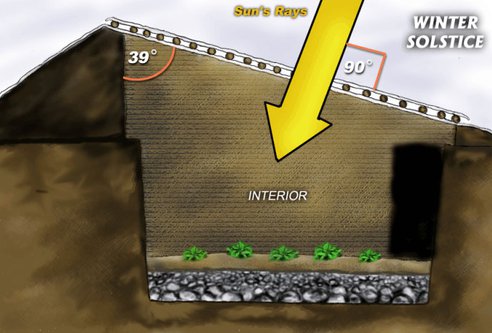 The Walipini utilizes nature’s resources to provide a warm, stable, well-lit environment for year-round vegetable production. Locating the growing area 6’- 8’ underground and capturing and storing daytime solar radiation are the most important principles in building a successful Walipini.
The Walipini, in simplest terms, is a rectangular hole in the ground 6 ‛ to 8’ deep covered by plastic sheeting. The longest area of the rectangle faces the winter sun — to the north in the Southern Hemisphere and to the south in the Northern Hemisphere. A thick wall of rammed earth at the back of the building and a much lower wall at the front provide the needed angle for the plastic sheet roof. This roof seals the hole, provides an insulating airspace between the two layers of plastic (a sheet on the top and another on the bottom of the roof/poles) and allows the sun’s rays to penetrate creating a warm, stable environment for plant growth.
 This earth-sheltered greenhouse taps into the thermal mass of the earth, so that much less energy is needed to heat up the walipini’s interior than an aboveground greenhouse. Of course, there are precautions to take in waterproofing, drainage and ventilating the walipini, while aligning it properly to the sun — which the manual covers in detail.
Best of all, according to the Benson Institute, their 20-foot by 74-foot walipni field model out in La Paz cost around $250 to $300 only, thanks to the use of free labour provided by owners and neighbours, and the use of cheaper materials like plastic ultraviolet (UV) protective sheeting and PVC piping.
Renewable energy brings power to the rural corners of Argentina
 Since 1999, the Renewable Energy in Rural Markets Project (PERMER) has aimed to put an end to this situation. Supported by the World Bank and the Global Environment Facility (GEF), the initiative connects homes and schools to clean energy sources such as solar panels and windmills.
So far, around 25,000 residential customers and nearly 2,000 schools have been reached, and 300 solar thermal stoves, furnaces and water heaters have been installed.
Also 2,000 users in small, isolated communities have benefited from small power systems (generation and distribution networks). The project has also included almost 400 public buildings, such as health centers, community centers, as well as Gendarmerie (Police force) and National Parks Administration’s stations.
In PERMER’s proposed scheme, photovoltaic or wind system are installed for the user, who then pays for its operation and maintenance dependent on their means.
“The project ensures that someone is responsible for the proper functioning of the systems at the provincial level, which allows it to be sustainable in the long term,” said Lucia Spinelli, Manager of PERMER on behalf of the World Bank.
Many rural Argentineans in 19 provinces found their quality of life improved through access to electricity.
“In the Impenetrable Chaco, the population is very spread out and so solar panels have had a significant impact, as they have managed to supply 14% of users,” said Raul Garcia, an Official in the Secretariat of Energy for the Province of Chaco who has been participating in PERMER over the last 12 years.
With an area spanning 12,000 square km of islands, the province of Entre Rios was an ideal candidate to join the initiative. It did so in 2010 and since then, two schools and 850 rural households have received photovoltaic systems.
“The children of fishermen can now go to school twice a week and do chores at home, it is not necessary to travel several miles to buy kerosene and it is much easier to charge mobile phones,” said Alberto Alcain, Alternative Energies Coordinator in Entre Rios.
“People have adapted well to technology and began to ask for solar panels instead of electricity lines,” asserted Graciela Pedro, who’s in charge of the Alternative Energies office at the Energy Agency of Neuquén.
There, all the rural schools and nearly 2,000 homes have solar panels. “The impact is rewarding. Families have more hours in the day to do their activities, such as women weaving and other crafts,” Pedro added.
NRG Energy launches new solar powered playground
 New solar canopy will demonstrate how solar can contribute to a new generation of sustainable projects.
Solar company NRG Energy has developed a new solar canopy which has been installed over a playground at the Dr Martin Luther King Jr School for Science and Technology in New Orleans. The company donated the canopy which is intended to enhance sustainability education for the students and demonstrate the viability of solar PV for a whole range of new and exciting projects.
As part of the launch, NRG hosted a panel discussion on the future of solar power. Jeffrey Sachs, Director of the Earth Institute at Columbia University, was among those attending along with Don Smolenski, President of the Philadelphia Eagles, Matt Petersen, President and CEO of Global Green USA and Laura Spanjian, Director, Office of Sustainability for the City of Houston.
“The new solar installation at the Martin Luther King School demonstrates the applicability and versatility of solar power in urban environments,” said David Crane, NRG CEO and President, who dedicated the new installation alongside the New Orleans Saints quarterback Drew Rees and the school CEO and Principal Dr. Doris Roche’-Hicks. “In addition to reducing the energy costs of the school, the solar panels will provide shade and shelter to students and teachers while on the school grounds.”
NRG has recently championed flagship projects at several key locations including Arizona State University, FedEx Field, the home of the Washington Redskins and various other stadiums across the US. The solar canopy at the school consists of 397 solar panels generating 112kW of power which will be enough to supply one-third of the building’s peak electricity demand. The installation also incorporates playground upgrades and various educational components including fans, drinking fountains, a garden irrigation system, prisms and inspirational quotations.
“More than just a source of energy, this playground will serve as a source of inspiration, education and fun for years to come,” said Dr. Hicks, the school principal.
3.5 MW solar farm in Saudi Arabia completed
 Phoenix Solar says that it has completed the largest open-land solar installation in Saudi Arabia.
The solar farm has a capacity of 3.5 MW and has been constructed on land belonging to the world’s largest oil research centre, the “King Abdullah Petroleum Studies and Research Center” in Riyadh.
On an area of 55,000 m² a total of 12,684 Suntech modules were installed in a construction time of 20 months. They will produce 5,800 MWh of solar electricity annually and thus save 4,900 tonnes of CO2 emissions. The central inverters were supplied by SMA.
In order to combat the expected high temperatures and sand storms, Phoenix Solar placed the generator connection boxes, which are normally in the solar field, in the well-insulated and air-conditioned inverter building.
According to the planners, this measure will enable significantly easier maintenance as well as extending the lifetime of the solar power station.
Ron Shen, Suntech Vice President Asia Pacific, declared that this project is an important milestone for the development of the solar industry in Saudi Arabia. Andreas Hänel, CEO of Phoenix Solar, added: “It was recently announced that Saudi Arabia plans to install 41 GW of solar capacity over the next 20 years. With this first-class reference project we are now well-established here in the region.”
San Francisco Bay Bridge Celebrates 75 Years With LED Light Up
 To commemorate 75 years of the San Francisco Bay Bridge, an $8 million public art installation will light up the iconic structure for the next two years.
Conceived by creative agency head, Ben Davis, and designed by New York-based artist Leo Villareal, Bay Lights will see the San Fran bridge illuminated by 25,000 white LED lights. The lights are programmable, so that different animations and abstract patterns can be created and will be visible from afar.
They will cover a massive 1.5 miles along the length of the bridge, and 500 feet in height.
The installation is scheduled for light up on March 5th 2013, until some time in 2015
Japan planning world’s largest offshore wind farm
 Nearly two years after a massive offshore earthquake and the tsunami which devastated the Fukushima Daiichi nuclear reactor and the mostly agricultural communities that surrounded it, the Japanese Agency for Natural Resources and Energy has unveiled plans to build the world’s largest offshore wind farm adjacent to the disaster zone.
The initiative comes part of a plan to reconstruct the area stricken by the disaster in March 2011.
By 2020, the government said, a total of 143 wind turbines on platforms 16 kilometres off the coast of Fukushima. The wind farm will generate 1 GW of power once completed, officials said.
Following the disaster at the Fukushima plant, all 54 of Japan’s reactors were shut down, and only two have been brought back online in the 21 months since as the government has tried to move closer to fulfilling its pledge to increase the use of renewable energy across the nation.
Among the unique features of the plan is Japan’s intention to rely on massive floating turbines which will be stabilised with ballast and anchored to the 200-metre-deep continental shelf that surrounds the Japanese coast via mooring lines, according to an analysis of the project by New Scientist.
The magazine also reported the wind farm will supply electricity to the powerful grid which Fukushima’s two nuclear power plants were connected to, reducing transmission costs.
The project is being overseen by Takeshi Ishihara of the University of Tokyo.
Wind Powered Battery Storage Pilots in Texas
 Duke Energy Renewables has developed a way of saving extra power generated by batteries at its Notrees Windpower Project in Texas.
The $44 million battery-storage system holds excess energy from the 153-megawatt Notrees farm and releases it when power supplies dip. This innovation is particularly helpful because winds often blow more strongly at night, when power needs are less, and more gently during the day, when power demands are higher.
With this battery storage system, wind generated power can be kept and used, as and when needed, thus stablising the grid. Data from the project is being collected and analysed for scale-up by the US Department of Energy, who helped fund Duke Energy Renewables’ wind power, storage battery.