Solar module efficiency: Panasonic says they topped SolarCity at 22.5%

panasonic solar panels

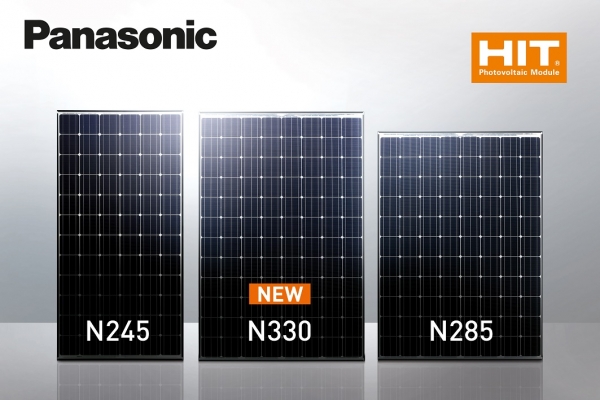
Panasonic’s new N330 module will be on show at SEUK next week, alongside the company’s record-setting prototype. Image: Panasonic.

Panasonic claims to have toppled a world record for module efficiency announced a few days ago by SolarCity and will be demonstrating the new module at next week’s Solar Energy UK exhibition organised by PV Tech’s publisher, Solar Media.

Last Friday SolarCity announced it had recorded 22.04% efficiency in a rooftop module from its pilot line, however this morning Panasonic has revealed its recorded module conversion efficiency of 22.5% on a commercial-sized prototype module, verified by the Japanese National Institute of Advanced Industrial Science and Technology.

According to pv-tech.org, Panasonic said the new record built on cell-level efficiencies of 25.6% recorded last year. “The new panel efficiency record demonstrates once again Panasonic’s proven leadership in photovoltaics and our ongoing commitment to move the needle in advanced solar technology,” said Daniel Roca, senior business developer at Panasonic Eco Solutions Europe.

The technology manufacturer has also announced the launch of its new HIT N330 module, a 96-cell, 330W panel which features 19.7% module-level efficiency and claims to deliver 27% more peak power compared to mainstream 260W multicrystalline modules.

Both products will be on show at next week’s SEUK expo, held at Birmingham’s NEC.

Wind energy is now as cheap as natural gas

wind energy

Wind power is now comparable in price to fossil fuels, new report says. Image via cdn7.triplepundit.com

Wind power is now comparable in price to fossil fuels, and solar is well on its way, according to a new report that confirms earlier predictions that renewables aren’t just the best option for the environment – they’re unequivocally the smartest long-term investment you can make on energy.

The report, by Bloomberg New Energy Finance, found that in the second half of 2015, the global average cost of onshore wind energy will be $83 per megawatt-hour of electricity (which is down $2 from the first half of the year), and for thin film solar photovoltaics, the cost is $122 per megawatt-hour (down $7 in the past six months).

The costs as they are now, and the steady drops we’ve seen in price over the past six months alone, suggest that as the technology to eke out more and more electricity from solar and wind energy gets ever-more sophisticated, those prices can only continue to fall.

“You start to go from a world where renewables are expensive, to a world where renewables are actually cheap. And that’s very meaningful,” said Seb Henbest, head of the Europe, Middle East, and Africa analysis for Bloomberg New Energy Finance. “Onshore wind is today competitive in many places in the US and around the world with coal and gas-fired generation technology.”

According to Science Alert, the report based its analysis on what’s known as the ‘levelised cost of electricity’, which takes into account several factors such as interest rates, capital expenditures, and the operating costs of facilities, and uses these to compare different energy sources on a dollar value. The team analysed over 55,000 projects around the world to come up with their global average figures.

In terms of breaking it down more specifically into locations, the report found that while coal-fired electricity costs $75 per megawatt-hour in North and South America (up from $66 per megawatt hour), in Europe, you’ll have to fork out $105 for the same amount. And gas-fired electricity costs $82 in the Americas, on average (up from $76 per megawatt hour), and $118 in Europe.

Those higher costs for fossil fuels in Europe – due in large part to government-regulated carbon policies – make it even more of a no-brainer for them to be getting into renewables, with the report finding that the average cost of wind is $85 per megawatt-hour in the UK and $80 in Germany, while the combined average for coal and natural gas was more than $100 per megawatt hour in both countries.

“In China, by contrast, coal-fired electricity generation remained extremely cheap – just $44 per megawatt hour,” Chris Mooney reports for The Washington Post. “Wind, in contrast, cost $77 and solar photovoltaics, $109.”

Mooney adds that the US is also not quite there yet, with the incredibly cheap average price of coal- and gas-fired electricity sitting at $65, while wind sit at $80 per megawatt-hour and solar at $107. The good news is that a lot of the cost of renewables is up-front – installation, construction, and the initial period of energy harvesting.

Unlike the process used to convert fossil fuels to electricity, converting renewable energy to electricity doesn’t require fuel, which means solar, wind, and even the currently expensive wave power sources will continue to get cheaper.

“Clean energy solutions like wind and solar are getting more affordable and more accessible by the day, meaning they are increasingly the smartest long-term financial investments for utilities and other electricity producers across America,” Michael Brune, the executive director of US-based environmental organisation, the Sierra Club, said in a statement. “The transition to a clean energy economy is going full speed ahead and pushing dangerous, dirty fossil fuels to the back of the line.”

SolarCity says it has created the world’s most efficient solar panel

solarcity solar panels

Solar panels created by SolarCity. Image via cdn.zmescience.com

SolarCity, the sun-powered startup founded by Elon Musk’s cousins Lyndon and Peter Rive, announced that it has created the world’s most efficient solar panel, with a 22 percent module-level efficiency.

Bright, a startup out of Y Combinator that installs solar panels in Mexico, agreed that if SolarCity’s new panel is indeed producing a 22 percent module-level efficiency, it would make the panels the most efficient. At least on the surface.

“The big caveat is that once you use more expensive materials, such as GaAs, the efficiency for modules can go way up (north of 40 percent),” Bright founder Jonah Greenberger told TechCrunch.

According to techcrunch.com, SolarCity created its new panel via a proprietary process that it claims not only ups the performance, but also significantly reduces the manufacturing cost relative to other high-efficiency technologies at the same size as other solar panels, adding an additional 30 to 40 percent more power per panel.

The percentages of overall energy production and module-level can be confusing but don’t get lost in them. The gist is these panels promise to have a higher output at a lower production cost – and SolarCity says it is the most efficient solar panel at the moment, reducing waste – cuttings costs for both consumer and company and adding an attractive amount of power performance.

SolarCity backs up the claim with third-party, independent testing from the Renewable Energy Test Center, an energy services and certification testing facility for solar panel products.

The sun-powered provider expects to install these new panels on rooftops and carports, initially and then move to commercial installations.

SolarCity plans to produce a small batch of the new modules out of its 100 MW pilot facility in Fremont, California this month and then will move production to SolarCity’s 1 GW facility in Buffalo, N.Y. The company expects to produce 9,000 to 10,000 solar panels per day when production is in full swing.

The company recently announced an initiative to lower the cost of sun power for lower-income families. In a partnership with solar panel installation firm Everyday Energy, SolarCity will work with affordable-housing developers to install its solar systems in California.

Clean energy outdoes coal in the UK

renewable energy UK

Anti-coal protests across London. Image via energypage.eu

According to the data released by the Department of Energy and Climate Change, renewables produced more power than coal plants for full three-month period for the first time in the United Kingdom.

The government statistics reveal that over the second quarter of 2015 the total share of electricity generation that came from renewable sources increased to a record high of 25%, Wired.co.uk has reported.

Experts believe this is due to an increase in wind turbines and solar panels being installed over the past 12 months, as well as more favourable weather conditions.

But although on the surface these statistics appear to be promising, according to projections from the European Commission, the UK continues to be one of the lowest ranking countries in the European Union when it comes to the percentage of energy consumed that is produced by renewables.

In 2013 the UK produced 8,400,000 TOE’s (tonne of oil equivalent) through renewables, compared to more than 33,680,000 in Germany, 17,377,000 in Spain and 23,073 in France.

Most of the UK’s renewable energy is produced with biomass and waste systems (61.7%) and wind energy (29.1%), with hydropower and solar energy still lagging far behind several other countries in northern Europe.

The new data has also come at a time when the future of renewable energy funding in the UK is facing considerable uncertainty; there has been growing concern in recent months that the UK’s renewable energy efforts are likely to be cut short after Conservative ministers called for subsidies to be redistributed.

Two giant Israeli solar plants to provide nearly 2 percent of the country’s electricity

solar power plants Israel

Istrael to invest in 121-megawatt solar power plant. Photo via Think Progress

Las week, Israel inked a $1 billion deal to build what will become the second 121-megawatt solar power plant under construction on a swath of country’s southern Negev desert.

When completed in early 2018, the two plants, along with a smaller 30-megawatt photovoltaic plant slated for the site, will provide 2 percent of the country’s total electricity production. Israel has a target of getting 10 percent of its electricity from renewable sources by 2020.

According to Climate Progress, the Israeli Finance Ministry said the overall site, named after the nearby town of Ashalim, will be the biggest of its kind in the world, and will have electricity storage options on top of solar power generation.

The 121-megawatt Megalim Solar Power Ltd. project is already under construction and is expected to be completed by 2017. The newly financed project — to be built by Abengoa, a Spanish firm that focuses on innovative technologies in sustainability, and the Israeli global infrastructure group Shikun & Binui — is expected to break ground next month. It is being financed by the Overseas Private Investment Corporation and the European Investment Bank as well as several local commercial banks.

The newly financed solar park will produce energy for more than 69,000 households, and prevent 463,000 tons of carbon dioxide emissions annually.

“This agreement is a milestone for renewable energy projects in the country,” said Yariv Nehama, deputy accountant general for the Finance Ministry. “The project is unusual in its scope and technological innovation, which combines capacity with energy storage.”

Both of these two large solar plants are concentrating solar power (CSP) — otherwise known as thermal solar — plants. Instead of converting solar power directly into energy, as photovoltaic plants do, CSP plants focuse the sun’s rays using parabolic troughs.

The reflected sunlight then heats a fluid, such as molten salt, that runs a generator which creates electricity. The Ashalim plant in Israel will be able to use the molten salt — salt that has been turned into a liquid due to high heat — to store thermal energy for 4.5 hours.

The International Energy Agency’s (IEA) 2014 CSP Technology Roadmap determined that CSP has a promising future due to its cheap and efficient storage qualities, and that 11 percent of global electricity will be generated by concentrating solar thermal power in 2050.

While growth of CSP has been slower than expected — in many ways due to the rapid drop of the cost of PV power — CSP has started to see significant growth.

In Israel, a sun-soaked desert country, solar power has been slow to catch on in large part due to the recent proliferation of natural gas, two large offshore reserves of which were discovered in the last decade.

Since 2011, natural gas has gone from providing about a third of Israel’s electricity to around half. As the Wall Street Journal recently reported, after the offshore gas reserves were discovered, the government stopped approving the addition of new solar projects to the grid.

Right now renewable energy only makes up about 2 percent of Israel’s electricity supply, far short of the 10 percent by 2020 goal.

The Israeli government expects electricity demand to double within the next 20 years due to population growth, higher living standards, and climate change that will create a need for more air conditioning.

Israel’s Environmental Protection Ministry recently recommended that the country cut its greenhouse gas emissions by 30 percent by 2030.

“Israel has all the conditions necessary to lead to an advanced climate policy: We have gas, sun, financing and brains that know how to find solutions,” Environmental Protection Minister Avi Gabai said earlier this month. “Our plan will leverage all of these advantages to create a growth engine for the economy, and the technology developed here will provide solutions for dealing globally with climate change.”

Study: Brains ‘excited’ by wind turbines

wind farm

Wind turbines are not linked to health complaints, study says. Image via power-eng.com

Groundbreaking research from Germany on low-frequency “infra­sound” adds to the recent body of work that is challenging wind energy proponents’ insistence that turbines are not linked to health complaints reported by those living close by.

According to The Australian, the international project led by the National Metrology Instit­ute of Germany (PTB) concludes that exposure to infrasound below the range of hearing could stimul­ate parts of the brain that warn of danger. It finds that humans can hear sounds lower than had been assumed and the mechanisms of sound perception are much more complex than previously thought.

The researchers do not claim the results are definitive regard­ing wind turbines and health impacts, and say more work is needed.

But the research builds on recen­t work in Japan and Iran — and investigations by NASA dating back to the 1980s — that suggests the health science of wind energy is far from decided and would benefit from further inquiry, though it is unlikely to persuade prominent wind farm advocate, Simon Chapman.

Dr Chapman, who did not respond to questions from The Australian about the German work, told a Senate inquiry into wind farms and health last month that he was not persuaded by other recent­ research.

“I believe there is much evidence that belief in the harms of wind farms is the cause of harm from wind farms and that those who are intent on spreading this fear are largely responsible for that harm,” he told the inquiry.

The Clean Energy Council was unavailable to comment. But others in the renewables industry say they are open to further inquiry.

Oliver Yates, the chief executive officer of the Clean Energy Finan­ce Corporation, which has less than 20 per cent of its portfolio invested in wind farms, said that “environmental considerations” were critical in any project.

Asked at a conference in Sydney yesterday if the corporation was concerned about increased health risks, he replied: “I encourage any necessary additional support or research people feel that they need to have in relation to this matter to get clarity and satisfaction within their own mind.”

The National Health and Medical Research Council is currently reviewing the evidence on wind turbines and health. The Australian Medical Association will review its position on the issue once the NHMRC reports. Until then, its position is that available Australian and international evidence does not link adverse health effects to wind farms.

The AMA’s vice-president, Geoffrey Dobb, said there was “no accepted physiological mechanism where sub-audible infrasound could cause health effects”.

The German study suggests the impact of very low frequency noise on some people is poorly understood. Scientists in Japan measured brain function and reported last year that it showed the brains of Japanese wind turbine workers could not achieve a relaxed state.

In a similar vein, a study of 45 people in three groups by Tehran University, published earlier this year, said “despite all the good benefits of wind turbines, it can be stated that this technology has health risks for all those exposed to its sound.”

Work by Neil Kelley and NASA in the 1980s on early model wind turbines found impacts from infrasound and led to design changes.

It identified a direct causal link between wind turbine infrasound and low-frequency noise and neighbours’ health problems including sleep disturbance, collect­ively described as “annoyance”.

As the number and size of wind turbines has increased, the number and spread of complaints has also grown. The German research says infrasound is pervasive and generates from an increasing number of sources, including renew­able energy sources such as wind parks and heat pumps.

“Although commonly declared as ‘non-audible’, the number of complaints about infrasound expos­ure has been increasing expon­entially in Germany and also in other countries serious problems exist,” the research paper says.

“It has been agreed that infrasound is perceived by humans and it represents an almost unknown hazard to human health.” Project leader Christian Koch told The Australian the intention of the PTB researc­h was to investigate how infrasound can be perceived by humans.

“We think this is a contribution to the many questions we have within this field but it is too early to conclude seriously about wind turbines­ and their impact,” Dr Koch said.

As part of the German research, laboratory tests were conducted using very pure low-frequency signals.

Test subjects were asked to describe their experience and their brain responses were measured using magnetoencephalography and functional magnetic resonance imaging technologies.

The results showed that human­s could hear sounds of eight hertz, a whole octave lower than had been previously assumed, and that excita­tion of the primary auditory cortex could be detected down to this frequency.

A PTB report on the research findings said all participants had explicitly stated that they had heard something.

Clinical observations showed a reaction in certain parts of the brain which play a role in emotions. “This means that a human being has a rather diffuse perception, saying that something is there and that this might involve danger,” Dr Koch said.

PTB said the wind energy sector and authorities had often tried to appease concerns of health impacts from wind farms by declaring that the sounds generated were inaudible and too weak to be the source of health problems.

But Dr Koch said the issue must be taken seriously. “Neither scaremongering nor refuting everything is of any help in this situation,” he said. Investigations were only beginning and further research was urgently needed.

The Australia-based Waubra Foundation has long been recommending independent research into the effects of industrial sound and vibration from wind turbines and other sources. The foundation said the German research had helped “demonstrate objectively and visually via functional MRI scans that an infrasound stimulus triggered physiological responses that were hardwired into the mammalian brain”.
Dubai installed solar “palm trees” that charge phones at parks and beaches

solar palm trees

Smart palms in Dubai. Image via fastcoexist.com

Dubai has recently installed “Smart palms” that store solar energy during the day and discharge power at night.

According to Fast Coexist, Smart Palm, the company, has set up two so far—one on Surf Beach, another in a park near the waterfront. It plans to plant them in 103 locations under a contract with the United Arab Emirates city.

The palms stand about 20 feet high, with solar fronds measuring 194 square feet (18 meters square). There are eight charging points and the palms have Wi-Fi range of 100 meters, according to the company. Less attractively, they also have screens and security cameras.

“For us, it was important to translate the important cultural identity of the date palm from being a plant that provided shelter, building materials, shade and sustenance, to our Smart Palm, designed to provide data, connectivity, energy and all in a sustainable manner,” says Viktor Nelepa, Smart Palm’s founder, in a press release.

In an email, spokesperson Vangel lvanov says the cost is yet to be finalized because the startup will probably be shifting to a 3-D printing manufacturing process.

Of course, you might want to avoid the palms during the day, at least in summer when temperatures get into the hundreds. But they do seem like a useful and playful addition at night, assuming they’re not too expensive.

Charge your phone in 2.5 hours with this paper thin solar charger

Solar technology is getting better and better, with a new Kickstarter campaign having been started for “Solar Paper”, which is touted as the world’s smallest solar chargers.
According to Tech Times, the chargers are available in four different models, with each offering different wattages, and the creators say that in the sun, the devices can charge an iPhone 6 in around 2.5 hours, which is a similar speed as a wall charger.

At only a little larger than a dollar bill and 0.45 inches thick at its thickest, the solar charger, built by Yolk, is only 13 percent of the size of the previous largest solar charger and only 26 percent of the weight of the main competitor.

While the charger is very small, that’s not the only selling point for it. Other solar chargers require users to unplug devices and then plug them back in when the charger gets covered by a shadow. Solar Paper, however, simply stops charging due to not getting enough sunlight and will start charging again when it does get enough.

paper thin solar charger

Types of Solar Paper by YOLK. Image via Tech Times

While the chargers are available in four models, different “models” include different numbers of panels, with each panel representing 2.5 W. Basically, the 5 W model is simply two panels, the 7.5 W model is three panels and the 10 W model is four panels.

The 2.5 W model, as the page explains, is not powerful enough to charge something like a smartphone, however, it is enough to charge an external battery. The 7.5 W model is recommended for smartphones and is able to charge an iPhone 6 in 2.5 hours. The 10 W version is recommended for things like an iPad.

This is also not the first crowdfunding campaign that Yolk has gone through. The company previously attempted to fund a solar charger called Solarade, which did not meet its funding goal. The company did, however, learn a lot through that campaign, such as one thing that users asked for after the last campaign being LED lights that indicate the charging status of the device. Yolk, however, took things a step further by offering an LCD display showing how much electrical current is being passed through the solar panel. This will give users a better understanding of solar technology and how it works.

“We would not put [an] LCD if we do not have [confidence] about our technology and the product,” says the company on its Kickstarter page. “We can display the power output because we are confident about our product and do not over advertise.”

For those interested in donating to the cause and getting their own Solar Paper charger, there are prizes between $49 for a 2.5 W model to $10,000 for a customized solar panel.

South Korea ingeniously uses solar panels to cover bike lane and shade bikers

Solar-Powered-Bike-Lane

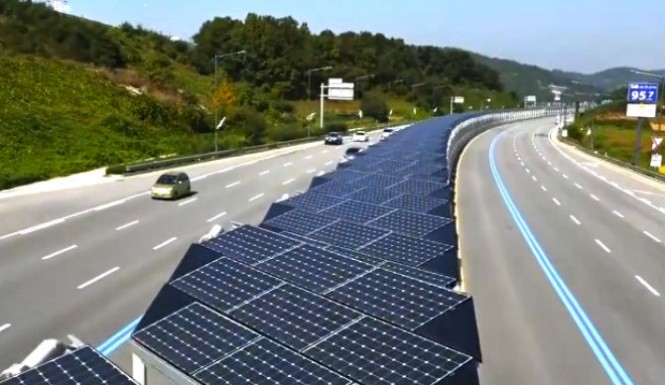
Solar-powered bike lane. Photo via inquisitr.com

Over the past five years, the solar energy community has seen major innovation in solar panels. First, the new solar panels are efficiently made to look like windows. As a result of the new design, there’s been a dramatic decrease in solar panel sludge, a waste pollutant left behind from solar panel creation that solar panel companies had issues with. Also, solar panels are becoming more versatile. This can be seen by having them incorporated into everyday items, like bicycles and water distillers, to improve efficiency.

Now there are reports of solar panels actually providing something else most people wouldn’t think about: shade. That is the case for a bike lane in South Korea which is topped with solar panels.

According to Inquisitr, a stretch of highway in South Korea features a solar-powered bike lane running down the median. It is offset from traffic, protected by barriers, and sheltered by solar panels. The bike lane is about a few hours’ drive away from Seoul and runs 20 miles from Daejeon to Sejong. All 20 miles of it is solar panel covered.

Just to give an idea how efficiently innovative this idea is, we’ll provide the scenario: the solar panels are five feet by two feet, short side aligned with the length of the bike lane, and are offset by one foot each.

That means over 13 miles of the bike lane is covered by solar panels totaling 35,200 panels. Now let’s assume the solar panels are set at producing 250 kW per year without fluctuation. That is exactly 8,800,000 kW of electricity, which is about 80 percent of the power used in New York City annually.

That’s a lot of electricity.

If you want to see what the solar-powered bike lane looks like, Inhabitat provided a video by a drone displaying it from above in their follow-up. It is attached below for viewing.

Emirates Insolaire Installs World’s First Coloured Solar Panels in Switzerland

world's first coloured solar panels in switzerland

Dubai firm installs Kromatix panels on building. Photo via Business Wire

Emirates Insolaire LLC, a pioneer in the development and application of unique solar technologies and a joint venture of Dubai Investments PJSC [DI] and SwissINSO Holding Inc., has created history with the successful installation of the world’s first KromatixTM coloured solar panels on a building façade in Lausanne, Switzerland.

According to Blackbird PR News, the entire installation, worth AED 850,000, is capable of generating sufficient electric power annually for two families of four people each. The building, boasting of its unique blue façade – thanks to the Emirates Insolaire glass panels, thus has the unique recognition of having the first coloured, photovoltaic solar panel façade in the world.

Two other projects in Basel, Switzerland, and Austria have also been completed. Emirates Insolaire continues to receive enquiries for its solar panels from UAE, Qatar, Saudi Arabia, Kuwait, Egypt, Bahrain, Lebanon, as well as from Europe, Asia, the US and Brazil.

Going by the projects on hand, demand and enquiries across the globe, Emirates Insolaire expects sales over 50,000 square metres for coloured solar panels in 2015 alone. Each coloured solar panel can generate above 150 watts electric power per square meter on roofs, or above 110 watts per square meter on façades.

Globally, the photovoltaic market has grown 40% year-on-year and the number of installations foreseen for 2015 is 160 GW – approximately 800 million square meters of glass. The share of Building Integrated Photovoltaic for rooftops and facades is witnessing one of the fastest growth rates.

Rafic Hanbali, Managing Partner of Emirates Insolaire, said: “The completion of Emirates Insolaire’s first project in Lausanne is a major milestone for the company. With the KromatixTM technology, the company has ushered in a paradigm shift in solar applications because of its aesthetic appeal to any building façade and efficiency due to its power generating attributes. The company sees significant growth opportunities going forward not only in the Europe but across the globe.”

KromatixTM solar panels can supply between 20% and 60% of the needed energy for a building. For certain industries with large roofs and façades, this can go up to 100%. Coming in virtually any colour, the Emirates Insolaire solar panels are optimised for both photovoltaic modules and solar thermal collectors.