Wind energy to reduce electricity bills

wind energy

Wind energy can reduce electricity bills

Green energy has always been seen as a great opportunity for the environment and the energy costs. If we take a deeper look into the economic aspects, we should pay attention to the cost of the feed-in tariff systems. First of all, we should take into account the aspects of the incentives and whether they are as expensive as they have always been and secondly we should analise whether the effect of wind is similar to other renewables.

A study made by the UPV/EHU’s Bilbao Energy Research Team (BERT) shows that wind is the most profitable of all green energy producers and in the meantime, solar is growing.

The UPV/EHU study takes a look at the power market in Spain between 2008 and 2012, a period of prosperity for the green energy in the country. Then, power production within the Special Scheme has a 57% increase- and quantifies its cost.

In order to make this happen, they had to measure the market savings made by green power sources but also had to calculate the quantity of incentives in renewable energy. The difference between them is the net cost of green energy.

This study is different from others because in this work the separate results for renewable technology are presented for the first time, demonstrating that the general conclusions cannot be applied to all the technologies across the board,” says Cristina Pizarro-Irizar, the lead author of the research.

The most important results are those obtained in 2008-2009 when the installed capacity was small, buut the savings generated on the electricity market had outcome the costs of the system. “It signified savings of between 25 and 45 euros per megawatt hour (MWh), depending on the year,” added Pizarro-Irizar.

Still, from 2010 onwards when green generation began to rise, the regulatory costs grew much, making a positive net cost on the system. “The penetration of renewable energy starts to be so high that the market prices do not fall any further and yet the costs of the incentives do in fact rise. There is a turning point and it is at that precise moment that the system is no longer sustainable. On the Spanish electricity market, that turning point was reached in 2010,” points out Cristina Pizarro-Irizar.

Solar energy clears the view

solar panels

A new kind of solar concentrator

Some scientist at Michigan State Univ. (MSU) have been working on a new kind of solar concentrator that if situated on top of a window makes solar energy and, at the same time, is letting people truly see through that window.

The name for this device is transparent luminescent solar concentrator and can be useful for buildings, mobile phones and other utilities that need a clear surface.

And as Richard Lunt of MSU’s College of Engineering says, the key word for this is “transparent.”

The process of creating solar power from cells located around luminescent plastic-like material is not recent. Still, the progress made in the past lead to few good results as the power production was not efficient and the materials were more colored than transparent.

“No one wants to sit behind colored glass,” reports Lunt, an assistant professor of chemical engineering and materials science. “It makes for a very colorful environment, like working in a disco. We take an approach where we actually make the luminescent active layer itself transparent.”

The solar capturing system needs small organic molecules produced by Lund and his colleagues to absorb specific invisible wavelengths of sunlight.

“We can tune these materials to pick up just the ultraviolet and the near infrared wavelengths that then ‘glow’ at another wavelength in the infrared,” he added.

The “glowing” infrared light is lead to the edges of the plastic and then transformed into electric power with the help of thin strips of PV solar cells.

“Because the materials do not absorb or emit light in the visible spectrum, they look exceptionally transparent to the human eye,” Lunt believes.

A big advantage of this new discoveries is its flexibility. As the technology is at the beginning, is can be helpful even for commercial or industrial applications for low cost needs.

“It opens a lot of area to deploy solar energy in a non-intrusive way,” Lunt said. “It can be used on tall buildings with lots of windows or any kind of mobile device that demands high aesthetic quality like a phone or e-reader. Ultimately we want to make solar harvesting surfaces that you do not even know are there.”

The researcher believes that there is more work to be done in order to increase the power efficiency. As we speak, it is able to make a solar conversion efficiency close to 1% but can reach 5% when truly optimized. The best LSC has got a 7% efficiency.

Old car batteries can be recycled into cheap, resistant solar panels

green technology

Scientists from MIT have found a way to reuse the so-thought useless batteries

Pollution is a really serious issue nowadays, and it comes as no surprise that car batteries do a lot of damage to the environment. A lot of them are being thrown away as a result of the fast evolution in the industry. So scientists from MIT have found a way to reuse the so-thought useless batteries. The solution they came up with involves turning them into very efficient solar panels and not using them for new car batteries.

As shown in the picture, a single piece of car battery can be transformed into a cheap solar panel that can be used to harvest energy for 30 homes. This can be done with the help of the lead from the battery and use it in order to create solar cells that use perovskite, a compound that can achieve until 19% efficiency level.

Every solar cell works on a very thin layer of perovskite that MIT says measures in in at approximately half of a micrometer in thickness. Just one car battery can make sufficient power aforementioned houses, and has the advantage of doing something for the environment and the recycling world.

These types of panels made from used car batteries can also, themselves, be recycled and transformed into new solar cells, lowering the pollution rate, that could otherwise become a threat. Moreover, the benefits don’t stop, as scientists reveal that this type of transformation iss both easier and cheaper than common silicon utilities.

Some spary on cells can convert everything into solar panels. A very cheap way of solar harvesting

solar pervskite spray

Scientist say the spray can be applied on any surface that cells can remain on.

Huge solar panels are soon to be history. In the future, anything can be converted in solar harvesting “panels”.

Researchers from Sheffield just discovered a low-cost, spray-on- paint like solar cell. This type of cell is made of perovskite, a cheap convenient material. As we all know, the spray is already a thing for masses, so the making of it is cheap, leading to small prices for users.

Scientist say the spray can be applied on any surface that cells can remain on. Still, their efficiency can be changed by flexible surfaces or different surfaces.

About 85% of photovoltaic cells are being made of crystalline silicon. This a a quite expensive way to produce solar energy. Plus, the conversion rate reaches 25%.

Perovskite is a mineral crystal structure formed in the calcium titanium oxide mineral species. Its first use was 5 years ago but lacked efficiency. Meaning the scientists made solid cells from polymers, which gave only a 16% efficiency. Efficient organometal halide perovskite-based photovoltaics were demonstrated two years ago.

The Sheffield team found that by spray-painting the perovskite they could make prototype solar cells with efficiency of up to 11 per cent. Nowadays, about 85% of solar cells are from crystalline silicon with a 25% conversion rate.

Researchers from the University’s Department of Physics and Astronomy and Department of Chemical and Biological Engineering have used this method before to make solar cells with organic semiconductors but the perovskite is definitely a major advantage.

Lead researcher Professor David Lidzey said: ‘There is a lot of excitement around perovskite-based photovoltaics. Remarkably, this class of material offers the potential to combine the high performance of mature solar cell technologies with the low embedded energy costs of production of organic photovoltaics.”

If the majority of solar cells are being made with energy intensive materials, perovskites, on the other hand, take much less energy. The scientists believe that by spray-painting the perovskite layer in the air, they will achieve to harvest solar energy using less energy.

Professor Lidzey also sayd: “The best certified efficiencies from organic solar cells are around 10 per cent.”
The Sheffield team discovered that by spray painting the perovskite, they can make prototype solar cells with efficiency a 11% efficiency. Perovskite cells 19% efficiency.

The most innovative solar-powered devices for the summer

Solar energy is a lot more than just a way to reduce world carbon emissions, this way of harvesting power is, mainly, a way of saving money and each and every one of us can benefit from it. While the well-known solar powered calculators have been around since the 70’s, the sun will now have the ability to power a lot more devices in the close future because solar PV cell science are getting more and more profitable. Here is a list of the most innovative solar gadgets.

1. Solar-powered sun lounger

solar powered sun lounger


This solar powered sun lounger contains a built-in water misters and allows you to charge your pool side devices close at hand and always charged.

2. Solar-powered lawnmower

solar-powered hybrid lawn mower

The robotic solar-powered hybrid lawn mower from Husqvarna is made of an solar panel that helps you extend the battery’s life and consume a lot less power.

3. Solar powered barbecue

Solar powered barbecue

The COOKUP 200 from ID Cook allows you to enjoy a barbecue on the move and most important, it doesn’t need fossil fuels at all.

4. Solar powered beer

Solar powered beer

The Cerddin Brewery in Bridgend, Wales works with 18 photovoltaic roof panels and gives you the necessary power to create their range of ales and ciders.

5. Solar powered refrigerator

solar refrigirator

And what more can you ask on a hot summer day than a cool beer? Sundanzer refrigerators and freezers are constructed so that they can function with the help of solar panels. Moreover, they got the title: commercial invention of the year by NASA in 2011.

6. Solar powered boombox

solar boombox

What summer party is good without good and loud music? Don’t worry, the solar-based music system from Soulra works with any Bluetooth-enabled device as much as 8 hours if fully charged.

7. Solar-powered bikini

solar bikini

You can’t be anything else but surprised by the bikini designed by New York designer Andrew Schneider, made of small, flexible photovoltaic cells that harvest the sunlight and charge the devices you need while you do nothing but having a good time.

8. Solar-powered electric bike

solar bike

The solar-powered electric bicycle can reach 11mph and it all costs just £30 if you use second hand components.

Source: www.eta.co.uk


From now on, we can cook without harming the environment

solar-powerd oven

British students made a special oven

A cheap Solar-Powered Oven could take wood’s or coal fuel’s place all over the world.

Nowadays, even with all the technology in our hands, people still cook with the help of wood and coal. Well that has got to change. These fuels are often expensive, produce carbon and lead to health issues. Moreover, they are not sustainable at all as they use wood and we all know we are not planting as many trees as we should.

The newly discovered solar over, developed by four British students, plans to change all this. It is made of 16 foot parabolic dish that harvests solar energy and conduscts it to a cooking box. “It’s a like a greenhouse,” as a student, Keno Mario-Ghae, says. “We have glass around the outside, then a box in the center. That allows us to get the heat in and get it nice and hot, but not let the heat leave.”

The good part of it is the fact that the dish is fixed on a wooden platform that permits it to fallow the sun rays. There are two tubes of water on both sides. One with the counterbalance role and the other leaks at a uniform rate, allowing the dish tilt at about 15 degrees per hour.

When tested, the oven went up to 400 degrees Fahrenheit in 45 minutes, as Mario-Ghae reports. Just enough to bake some bread rolls in not more than an hour.

The purpose of the whole project is to lower the costs and use materials from the area such as old oil-drums. The costs of the device would reach no more than $350 dollars. So a lot cheaper than the existing solar-ovens. The letter reach thousands of dollars when imported to developing countries.” There are a lot of costs you don’t have to deal with if you’re building it in the country where it’s needed,” the student says.

The developers of the project just finished the third year of a manufacturing engineering degree at Cambridge University. They wish to invest in more prototypes and maybe contribute to private projects for people in need. Their project also entered the 2014 Dyson Awards, due in the 7th of August.

Self-cooling solar cells are now possible with the help of tiny glass pyramids

solar cells

Solar cell efficiency increases

When solar panels are used to give away power, are using small solar cells that need to have direct sunlight a long time. This is not a very difficult task, but can rise problems from time to time. As the solar cells heat up, their efficiency level is going down and the age quickly. Taking all this into account, the solar energy is not as cheap as we might think.

There are many ways the can get cooler in an active way, but this ways are generally not as cheap as we wish and they can also be problematic from the efficiency point of view. So, we might want to develop passive methods to cool the cells. In order to do this, a team of researchers from Stanford University developed a solution.

The highest level of efficiency reaches only conversion rates for the solar power they harvest, even if we are getting closer to a 50% rate. The remaining heat can be considered waste, as it brings the cells to 55 degrees Celsius. Every Celsius degree means a 0.5% cell efficiency decrease. This means that an efficiency levels at 30% is only bringing approximately 21% solar power.

The Stanford researchers brought a passive cooling solution by making use of the wavelengths of light. In order to do this, they use a thin sheet of silica glass among with the pyramids and shapes only a few microns thick. This means that visible light can enter through the glass unimpeded, but it also refracts away the infrared wavelengths that can be the cause of the extra heat.

In conclusion, with just a little extra cost, the additional glass layer can passively cools down the cells and the efficiency level can remain the same. Moreover, the live of the cells is longer, and an ideal efficiency level is to be reached. So far, this theory has been tested in a lab, but some outdoor test will be run in the near future. If these are successful, it might become a standard procedure for the next solar panel production, thanks to the big efficiency advantages.

New sponge-like material generates steam with the help of a small concentration of solar energy

solar energy

New sponge-like material from MIT

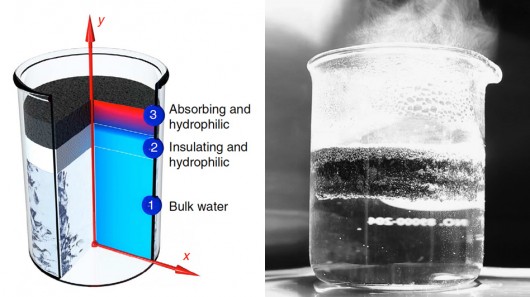
Scientist from the MIT’s Department of Mechanical Engineering report that they have found a way to make a sponge similar substance that is useful for transforming water into steam with the help of sun rays one-hundredth as bright as that requested by classic steam-producing solar power plants. Made of graphite flakes layered on a bed of carbon, the new substance is said to transform 85% of the harvested solar power into steam.

From the practical point of view, researchers believe that the graphite flakes and carbon foam combination they made can insulate a material structure that can float on water. They have developed several experiments and believe they discovered a method to raise the heat withholding properties in the upper layer by expanding its volume. They experimented this in a microwave. The outcome is exceedingly permeable top layer able increase absorption and withholding of solar energy.

The layer on the bottom is designed from carbon and it contains hundreds of tiny pockets of air that helps the material floating, and meanwhile it is insulating in order to prevent the heat from going out. The essential fact is that for the steam generation, the foam is also perforated with small pores the give permission to the water to go back up.

So, when the light from the sun illuminates and heats the material it gives pressure to the foam and air and helps the water to get pass the carbon and go into the graphite layer. As this takes place, the heat on the materials turn water into steam. As a result, if the light is more intense, the quantity of water absorbed is higher and more steam is generated.

“Steam is important for desalination, hygiene systems, and sterilization,” says Hadi Ghasemi, a postdoctoral MIT student who ran the material development. “Especially in remote areas where the sun is the only source of energy, if you can generate steam with solar energy, it would be very useful.”

Scientists also say that the sponge-like material can be made from cheaper material and can be the beginning of a new type of compact, steam-powered applications, especially as this method gives a significant improvement over classic solar-powered steam generation methods.

UK renewables embraced by foreign investors

UK green energy

Foreing investments in UK

61 green energy projects in the UK were targeted by foreign investors in 2013, fact that come as a confirmation that this domain is considered one of the most attractive ones for abroad investments, as the latest government report shows.

UK Trade and Industry yesterday announced that 2013/14 was a cosmic one for away investment. This was confirmed by the last report in the country, report that also says the biggest number of inbound was recorded in the 1980s.

The new report focuses on green energy through the first 12 sectors for inward investment, counting over 60 projects that were supported last year and 46 a year before that.

Offshore wind reveals a surprisingly tempting sector as the British countries carries on as the market leader and has wants to produce at least 10GW of capacity until 2020. In 2013 saw Canadian pension fund La Caisse plough £644m in London Array, the world’s biggest offshore wind farm.

In the meantime, Swedish utility Vattenfall put £400m Peny Cymoedd onshore wind farm located in the Wales, that is said to generate 300 jobs.

BP, AB Sugar and DuPont also last year opened up the £350m Vivergo bioethanol plant in Hull, that can generate 420 million liters of the renewable transport fuel every year at full capacity.

The report was opened in front of the Commonwealth Games Business Conference in Glasgow, that begins tomorrow, and wants to attract more investors to the UK. It reveals that through the economy, the British country captivates support for 14% more projects that in the years before, and help the country with 66,390 new jobs, a number overcomed only in 2001.

Still, the report also tells us that the oil and gas sector also became an important part of the investments as contributions were made by foreigners for 52 projects in the past year. Software and computer services are still the most attractive area, even if investment fell slightly from 261 projects in 2012 to 229 projects last year.

“Part of our long-term economic plan for the UK is about promoting every part of our country to the world and Glasgow’s Commonwealth Games will give us another fantastic platform to do this. I promise this government will continue to work on behalf of every hardworking business in the UK to drum up trade, encourage investment and pave the way for growth so we can generate jobs, pay our way in the world, and create stability, security and a brighter future for our country,” said Prime Minister David Cameron in a statement.

Solar transforms desert sand into art: glass bowls and sculptures with a 3D printer

solar invention

Markus Kayser and his amazing invention

If we collect the sun’s rays we have a way through which we can freely power electronic devices. Nothing new so far. Sill, a student discovered a extraordinary use of the sun’s energy. Markus Kayser claims he can use the sun to develop a super-printer that can build glassware.

The student discovered this while working at his graduate project for which he worked in the the Sahara in Egypt. It was there where his ingenious idea, ‘Solar Sinter’, caught life. This is an object designed to transform the sand into unbelievably beautiful glass bowls and sculptures uing only sun rays.

The new invention is working with the help of : a photovoltaic panel, the focal point for drawing the sun’s rays, a sun tracker, fresnel lens (for magnifying the rays), a battery, controlling electronics, and lst but not least, a silver tent dubbed the “office”, a place that Kayser can use to protect himself from the hot sun and, at the same time, monitor the whole process. Taking the mini-station in a deserted location the student uses only natural free power.

This new Solar Sinter’ is capable of conceiving any form starting from bowls, sculptures and and, why not, furniture. This machinery can also transform a desert into a a high-tech production facility for high-end design.

The interior of the new solar based 3D printer the sands from the desert substitutes traditional resin in the production process. The sands are disintegrated ad transformed into different shapes using the 3D printer. The whole procedure process is as wonderful as the objects themselves, delightfully glittering and turning as the sands melt together, recalling footage of the birth of stars in space.

Keyser devotes himself to develop strategies that search for ways to confirm that there is a probability that with the help desert sands we can discover an endless supply of a pure solar power. His former program, Sun Cutter, also involved the sun’s rays, but this time he utilized them to make gently cut the wood, an object similar to a fine laser.

Markus Kayser – Solar Sinter Project from Markus Kayser on Vimeo.