A huge floating solar power plant to be built in India

solar technology

Floating solar power plant in India

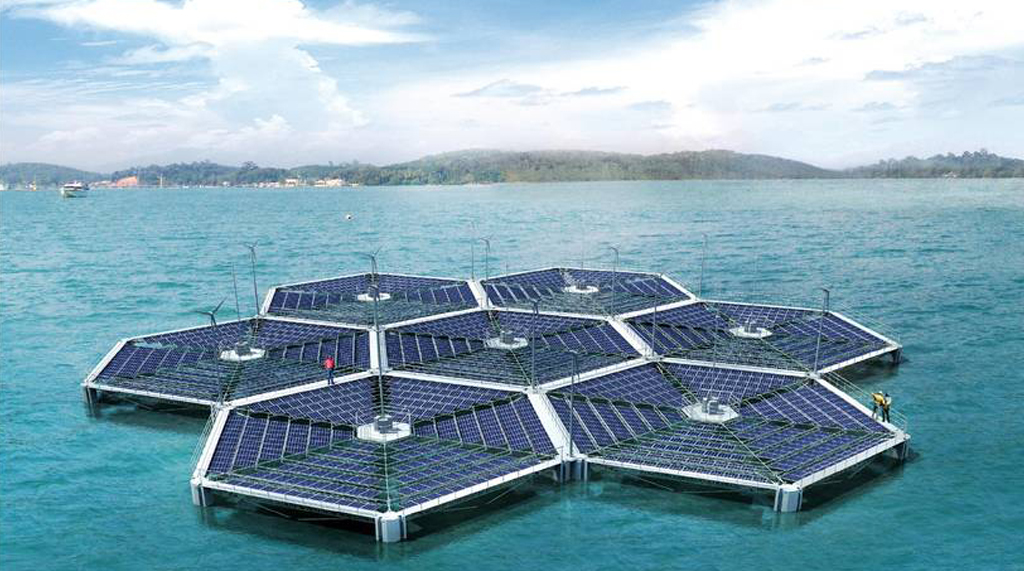
The National hydroelectric power company in India announced that they are going to construct a great solar power plant that will sail on top of a lake.

India has previously announced their strategy to build a 10 megawatt solar situated on some of the its canals, the Asian country took their idea to another level and want to construct a floating power station that will be situated on one of the large stretches of water in Kerala, India.

This particular floating solar power plant machinery was expanded by India’s Renewable Energy College and it is going to be implemented by the National Hydro Power Corporation, India’s national energy company. The very first of its plants will be authorized this fall.

“NHPC had contacted us for offering technical know-how and installation assistance for their proposed 50-mw plant,” reports the chairman of the Renewable Energy College, Gon Choudhury. “Each station would require around 3000 square feet of space to generate 20 kilowatt of power. There are many water bodies that could be used for this,” he added.

The project is also said to be eco-friendly and it will have a small impact on the surroundings, as Choudhury illustrates:

“The ecology of the water body is not likely to be affected much and it will also reduce evaporation, thus helping preserve water levels during extreme summer. Solar panels installed on land face reduction of yield as the ground heats up. When such panels are installed on a floating platform, the heating problem is solved to a great extent. This isn’t an ideal solution, it’s not as though we can go and cover the world’s oceans with photovoltaic cells, but it’s certainly a solid intermediary step until we get those space-based solar farms up and running.”

This project looks a lot like one of Japan’s offshore solar power plants built in 2013. The 70MW Kagoshima Nanatsujima Mega Solar Power Plant was conceived as part of the move towards a more green energy area as a follow-up of the 2011 Fukushima meltdown and is located in Japan’s Kagoshima Prefecture.
A huge floating solar power plant to be built in India

solar technology

Floating solar power plant in India

The National hydroelectric power company in India announced that they are going to construct a great solar power plant that will sail on top of a lake.

India has previously announced their strategy to build a 10 megawatt solar situated on some of the its canals, the Asian country took their idea to another level and want to construct a floating power station that will be situated on one of the large stretches of water in Kerala, India.

This particular floating solar power plant machinery was expanded by India’s Renewable Energy College and it is going to be implemented by the National Hydro Power Corporation, India’s national energy company. The very first of its plants will be authorized this fall.

“NHPC had contacted us for offering technical know-how and installation assistance for their proposed 50-mw plant,” reports the chairman of the Renewable Energy College, Gon Choudhury. “Each station would require around 3000 square feet of space to generate 20 kilowatt of power. There are many water bodies that could be used for this,” he added.

The project is also said to be eco-friendly and it will have a small impact on the surroundings, as Choudhury illustrates:

“The ecology of the water body is not likely to be affected much and it will also reduce evaporation, thus helping preserve water levels during extreme summer. Solar panels installed on land face reduction of yield as the ground heats up. When such panels are installed on a floating platform, the heating problem is solved to a great extent. This isn’t an ideal solution, it’s not as though we can go and cover the world’s oceans with photovoltaic cells, but it’s certainly a solid intermediary step until we get those space-based solar farms up and running.”

This project looks a lot like one of Japan’s offshore solar power plants built in 2013. The 70MW Kagoshima Nanatsujima Mega Solar Power Plant was conceived as part of the move towards a more green energy area as a follow-up of the 2011 Fukushima meltdown and is located in Japan’s Kagoshima Prefecture.

A huge floating solar power plant to be built in India

solar technology

Floating solar power plant in India

The National hydroelectric power company in India announced that they are going to construct a great solar power plant that will sail on top of a lake.

India has previously announced their strategy to build a 10 megawatt solar situated on some of the its canals, the Asian country took their idea to another level and want to construct a floating power station that will be situated on one of the large stretches of water in Kerala, India.

This particular floating solar power plant machinery was expanded by India’s Renewable Energy College and it is going to be implemented by the National Hydro Power Corporation, India’s national energy company. The very first of its plants will be authorized this fall.

“NHPC had contacted us for offering technical know-how and installation assistance for their proposed 50-mw plant,” reports the chairman of the Renewable Energy College, Gon Choudhury. “Each station would require around 3000 square feet of space to generate 20 kilowatt of power. There are many water bodies that could be used for this,” he added.

The project is also said to be eco-friendly and it will have a small impact on the surroundings, as Choudhury illustrates:

“The ecology of the water body is not likely to be affected much and it will also reduce evaporation, thus helping preserve water levels during extreme summer. Solar panels installed on land face reduction of yield as the ground heats up. When such panels are installed on a floating platform, the heating problem is solved to a great extent. This isn’t an ideal solution, it’s not as though we can go and cover the world’s oceans with photovoltaic cells, but it’s certainly a solid intermediary step until we get those space-based solar farms up and running.”

This project looks a lot like one of Japan’s offshore solar power plants built in 2013. The 70MW Kagoshima Nanatsujima Mega Solar Power Plant was conceived as part of the move towards a more green energy area as a follow-up of the 2011 Fukushima meltdown and is located in Japan’s Kagoshima Prefecture.

A huge floating solar power plant to be built in India

solar technology

Floating solar power plant in India

The National hydroelectric power company in India announced that they are going to construct a great solar power plant that will sail on top of a lake.

India has previously announced their strategy to build a 10 megawatt solar situated on some of the its canals, the Asian country took their idea to another level and want to construct a floating power station that will be situated on one of the large stretches of water in Kerala, India.

This particular floating solar power plant machinery was expanded by India’s Renewable Energy College and it is going to be implemented by the National Hydro Power Corporation, India’s national energy company. The very first of its plants will be authorized this fall.

“NHPC had contacted us for offering technical know-how and installation assistance for their proposed 50-mw plant,” reports the chairman of the Renewable Energy College, Gon Choudhury. “Each station would require around 3000 square feet of space to generate 20 kilowatt of power. There are many water bodies that could be used for this,” he added.

The project is also said to be eco-friendly and it will have a small impact on the surroundings, as Choudhury illustrates:

“The ecology of the water body is not likely to be affected much and it will also reduce evaporation, thus helping preserve water levels during extreme summer. Solar panels installed on land face reduction of yield as the ground heats up. When such panels are installed on a floating platform, the heating problem is solved to a great extent. This isn’t an ideal solution, it’s not as though we can go and cover the world’s oceans with photovoltaic cells, but it’s certainly a solid intermediary step until we get those space-based solar farms up and running.”

This project looks a lot like one of Japan’s offshore solar power plants built in 2013. The 70MW Kagoshima Nanatsujima Mega Solar Power Plant was conceived as part of the move towards a more green energy area as a follow-up of the 2011 Fukushima meltdown and is located in Japan’s Kagoshima Prefecture.
A huge floating solar power plant to be built in India

solar technology

Floating solar power plant in India

The National hydroelectric power company in India announced that they are going to construct a great solar power plant that will sail on top of a lake.

India has previously announced their strategy to build a 10 megawatt solar situated on some of the its canals, the Asian country took their idea to another level and want to construct a floating power station that will be situated on one of the large stretches of water in Kerala, India.

This particular floating solar power plant machinery was expanded by India’s Renewable Energy College and it is going to be implemented by the National Hydro Power Corporation, India’s national energy company. The very first of its plants will be authorized this fall.

“NHPC had contacted us for offering technical know-how and installation assistance for their proposed 50-mw plant,” reports the chairman of the Renewable Energy College, Gon Choudhury. “Each station would require around 3000 square feet of space to generate 20 kilowatt of power. There are many water bodies that could be used for this,” he added.

The project is also said to be eco-friendly and it will have a small impact on the surroundings, as Choudhury illustrates:

“The ecology of the water body is not likely to be affected much and it will also reduce evaporation, thus helping preserve water levels during extreme summer. Solar panels installed on land face reduction of yield as the ground heats up. When such panels are installed on a floating platform, the heating problem is solved to a great extent. This isn’t an ideal solution, it’s not as though we can go and cover the world’s oceans with photovoltaic cells, but it’s certainly a solid intermediary step until we get those space-based solar farms up and running.”

This project looks a lot like one of Japan’s offshore solar power plants built in 2013. The 70MW Kagoshima Nanatsujima Mega Solar Power Plant was conceived as part of the move towards a more green energy area as a follow-up of the 2011 Fukushima meltdown and is located in Japan’s Kagoshima Prefecture.

New record high for green energy price with the construction of expensive wind turbines at the sea

energy price

The green energy price boosted up as annual bill

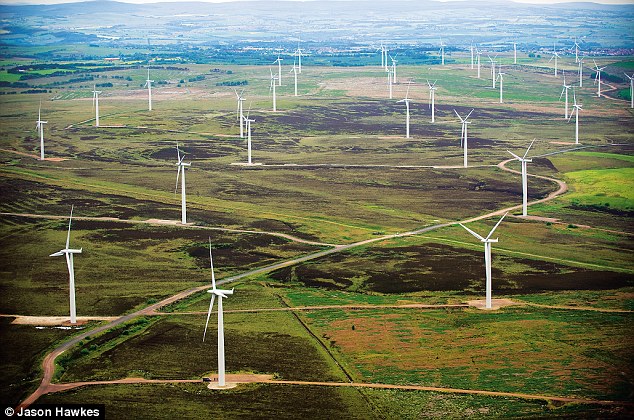
The green energy price boosted up as annual bill for users reached £2.5bn. There are more plants to be built and the price goes up with each one of them.

The cost of generating renewable electricity has reached record high because subsidies belong to expensive offshore wind farms and household solar panels, as new figures are revealed. More and more turbines are constructed and a lot of homeowners put solar panels on their homes. So, the annual bill for these users reached £2.5bn.

Every unit of renewable energy is now more expensive, as new figures tell and they reached 66.97 per MWh in 2012-13. The rise was high as it comes from £54.26 in 2012, even if the ministers requested a weigh down of the costs.

The rise shows the force to build turbines offshore, that will get twice as much subsidy in comparison to the ones at shore, as the latter are quite controversial. Companies that built this large scale plants received subsides that reached £2bn, from £1.5bn the former year. This shows that there is a surge of householders to put solar panels on their homes at this kind of subsides before the support was reduced in March 2012. They got £500m in 2012-13, coming from £150m the year before.

The director of Renewable Energy Foundation, Dr. John Constable, reports : “DECC is subsidizing renewables to meet arbitrary and over-ambitious EU targets, so it was inevitable that we would move rapidly up the cost curve once the ‘cheaper’ opportunities had either been fully developed like landfill gas or exceeded the limits of public acceptability like onshore wind.

Subsidy costs are now spiraling out of control – the annual burn is about £3bn a year and rising fast. There still is a good case for experimenting with renewables, but building so much capacity when the whole sector is still fundamentally uneconomic is bound to end in tears.”

A spokesman for the Department of Energy and Climate Change said: “As we move closer to achieving the government’s renewables target it is inevitable we will start using more expensive forms of renewable energy such as offshore wind, which can be deployed at far greater scale than other renewable technologies. By supporting these technologies now we are driving down their costs. Nonetheless the support levels for each technology are coming down over time and our analysis suggests household electricity bills will be on average £41 lower per year between 2014-30 compared to meeting the our targets using current measures.”

Renewable energy supply will go beyond gas by 2016 at a global scale

Renwable_energy_will_surpass_gas
Gas will be exceeded by renewable energy worldwide until 2016, reaching almost a quarter of the planet’s power supply by 2018, by 2016 it will exceed that from gas and be the twice of that of nuclear plants. It has already exceeded overall consumption of electricity in China by 2012.

Broadcasted on Wednesday, this year’s second Medium-Term Renewable Energy Market Report anticipates that alternative power will rise by 40% in the coming 5 years, although the economic context has seen better days. Renewable energy is by now the quickest-growing power producing sector and will be in 2018 at 25% of global supply exceeding with approximate 5% the ratio from 2011.

Thus, the portion of non-hydro sources like geothermal or bioenergy, wind and solar energy will be doubled by 2018, reaching 8%, up from 4% by in 2011, and half that in 2006.

IEA Executive Director, Maria van der Hoeven stated from the report: “As their costs continue to fall, renewable power sources are increasingly standing on their own merits versus new fossil-fuel generation, this is good news for a global energy system that needs to become cleaner and more diversified, but it should not be an excuse for government complacency, especially among OECD countries.”
This report, however warns that renewable energy growth is evolving in complexity and presents challenges, such as an increasing discussion regarding the expenses of renewable sustenance policies in various European countries who are affected by a stagnate economy and energy request.

There are two positive factors that sustain optimism: First of all, acceleration has been observed at the coming-out markets in investment and placement, where renewable energy is helping to approach the rapid increase of energy demand, the variation on energy producers and local pollution responsibilities. Second, along with hydropower, geothermal and bioenergy, solar energy is drawing attention in markets with high billing prices, like those produced by oil-fired energy. Plus the fact that photovoltaic energy production can be a lower expense than one centralized supplier.

Roxana Moraru

Using Solar Energy to Create Wind Power

solar_energyA new type of wind power plant is in the works, and it is claimed to be able to produce clean energy from the sun and the wind with virtually no carbon footprint, fuel consumption, or waste production.

And not only that, it purportedly uses heat from the sun to produce its own wind, which would make this new type of plant desirable in areas with low or inconsistent winds.

The Clean Wind Energy Downdraft Tower is a skyscraper-sized hollow cylinder that uses the natural downdraft tendencies of air by spraying water (as a fine mist) across the top opening of the tower to cool the hot dry incoming air. As the water evaporates and cools the air, it becomes denser and heavier than the outside air, and then falls through the tower at speeds up to (and above) 50 mph. Once the faster moving air reaches the bottom of the tower, it is channeled through wind turbines in the base of the tower, generating electricity.

In addition, if the Tower is located in areas conducive to direct wind harvesting, the exterior of the Tower could be covered with “vertical wind vanes” to help  capture prevailing winds to produce supplemental power.

“One tower is equivalent is to at least one nuclear power plant. But here’s the big difference of course. You don’t have nuclear issues, you don’t have the safety issues, you don’t have spent nuclear rods, you don’t have the storage issue. These towers apparently they last forever. All you’re using is water, evaporation, wind gradients and presto! You do have the energy that’s produced through turbines and generators. So what we’re talking about is water and wind at free will.” – George Elliott, scientist and consultant for the Wind Energy Tower.

Clean Wind Energy, Inc. (soon to Solar Wind Energy Tower, Inc.), also plans to build a pair of demo towers, up to 2,250 feet tall, near Yuma Arizona, potentially powering up to 1.6 million homes in California and Arizona.

“The first Tower in Arizona has a projected output capacity, on an hourly basis, of up to 1000 megawatt hours, gross. Using a 70% capacity factor the Tower’s potential hourly yield would be 700 megawatt hours from which, approximately 17% will be used to power its operations, yielding approximately 600 megawatt hours available for sale to the power grid.” – Clean Wind Energy, Inc.

Underground greenhouse for year-round gardening

greenhouse_gardeningGrowers in colder climates often utilize various approaches to extend the growing season or to give their crops a boost, whether it’s coldframes, hoop houses or greenhouses.

Greenhouses are usually glazed structures, but are typically expensive to construct and heat throughout the winter. A much more affordable and effective alternative to glass greenhouses is the walipini (an Aymara Indian word for a “place of warmth”), also known as an underground or pit greenhouse. First developed over 20 years ago for the cold mountainous regions of South America, this method allows growers to maintain a productive garden year-round, even in the coldest of climates.

It’s a pretty intriguing set-up that combines the principles of passive solar heating with earth-sheltered building. But how to make one?From American sustainable agriculture non-profit Benson Institute comes this enlightening manual on how a walipini works, and how to build it.

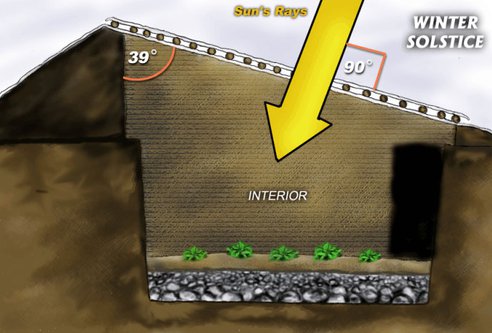
gardening_greenhouseThe Walipini utilizes nature’s resources to provide a warm, stable, well-lit environment for year-round vegetable production. Locating the growing area 6’- 8’ underground and capturing and storing daytime solar radiation are the most important principles in building a successful Walipini.

The Walipini, in simplest terms, is a rectangular hole in the ground 6 ‛ to 8’ deep covered by plastic sheeting. The longest area of the rectangle faces the winter sun — to the north in the Southern Hemisphere and to the south in the Northern Hemisphere. A thick wall of rammed earth at the back of the building and a much lower wall at the front provide the needed angle for the plastic sheet roof. This roof seals the hole, provides an insulating airspace between the two layers of plastic (a sheet on the top and another on the bottom of the roof/poles) and allows the sun’s rays to penetrate creating a warm, stable environment for plant growth.

walpini_greenhouseThis earth-sheltered greenhouse taps into the thermal mass of the earth, so that much less energy is needed to heat up the walipini’s interior than an aboveground greenhouse. Of course, there are precautions to take in waterproofing, drainage and ventilating the walipini, while aligning it properly to the sun — which the manual covers in detail.

Best of all, according to the Benson Institute, their 20-foot by 74-foot walipni field model out in La Paz cost around $250 to $300 only, thanks to the use of free labour provided by owners and neighbours, and the use of cheaper materials like plastic ultraviolet (UV) protective sheeting and PVC piping.

Renewable energy brings power to the rural corners of Argentina

Since 1999, the Renewable Energy in Rural Markets Project (PERMER) has aimed to put an end to this situation. Supported by the World Bank and the Global Environment Facility (GEF), the initiative connects homes and schools to clean energy sources such as solar panels and windmills.

So far, around 25,000 residential customers and nearly 2,000 schools have been reached, and 300 solar thermal stoves, furnaces and water heaters have been installed.

Also 2,000 users in small, isolated communities have benefited from small power systems (generation and distribution networks). The project has also included almost 400 public buildings, such as health centers, community centers, as well as Gendarmerie (Police force) and National Parks Administration’s stations.

In PERMER’s proposed scheme, photovoltaic or wind system are installed for the user, who then pays for its operation and maintenance dependent on their means.

“The project ensures that someone is responsible for the proper functioning of the systems at the provincial level, which allows it to be sustainable in the long term,” said Lucia Spinelli, Manager of PERMER on behalf of the World Bank.

Many rural Argentineans in 19 provinces found their quality of life improved through access to electricity.

“In the Impenetrable Chaco, the population is very spread out and so solar panels have had a significant impact, as they have managed to supply 14% of users,” said Raul Garcia, an Official in the Secretariat of Energy for the Province of Chaco who has been participating in PERMER over the last 12 years.

With an area spanning 12,000 square km of islands, the province of Entre Rios was an ideal candidate to join the initiative. It did so in 2010 and since then, two schools and 850 rural households have received photovoltaic systems.

“The children of fishermen can now go to school twice a week and do chores at home, it is not necessary to travel several miles to buy kerosene and it is much easier to charge mobile phones,” said Alberto Alcain, Alternative Energies Coordinator in Entre Rios.

“People have adapted well to technology and began to ask for solar panels instead of electricity lines,” asserted Graciela Pedro, who’s in charge of the Alternative Energies office at the Energy Agency of Neuquén.

There, all the rural schools and nearly 2,000 homes have solar panels. “The impact is rewarding. Families have more hours in the day to do their activities, such as women weaving and other crafts,” Pedro added.