Moving to renewable energy would create millions of jobs, study finds

solar industry jobs

Moving toward renewable energy would be a boon to the economy, studu says. Image source

A new report has found that transitioning to a clean energy economy would be an economic boon to the United States, increasing employment, reducing costs to consumers, and benefiting investors.

The report, from NextGen Climate America, showed that investment in efficiency, renewable sources of electricity, and fuel switching — such as moving from fossil fuel-powered cars to electric vehicles — would add a million jobs by 2030, and roughly 2 million jobs by 2050, while increasing GDP by $290 billion and improving household income. The researchers looked at scenarios that would reduce emissions by 80 percent below 1990 levels.

“While addressing climate change is one of our greatest challenges, it is one of our greatest opportunities to build the economy,” Tom Steyer, co-founder of NextGen and billionaire climate activist (and a board member of the Center for American Progress), said on a call with reporters Monday.

The construction industry, in particular, could see a huge bump in jobs — to the tune of 1.2 million more in 2050 than under the business-as-usual scenario. That’s because it will take a lot of people to build the wind farms, install the solar panels, and retrofit the buildings needed to reduce America’s dependence on fossil fuels.

Efforts to lower emissions are often subject to the criticism that they will hurt the economy, even though actual examples of programs have shown that efficiency and clean energy programs can actually boost economic factors like household disposable income.

“The go-to argument against [climate action] is that it’s bad for the economy and it’s a job killer,” Steyer said. This report shows otherwise. Steyer also pointed out that in the last few years, jobs in the solar industry have grown 20 times faster than the rest of the economy.

In addition, the so-called reference case — a general economic forecast — did not take into account the potential costs of not addressing climate change. Recent reports have shown climate change poses a significant financial risk.

According tothinkprogress.org, the report studiously stays away from telling policymakers how to get to 80 percent less emissions. Rather than policy recommendations, the researchers took a feasibility study and used it to build out the economic impacts.

The researchers used a 2014 report, Pathways to Deep Decarbonization in the United States by Energy and Environmental Economics, which looked at whether it was technologically feasible to reduce carbon emissions significantly enough to avoid 2°C warming.

Economist Jeffery Sachs told reporters it was critical to first determine where we want to go, and then tailor policies to achieve those end goals.

“Too often our national policy conversation jumps straight to the question, ‘Is it a tax? Is it this or that?’ Whereas what this report does, much better, in my opinion, is to show here’s where we want to go,” Sachs said.

Overall, the report painted an optimistic picture of the economy under a clean energy scenario. It’s worth noting, though, that the gains will not be across the board. Job growth in two of the nine regions was expected slow under the low-carbon scenarios. Those two regions — which include roughly the area from Montana to Texas, a fossil fuel heavy swath of the country — would have slower job growth.

That means that as the country does develop policies to achieve these goals, it will likely need to dedicate resources — educational and economic — to areas that will have a harder time getting off fossil fuels.

“To help them adapt we need to provide dedicated new resources for economic diversification, job creation, job training and other employment services for workers and communities affected by job losses at coal mines and coal-fired power plants,” the authors said.

Jobs notwithstanding, all regions were found to see increases in disposable income.

Trina Solar announces new efficiency record of 21.25% for multi-crystalline silicon solar cell

trina solar pv record

Chinese PV producer announces new efficiency record of 21.25% efficiency for multi-crystalline silicon solar cell. Image source

Trina Solar, a global leader in photovoltaic modules, solutions and services, today announced that its State Key Laboratory of PV Science and Technology of China has set a new world record for a high-efficiency p-type multi-crystalline silicon solar cell.

According to a press release, the record-breaking p-type multi-crystalline silicon solar cell was fabricated on a high-quality mc-Si substrate with a process that integrates advanced Honey Plus technologies including back surface passivation and local back surface field.

The 156×156 mm2 solar cell reached a total area efficiency of 21.25%. The result has been independently confirmed by the Fraunhofer ISE CalLab in Germany. This efficiency record breaks the previous 20.76% efficiency world record for mc-Si solar cells also established by Trina Solar one year ago. To set this new record, only low-cost industrial processes which can be easily integrated into large-volume production were used.

“We are very pleased to announce the new efficiency results achieved by our scientists and researchers at the State Key Laboratory of PV Science and Technology. To the best of our knowledge, this is the first time ever that a multi-crystalline silicon solar cell has been able to achieve a conversion efficiency of over 21%,” said Dr. Pierre Verlinden, Vice-President and Chief Scientist of Trina Solar.

“This exciting result shows that the development path toward higher efficiencies continues to be bright, even for silicon. Our aim is to continuously integrate innovative technological developments to improve the efficiency and lower the cost of our PV products. This technology advancement in efficiency will strengthen our leadership in the PV industry and allow us to continue providing affordable solar power to the world.”

IEA: Energy efficiency improvements avoided 870 Million tonnes Of CO2 in 2014

Energy Efficiency Market Report 2015

Energy Efficiency Market Report 2015. Image via iea.org

A new report from the International Energy Agency has concluded that energy efficiency improvements since 1990 helped avoid 870 million tonnes of CO2 emissions in 2014.

According to the International Energy Agency’s (IEA) Energy Efficiency Market Report 2015, cited by Clean Technica, over two decades of energy efficiency improvements throughout IEA-member countries contributed to a cumulative 10 billion tonnes of carbon dioxide emissions avoided over these last 25 years, which is roughly equivalent to annual emissions by all IEA member countries.

“Per capita energy consumption in IEA countries has dropped to levels not seen since the 1980s yet income per capita has never been higher,” write the authors of the report, released last week. “Energy efficiency improvements over the last 25 years are the primary reason for this uncoupling of energy consumption and economic growth, and have enabled consumers in IEA countries to spend USD 5.7 trillion less on energy, while enjoying higher levels of energy service.”

Specifically, energy intensity throughout the OECD member-states improved by 2.3% in 2014, with energy consumption reaching its lowest levels since 2000, while GDP grew by $8.5 trillion, an increase of 26%.

The report goes a long way to backing up IEA’s analysis that energy efficiency improvements are the most effective tool to reduce energy sector carbon emissions, with the IEA suggesting that such improvements account for more than 40% of the required reductions to limit global warming to 2 degrees.

The IEA points out that energy efficiency investments in IEA countries since 1990 generated 520 Mtoe of avoided total final consumption (TFC) in 2014, which is larger than the larger annual TFC of Japan and Korea combined.

Scottish castle goes solar

solar-powered castle

Ayton Castle, image via everycastle.com

The 19th-century Ayton Castle’s grounds will be home to 188 solar panels, providing 50KW of electricity, after Scottish Borders Council approved the plans by the castle owners.

The special high-level mounting system means livestock can still graze the fields unprotected under the panels.

According to thenational.scot, Director of conservation charity WWF Scotland Lang Banks said: “Due to their age and construction materials, historic buildings can often be quite a challenge when it comes to trying to reduce energy use and cutting carbon. So while energy savings efforts should still be made, choosing to generate your own on-site renewable energy too makes perfect sense.”

Last week, the first large-scale solar project in Fife was also given the go-ahead, with a total of 11,000 panels planned for sites at Tayport, Wormit and Crail.

Builder Green Hedge Renewables says the 3,300-panel site at Wormit can power 1,300 homes.

The largest of the sites at Tayport will house 5000 panels at the start of October.

As well as the development at Ayton Castle, plans have been submitted for a monster 40,000-panel site.

50,000 battery packs to power Israeli thermal solar plant

solar thermal plant in Israel

BrightSource heliostat fields generate solar thermal energy. Image via israel21c.org

50,000 lithium-ion rechargeable battery packs will be supplied by Tadiran Batteries to BrightSource’s 121 MW Shalim Thermal Solar Power Station in Israel. These batteries have been designed to last 25 years, even in harsh environments. Tadiran is a subsidiary of the better-known Saft Group.

According to solarlove.org, BrightSource Energy, Alstom, and NOY Infrastructure & Energy Investment Fund are partners in the thermal solar station project. Oakland, CA–based BrightSource will be the provider of the concentrating solar power technology that some call a “solar power tower.”

Over 50,000 computer-controlled heliostats — which function like mirrors — will be combined with the tower that is over 200 meters tall to generate electricity. The Tadiran battery packs will be used to help manage these controllable mirrors, which track the sun on two axes. Using batteries instead of expensive cabling reduces the overall project cost.

This CSP plant will generate copious amounts of steam to turn turbines that generate electricity. It has been estimated that when the thermal solar plant is operational, it will generate enough electricity to power about 120,000 homes in the area. The construction site is the Negev desert, and up to 1,000 jobs will be created by the project.

Igal Carmi, President and CEO at Tadiran Batteries, explained, “We are proud to have been selected by BrightSource Energy to supply our state-of-the-art range of rechargeable lithium-ion battery systems for this innovative project. Awarded by a new client in a new sub-segment of energy harvesting, this order represents a significant commercial breakthrough for Tadiran and highlights the recognition by the industry for the excellence of its batteries.”

This project is exciting for a number of reasons. You can imagine how much sunlight is available in an Israeli desert, so it makes no sense not to utilize some of it. Secondly, battery technology is being used and this type of technology is beginning to emerge as a clean energy solution in a number of settings. Thirdly, the potential to provide electricity to well over 100,000 homes from one clean energy source is remarkable. Israel is also considered to be a technology leader, so it “makes sense” that clean energy technology would take root there.

EU finds potential for energy savings in food industry

clean energy in food industry

EU wants to save energy in food industry. Image via globalmeatnews.com

The EU’s food production industry has some catching up to do when it comes to adopting renewable energy, according to a new report that took a close look at the food sector.

Overall, renewable sources now account for 15 percent of the EU’s energy mix, but in the food production sector, that share is only about 7 percent, according to study, which acknowledges the challenges of decarbonising food production.

According to summitcountyvoice.com, farmers and industry have made some progress, but consumers could play a bigger role by reducing meat consumption, buying locally and seasonally, and reducing food waste.

To reach their conclusion, the researchers broke down the energy content of a typical European food basket composed of 17 largely consumed food products, estimating the amount of energy needed to cultivate, process, pack and bring food to European citizens’ tables.

The food basket is based on data from EU-27 in 2013 (when data for Croatia who joined the same year were not available) and accounts for about 60 percent of EU food consumption. The energy required to ensure food supply in the EU amounted to around 26 percent of the EU’s final energy consumption in 2013.

In the report, different solutions are discussed on how to lower this figure and to make it more sustainable by increasing the renewable energy share.

Consumers can also play an important role when choosing their food: reducing their energy ‘food print’ includes reducing consumption of meat and animal-related products, buying locally and seasonally, as well as reducing food waste and choosing organic food when possible.

Different food products need very different amounts of energy depending on their nature, their origin and the kind of processing they require. Refined food and products of animal origin generally need much more energy than vegetables, fruit and cereal products.

Clean energy can lift African GDP

solar energy Africa

Solar energy in Africa. Image via busiweek.com

The African continent could generate nearly a quarter of its energy needs using indigenous, clean, renewable energy by 2030.

“Africa holds some of the best renewable energy resources in the world in the form of biomass, geothermal, hydropower, solar and wind,” Adnan Z. Amin, the IRENA Director-General recently said.

“This, combined with the precipitous drop of renewable energy technology costs, creates a massive opportunity for African countries to both transform and expand their energy systems while providing a pathway for low-carbon economic growth,” he said.

According to busiweek.com, IRENA offers a comprehensive roadmap for Africa’s energy transition, insisting that a combination of modern renewable technology could realistically meet 22% of Africa’s energy needs by 2030. This is more than a four-fold increase from just five per cent in 2013.

The report also finds that scaling up modern renewables in Africa is an affordable means to help meet fast-growing energy demand while increasing energy access, improving health and achieving sustainability goals.

The report identifies nearly 10 exajoules (the equivalent of more than 341 megatonnes of coal) of options for sustainable development through renewable energy.

Roughly 40% of this energy would be in the power sector. Solar resources are abundant across the continent, while biomass and hydropower potential are more plentiful in the central and southern regions.

Wind resources are strongest in the north, east, and southern regions, and geothermal energy is strong in the Great Rift Valley.

Renewable energy capacity additions could increase the share of modern renewables in the power sector to 50% by 2030, reducing carbon dioxide emissions by more than 310 megatonnes.

Developing these projects is more cost-effective than ever before, with solar and wind projects across Africa now producing record-low electricity prices.

Roughly 50% of the energy from the recommended options would be through biomass-based heat applications. Half of all energy use in Africa today involves traditional biomass consumption.

The report estimates that a shift to modern renewable energy cooking solutions would reduce the use of traditional cook stoves by more than 60%, saving $20 billion to $30 billion annually by 2030 through the reduction of health complications from poor indoor air quality.

“Tapping into renewable energy resources is the only way African nations can fuel economic growth, maximise socio-economic development and enhance energy security with limited environmental impact,” Amin said

“The technologies are available, reliable and increasingly cost-competitive.

“The onus is now on Africa’s governments to create conditions to accelerate deployment, paving the way for Africa’s unfettered, sustainable development,” he said.

The report recommends 14 actions to speed the uptake of renewables on the continent, including enabling policies and a regulatory framework to catalyse investment, adopting investment promotion measures, and off-grid renewable energy solutions to increase energy access and reduce poverty.

California’s plan to gain 50% clean energy by 2030

renewable energy California

California Governor Jerry Brown has signed landmark legislation requiring the state to get 50 percent of its energy from renewables by 2030. Image via ww2.kqed.org

California’s Governor, Edmund G. Brown Jr., recently signed an legislation committing the state to generating half of its electricity from renewable sources by 2030.

According to energymatters.com, the bill, SB 350, builds on California’s current 33 percent renewables portfolio standard, which was signed into law by Governor Brown in 2011.

“California has taken groundbreaking steps to increase the efficiency of our cars, buildings and appliances and provide ever more renewable energy,” said Governor Brown. “With SB 350, we deepen our commitment.”

Now known as the Clean Energy and Pollution Reduction Act of 2015, the legislation also seeks to double the energy efficiency savings in electricity and natural gas final end uses of retail customers through energy efficiency and conservation.

The Governor had also attempted to implement legislation to enforce a 50% reduction in petroleum use by 2030, but was reportedly defeated by oil interests. California produces around 218 million barrels of crude oil and is the 3rd largest producing state in the U.S. according to the Western States Petroleum Association (WSPA).

“What has been the source of our prosperity now becomes the source of our ultimate destruction, if we don’t get off it. And that is so difficult,” Brown said at a signing ceremony at Griffith Observatory. Images captured at the signing clearly show thick haze enshrouding the city of Los Angeles.

Still, Governor Brown sees today’s signing as a major step forward. His efforts and those of Senator Kevin De Leon have been praised by various groups.

“PSR-LA is committed to continue to work with the Governor, the Legislature, and the California Air Resources Board to make sure SB 350 is fully implemented,” said Physicians for Social Responsibility-Los Angeles (PSR-LA) Executive Director Martha Dina Argüello.

“By increasing renewable energy production and energy efficiency in buildings we can reduce the terrible health burdens caused by our use of dirty energy and fuels.”

The legislation is good news for the state’s solar industry.

According to the Solar Energy Industries Association (SEIA), California installed 4,316 MW of solar electric capacity last year, ranking it 1st in the USA. The state also leads the nation in total installed capacity, with 11.535GW operational.

The SEIA says there is enough solar installed in the state to power 2,891,000 homes.
More than 2,200 solar companies are operating in California; manufacturing products and providing services ranging from solar power system installations to the manufacturing of components used in solar panels.

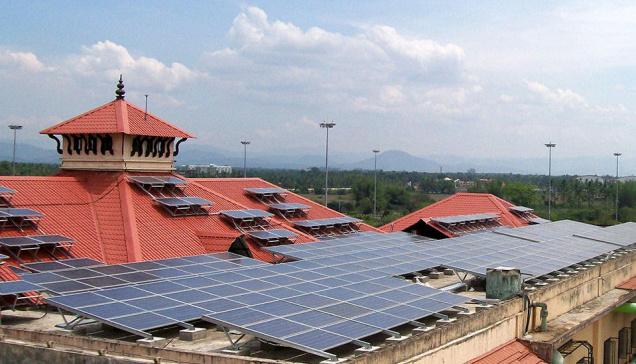
How is the world’s first solar powered airport faring?

solar-powered-airport

Cochin International Airport. Image via thehindubusinessline.com

As an airplane hovers over Cochin International Airport, one is struck by the dazzling array of reflective panels near the runway.

Standing out in a field of green are more than 46,000 solar panels tapping the power of the bright sunlight and converting it into energy.

Located in the southern state of Kerala, Cochin is now the first airport in the world to run completely on solar power.

According to BBC News, the airport started with a small pilot project by installing a solar energy plant with 400 panels on its rooftop in 2013. When that experiment succeeded, it decided to go all the way.

In August this year, the airport became totally self sufficient in meeting its energy needs after it installed a 12 megawatt solar plant close to the cargo terminal.

The airport’s managing director VJ Kurian says it was the huge power bills that prompted them to look at greener solutions.

Challenge

The airport, which is the seventh busiest in India handling more than 1,000 flights a week, consumes nearly 48,000 units costing 336,000 rupees ($5,160; £3,364) every day.

Today, with its solar power plant it produces more energy than it needs and banks the rest with the state power grid for rainy days and night-time requirements.

Mr Kurian says airports across the country have approached him to learn more about the “Cochin model”. A team from Liberia is also interested to learn more about harnessing the sun’s energy.

The installation of the solar plant cost nearly $9.5m (£6.27m) and took around six months to complete. The company is hopeful of recouping the costs in less than six years. So far it has been a smooth journey for the airport, says Mr Kurian.

The challenge though is just around the corner.

The airport is looking to inaugurate a new international wing in January comprising nearly 1.5m sq ft which will require more energy than what the existing plant is generating.

Additional solar panels will have to be set up if the authorities wants to hang onto the “first fully solar powered airport” tag.

Cochin may have shown the way forward but the rest of India is not far behind in tapping the vast potential of the sun. As most parts of the country receive sunshine for over 300 days a year, the possibilities are plenty.

Recognising this, Prime Minister Narendra Modi has outlined his vision of increasing the country’s solar power capacity to 100,000 megawatts by 2022.

This is a dream that can be realised by having photovoltaic panels on the rooftop of every home in India, generating enough power to reduce the country’s massive fuel bill and dependence on fossil fuels.

Solar energy is also a much cleaner source of energy than conventional forms of energy like thermal and nuclear. Considering the global debate on climate change, developing economies like India with its ever increasing need for energy to fuel growth can turn to the sun to power ahead.

Concerns

But it is not a simple process, despite the presence of abundant sunshine.

As Ashish Khanna, chief of Tata Power Solar points out, “We don’t have the [electricity] grid stability which can take the kind of power we are talking about. Also the quality of power is important.”

“We in India are very cost conscious and when we are talking about rooftop power, people may take decisions involving inexpensive pieces of equipment that may not contribute to the kind of quality we are talking about. The challenge right now is that there are no standards in place.”

Meanwhile, the solar plant at Cochin airport will produce 18 million units of power from the sun annually which is enough to meet the energy needs of 10,000 homes for one year.

The bonus is the environmental benefit of reducing carbon dioxide emissions by more than 300,000 metric tonnes which is equal to planting three million trees or not driving 750 million miles.

In a country where more than 300 million people still have no access to power, going solar may just be the solution that is needed to light up their lives.

Aspen now running on 100% clean power

Aspen renewable energy

Aspen is 100% green! Image via everystevejobsvideo.com

Aspen is the third American city to make the transition to 100% renewable energy. Following in the footsteps of Burlington, Vermont and Greensburg, Kansas, Aspen has disconnected itself from coal power completely and is running on a clean combination of wind and hydroelectric power.

Diversifying Green Sources

According to earthtechling.com, wind energy produced by four large wind farms in nearby Nebraska and South Dakota are supplying 53% of Aspen’s energy now, and 46% is coming from hydroelectric installations at the Ruedi, Maroon Creek and Ridgway Reservoirs. The final 1% comes from landfill gas.

Aspen has tapped into solar power too, with a large photovoltaic system set up to power their water treatment plant. There are also plans to install a solar thermal system for heating the water at the local indoor pool.

No newcomer to the green energy movement, Aspen was the first American city west of the Mississippi River to adopt hydroelectric power, in 1885. Since then, the town has relied on a mixture of energy sources. As recently as last year, coal power made up 20% of the city’s energy profile. Unfortunately for Aspen, delicate mountain ecosystems are among the worst affected by coal plant emissions. They would be among the first to feel the disastrous and lasting effects of a changing climate: Aspen and other mountain towns like it are in a sense “canaries in the mineshaft” for global climate change. Getting away from coal was a necessary step for their survival.

Tracking Greenhouse Emissions and Reducing Waste

When the Aspen city council adopted the forward-thinking Canary Action Plan in 2007, they aimed to reduce overall local greenhouse emissions and promote local environmental stewardship. The plan commits to reducing the community’s remaining greenhouse emissions 30% by 2020 and 80% by 2050.

While shifting the city to renewable energy was a large part of the initiative, the Canary Action Plan also includes energy efficiency incentives for Aspen residents, and environmental programs about energy and waste reduction for elementary and middle school students.

It’s very important to the City of Aspen that its residents be involved with the move towards greener living: the municipal government has an online dashboard, updated hourly, where anyone can see how much energy is being produced by the city’s hydroelectric projects.

In order to achieve their goals, The City of Aspen government implemented an emissions tracking system. They monitor city-owned buildings and facilities for annual emissions related to energy use, and they regularly assess the emissions from local ground transportation and air travel.

With a greenhouse emissions “budget” that decreases by 2% annually, Aspen is continually finding ways to improve their energy efficiency and meet their goals. Over the decade of 2004 to 2014, they managed to reduce their total emissions by 42%, achieving far more than their goal of 30%.

By continuing to encourage home energy improvements and the use of alternative transportation, Aspen is well on its way to complete carbon neutrality.