Renewable energy use rises in Germany

solar_PV_Gerrmany
Lessened FIT, feed-in tariffs, high wattage potential and the increasing opportunities of energy deposit define renewable energy systems and make it a more appealing choice for German solar manufacturers. Solar power is being used by an increasing number of households and they utilize personalized plant designation, energy administration and cache.

Consumers of solar energy are more and more implicated in the consumption of high proportions of renewable solar electricity. A growth in electricity costs plus the lowering of prices in photovoltaic systems and the reducing of flaws in solar power have made these systems a fashion.

A new analysis made by the German Solar Industry Association (BSW-Solar) displays the fact that the interest of self-generating users has increased among entrepreneurs and households.

Carsten Körnig, CEO of BSW-Solar declared “Private electricity prices are now almost twice as high as the cost of self-generated solar electricity from the roof of a house.” The survey also displays that installers are facing more and more necessities. “The planning is challenging and advising potential investors is more complex,” said Körnig. Four out of five installers report expanded effort and time for the marketing of PV systems.

The production of solar electricity with its costs and feed-in tariffs as low as €0.15/ kilowatt hour and the fact that electricity rates €0.27/ kilowatt hour, if now higher, renewable energy has become a quite more appealing option instead of  grid-based production.

This fashion is also noticeable among an increasing number of entrepreneurs, who are cutting down their electricity bills by the use of company-owned PV systems.

Such entrepreneurs with proper roof surfaces can usually reach greater consumption rates even if they don’t have the ability to store the energy, declared BSW-Solar. Companies that are based on solar energy production and have a higher base capacity in daytime can widely cover their power utilization through the energy output of their PV systems.

Roxana Moraru

German manufacturer delivers solar thermal system to Kabul

Many hours of sun at consistently low temperatures: The winter in Afghanistan is predestined for the use of solar heat.

The German collector manufacturer REM, Rottenburg/Laaber, has now delivered the first solar thermal system for a multiple dwaelling with 20 flats in Kabul – the beginning of a series of contracts for a total of 21 systems, which will be installed in Kabul and the surrounding area. Solar Sky GmbH in Kassel was in charge of project planning and construction of the system, consisting of 20 collectors and a 3,000 litre tank.

The private builder in Afghanistan hopes to find a solution to support heating during the cold season by the use of solar thermal energy. “The winters in Kabul are similar to those in Germany. There are four months in which the average temperature falls below freezing,” according to the solar expert Assghar Mahmoudi from Solar Sky. Measured in kWh/m², however, the amount of solar energy there is two or three times higher than in Germany.

“In Afghanistan there aren’t any real heating systems. Because of the frequent power failures, reliable heating for housing is quite difficult,” explains Mahmoudi.

The collector system is now being installed and, augmented by a gas fired boiler, will supply energy to heat drinking water and rooms in the future.

The world’s first country powered completely by the sun

Nestled in the South Pacific lies a paradise-on-earth, called Tokelau. In essence a group of islands, this beautiful country has now been crowned as the world’s first nation to go 100% solar-powered!

Using a one megawatt array spread across three atolls, Tokelau is capable of powering 1,400 residents’ lives with renewable energy, generating enough power to satisfy 150% of their electricity needs!

Using 4,032 solar panels and 1,344 batteries, the system was installed by New Zealand-based PowerSmart for a price of £4.7 million. The country also generates energy by burning coconut oil in case of cloudy days or emergencies.

The system has helped the country reduce its carbon emissions by nearly 950 tonnes a year, turning Tokelau into an ideal example for the rest of the world.

Solar ORC systems providing hot water and electricity in Africa seted up by STG International

Electricity isn’t really an energy source that can be yet be taken for granted in certain isolated parts of Africa where more often than not, a regular supply is considered a luxury.

STG International, an MIT non-profit has come up with a feasible way to power up clinics and schools in such parts of Africa using alternative energy sources instead of complete grid reliance.

Using a new hybrid power and heat solar system that’s capable of providing electricity, hot water and space heating, STG International is currently drawing plans to set up five such units in Africa.

With MIT graduate PHDs Matthew Orosz and Amy Mueller leading the way, these units will be tested for viability and will use ORC Engine instead of solar electric panels.

Capable of providing up to 18-24kW-hr of energy and 200-300 gallons of hot water daily, this system could prove to be a boon for rural development, not just in Africa but also other far-flung areas disconnected from the grid around the globe.

Intersolar Europe 2011

Intersolar 2011 will take place in June 8-10 in Munich, Germany.

This year Intersolar Europe expects about 2.000 international exhibitors to fill the 165.000 square meter exhibition space.

The exhibition will span a total of 15 exhibition halls, three more than last year.

The organizers expect 2.500 participants.

Special Exhibition PV Energy World, a new feature, will address the possibilities of PV grid integration.

It will also present the German energy mix of the future and the role PV is expected to play in it.

The accompanying program will complement the variety of innovations on display in the areas of photovoltaic, PV production technology and solar thermal technology.

Professionals from industry, commerce and trade, suppliers and institutions expected a larger program with conferences, seminars, workshops and lectures on the latest industry trends and teaching of practical know-how.

Intersolar Europe as a world-leading makes this a specific, personal exchange of valuable information on products, markets and services.

Google invests into solar thermal power plant

Google said it would invest $168 million into the Ivanpah solar thermal power plant being erected by BrightSource Energy.
The Ivanpah plant, rated at 392 megawatts, is slated to be the first in a series of large solar thermal plants from BrightSource. The company has additional power contracts for 1,300 megawatts with Southern California Edison and 1,310 megawatts with Pacific Gas & Electric.
The technology underlying Ivanpah and many of the other new projects differs from conventional solar thermal power plants. At Ivanpah, fields of relatively flat, computer-controlled mirrors will focus the heat of the sun onto a water tank to create steam. The steam ultimately powers a turbine. The architecture, says BrightSource, can more economically and efficiently capture and transfer energy than the traditional systems that use parabolic mirrors to heat oil in tubes. BrightSource should know: It grew out of a parabolic company called Luz that built some of the most successful parabolic fields ever erected.
Google has invested $250 million in alternative power projects, including wind and solar farms.

Source: www.greentechmedia.com

Solar steam generation power plant opens in Spain

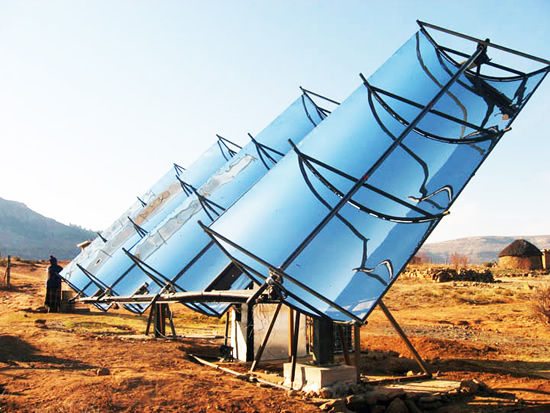
Concentrated solar power plants use lenses or mirrors to heat fluid – such as synthetic oil – which in turn is used to generate high-pressure steam to drive a conventional turbine. A new experimental solar steam generation power plant that opened last week in southern Spain is aiming to improve on the efficiency of existing systems by using water as the direct working fluid and incorporating novel methods for storing the energy, so it can be dispensed even on cloudy days or at night.
The pilot plant is located in the municipality of Carboneras, and is the result of a collaboration between the German Aerospace Center (Deutsches Zentrum für Luft- und Raumfahrt, or DLR) and Spanish utility company Endesa. It was officially put into use on March 31st.
The water in the receiver tubes is kept at a pressure of up to 120 bar (1740 psi), which results in the creation of superheated 500C (932F) steam. That higher temperature allows the whole process to work more efficiently, bringing down the cost of solar thermal power generation and making it a more viable option.
Heat gathered by the plant can be stored in both sensible and latent forms, for use in creating energy when the sun isn’t brightly shining. In the sensible heat system, heat from the steam is absorbed by a concrete storage system, so it can later be released to create more steam and drive the turbine. In the latent heat system, the steam is used to heat salt, which absorbs energy when it reaches a temperature of 305C (581F) and changes from a solid to a liquid state. When the salt cools back down below 305 degrees and reverts to its solid form, that energy is released.

Source: www.gizmag.com

Mid-sized solar projects will be ditched if incentive cuts go through UK legislation

The chilling effect of the coalition’s proposed cuts to feed-in tariff incentives on planned solar projects with 50kW capacity was hammered home last week with the release of new data suggesting that virtually no mid-sized installations will go ahead if the incentives are slashed as planned.
Officials from the Department of Energy and Climate Change (DECC) last week hosted a workshop alongside the Micropower Council and the British Photovoltaic Association where they were presented with detailed evidence on how the proposed feed-in tariff cuts of between 40 and 70 per cent are expected to result in a freeze on all projects with over 50kW capacity, including community-owned and public sector projects.
“We’ve all had our rant about the cuts, now we need to help ministers with the evidence they need to make decisions,” Dave Sowden, chief executive of the Micropower Council, told BusinessGreen. “It is still a bun-fight, but it is turning into an evidence-based bun-fight.”
Officials saw presentations from three solar developers – building giant Kingspan, solar specialist Suntech and insulation and solar technology installer Mark Group – all of which demonstrated that the scale of the feed-in tariff cuts proposed in the government’s ongoing review will make the full range of 50kw plus projects unviable.
Most notably, Kingspan used three real life projects with capacities of 100kW, 250kW and 500kW to undertake a detailed analysis of the rates of return available to firms at different locations and under the current and proposed tariff regimes.
The analysis found that, with the current tariffs, firms deploying the projects could expect to receive rates of return before tax ranging from 7.1 per cent for a 100kW installation in Edinburgh to 11 per cent for a 500kW array in Plymouth.
In contrast, once the tariff proposed in the government’s consultation is applied, none of the projects attains the five per cent rate of return DECC has said in its impact assessment that it wants to achieve. The best rate of return is 4.7 per cent for a 100kW array in Plymouth, while all other projects would deliver returns of between 3.8 and -1.2 per cent.
Significantly, Kingspan’s analysis is based on real life projects and the company has offered to make all of its calculations, invoices and contracts available to DECC officials.
A DECC spokeswoman said that the workshop was part of the government’s efforts to support its ongoing consultation exercise, adding that the department was in “listening mode” and committed to ensuring that “everyone gets the chance to put their view across”.
Source: businessGreen