New Air Liquide R&D laboratory for the solar industry inaugurated

Air Liquide inaugurated an R&D laboratory for the solar industry.

The Group is the first player in this market segment to roll out a pilot manufacturing line for solar cells using crystalline silicon technology.

Today, this technology accounts for 88% of total production worldwide.

This crystalline solar cell manufacturing line will be used to fully test and evaluate new molecules and processes adapted to the needs of each client. The research being undertaken seeks to improve the performance of solar cells while lowering the cost production per watt, with the aim of making solar energy more competitive.

A pool of scientists with experience in photovoltaic technologies will run the research effort carried out at the Air Liquide Group R&D center located on Plateau de Saclay, near Paris, France.

A new wind farm in Austria

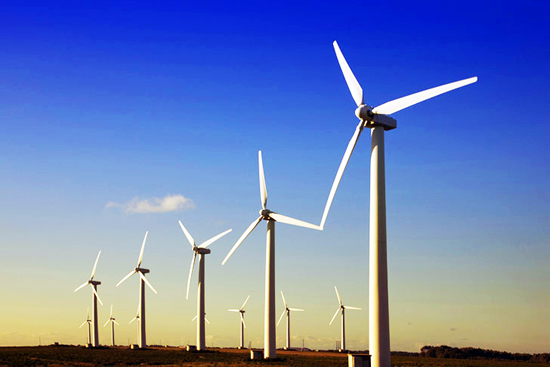
Stephan Pernkopf, Lower Austria’s Secretary of the Environment, Agriculture, and Energy, officially opened the Dürnkrut-Götzendorf wind farm in Lower Austria.

Ten Vestas V90 turbines, each with a hub height of 105 m, rotor diameter of 90 m and a nominal capacity of 2.0 MW comprise the wind farm.

Stephan Pernkopf says that “Gänserndorf District is number one in wind power in Lower Austria. With the new wind farm, the district now has more than 100 windmills in operation. They generate twice as much power as is needed to supply 36,000 households.”

The Dürnkrut-Götzendorf wind farm alone is expected to supply environmentally friendly electricity to 15,000 households.

Currently, 377 wind turbines are in operation in Lower Austria, providing energy for 340,000 households. That is more than 11% of Lower Austria’s total electricity udemand.

More than half of all of the wind turbines in Austria are located in Lower Austria.

Dubai is going to build its first Eco-friendly mosque

People have resorted to minimize the consumption of electricity and maximize the growth of plants and trees around themselves.

Even religious institutions are being designed keeping the hazards of global warming in mind. An example of such an institution is a mosque which is about to be set-up in Dubai.

The project has been set to be completed in 18 months.

The mosque has been aimed to be completed by the closing of 2013 and is decided to be located behind the Al Rowad village near the Deira Clock Tower. It will cover an area of about 4180 square meters with the capacity of 3500 men praying inside it.

Photovoltaic panels are to be used to provide electricity for heating water for ablutions and other work. A highly efficient air-conditioning and a computerized system will be installed mainly to check the efficiency of the electrical equipment.

In the construction of the mosque, asbestos and polystyrene shall be avoided to add to the Eco-friendly environment.

The main front of the building will have a special coating on it to keep it cool in summers. The mosque will be placed in such a direction so as to get the maximum light, thus reducing the consumption of electricity. In addition, there will also be techniques to save water used in ablutions by reusing it for the purpose of flushing toilets and for irrigating the landscape filled with greenery.

The foundation aims at reducing the water consumption by 25% and electricity consumption by 20%.

US photovoltaic market is growing up

In the second quarter of 2012, the PV market in the USA grew by 116% in comparison to the same period of the previous year.

In total, a photovoltaic output of 741.7 MW was newly connected to the grid – this is the second best value overall after 791.3 MW in Q4 2011 and 45% more than in the first quarter of this year (512 MW).

Solar power plants accounted for 477 MW of the new installations in the second quarter. Until the end of the year, 1.1 GW of new PV capacity could be installed, in total 3,400 MW are under development according to the study.

Also a strong growth is predicted in this market for 2013.

In the home photovoltaic sector, the prices were 5.84 $/W for privately financed facilities, while facilities installed by third parties on rented roofs were available for 5.64 $/W.

China’s wind-energy industry grows 96% in six years

China has on previous account been pulled up for constantly pumping dreadful emissions in the air and has taken up the cause to go green.

Growing from 2,000 megawatts to 52,580 megawatts in just six years time, the country has managed to surpass the United States and is currently drawing plans to reach a whopping 200,000 megawatts by 2020.

China’s wind energy industry has grown nearly 96%, enough to make similarly-prosperous countries around the globe go red-faced.

The country seems to have lived up to its word, surprising the world with its continual wind-power growth.

London’s first carbon neutral building

London has just welcomed home its first truly green and completely carbon neutral building.

This building located on the north bank of the Thames sports green roofs and solar panels. It uses  30% of the infrastructure from a former project on the same site in an attempt to reduce costs and building material.

This five-storey office makes use of timber and packs a total floor space of about 800,140 square feet.

Complete with a high-performance façade that makes optimal use of natural lighting and a lot of thought put into efficiency of water usage and electricity use, this swanky green building will pave the way for green architecture in the city of London.

SeaScraper helps filter ocean water and collect waste

Our oceans today are being ridden with waste, particularly plastic and non-degradable materials taking to the sea.

This in turn proves treacherous for the eco-system and marine life and destroys both gradually, having an adverse effect on the environment.

Behold the SeaScraper, an architectural brainchild designed to keep our water bodies clean.

Structured like icebergs, these are largely submerged beneath the surface of the sea and use three separate zones to collect waste including a dedicated waste collection unit, recycling and energy recovery facilities in the middle and housing/recreational estates above sea level.

An innovative way to clean up our oceans that could pretty much prove to be extremely practical if built sustainably, these SeaScrapers could do the eco-system a huge favor if they’re ever turned into a reality.

100 biogas plants may be built in Russia

Altenergo, a Russian energy company, is considering investing about $ 2 billion in the construction of 100 biogas plants in the Belgorod Region in Central Russia during the next several years.

The company plans to build at least 100 biogas plants with a capacity of 230 MW in rural areas of the Belgorod region, which will produce 9.6 million kWh of electricity and 18,200 Gcal of heat per year.

Successful implementation of the project will allow to provide with electricity and heat more than 1 million inhabitants of the region, which is about 13 % of the total consumption.

t present the share of renewable energy sources in Russia’s total energy balance remains small, not exceeding 1 %, however, according to state plans, it should be increased up to 4.5 % by 2020.

Most of the funds for the project is expected to be provided by the Russian banks and in particular Sberbank, which has already invested about 480 million rubles in the construction of one of the first Russian industrial biogas plant also in the Belgorod region which will have a capacity of 500 kW.

First solar charged train

UNESCO heritage Himalayan Queen train from Kalka to Shimla in northern India has become the first train in the world to adopt solar PV panels.

200 W PV modules were fixed on the roof of each of its seven coaches. The generated energy is stored in 2×65 AH Sealed Maintenance Free Tubular 24 V batteries. The engineering marvel took almost a year of trial before being finalized.

The generated energy is used to operate the train. The load drives seven numbers of 6 W LED lights in each of the coaches, besides provision for charging mobile phones during the five-hour journey.

With the PV system and energy efficient lighting in place, a 3 KW alternator, flat belts, regulator rectifier unit, axle pulleys, alternator pulleys and flooded batteries were removed from the underframe of the coach. Thus, they were made more lightweight and speed was increased.

However “dynamic coach balancing”, which was of paramount importance, was a challenge that was successfully mastered by the engineers.

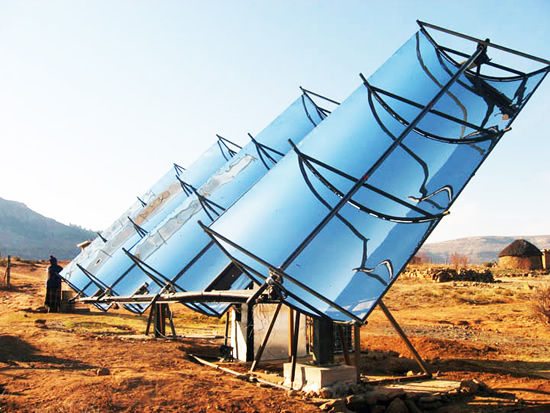
Solar ORC systems providing hot water and electricity in Africa seted up by STG International

Electricity isn’t really an energy source that can be yet be taken for granted in certain isolated parts of Africa where more often than not, a regular supply is considered a luxury.

STG International, an MIT non-profit has come up with a feasible way to power up clinics and schools in such parts of Africa using alternative energy sources instead of complete grid reliance.

Using a new hybrid power and heat solar system that’s capable of providing electricity, hot water and space heating, STG International is currently drawing plans to set up five such units in Africa.

With MIT graduate PHDs Matthew Orosz and Amy Mueller leading the way, these units will be tested for viability and will use ORC Engine instead of solar electric panels.

Capable of providing up to 18-24kW-hr of energy and 200-300 gallons of hot water daily, this system could prove to be a boon for rural development, not just in Africa but also other far-flung areas disconnected from the grid around the globe.