Renault has the automotive world’s biggest solar-powered vehicle canopy

French automaker Renault has come up with a fabulously green way to shelter the cars that roll out of its assembly lines.

The company has recently installed a canopy soaked through with solar panels that has been termed as “the world’s largest photovoltaic system in the auto industry”.

The canopy generates green energy and also shelters the company’s cars beneath. Six of Renault’s production sites including Douai, Maubeuge, Flins, Batilly, Sandouville and Cléon will make use of these systems covering 40 hectares or 400,000 square meters in all.

Capable of generating 52,600 MWh of electricity a year and reducing Co2 emissions by 200-tons annually, these solar panels will prove to be a boon for Renault, helping the automaker substantially reduce its carbon footprint in France.

The world’s first country powered completely by the sun

Nestled in the South Pacific lies a paradise-on-earth, called Tokelau. In essence a group of islands, this beautiful country has now been crowned as the world’s first nation to go 100% solar-powered!

Using a one megawatt array spread across three atolls, Tokelau is capable of powering 1,400 residents’ lives with renewable energy, generating enough power to satisfy 150% of their electricity needs!

Using 4,032 solar panels and 1,344 batteries, the system was installed by New Zealand-based PowerSmart for a price of £4.7 million. The country also generates energy by burning coconut oil in case of cloudy days or emergencies.

The system has helped the country reduce its carbon emissions by nearly 950 tonnes a year, turning Tokelau into an ideal example for the rest of the world.

Samsung opens Korea’s first offshore wind farm

Samsung has been leading the world of technology and has turned into one of the world’s largest consumer electronics giants lately.

The Samsung Heavy Industries has now moved towards the greener horizon and has announced plans for an 84-megawatt offshore wind farm. This will be Korea’s first and will be built jointly with Korea Southern Power Co in Jeju Island.

To be built with a depth of about 30 meters and 2 kilometers away from the coast of Daejeong-eup in Seoguipo in Jeju Island, Samsung plans to have this one up and running by 2015. The wind farm will generate enough energy to power up 100,000 households with clean and green juice.

The world’s largest wind farm, London Array

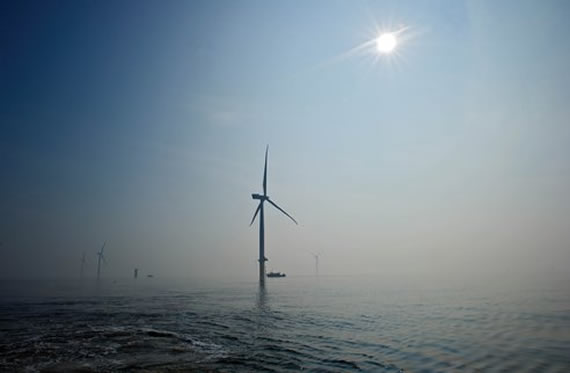
The world’s largest wind-farm, the London Array has finally begun generating energy.

Located in the Thames Estuary, the project will be worth 630 MW when completed. Currently, just 15 of the total 175 turbines have been installed, with the rest being set up.

The remaining turbines are expected to be constructed by the end of this year.

Once completed entirely, the London Array will generate enough juice to power nearly 470,000 UK homes. And this is just the first phase.

The second phase of the project will increase the capacity to 870 MW, slightly off the previously planned 1 GW capacity.

Warrant Buffet’s MidAmerican purchases two wind-farms

Warrant Buffet’s MidAmerican purchases two wind-farms capable of generating 300 megawatts.

American business magnate, investor, and philanthropist better known as the “Wizard of Omaha”, Warren Buffet has now shown his greener side. The billionaire’s Berkshire Hathaway’s subsidiary, MidAmerican, has recently purchased to massive wind farms in California.

Generating a total of 300 megawatts of electricity, these wind farms will be part of the Wind Energy Center located in Tehachapi. The energy generated will be sold to Southern California Edison as part of a long-term power purchase agreement.

That apart, the project is expected to generate just about enough energy to power up nearly 80,000 American homes.

Also, the move could help Warren Buffet offset the pollution his coal trains have been spewing in the environment!

The European Union has passed the milestone of 100 GW

EU reaches 100 GW wind power milestone.

It took the European wind energy sector some twenty years to get the first 10 GW grid connected. It needed 13 years to add an additional 90 GW. And half of the actual total European wind power capacity has been installed over the past six years.

100 GW of wind power can generate electricity over a year to meet the total consumption of 57 million households, equivalent to the power production of 39 nuclear power plants, 52 gas power plants or 62 coal power plants. Or: “It would require burning 72 million tons of coal annually in coal fired power plants to match Europe’s annual wind energy production. Loading that amount of coal on trains would require 750,000 wagons with a combined length of 11,500 kilometres – the distance from Brussels to Buenos Aires, Argentina,” said Christian Kjaer, CEO of EWEA.

“Despite only utilising a tiny fraction of Europe’s vast domestic wind energy resources, wind power is having a substantial impact on Europe’s energy security and environment, and benefits us hugely in creating green jobs and technology exports”, he added.

Eco Homes in South Korea

Environment friendly homes are getting popular with time. Known as Eco homes or green homes, they are best suited for protecting the environment in the best possible manner.

Solar energy is being generated for building these homes in South Korea. Natives of South Korea are mounting solar panels on their roofs so that they can cut on their electricity bills with ease. Along with this, solar power energy is considered the best source, which can help you on sustaining energy in the best possible manner.

Homeowners in South Korea are incorporating these methods so that they can renovate their homes in an environment friendly manner.

A group of architects from South Korea is the one who conceptualize this dream project of having green or eco homes.The architects of South Korea have shown their potential by designing and making a home, which is truly considered as eco home. More than 95 green technology aspects are taken into use for building the eco homes for perfect results.

The architects are stating that, in the near future, energy sources would be costly and at that point, of time, eco homes would be the best choice for all.

The technology plays a major role in having eco homes in South Korea. With time, use of eco homes will grow at a rapid pace, as the benefits, which are associated with it, are beneficial in the end.

Google Purchases 48 MW of Wind Power

Google Purchases 48 MW of Wind Power for Its Oklahoma Data Center.

That’s a very large amount of electricity, enough to power a small city.The recent announcement shows that with a forward-thinking approach, large companies can make significant contributions to the transition to a renewable energy economy.

“To power its Oklahoma data centre – one of the facilities responsible for bringing you your Gmail, Docs, and Google search results – Google faced a local electricity mix of over 50% coal power,” Greenpeace writes. “But as one of the major electricity customers in the state, Google worked with the local utility to secure a new supply of renewable wind energy.”

Google’s decision to source the electricity for its data center entirely from renewable energy should send a message to other large “internet companies and electric utilities around the world that renewable energy is not only possible, but is simply smart business in the 21st-century economy,” Greenpeace adds.

Sharp unveils new semi-transparent solar panels

Sharp unveils new semi-transparent solar panels with 6.8% conversion efficiency.

See-through solar panels have been a long standing dream of many, and Sharp has just given the world its first taste of the revolutionary technology.

Designed specifically for use as balcony railings and skyscraper windows, these solar panels have a semi-transparent black finish with a solar power conversion efficiency of about 6.8%.

These panels pack a maximum output of 95 watts and measure in at 4.5-feet wide by 3.2-feet tall. Now the efficiency of these panels might not match up to those conventionally used, but replacing windows with these is bound to turn just about any building greener!

Also, Sharp has not revealed the pricing details and we hope as technology progresses, these transparent panels will turn a little more efficient!

Drastic cuts for Bulgarian green electricity producers

In Bulgaria, the support for the production of electricity from renewable energy sources has been drastically reduced.

Seems that energy regulator DKEVR (english: SEWRC) has retroactively cut feed-in tariffs for electricity from PV and wind generation sources.

SEWRC based its decision from 14 September on requests from network operators to temporarily increase access prices to the transmission grid.

According to the energy regulator, expenditures of the electricity networks have massively increased due to the great number of new renewable energy sources feeding into the grid. In order to cover the costs, remuneration per kWh fed into the grid by renewable power sources had to be reduced.

Renewable electricity producers’ associations characterised the commission’s decision of September 14 as illegal and demanded its withdrawal. The reason would be that the cuts contradicted the renewable energy law, guaranteeing investors fixed prices over long time periods.

According to the Bulgarian Wind Energy Association (BGWEA), “The drastic cuts will push the majority of all existing renewable energy projects into bankruptcy, as with income losses of 10 % to 39 % most projects will not be able to make their loan repayments anymore. This means that several billion Leva worth of domestic and foreign investment along with hundreds of newly created jobs have been destroyed overnight.”

Moreover, due to the retroactive cuts the Bulgarian banking system would run the risk to end up with a massive amount of bad loans on its books.

The branch is appealing against the decision in Brussels. The European Wind Energy Association (EWEA) has expressed its protest in a letter to EU Energy Commissioner Günther Öttinger.

At the same time, renewable energy producers in Bulgaria plan to increase pressure on the government. The Bulgarian PV Association (BPVA) has published an appeal that calls upon the members of the branch to meet for a protest meeting in front of the DKEVR building in Sofia on Monday 24, September at 9.30 local time.