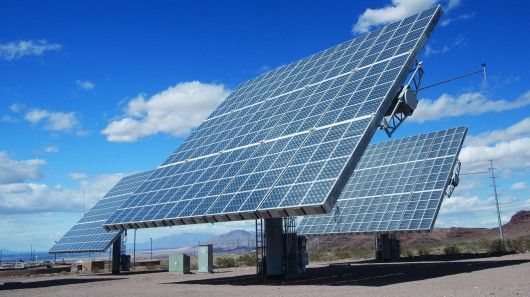
New 4.5 MW solar park accomplished by the german Conergy in France

New_solar park_completed_in_France

Today’s Conergy realization is a solar park for the financier UEM, the local energy producer and framework operant, sheltered on an area of 9.5 hectares with the capacity of 4.5 MW.
This project holds 18,000 Conergy “P Series” units, it is situated in La Fare-les-Oliviers of Southern France, and will provide about 6,500 MWh annually, or plenty electricity to sustain about 1,800 homes.
Although the market is difficult and the price competition is forceful, the german provider Conergy continues to accomplish and provide for projects in European investors from Greece, Spain and Portugal. It also remains active in Southeast Asian markets like Thailand.
Conergy did not only provide PV units, but also brought to operation the design and installment for the entire project. In addition, it will carry on its involvement in sustenance and functional administration for the solar park.
Along with this project, Conergy backed up Sunlap in the building of two carport plants in La Fare-les-Oliviers with “P-Series” units and IPG15T inverters. It will sustain almost 127 MWh annually.

Conergy’s Managing Director Philippe Pflieger revealed a positive point of view. “With its decision to increase both, market volume and subsidies, the government has given a boost to the solar sector. Although the economic situation in this country remains tense, we believe that these steps will restore a good outlook for solar energy in our country.”

Roxana Moraru

$27.2 billion to invest in PV market in five years

PV_market_raise

The global PV materials market will double until 2018. Lux research says the main reason is the improvements of the supply demand balance. The global demand will be represented by materials differentiation and innovations.

Taking into account last year’s investments, the PV material market will grow from $17.8 billion to $27.2 billion by 2018. Part of that sum, $12.8 billion to be precise, is formed of witih metals, including polysilicon and metallic absorber materials. A $6 billion raise is due to the global demand of silicon modules.

Lux Research analyst, Fatima Toor announces that “differentiated materials that enable high cell or module efficiencies or longer lifetime will be able to earn a premium and cash in on the growing demand.”

Toor also said that the need of improved quality may lead to materials innovations that could lower the price per watt as well as the price per kilowatt hour.

Materials such as backsheets, non-EVA encapsulants, metallization pastes and antireflection coatings can also lead to material innovations.
Moreover, effective planning and implementation of the module quality can be the source of opportunities for materials developers.
Roxana Moraru


Solar modules will have new switch-off solutions produced by Bosch

new_solar module_switch-offBosch is in the process of developing new switch off solutions design for solar modules. The new products will be presented at the Intersolar trade fair. 

The new solutions for both commercial and residential applications are optimizes for module electronics, particularly module junction boxes and control units.

The automatic switch-off is very useful in hazardous situations. Another advantage is the voltage-free state, meaning that the owners can have the modules installed and not risk electric shocks.

In case of main supply shutdown, intelligent electronics in every junction box guarantee the self-regulated switch-off of the entire system and its distinctive modules. This function can also be called up with a control signal from an exterior emergency switch. The new Bosch idea is distinct by initializing an automatic following restart as soon as the problematic situation has stopped. By this, the production is ensured once the situation ended.

After passing a large number of tests and being used in the field, prototypes have affirmed their strong capability.

All basic solar module types can benefit from the innovative solutions. In fact, the automatic switch –off can be installed without rebuilding the machines, in most cases. Moreover, the new product designed by Bosch Solar Energy matches with a handful of industrial standards and codes that where formerly introduced.

At the Intersolar trade fair, where the new concept will be promoted, Bosch will also showcase new black premium solar module, the white high-performance module and the new frame concept.

Roxana Moraru


Import charges for PV products will be raised up to 67.9% by August

China_ant-dumoing_duties
Further details regarding import charges have been released by the European Commission on the crystalline photovoltaic imports from China. By August, there is a possibility that Chinese companies will be confronted by contingent charges of an average 47.6% if they fail to reach an agreement with the EU.

Such measures will be taken on August 6 by the European Commission, who will set company specific charges that can range from 37.3 to 67.9% in case of failure in an agreement between the parts.

An equable tariff of 11.8% will be put into action starting from June 6 through August 5. This tariff applies to all companies concerned.  The guidelines introduced in March making it necessary to record imports will be halted because of the anti-dumping duty.

Announced on Wednesday in the Official Journal of The European Union, granted by the EU Regulation 513/2013, the initial import duties for China’s crystalline solar trades are established in conformity with “net free-at-Union-frontier price, before duty.” Thus, these imports are “subject to the provision of a security equivalent to the amount of the provisional duty” before their release into the EU.

Lower duty rates will be granted to those companies that have stood up for EU investigations and have lower dumping allowance.
According to the EU regulation, companies that have supported EU investigations and that have lower dumping margins as well as lower injury margins for EU manufacturers will face lower duty rates.

As a consequence, Trina affronts an import duty rate of 51.5%; Jinzhou, a rate of 38.3%; Suntech 48.6%; Yingli 37.3%; 51.5%; LDK 55.9%; JA Solar 58.7%; and Delsolar an import duty rate of 67.9%.

Not only products made in China but also those exported by the country, such as crystalline photovoltaic modules, cells and wafers will face these taxes.

For 130 other companies that are part the EU investigation and are listed in the regulation annex, a preliminary duty of 47.6% will apply from Aug. 6. All other uncooperative companies with the EU investigation will be confronted with 69.7% import duties.

A concluding resolution will be made by the EU Council of Ministers on the level, likely to be sustained and be held valid in the subsequence of import charges on December 5 through the EU affiliated countries. In regard to the retroactive administration of anti-dumping control, no decision has been made yet.

Roxana Moraru

PV generation saved by the Japanese government. The companies are offer low-interests loans

PV_industry_in_Japan
The government in Japan is willing to help the Pv industry bloom. Regarding this matter, the government thought is for the best that the companies are offered low-interest loans for. The offer is available to those who install rooftop power systems.

The Japanese government is offering to help rooftop PV installers boost.

The Ministry of Economy, Trade and Industry in Japan will soon provide secure low interest loans to companies burrowing rooftop space for solar panels.

Citing the Nikkei newspaper, Bloomberg informs that the credit will be available via public financial institutions such as the Development Bank of Japan.

Companies will be allowed to sell electricity produced by the solar panels on the rooftops of people’s homes. These homeowners will also have something to gain in return for renting their rooftop space: they will receive between 10,000 yen ($97, €75) and 20,000 yen ($195, €150) a year.

Roxana Moraru

A new South African PV project has Google’s $ 10m investment

Google_PV_investents_in_South_Africa
Richard Needham, the Google director, announced that his company invested ZAR103 million, meaning US$10 million in the Jasper Project. The search engine giant believes that the African country can become a renewable energy driver for the entire continent.

Google’s director for energy and sustainability believes that there are points to take into account when analyzing PV investments.  It can have an economic sense or it can attract other investments that will “bolster the growth of the renewable energy industry and move the world closer to a clean energy future”, in the director’s terms.

The failure of the Google’s investments is almost never revealed but Bloomberg did not failed to announce that the giant is one of the equity investors in the african PV project together with SolarReserve, a U.S project developer, development partner Kensani Capital Investments; Intikon Energy; the state-owned Development Bank of Southern Africa; non-profit organization P.E.A.C.E.; and state pension fund Public Investment Group.

The search engine giant never fails to announce its investments in renewable energy so Reuters says that the company funded $94 million of photovoltaic projects in California and launched a $280 million financing package with SolarCity for residential solar installations among with acquiring a 49% stake in a German solar project in 2011.

Roxana Moraru

300 MW of solar projects are to be constructed by Chinese Merchants

china_market_research
The Chinese city of Xingtai and China Merchants New Energy Group signed a deal to develop 300 MW of solar projects in home market.

China Merchants New Energy Group (CMNE), a renewable energy project developer is going to build this year a third of the initial project, meaning 100 MW of solar project will be located in China’s Hebei province south of Beijing, as the company spokesman announced during this week.

The representatives of the company also said they will not give information regarding the financial details of Xingtai enterprise. Despite this, the company allied with Xinjiang Production and Construction Corps Investment Co. so that they could develop 300 MW of solar projects in the Xinjiang province in northwestern China by 2015 with a total investment of invest CNY 3 billion ($489 million, €378 million).

Moreover, in the past year CMNE invested CNY 10 billion in solar projects. The money came from China Development Bank. This was also a joint venture with with Chinese polysilicon giant GCL-Poly Energy Holdings with whom they would produce 973 MW of PV facilities.

Last year CMNE secured CNY 10 billion from the China Development Bank to finance solar projects and the group partnered with Chinese polysilicon giant GCL-Poly Energy Holdings to develop some 973 MW of PV facilities in the country.

Roxana Moraru

Lightway Solar, a Chinese producer, has been approved in developing a 50 MW photovoltaic sites in Prundu, Romania. The project rises to € 76 million.

€ 76 million will be invested in 50 MW PV project in Romania

Lightway Solar, a Chinese producer, has been approved in developing a 50 MW photovoltaic sites in Prundu, Romania. The project rises to € 76 million.
China Development and Reform Commission agreed with this project thus giving a boost to the solar energy harvest in Romania.
Regarding to the NDRC’s statement, the project’s cost will reach the amount of RMB 610 million, the equivalent of € 76 million.
The project has not been acquired yet. The parts of interest are still negotiating. As evidence, there hasn’t been any confirmed purchase, fact declared by a Lighway Solar spokesperson.

parc_fotovoltaic_romania_PV“We are now starting the first move in Romania where the government has introduced a series of PV policies. Lightway will cooperate with our end investors to win the support; also in Germany, our team will further upgrade for an intensified European PV market competition, including distributed generation market”, are the words of Wei Zhen, general manager of Lightway Deutschland GmbH, unraveling their European strategy.

Roxana Moraru

China – Market research predicts China’s demand for PV in 2014 is 0.9-3.6GW

China – Market research predicts China’s demand for PV in 2014 is 0.9-3.6GW
china_market_researchTaking in consideration China’s reputation as the promised land for the solar industry, the newst report from Solarbuzz sayz that there are wild fluctuations in demand of the country, this could mean suppliers which rely on markets outside the People’s Republic will enjoy an advantage.
The solar market research company, in its latest edition of NPD Solarbuzz Quarterly, predicts that demand in China up to April 2014 will vary wildly between 0.9 and 3.6 GW per quarter.
Although NPD Solarbuzz is forecasting that will add up to more than 20% of global demand over the next four quarters, it will make managing inventories tough for companies focused on the Chinese market, whereas companies dependent on other regions will benefit from more predictable levels of demand.
The report’s authors say demand in Europe, of which 65% will come from established German, Italian, French and U.K. markets, will amount to between 2.7 and 3.2 GW quarter on quarter.
The rest of the world, with Japan predictably strong in the first half of the 12-month cycle and the U.S. mirroring that seasonality in the following six months – supported by emerging markets in south east Asia and the Middle East – will also supply more predictable demand in the year ahead.


A new „Top Brand PV” award is given to Trina Solar in Germany

photovoltaic_plant_trina_solarA new „Top Brand PV” award is given to Trina Solar in Germany!

Taking in consideration the their brand and brand awarness, german installers have once more given Trina Solar top marks. For this achievement, EuPD Research has rewarded the manufacturer with the premium seal “Top Brand PV” for the second time running.

The PV module, solutions and services provider Trina Solar has once again been awarded the “Top Brand PV” seal in the “Modules” category in Germany. EuPD Research awards this seal only to leading photovoltaic manufacturers who have completed an in-depth quality check.

Therefore, Trina Solar now belongs to the worldwide elite brands in the solar industry. The seal is awarded each year only to those manufacturers whose brands are rated unusually highly in comparison to their competitors by installers. Trina Solar has received top marks for their brand, brand awareness and market penetration for the second time running in an independent installer survey by the Bonn based market and opinion research institute EuPD Research.

The “Top Brand PV“ seal was developed by EuPD Research in 2010 as a way of objectively evaluating the brand management strategies of module and inverter manufacturers. The branch seal is awarded after the completion of a complex market analysis based on qualified statements regarding the brand awareness of market intermediaries and the buying behavior of their customers. This way, manufacturers receive an unfiltered assessment of their own brand as well as feedback on where potential lies to optimize their brand management.

For wholesalers, installers and end customers, the PV seal provides an independent aid for orientation when choosing a premium brand. Trina Solar now once more belongs to the small group of elite brands worldwide who are qualified to carry the seal.

Ulrich Mamat, Regional Sales Director and Managing Director of Trina Solar Germany, explained: “It is an honor to receive the Top Brand PV award in back-to-back years. We have continually increased our brand awareness over the last few years – our strong local presence, with contacts on the ground, has been crucial to achieving this. Furthermore, we see ourselves as a partner to our customers, offering not only modules of the highest quality but also value-added services as a key part of our portfolio. For example, installers benefit from the training opportunities provided by the Trina Solar Training Academy, and from our popular Partner Plus program, which was very well received and played a major role in increasing awareness of the Trina Solar brand.”