$14.2 billion offshore wind farm in France

The offshore wind farms are located far out into the sea; they trap winds at faster speeds than they would on land, and also, save up a lot of land space.

The French government of Nicolas Sarkozy has launched a €10 billion ($14.26 billion) tender to build about 1,200 wind turbines in 5 different offshore wind farms.

France depends mostly of nuclear energy.

France wants to diversify his energy generation with renewable sources and to have 23% of France’s energy come from renewable sources by 2020.

The offshore wind farms will be located off France’s coast on the North and West and will generate about 3.5% of France’s electricity needs.

Wind energy market saw decreased demand in 2010

In 2010 the U.S. wind energy market took a hit with a decrease in investment compared with 2008 and 2009.

According to the Department of Energy’s, the report investment in terms of how much wind energy capacity was built and connected to the national electric grid.

In U.S. in 2010 were installed about 5 gigawatts’ worth of wind energy farms representing an $11 billion investment, according to the report.

Compare to the 10 gigawatts that were installed in 2009 in the U.S., and the 8 gigawatts in 2008, 2010 represents a decrease in wind energy installations.

“The combination of the delayed impact of the global financial crisis, relatively low natural gas and wholesale electricity prices, and slumping overall demand for energy outweighed the ongoing availability of existing federal and state incentives for wind energy deployment, resulting in a steep drop in capacity additions relative to both 2008 and 2009,” according to the
report.

China was the world’s fastest-growing market and U.S. was still the second-fastest-growing wind energy market in the world in 2010.

Wind turbine component manufacturing in the U.S. grew in 2010 and about 68 percent of components used in U.S. wind projects installed between 2009 and 2010 were made in the U.S.

Six Slovak solar parks on the grid

Six solar parks were putted on the grid by the german Vario green energy group in the Slovak Republic in May and June 2011.

The project planning, system configuration and the delivery of all the components were done by Vario green energy Concept GmbH from Holzgerlingen near Stuttgart, together with Vario green energy Parks GmbH from Munich.

The six solar photovoltaic power plants in Poltár, Biskupice and Ruminceparks have a power of 1 to 1.2 MW each and a total power of 6.2 MW.

The assembly time was six to eight weeks, but it worth because 70,000 solar modules will feed in an annual 7 million kilowatt hours of electricity into the local grid.

The plant operators will receive a remuneration of 38.23 Eurocents, according to the current Slovak feed-in tariff.

Since 1 July the solar electricity funding will be limited to roof-top plants with a power of 100 kilowatts maximum, but despite the cuts in financial support, Vario will remain active in Slovakia and plans to concentrate only on the roof-top market.

Schneider Electric will supply photovoltaic inverters in North America

Schneider Electric, a specialist in energy management, has been selected by a major global engineering and construction company to supply photovoltaic inverters throughout 2011 in North America.

Schneider will supply an order of 100 MW of capacity, which is the largest order in Schneider Electric’s history in North America and one of the largest ever in the North American market.

“The extensive experience we have in the field, in a broad variety of operating environments, is one of the primary reasons for our company’s continued success and the satisfaction of our customers,” said Rudy Wodrich, Commercial Vice President, Americas.

With this order Schneider proves again his leadership in PV inverters and solutions.

Solar powered charger – efficient and flexible

Solar powered chargers have the serious potentiality to defy the main electricity grids, at least for charging of small appliances.

Designer Nikolay Bastrakov has made use of existing technologies to create his own version of a solar charger, whose intrinsic system counters the conventional problems to efficiently generate higher degree of power output.

He designed one of the world’s most efficient solar powered chargers.

This device is based on the user convenience of compactness, portability, and aesthetics.

The main form can be easily attached to a backpack because it has a mobile battery.

The compact form was made from silicone with an additional coating of the polymer film to form a singular structural element.

The designer had used thin film solar cells, which were assembled on a common substrate, and this substrate was connected to the main control unit housed in a silicone cell.

The advantage of thin film solar cells is to be effective on even cloudy days.

The device has a control unit which includes a converter, a small battery, micro-processor for processing the information received from the sensors.

This display system utilizes electronic ink.

This type of display forms an image does not emit and reflect light.

The bendable control unit can be attached to bags and backpacks to accentuate upon their degree of portability.

Spanish solar market is rising

The statistics for the PV market for 2010 released by the Spanish photovoltaic association ASIF, according to which the Spanish PV industry is moving strongly into the international market.

Thanks to the changes in the Spanish solar energy promotion policies and because a yearly cap of 500 MW was set, the international sales in 2010 increased by 130% compared to the previous year.

The total capacity of Spanish PV production was 1.000 MW in 2010, of this, 70% was exported and only 30% installed locally.

In Spain itself, 392 MW of new photovoltaic systems were installed, of which a good 60% were locally produced.

2009 was a bad year for Spanish market because subsidies were massively cut and the sales in Spain only reached 17 MW.

However, a large portion of the projects completed in 2010 were actually old projects, the completion of which was delayed by the crisis of the year before.

The ASIF predicts that Spanish solar market will increase more in the coming years, and expects only 300 MW of new capacity to be installed in 2013.

Renewable energy from “Green Power Islands”

Green Power Islands – a great idea to generate and store renewable energy on uninhabited islands around the globe.

The Danish architectural firm Gottlieb Paludan has proposed generating power through wind or solar — depending on the climate — and then using the water surrounding the islands to store the power using pumped hydro technologies.

This new concept for producing and storing renewable energy could even provide all the power for Denmark’s population.

The idea of the architects is to create a “Green Power Island” off the coast of Copenhagen, which would become an “energy super centre” for the country.

The massive island would be accompanied by offshore wind farms, and populated with solar arrays and seawater pumps, and would produce marine biomass for biofuel.

The energy will be stored using pumped hydro facilities.

The architects from Gottlieb Paludan have suggested a few areas around the world where Green Power Islands could be built on existing islands.

These include: the Florida Keys, Jiangsu in China, Manama in Baharain and Tamil Nadu in India.

Gamesa a world leader in wind turbines

During 2011 Gamesa made progress in offshore strategy, technological design and development of the G11X-5.0 MW platform which will be equipped with a 128-metre rotor diameter.

Gamesa has a 15 years experience in the design, manufacture, installation and maintenance of wind turbines, having installed 21,000 MW in over 30 countries across four continents, with over 13,600 MW under maintenance.

All this makes her a world leader.

Recently, in Liverpool Gamesa showcased theG128-5.0 MW offshore wind turbine.

The first prototypes are scheduled for completion in the last quarter of 2012.

The company plans to invest over €150 million between now and 2014 in the UK wind power offshore.

Egypt has one of the first solar-gas hybrid plants in the world

Iberdrola has started its plans to commission the 150-MW Kuraymat power plant due south of Cairo, which fuses solar energy with a combined cycle gas plant, even in Egypt was a “nightmare”.

The Integrated Solar Combined Cycle (ISCC) facility was opened this month.

The project has a total capacity of 150 megawatts (MW).

This facility incorporates technology that combines the use of gas and solar energy and  is one of the first of its kind in the world.

The power plant is located 95 kilometers south of Cairo, will supply enough power for 200,000 people while saving around 16,000 tonnes of carbon dioxide emissions into the atmosphere each year.

At Kuraymat project 1,000 people have worked over the last three years.

The Egyptian plant has been built very close to the River Nile.

The area where the plant is built has become a strategically important region for the generation and distribution of electricity in Egypt.

Having this solar-gas plant, Egypt will save 5,000 tonnes of natural gas every year.

Iberdrola Engineering built and designed this ISCC-type facility to work in two different operational modes, in order to increase efficiency: during the night it operates as a conventional natural gas combined cycle plant, while during the day it operates a normal cycle but with the added energy provided by the sun.

On one side, the Kuraymat plant is fitted with a General Electric model 6FA gas turbine and a Siemens model SST900 steam turbine, while on the other it has a solar field covering 130,800 m2, with 160 parabolic cylinder CSP collectors and 1,900 m2 of mirrors.

Kuraymat is the first solar thermal electric facility in Egypt.

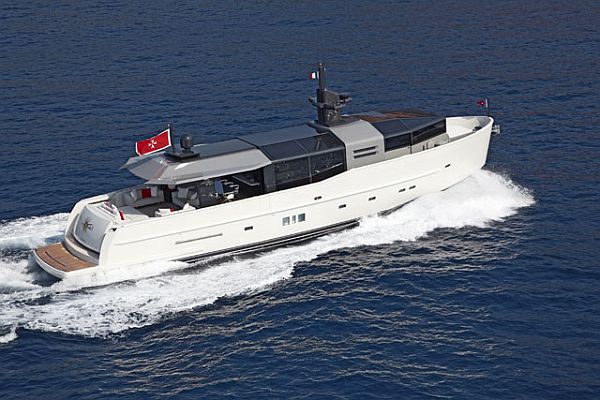
A solar-powered superyacht is available for charter in the Mediterranean

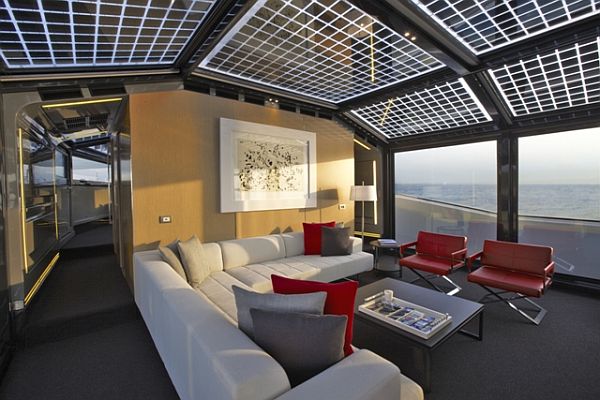
Arcadia 85, the super-yacht built with solar panels is offering charter holidays in the Mediterranean, during the summer of 2011.

The solar-powered yacht was named ‘Solar’ and from €49,000 (about $70,371) per week, up to eight people can feel confident about their carbon footprint, without losing out on luxury.

This yacht has the lowest fuel emission of any yacht in its class because it has an economical speed of 9 knots, when the diesel engines use only 30 liters per hour.

Solar’s panels run the hotel load, which it means everything from air conditioning to lighting, plus pumps and refrigeration.

The Solar yacht was built by  Edmiston & Company, it boasts a deck of 60 square meters and has  four cabins that have all necessary audio visuals, a spacious saloon in the top deck which is the entertainment area and sitting place and a huge saloon.

The super-yacht reaches a top speed of 18 knots propelled by a fuel that is organic in nature.

Also, on the yacht is a delicious cuisine where the chef uses only organic ingredients.

This is the perfect green-way to relax on your holiday.