An amazing solar tower in Arizona will power 150.000 homes

EnviroMission has decided to set up a solar tower with huge dimensions in the desert of Arizona.

The tower will instantly become one of the world’s tallest buildings because it measure some 2625 ft in height and 130 meters in diameter.

The structure will produce 200MW electricity, enough to power 150,000 US homes.

This project would also be a good money eater, costing a sensational US$750 million to the participants.

Arizona being a desert has an air temperature as high as 40 degrees Celsius.

As we know that air rises up making space for a cooler gush, the heated air at the bottom of the tower would rise up and the temperature at the ground level can be raised to 80 – 90 degrees.

Turbines would be integrated into the system such that when the hot air makes its upward move, it rotates the turbines and electricity is generated.

The temperature will be greater between the layers of air if the tower is planned tall and more energy would be generated.

No continuous raw feed would be required to keep the system working. Nature would take that responsibility.

This arrangement can be expected to keep working for 80 years without any maintenance need.

$14.2 billion offshore wind farm in France

The offshore wind farms are located far out into the sea; they trap winds at faster speeds than they would on land, and also, save up a lot of land space.

The French government of Nicolas Sarkozy has launched a €10 billion ($14.26 billion) tender to build about 1,200 wind turbines in 5 different offshore wind farms.

France depends mostly of nuclear energy.

France wants to diversify his energy generation with renewable sources and to have 23% of France’s energy come from renewable sources by 2020.

The offshore wind farms will be located off France’s coast on the North and West and will generate about 3.5% of France’s electricity needs.

Six Slovak solar parks on the grid

Six solar parks were putted on the grid by the german Vario green energy group in the Slovak Republic in May and June 2011.

The project planning, system configuration and the delivery of all the components were done by Vario green energy Concept GmbH from Holzgerlingen near Stuttgart, together with Vario green energy Parks GmbH from Munich.

The six solar photovoltaic power plants in Poltár, Biskupice and Ruminceparks have a power of 1 to 1.2 MW each and a total power of 6.2 MW.

The assembly time was six to eight weeks, but it worth because 70,000 solar modules will feed in an annual 7 million kilowatt hours of electricity into the local grid.

The plant operators will receive a remuneration of 38.23 Eurocents, according to the current Slovak feed-in tariff.

Since 1 July the solar electricity funding will be limited to roof-top plants with a power of 100 kilowatts maximum, but despite the cuts in financial support, Vario will remain active in Slovakia and plans to concentrate only on the roof-top market.

Schneider Electric will supply photovoltaic inverters in North America

Schneider Electric, a specialist in energy management, has been selected by a major global engineering and construction company to supply photovoltaic inverters throughout 2011 in North America.

Schneider will supply an order of 100 MW of capacity, which is the largest order in Schneider Electric’s history in North America and one of the largest ever in the North American market.

“The extensive experience we have in the field, in a broad variety of operating environments, is one of the primary reasons for our company’s continued success and the satisfaction of our customers,” said Rudy Wodrich, Commercial Vice President, Americas.

With this order Schneider proves again his leadership in PV inverters and solutions.

Egypt has one of the first solar-gas hybrid plants in the world

Iberdrola has started its plans to commission the 150-MW Kuraymat power plant due south of Cairo, which fuses solar energy with a combined cycle gas plant, even in Egypt was a “nightmare”.

The Integrated Solar Combined Cycle (ISCC) facility was opened this month.

The project has a total capacity of 150 megawatts (MW).

This facility incorporates technology that combines the use of gas and solar energy and  is one of the first of its kind in the world.

The power plant is located 95 kilometers south of Cairo, will supply enough power for 200,000 people while saving around 16,000 tonnes of carbon dioxide emissions into the atmosphere each year.

At Kuraymat project 1,000 people have worked over the last three years.

The Egyptian plant has been built very close to the River Nile.

The area where the plant is built has become a strategically important region for the generation and distribution of electricity in Egypt.

Having this solar-gas plant, Egypt will save 5,000 tonnes of natural gas every year.

Iberdrola Engineering built and designed this ISCC-type facility to work in two different operational modes, in order to increase efficiency: during the night it operates as a conventional natural gas combined cycle plant, while during the day it operates a normal cycle but with the added energy provided by the sun.

On one side, the Kuraymat plant is fitted with a General Electric model 6FA gas turbine and a Siemens model SST900 steam turbine, while on the other it has a solar field covering 130,800 m2, with 160 parabolic cylinder CSP collectors and 1,900 m2 of mirrors.

Kuraymat is the first solar thermal electric facility in Egypt.

Californian college – 100% electricity from solar panels

The first college in the U.S. to go ‘grid positive’, the Butte College has installed 25,000 solar panels.

The college will generate over 100 percent of its electricity from solar power.

The solar panels are expected to generate more than 6.5 million kilowatt hours of electricity annually, which is more than the annual power consumption of the college.

The system generates more energy than it consumes, it says that it will be able to save between $50 million and $75 million over the next 15 years.

Butte College will surely set an example for other American institutions to go green.

3000 MW by 2020 in Malaysia

Malaysia‘s parliament announced the country’s installation targets for renewable energies and the plan to install 3,000 MW of renewable by 2020.

They expect that 1,250 MW will be generated by photovoltaic installations and another 1,065 by biomass.

With the implementation of these ambitious targets Malaysia follows other Asian countries like Thailand or Taiwan.

The Malaysia’s Minister of Energy announced that the legislation will come into effect in midsummer this year.

The 2011 quota for photovoltaic power is 29 MW with 9 MW set aside for projects smaller than 1 MW.

Malaysia’s feed-in-tariffs for photovoltaic power are divided into six different sections:  systems smaller than 4 kW, between 4 and 24 kW, between 24 and 72 kW, between 72 and 1 kW, between 1 MW and 10 MW and installations between 10 and 30 MW.

The Army plans to install microgrids in Afghanistan

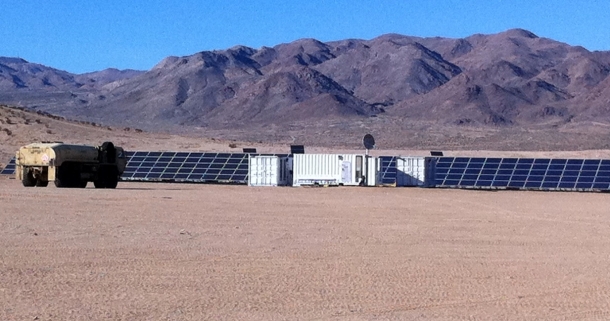
To reduce its energy the Army plans to install microgrids in Afghanistan.

The Army said earlier this week that they will deploy a system designed to use fuel more efficiency and pave the way solar and wind power in the field.

Now, the Army uses diesel generators to power its bases which have a significant financial and military cost as fuel convoys are often targets for attack.

The Army plans to save fuel with the new microgrids.

The microgrid bases will be formed from four generators able to produce one megawatt.

The microgrids will include controls to integrate power generated from solar panels and storage systems.

“They’re being designed so that a soldier can just hook them up any way and plug things in and not have to worry about doing prior analysis of how the power grid should be laid out or what load should be placed where,” said Chris Wildman, the Hybrid Intelligent Power program lead, in a statement.

The strategy of U.S Army is to minimize the amount money spent on fuel, using solar panels for diesel generators and portable solar panels for soldiers on patrol.

SolAir – a new hybrid wind/solar power generator

This new invention named SolAir is a small wind turbine combined with solar panels.

Each device has three rotating blades, a 64 radius, and weighs approximately 60 lbs.

A solar panel 40 square inches in size is integrated into the micro wind turbines.

These SolAir’s are getting quite popular in San Diego, because they can generate power in winds anywhere from 6 mph to 60 mph.

SolAirs are often installed along the roof line of residential or commercial buildings, but they can be used in a variety of locations.

SolAir product is ideal for many parts of the country because the small wind feature combined with solar panels allows for electricity generation on sunny days with little wind or windy days with/without sun.

State incentives and federal income tax credits can reportedly cover up to 50-70% of the total cost of the micro clean energy system.

SolAir ha a quick process of install and once installed you start saving money on your electric bill.

A new type of solar cells who can harness energy from infrared spectrum

A new solar cell has been designed by researchers at the University of Toronto.

This solar cell can be useful in creating cost effective thin coatings capable of efficiently converting solar power into electricity.

The solar cell is based on colloidal quantum dots.

In search for an efficient infrastructure that would harness the potential of the sun’s visible as well as infrared spectrum, the researchers have been successful in designing a device.

“The device is a stack of two light-absorbing layers — one tuned to capture the sun’s visible rays, the other engineered to harvest the half of the sun’s power that lies in the infrared,” said lead author Dr. Xihua Wang.

The CQD solar cells are made of nanoscale materials that can readily be tuned to respond to specific wavelengths of the visible and invisible spectrum.

This new devices can function with higher efficiency when compared to the conventional solar cells.

These solar cells can in principle reach up to 42 per cent efficiencies, while the best single-junction solar cells are constrained to a maximum of 31 per cent efficiency.

The solar cells that are packed into consumer goods or those that adorn roof tops have an average efficiency of 14-18 percent.