The first solar powered netbook by Samsung

Samsung intends to introduce a solar powered netbook – Samsung NC215S in the Russian market.

The netbook is eco-friendly, has solar panels and a battery life of around 14.5 hours.

Also he has 1 GB RAM, is powered by Intel ATOM N570 (166 GHz) and has a 10 inch display.

It has LED display and has an effective anti-reflective coating on it, which is said to give very colorful and vivid images even in direct sunlight.

With only two hours spent under the sun, the eco-friendly netbook could preserve the charge for an hour.

With this solar powered netbook the carbon dioxide emission into the atmosphere could be reduced significantly when compared to other exclusively electric- powered netbooks.

The solar netbook is an excellent option for those who want to take it to parks for a picnic or such, for direct sunlight is plenty for this.

Samsung will introduce this new solar powered netbook in Russia and U.S in the first week of July and in Europe after that.

The price of the new solar powered netbook in U.S would be $399 while 13999 Rubles in Russia.

Water your garden automatically using solar panels

Your garden will not be thirsty of water when you’re gone.

A new concept for gardens, the Garden Sitter, is a solar powered system, programmable rain barrel irrigation system that is capable of watering a garden for months together, without any sort of human intervention.

The system was designed by Gary Lee of Edenton, North Carolina.

Gary Lee designed his very own solar rainwater harvesting irrigation system, then he turn around and makes it available to the public.

The system is powered by solar energy, which makes it more acceptable among the increasingly environment conscious population.

The system is equipped with a North Carolina Cypress box which contains 5 watt solar panel. It also has a 7 amp charge controller and battery. The LED lights attached to it, sum up the status of charging.

You can set the time according to your convenience and shoo off the nightmare of a destroyed garden.

The construction of the system, it consists of twin barrels and has a holding capacity of 2600 gallons.

It can be used throughout the growing season and is expected to save an estimated 5000 gallons.

This is a magnificent invention because uses a renewable source of energy to function and the other that Garden Sitter is save water, a bare necessity that is becoming increasingly expensive around the world.

The solar plant that can generate solar power even at night

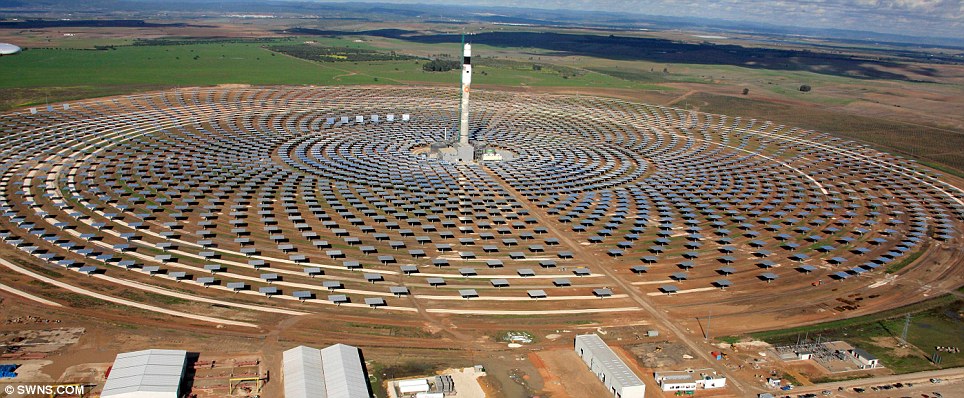
The world’s first solar power station that generates electricity at night is Gemasolar Power Plant near Seville in southern Spain which consists of an incredible 2,650 solar panels spread across 185 hectares of rural land.

The mirrors – known as heliostats – focus 95 per cent of the sun’s radiation onto a giant receiver at the centre of the plant.

This ingeniously and rather scrupulously conceived £260million ($425 million) power station is actually collaborative effort by Abu Dhabi energy company Masdar and a branch of Spanish engineering firm SENER called Torresol Energy.

Heat of up to 900C is used to warm molten salt tanks, which create steam to power the £260million station’s turbines.

But, unlike all other solar power stations, the heat stored in these tanks can be released for up to 15 hours overnight, or during periods without sunlight.

The sunny weather of southern Spain rather sustains the solar energy during most of the yearly mornings which allows the plant to generate clean and green electricity at an estimated 270 days per year, 3 times more than other renewable solar projects.

It is expected to produce 110 GWh/year – enough to power 25,000 homes in the Andalucia region.

IBM software makes green buildings

In the future our apartment homes will be a lot more efficient than they are today.

New systems like IBM’s latest software will help users keep tabs on just how much energy they’ve been using, helping cut down unnecessary electricity usage during peak hours, indirectly cutting short electricity bills by considerable lengths.

This new software from IBM monitor how much energy residents use and check the energy consumption of heating systems, cooling systems, ventilators, refrigerating systems and the HVAC-R too.

Whit these new inventions buildings will go greener and more energy-efficient.

A new record efficiency for solar cells

Always scientists around the world have been trying to create a low cost solar cell that is both efficient and easy to manufacture.

The purpose is to make solar energy affordable for the common people.

Swiss researchers from Swiss Federal Laboratories for Materials Science and Technology’s (EMPA) Laboratory for Thin Film and Photovoltaics have established a new world record efficiency of 18.7% for flexible copper indium gallium (di)selenide (CIGGS) solar cells on plastics.

This new discovery has the potential to lower the cost of solar energy drastically because they are cheaper to produce and this latest breakthrough brings them closer to the highest efficiency levels achieved by crystalline silicon and rigid CIGS cells.

These highly efficient solar cells will drop the cost of solar energy and make them ideal for use in demanding applications such as solar facades and portable electronic devices.

The new generation of green rocket

U.S. military researchers have developed a new generation of green rocket fuel.

The new green rocket fuel emits less corrosive and toxic chemicals than the conventional rocket propellants.

Typical rocket fuel is very toxic and creates environmental pollution because the fuel has a structure of propellant which contains high grade kerosene, rubber and chemicals like hydrazine, nitrogen tetroxide and nitrous oxide.

‘One of the important requirements in the development of less hazardous liquid bipropellants for rocket propulsion is reduced vapor toxicity of oxidizer and fuel,’ says propellants expert John Bellerby of Cranfield University, UK.

Also Bellerby adds that hydrogen peroxide is an attractive low-hazard alternative oxidizer and finding a fuel with low vapor toxicity that is hypergolic with this oxidizer and also produces a high performance has proved difficult.

Repeated tests have proved the hypergolicity of the hydrogen rich ionic-liquid fuels with hydrogen peroxide as the oxidizing agent, which can be considered as green bipropellants for the future.

This type of ionic liquids as the pioneer in liquid bi propellants and in the future and will bring out better and green performances.

Audi engines will use wind power

Audi wants to build vehicles with clean power and zero- and low-emissions.

The manufacturer plans to use wind power for its upcoming electric and natural gas vehicles.

Like other large companies, Audi is financing the construction of four wind turbines off the North Sea that will generate annually up to 53 GWh of electricity and from this electricity, the manufacturer plans to use a portion of the wind power to charge its electric e-tron vehicles.

Audi can power fuel cell vehicles, including the Audi Q5 HFC by harnessing the power of wind to produce hydrogen through electrolysis.

Audi currently uses e-gas to power a CNG version of the A3.

The A3 TCNG will be even more environmentally friendly; Audi plans to break ground on its own synthetic methane facility in July. Using CO2 from a connected waste-biogas plant, Audi’s facility will produce annually 1,000 metric tons of e-gas.

This fuel will be added to Germany’s natural gas network, which serves 900 CNG stations.

A new portable eco-lantern

This new invention allows growing a little plant inside, the eco-lantern is designed by Franklin Gaw.

Eco-Lantern works as a complete bio-environment for a little plant that grows in its belly and also serving the primary purpose of lighting.

Eco-Lantern is a hand-held lantern that doubles up as a terrarium for tree saplings using a growth light as the light source.

The top of the lantern enable you to reach inside and set up the plant with pebbles for water retention, moist soil, moss and finally the plant itself.

The powered light functions as a growth light, mimicing the color and temperature of the sun’s rays.

The eco-lantern uses an integrated flexible solar panel to charge.

First wind farm in Peru

The Ministry of Energy and Mines has agreed to build the first wind farm in Peru.

According to the Latin American Wind Energy Association (LAWEA), this South American country boasts an “amazing” wind potential.

The wind farm will be constructed in Pariñas district in the province of Talara (Piura) and will have an installed capacity of 30 megawatts.

Latin America is gradually ramping up its wind capacity and a lot of renewable energy developments taking place across the continent have a policy support.

A new solar powered iPhone dock, the Eton Soulra XL Solar Dock

The new arrival in the iPhone market is the accessory Eton Soulra XL Solar Dock.

This one uses a retractable solar panel which powers on the dock’s speakers, allowing for 5 hours of playback on a full charge.

This is a perfect way to have fun with you iPhone either the pool or camping.

It has a 72 sq inch solar panel that soaks in enough sunrays to power on the speakers that boast an output of 22W.

Your gadget will work so long as the sun shines bright.

You can buy the Eton Soulra XL Solar Dock for just $300.