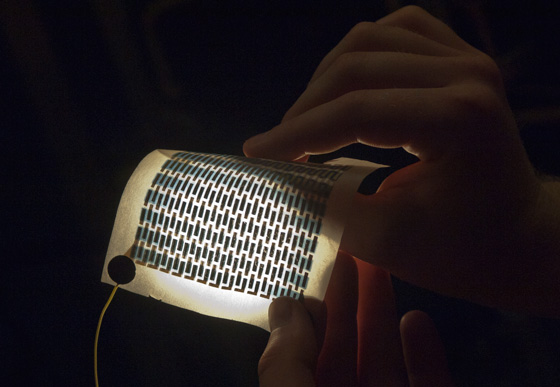
PV world comes with another surprise: paper-based solar cells

High transparecy paper based solar cells introduced by researchers

Chinese-AMerica developers prooduce new paper based cells

An American- Chinese team of solar developers shows that there is a way that they can develop highly efficient solar cells from cheap wood fiber.

A team of developers from the South China University of Technology teamed up with the University of Nebraska-Lincoln and revealed a report that shows that a new type of paper can be used as a base for the future generation of solar cells. The innovative cells could reach a level of 95% of transparency.

The report underlines the fact that the new wood-based papers has a bigger quality that all the other materials, especially regarding transparency, low-cost, efficiency and eco-friendly performance that can revolutionize the solar PV industry.

As the report shows, the paper constitutes of TEMPO-oxidized wood fibers that dispose of micropores and nanopores instead, so that the transparency values and optical haze reach values above 90%, respectively 60%. The latter is the highest figure among the transparent substrats. Normally, materials that offer a big transparency , a big advantage for the solar transmission, lower the optical haze values to less than 20%.

But the TEMPO treatment undermines the connection between the microfibers that make up generally wood fibers leading them to crash into a structure that dispose of micropores. Usually, the wood fibers in ordinary paper have low transparency because of the microcavities that are a part of the porous structure. The transparency is booted by replacing micropore with nanapores

The representative of the Department of Materials Science and Engineering at the University of Maryland , Liangbing Hu , says that “the papers are made of ribbon-like materials that can stack well without microsize cavities for high transmittance, but with nanopores for high optical haze.”

Apple wants to go green with a solar-powered MacBook

Apple recieved patent solar-powered  laptop

Apple has plans for renewable display for Macbooks

The solar-powered MacBook is to use a PV unit for energy generation, as the patent application reports

Apple looks set to go solar with one of its next lines of Mac Books.

The U.S department of Patent and Trademark authorized the Cupertino company a license for an “electronic device display module and a two-sided display that contains a photovoltaic unit that can be used as the both the screen and lid of the new laptop from Apple.

As the patent abstract states, “the rear plate may be formed from electrochromic glass and may cover photovoltaic cells and touch sensors”.

The Patent and Trademark Office publicized an Apple application in last year’s fall that explained a possibility of gearing electronic devices with internal converters with the purpose of using external solar panels.

Although the rumors that the MacBook company is working on the development of PV technology for its products, Apple did not made any official statements.

Theories about Apple’s investments in the green energy area appeared after the company purchased a module manufacturing facility from First Solar last year in Mesa, Arizona.


Chinese modules with Taiwanese cells are considered Chinese

European commission sets new rules for Chinese modules

Chinese modules with cells from Taiwan considered Chinese

The European Commission forced to set another set of rules regarding the provenance of the Chinese modules in order to block goods selling from third countries.

Industry allegations regarding the fact that a recent resolution about he sources of solar modules manufactured in China, using Taiwanese cells spared the panels from minimal module pricing and export cap neccesities were rejected by the European Commission. Karel De Gucht, EU Trade Commissioner arranged in July a minimum module cost for these modules made in China, along with an annual cao on the quantity of panels that could be exported to Europe, it is said to be 7 GW of the predicted 10 GW of solar EU imports from China.

PV magazine pointed out on Jan. 27 an industrial source who declared that a choice made by the EU inDecember by which it was clarified the rules of origin excused these panels made in China, with use of Taiwanese cells from the deal agreement and it became very improbable that the quantity of panels produced with Chinese cells to reach the 7 GW amount.

The European Commission’s press officer for EU Trade Policy, Helene Banner, announced that the set of rules of origin apply to “goods originating in China” but also to “goods consigned from China, irrespective of their origin.”

This means that modules that are put together in China and Taiwanese cells are part of the second statement, , since they are accredited from China, as the press officer explained.

The Commission wanted to spell out the rules of origin because they wanted to prevent avoid situations like Chinese manufacturers sending unfinished modules to third countries and after that to sell them as if they were produced in those countries, by that refrain from the measures. But if the origin of the goods is stated the products will be looked at as made in China.

China sets new record in the PV world

China sets new installations record

China installed 12 GW of solar last year

Chinese PV developers reached a new milestone with 12 gigawatts of solar panels installed last year, almost doubling the total amount of solar plants in the U.S, this year they could exceed that as Bloomberg New Energy Finance announced.

The solar PV panels were made in the Chinese provinces of Gansu, Xinjiang and Qinghai and bring China’s state-owned power companies the world’s biggest owners of solar valuables, as the London-based research company reported.

China was the largest solar market in 2013, outweighing the old leader Germany. Chinese solar installations are three times higher than they were two years ago, with a total of 3.6 gigawatts. This year it is said the Asian country will have 14 gigawatts of solar installed, as figures predict.

“The 2013 figures show the astonishing scale of the Chinese market. PV is becoming ever cheaper and simpler to install, and China’s government has been as surprised as European governments by how quickly it can be deployed in response to incentives.” said the lead solar analyst at New Energy Finance Jenny Chase.

Chinese investors completed the projects before the end of the year, until the1-yuan (17 U.S. cents) a kilowatt-hour incentive expired. This may bring maybe 2 gigawatts of late-year additions that are not part of the 12-gigawatt total.

China brought a 28 per cent raise in global solar installations in 2013. All installation may bring another 20 per cent this year, according to announcement. Until last year, no country execeded8 gigawatts of solar power installations in a year.

Solar energy helps India with wildlife conservation

Indian village energy crisis solved by solar panels

Indian Village equiped with solar panels

Tiwaru Gaon, a Mayodia model Village, is one of the many villages that have no connection with electricity. That is the reason why Wildlife trust of India in association with the Department of Environment and Forest, Arunchal Pradesh supported by Europaeische Tierschutzstftung equiped the Indian village with solar energy installations. This comes as a solution for the electricity crises that the villagers are facing.

The action od the Wildlife trust of India comes as a premiere in the Mehao Wildlife Sanctuary area (Mehao WLS) in Arunachal Pradesh in India. The villagers got solar equipment based on a total solar energy lighting system made of one solar panel, one chargeable multipurpose battery unit, one table lamp and an emergency light. The action is part of the “Interaction for Conservation Awareness & Distribution of Solar Equipment” an event organized by Wildlife Trust of India (WTI) in collaboration with Department of Environment & Forest, Arunachal Pradesh with support from Europaeische Tierschutzstftung that took place on Sunday.

Sunil Kyarong, Deputy Director and Regional Head of Wildlife Trust of India says that ”the community living around any protected area is the first layer of the protection shield. In order to consolidate the shield, we need to understand the psychology and the needs of the people. The distribution of solar sets will further bridge the conservation support and confidence for the ongoing Asiatic Black bear rehabilitation project and Hoolock Gibbon Translocation Project in Mehao Wildlife Sanctuary.”

Tiwari gaon is located at the edge if Mehao Wildlife Sanctuary (Mehao WLS), a place for people to sustain the bear conservation and rehabilitation project and Hoolock Gibbon Translocation Project for the safety of the wildlife.

“We do not have power supply since the inception of this village in the Mishmi hill ranges of Arunachal Pradesh. It is a great help to our villagers who has been suffering due to the energy power crisis. Despite such limitations they are actively supporting the wildlife conservation in Mehao Wildlife Sanctuary” as Napi Umpo, the village headman of Tiwari Gaon, announced.

Researchers found a way to convert solar into fuel

Solar top be converted in fuel for cheaper energy

Solar can be converted into fuel

The Frontier Research Center at UNC-Chapel Hill discovered a way to transform solar into fuel, so that people could have power even when the sun sets.

People could be truly independent with the help of this system and could say goodbye to the pricey solar batteries. U.S solar power researchers say the sun can be used to separate water into hydrogen and oxygen. The Research Center recently published two papers about this whole process, papers published in the Proceedings of the National Academy of Sciences.

Tom Meyer, a chemistry Professor, explains that the system uses solar power until daylight exist, and meanwhile it cheaply separates hydrogen and oxygen from water. The two elements can then be stored separately and burned for power.

Meyer reports that power utilities have already got infrastructure for that: “See, that’s the beauty of it, I think. With this, you can plug into existing engineering, existing technologies. People know how to generate hydrogen. They know how store it. They know how to use it to extract energy in a power plant. So that’s all done. You know, all we want to do is find a way to give it to them in a relatively inexpensive way using the sun.”

Meyer also believes that this method can be used for cheaper power utilities someday:
“This is a basic research project that’s knocking on the door to become a technology. I think the principles are established and it’s really important, but the efficiency of the devices that we have are very low. That is, ‘Here’s all the sun’s energy. How much do you actually use in a useful way?’ And the answer’s about one percent.”

What Mayer says is that right now, only one percent of the solar power that gets to the device is being used to transform water into fuel. He also believes that the procedure won’t be effective for commercial use until that one percent turns into 10. His team also research for a way of separating carbon dioxide into its basic elements for fuel.

PV market is dominated by large-scale PV projects

Large scale PV helps the industry grow

PV industry is gowing thanks to large scale PV

Global PV growth is related to large scale project, 60% of which belong to China, the U.S. and Japan, a increase of 50% from 2010.China, the U.S. and Japan accounted for some 60% of all large-scale PV projects in 2013, up from less than 10% in 2010.

The large-scale PV market is comprised of rooftop projects larger than 100 kW and ground-mounted installations. As the most recent figures from the solar analysts, NPD Solarbuzz , show that large scale solar PV installations toped 26 GW during 2013 and stand exclusively for the annual development of global PV demand from 30 GW in 2012 to 36 GW in 2013.

Moreover, the solar analysts group say that they discovered that the large-scale solar PV market included also rooftop projects bigger than 100 kW in size and ground-mounted solar PV projects.

China stands for almost one-third of all large-scale solar PV capacity planted in 2013. PV panels installed in China, the United States and Japan stand for almost 60% of large-scale PV projects. This percentage comes after the three countries accounted for under 10% of large-scale PV additions in 2010.

Germany, India and the United Kingdom gathered with China, the U.S. and Japan in reaching or approaching GW status for large-scale PV added in 2013.

NPD Solarbuzz predicts that this trend approaching large-scale PV will carry on in 2014, and nearly 75% of all new solar PV capacity added will exist thanks to this segment. Furthermore, new PV for emerging solar PV regions will provide more upside potential.

Storing soar energy can be more cost-effective

Storage of solar energy can be cheaper

Cheaper energy storage discovered by swiss scientist

If platinum takes the place of molybdenum in photoelectrochemical cells, as scientist from two Swiss labs report, the technique that can increase the hydrogen production through water splitting as a way of solar energy storage.

The only form of renewable that can be explored enough to supply the everybody’s up going needs is solar energy. Still, it is highly necessary to find efficient ways of storing solar energy because there is a need for a consistent energy supply when sunlight is limited.

The most effective way to do this is to utilize solar energy to separate water into hydrogen and oxygen and get the energy back by consuming hydrogen in a fuel cell. Scientist from two labs at EPFL have found a way to create an effective method to obtain scalable solar water splitting device with cheap materials.

Sill, solar systems cannot constantly produce adequate energy since sunlight is not always the same everywhere. This can be solved with another device that is able to store energy for a later use in the form of hydrogen with very little pollution.

Through the most sustainable methods of hydrogen production is photoelectrochemical water-splitting. In this method, they use solar energy to split water molecules into hydrogen and oxygen with a process called “hydrogen evolution reaction.” This method needs a chemical agent that grows its speed, named catalyst. The most familiar catalyst in this devices is platinum, that is situated on the surface of the solar panel’s photocathode—the solar panel’s electrode that transforms light into electric current.

The team from EPFL discovered that you can make efficient solar-powered water splitting devices even with abundant and cheap materials.

The group of Xile Hu came up with a molybdenum-sulfide catalyst for the hydrogen evolution reaction, and the group of Michael Grätzel discovered that copper oxide can be a photocathode. They also found that the molybdenum sulfide can be stored on the copper(I) oxide photocathode for use in photoelectrochemical water splitting by a deposition process.

The method reveals more efficiency then other hydrogen evolution reaction catalysts like platinum. It also preserves the optical transparency for the light-harvesting surface and it offers improved stability under acidic conditions, meaning lower maintenance. Moreover, both the catalyst and the photocathode are made of cheap, earth-abundant materials that can reduce the cost of photoelectrochemical water-splitting devices. As senior author Xile Hu says, the work is a state-of-the-art example for solar hydrogen production devices.

UK wind farm subsidies are to be cut off by Europe

Europe will oblige UK to cut wind power subsidies

U.K will cut off wind energy subsidies

The European Commission is going to request the British country to put an end to wind farm subsidies.

Ministers have been told that the present degree of state support for renewable energy sources have to be eliminated until 2020. Moreover, solar energy is not escaping either, as taxpayer support will also be phased out.

The European Commission that supervises the European single market is ready to try and convince that onshore wind in UK and solar power industries are developed enough to function even if taxpayers do not contribute.

A Government source announced that European officials have privately ordered ministers that they have to lower public support for onshore wind and solar generators.

Even if Conservative ministers don’t always agree with the Commission’s sometimes criticize the EC for its intervention in domestic matters, they are understood to be keen to cooperate in the case of renewable energy subsidies. A Conservative minister’s words are: “It’s absurd that taxpayers are being made to subsidies wind technology.”

The operators of onshore wind turbines get subsidies that make the power they generate more expensive. Ministers begun to cut off those subsidies, reducing tariffs that are applied to household bills and withering guaranteed prices for onshore wind. But the EC is pressuring him Coalition to impose a less supportive system for onshore wind and solar power. This new regime will take care of the fact that there will be a competition between wind farm operators and that there will be a share of a reduced pool of public subsidies.

The Energy Secretary, Ed Davey, announced that onshore wind and solar farm developers would be obliged to compete to secure government subsidies. The commission will announce the results of a review of support for renewable energy this month.
Although UK is happy with this cut off, other EU states do not want to reduce public support for renewables.

The EU’s climate action commissioner, Connie Hedegaard , said “One of the things Europe has to do better is how we subsidies renewables. That is why the commission is reviewing state aid guidelines for energy, including renewables. My view is that if you have mature technologies, renewables or not, they should not have state aid. If they can manage themselves why have state aid?”


2014 comes with a bad new for Romania: the green certificates are being reduced to half

Green certificates for solar to be reduced

Romanian Government announced the reduction of green certificates

The green certificates will be halved this year for all green energy projects that will be fulfilled after the first month of 2014. This means there will be three certificates per MW since now there are six per MW.

The Romanian government recently reported that it will reduce its support not only for solar PV, but also for wind and hydro energies by bringing down the number of green certificates. This measure is valid from today but is only valid for projects finished in February.

Unfortunately, solar PV is dealing with the biggest cut. This means that projects finished during next month will only get three green certificates per MW, as now they are getting six.

Romania is going with a measuring system for the support of renewables that says that the project developers get green certificates for every megawatt generated for 15 years after commissioning. Power suppliers and industrial users are obliged to purchase certificates based on an annual quota given by the energy regulator. So, the project developers are wining by selling certificates and also by selling electricity.

Still, a new study run by the National Energy Regulatory Authority (ANRE) reveals that renewable power producers get way too many certificates for the generated energy and the investment they make in power plants is too small. So, the Romanian government was advised to cut the number of certificates per quota.

By these means, the Romanian government requested its efforts to be a struggle to minimize the effects of electricity high prices for households and industry.

The new contribution cuts, starting tomorrow, will have a purpose of obtaining a green certificate suspension approved in June by which the ministry ceases two out of six green certificates granted to PV energy producers per MWh put into the grid. These plans, however, will not be concerned in tomorrow’s policy.

Yet, the latest government policy is being regarded by many critics to be an attempt to put cuts in the investment flow into PV and other renewable techs, which have topped the initial national targets set by the energy manager bestowing to the country’s EU engagements.

Roxana MORARU