The Solar and Wind Expo 2011

In Maryland The Expo will be held at the Timonium Fairgrounds May 13 through May 15, located right in the heart of the Baltimore/Washington metropolitan area.
In Pennsyvannia The Solar and Wind Expo will be held June 10th through the 12th 2011 at the Valley Forge Convention Center, which is located in King of Prussia is directly across from Valley Forge National Park.
Attendees will browse exhibits and hear top experts in the field of green technology speak in the comfort of an air-conditioned venue with ample parking, as well as being located off of major public transportation routes.
“The best renewable energy event of the year!  The Solar & Wind Expo was well marketed, managed and attended and far exceeded our expectations even with Sunday being Mother’s day!”
Source: thesolarandwindexpo.com

SolarCity sees U.S. panel prices tumbling in 2011

Solar panel prices in the United States are likely to drop by 20 cents per watt this year, according to the head of SolarCity, one of the nation’s largest photovoltaic solar service companies.
That drop would put the price of the panels that convert sunlight into electricity at about $1.40 per watt on average, or about 12.5 percent below prices quoted at the beginning of 2011.
Chief Executive Officer Lyndon Rive said the decline will help privately held SolarCity, which buys the panels from manufacturers and installs them for homes and businesses, to reach its cost-cutting target of 5 to 8 percent this year.
Prices for solar panels have dropped by about 75 percent in the past decade, and make up less than half the total cost of installing a rooftop system.
Most major solar manufacturers are increasing their output capacity of solar panels this year in a bid to grow their market share, even as key markets in Europe trim spending on the subsidies that are crucial to the fast-growing industry.
That could lead to a glut of solar panels on the market, squeezing margins at companies such as Trina Solar, First Solar Inc and SolarWorld AG.
However, market experts say those price declines are necessary to help the renewable power source compete with other sources of energy such as natural gas and coal, as well as reduce its dependence on government supports.

Source:  www.reuters.com

New advance in biofuel technology

U.S. Energy Secretary Steven Chu congratulated a team of researchers at the Department’s BioEnergy Science Center who have achieved yet another advance in the drive toward next generation biofuels: using bacteria to convert plant matter directly into isobutanol, which can be burned in regular car engines with a heat value higher than ethanol and similar to gasoline. This research is part of a broad portfolio of work the Department is doing to reduce America’s dependence on foreign oil and create new economic opportunities for rural America.
BACKGROUND ON THE SCIENTIFIC ADVANCE ANNOUNCED TODAY
The work was conducted by researchers at the Department of Energy’s BioEnergy Science Center (BESC), led by Oak Ridge National Laboratory. Using consolidated bioprocessing, a research team led by James Liao of the University of California at Los Angeles for the first time produced isobutanol directly from cellulose. The team’s work, published online in Applied and Environmental Microbiology, represents across-the-board savings in processing costs and time, plus isobutanol is a higher grade of alcohol than ethanol.
“Unlike ethanol, isobutanol can be blended at any ratio with gasoline and should eliminate the need for dedicated infrastructure in tanks or vehicles,” said Liao, chancellor’s professor and vice chair of Chemical and Biomolecular Engineering at the UCLA Henry Samueli School of Engineering and Applied Science and a partner in BESC. “Plus, it may be possible to use isobutanol directly in current engines without modification.”
Source: http://energyportal.eu/latest-green-energy-news/9681-energy-department-announces-new-advance-in-biofuel-technology.html

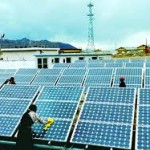
Tibet’s largest solar power plant to become operational in May

The largest solar power plant in Southwest China’s Tibet Autonomous Region will become operational in May to help ease the plateau region’s power shortages.
The 30-megawatt solar photovoltaic generation project in Xigaze Prefecture, about 3 km northwest of Tibet’s second largest city Xigaze, is perched at 3,895 meters above sea level, the project’s steering committee said Thursday in a press release.

It said the project would cost 800 million yuan (122 million U.S. dollars), funded solely by Linuo Power Group, a leading provider of solar photovoltaic power generation systems based in east China’s Shandong Province.

Construction of the first phase, costing 249 million yuan and covering an area of 30 hectares, began in May last year. It will generate up to 20.23 million kilowatt-hours of electricity annually, the document said.

German bored piling technology was used to dig through the thick layer of perennial frozen earth on the plateau, said project manager Zhang Daobin. It was the first time such technology had been employed in Tibet.

He said the first phase of the project alone could ease some power shortages in Xigaze Prefecture, by supplying electricity for more than 100,000 farming and herding families.

The clean energy project would help save 7,600 tonnes of coal annually and reduce carbon dioxide emissions by at least 13,800 tonnes, said Zhang.

Last year, a 10-megawatt solar photovoltaic generation project was built in Yangbajing, a town 90 km northwest of Tibet’s capital Lhasa, with a designed power generation capacity of 430 million kwh during its 25-year life span.

Source: http://english.peopledaily.com.cn/90001/90776/90882/7336743.html