Spanish solar market is rising

The statistics for the PV market for 2010 released by the Spanish photovoltaic association ASIF, according to which the Spanish PV industry is moving strongly into the international market.

Thanks to the changes in the Spanish solar energy promotion policies and because a yearly cap of 500 MW was set, the international sales in 2010 increased by 130% compared to the previous year.

The total capacity of Spanish PV production was 1.000 MW in 2010, of this, 70% was exported and only 30% installed locally.

In Spain itself, 392 MW of new photovoltaic systems were installed, of which a good 60% were locally produced.

2009 was a bad year for Spanish market because subsidies were massively cut and the sales in Spain only reached 17 MW.

However, a large portion of the projects completed in 2010 were actually old projects, the completion of which was delayed by the crisis of the year before.

The ASIF predicts that Spanish solar market will increase more in the coming years, and expects only 300 MW of new capacity to be installed in 2013.

Gamesa a world leader in wind turbines

During 2011 Gamesa made progress in offshore strategy, technological design and development of the G11X-5.0 MW platform which will be equipped with a 128-metre rotor diameter.

Gamesa has a 15 years experience in the design, manufacture, installation and maintenance of wind turbines, having installed 21,000 MW in over 30 countries across four continents, with over 13,600 MW under maintenance.

All this makes her a world leader.

Recently, in Liverpool Gamesa showcased theG128-5.0 MW offshore wind turbine.

The first prototypes are scheduled for completion in the last quarter of 2012.

The company plans to invest over €150 million between now and 2014 in the UK wind power offshore.

Renewable energy from “Green Power Islands”

Green Power Islands – a great idea to generate and store renewable energy on uninhabited islands around the globe.

The Danish architectural firm Gottlieb Paludan has proposed generating power through wind or solar — depending on the climate — and then using the water surrounding the islands to store the power using pumped hydro technologies.

This new concept for producing and storing renewable energy could even provide all the power for Denmark’s population.

The idea of the architects is to create a “Green Power Island” off the coast of Copenhagen, which would become an “energy super centre” for the country.

The massive island would be accompanied by offshore wind farms, and populated with solar arrays and seawater pumps, and would produce marine biomass for biofuel.

The energy will be stored using pumped hydro facilities.

The architects from Gottlieb Paludan have suggested a few areas around the world where Green Power Islands could be built on existing islands.

These include: the Florida Keys, Jiangsu in China, Manama in Baharain and Tamil Nadu in India.

A solar-powered superyacht is available for charter in the Mediterranean

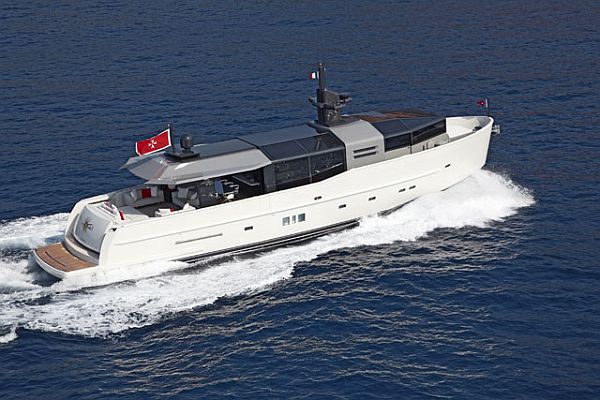
Arcadia 85, the super-yacht built with solar panels is offering charter holidays in the Mediterranean, during the summer of 2011.

The solar-powered yacht was named ‘Solar’ and from €49,000 (about $70,371) per week, up to eight people can feel confident about their carbon footprint, without losing out on luxury.

This yacht has the lowest fuel emission of any yacht in its class because it has an economical speed of 9 knots, when the diesel engines use only 30 liters per hour.

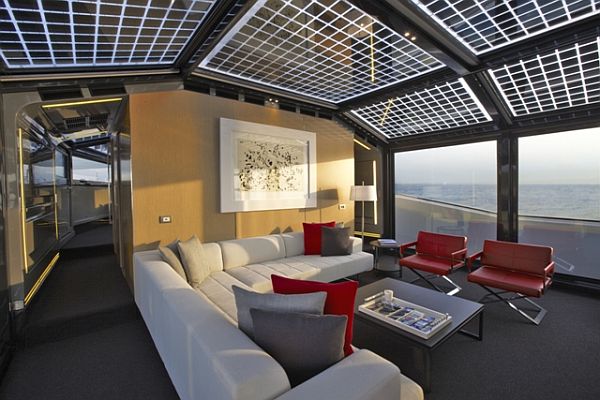
Solar’s panels run the hotel load, which it means everything from air conditioning to lighting, plus pumps and refrigeration.

The Solar yacht was built by  Edmiston & Company, it boasts a deck of 60 square meters and has  four cabins that have all necessary audio visuals, a spacious saloon in the top deck which is the entertainment area and sitting place and a huge saloon.

The super-yacht reaches a top speed of 18 knots propelled by a fuel that is organic in nature.

Also, on the yacht is a delicious cuisine where the chef uses only organic ingredients.

This is the perfect green-way to relax on your holiday.

A solar-powered superyacht is available for charter in the Mediterranean

Arcadia 85, the super-yacht built with solar panels is offering charter holidays in the Mediterranean, during the summer of 2011.

The solar-powered yacht was named ‘Solar’ and from €49,000 (about $70,371) per week, up to eight people can feel confident about their carbon footprint, without losing out on luxury.

This yacht has the lowest fuel emission of any yacht in its class because it has an economical speed of 9 knots, when the diesel engines use only 30 liters per hour.

Solar’s panels run the hotel load, which it means everything from air conditioning to lighting, plus pumps and refrigeration.

The Solar yacht was built by  Edmiston & Company, it boasts a deck of 60 square meters and has  four cabins that have all necessary audio visuals, a spacious saloon in the top deck which is the entertainment area and sitting place and a huge saloon.

The super-yacht reaches a top speed of 18 knots propelled by a fuel that is organic in nature.

Also, on the yacht is a delicious cuisine where the chef uses only organic ingredients.

This is the perfect green-way to relax on your holiday.

Egypt has one of the first solar-gas hybrid plants in the world

Iberdrola has started its plans to commission the 150-MW Kuraymat power plant due south of Cairo, which fuses solar energy with a combined cycle gas plant, even in Egypt was a “nightmare”.

The Integrated Solar Combined Cycle (ISCC) facility was opened this month.

The project has a total capacity of 150 megawatts (MW).

This facility incorporates technology that combines the use of gas and solar energy and  is one of the first of its kind in the world.

The power plant is located 95 kilometers south of Cairo, will supply enough power for 200,000 people while saving around 16,000 tonnes of carbon dioxide emissions into the atmosphere each year.

At Kuraymat project 1,000 people have worked over the last three years.

The Egyptian plant has been built very close to the River Nile.

The area where the plant is built has become a strategically important region for the generation and distribution of electricity in Egypt.

Having this solar-gas plant, Egypt will save 5,000 tonnes of natural gas every year.

Iberdrola Engineering built and designed this ISCC-type facility to work in two different operational modes, in order to increase efficiency: during the night it operates as a conventional natural gas combined cycle plant, while during the day it operates a normal cycle but with the added energy provided by the sun.

On one side, the Kuraymat plant is fitted with a General Electric model 6FA gas turbine and a Siemens model SST900 steam turbine, while on the other it has a solar field covering 130,800 m2, with 160 parabolic cylinder CSP collectors and 1,900 m2 of mirrors.

Kuraymat is the first solar thermal electric facility in Egypt.

Californian college – 100% electricity from solar panels

The first college in the U.S. to go ‘grid positive’, the Butte College has installed 25,000 solar panels.

The college will generate over 100 percent of its electricity from solar power.

The solar panels are expected to generate more than 6.5 million kilowatt hours of electricity annually, which is more than the annual power consumption of the college.

The system generates more energy than it consumes, it says that it will be able to save between $50 million and $75 million over the next 15 years.

Butte College will surely set an example for other American institutions to go green.

Solar thermal power generation has a new research centre

A new solar research institute was established by the German Aerospace Center.

The German Aerospace Center has more than 30 years experience in solar energy and solar thermal plants.

This technology has become increasingly important during recent years in sunny regions such as Spain and the southeast of the USA.

The Concentrated Solar Power (CSP) uses sunlight to produce steam, and then generates electricity by driving a conventional steam turbine.

The German federal state of North Rhine-Westphalia will subsidize this new institute with approximately € 27 million in the next few years.

Solar thermal power plants are usually very large projects with long lead times.

3000 MW by 2020 in Malaysia

Malaysia‘s parliament announced the country’s installation targets for renewable energies and the plan to install 3,000 MW of renewable by 2020.

They expect that 1,250 MW will be generated by photovoltaic installations and another 1,065 by biomass.

With the implementation of these ambitious targets Malaysia follows other Asian countries like Thailand or Taiwan.

The Malaysia’s Minister of Energy announced that the legislation will come into effect in midsummer this year.

The 2011 quota for photovoltaic power is 29 MW with 9 MW set aside for projects smaller than 1 MW.

Malaysia’s feed-in-tariffs for photovoltaic power are divided into six different sections:  systems smaller than 4 kW, between 4 and 24 kW, between 24 and 72 kW, between 72 and 1 kW, between 1 MW and 10 MW and installations between 10 and 30 MW.

Algeria discovered solar thermal just one year ago

Algeria is the fourth biggest exporter of natural gas worldwide, the second biggest producer of liquefied petroleum gas and the tenth biggest producer of mineral oil.

The consequence is clear: renewable energies are not in the focus of the government.

The administration of the country only talks about photovoltaic and wind energy.

During a conference in Algeria in January, the state-owned electricity and gas utility Sonelgaz had 20 minutes to talk about projects in the field of renewable, and the speaker did not once mention the words ‘solar water heating’.

Algeria still remains in a deep slumber when it comes to heating water with the sun.

So far, annual market volume is estimated at around 50 residential systems per year.