Russia is going put $4.2 billion in the solar sector until 2020

Solar PV blooms in Russia

Solar PV blooms in Russia

The technology giant in the state’s propriety, Rusnano, together with the conglomerate Renova are important pieces the European – Asian country’s solar energy field.

PV devlelopers in Russia are willing to install PV plants in sunny southern regions

The main investing in this sector is said to be made by both state and private parts, as the The Russian Ministry of Energy expects. Taking all this into account, Russia will get to RUB 150 billion (US$ 4.2 billion) by 2020.

The corporate affairs director at Hevel Solar, Anton Usachev is certain that solar power plants will find their home in the southern and southwestern Russian regions of Altai, Bashkortostan, Orenburg, Samara and Omsk in upcoming six years. This words come from Russia’s biggest module producer. He also states that until 2020, approximately 1.5 GW of solar are going to function in the country.

Rusian solar boosts with the help of companies collaborations

The above mentioned company, a collaboration between state-owned tech giant Rusnano and Russian conglomerate Renova, is also planning to settle PV manufacturing plants in Russia. The biggest one is said to be commissioning in June in Chuvashia with an expected capacity of more than 100 MW a year.

Another company included in Renove and France’s Schneider Electric Avelar Energy Group, is willing to launch an inverter production facility in the upcoming years.

Not a long time ago, things were the invested sum in solar energy development did not exceed a $1 billion a year. Besides that, almost 90% had gone to biomass processing projects. But this is going o change along with the arrival of PV in the country.

Coloured solar panels for building exterior introduced by Antec Solar

New thin film coloured panels are available for building integration

Colored PV

Antec Solar’s thin-film applications are accessible terracotta, green and blue.

Antec’s new product line is named ATFKrom and it is considered a premiere as it is made of the the first coloured photovoltaic modules for façade integration. This modules are built thanks to the company’s thin-film technology and are ready for use in colours like terracotta, green and blue.

New coloured solar panels

The new photovoltaic modules of the ATFKrom product line are supplied with an exclusive solar glass. The new patented solar glass is responsible for the persistent and aesthetically refined presence. The new basic photovoltaic technology is now close to being invisible. Antec Solar GmbH uses the exclusive Kromatix™ solar glass of SwissINSO, a company founded in Lausanne (Switzerland).

Tailor-made solutions for any facade
Norbert Kreft, CTO of Antec Solar GmbH believes  that “It is the first time that a glass technology is available providing coloured solar panels which can be integrated in a way, that they act look like normal cladding. With this innovative solar glass architects, developers, installers and private investors will now receive a high-quality aesthetic solution, which so far did not exist – and that at a high efficiency.This enables us, to deliver tailored solutions for every facade and in virtually any PV technology ” The customers are free to choose the colour, the format, the form and needed amount of panels.

Coloured solar panels for building integration

Moreover, Antec Solar delivers with the product line ATCKrom coloured modules for building integration based on intermediate products found in nearly all PV technology. Taking into account the requirements, favorite appearance and requested design, the user can pick the right technology and achieve the desired energy output.

Expensive public illumination was put to an end on a street in Nepal’s capital city, Kathmandu

Nepal's capital city has solar street lamps

Nepal has solar street lamps

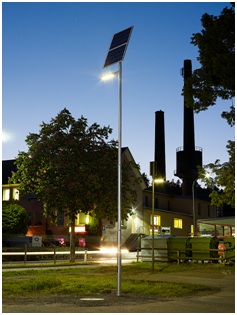
A central street from the Nepal’s capital city, Kathmandu, has a new way of facing the dark: solar powered street lamps.

This big step for the Asian solar industry couldn’t have been possible without the collaboration between Kathmandu Metropolitan City and Durbarmarg Development Board (DDB). The chief of the Urban Development Committee from KMC announced that most of the construction is finished, meaning that poles with twin lights have already been installed.

KMC gave permission to DDB to put into action the project that will bring to the street of Durbarmarg not less than 30 solar street lamps, installed on both sides of the street.

 “Right now we have planted the lamps just as dividers. We will also equip the foot lanes with additional lamps,” announced Rijal, chief at KMC.

To project is predicted to reach Rs 11.79 million and is possible due to a public-private partnership of KMC and the DDB. If this project reaches its goals, KMC is willing to bring a clean light to all main roads in the city.

 “This is just a pilot project, and we are sure it will attract more local communities to solar powered lamps, considering the growing power crunch. This will be proposed in most of the four lanes within the Capital,” said Rijal.

The project was no easy to implement as in 2013 KMC asked for help from public and consumers committees for about 30% of the installation price but they got no support at all. Still,  KMC got Rs 380 million from the Asian Development Bank (ADB).

The bank is going to supply with 600 light, and half of them will be under the jurisdiction of KMC.

 Roxana Moraru

Solar power has reached Indian ATMs

ATMs in rural India to work on green energy

Solar ATMs installed in Indian rural areas

Telecom towers, bank branches, data centers and ATMs in power deficient rural India can now benefit from solar power energy. This applies to the pour in energy area of the Asian country.

Not only is the government showing its support, but companies are also helping with supplies for power back-up and solar power producers. This direction is getting popular as many companies are in need of green power.

Sunil Khanna, president and Managing Director, Emerson Network Powe r “We are providing solar inverters of smaller ratings to ATMs. More than ATMs, our concentration is bank branches. At present, the adoption of solar power in the banking sector is at a nascent stage, but it is aggressively picking up.”

Still, he said that it is not easy to keep a record of the ATMs using solar energy but he is optimistic about Tier-3 and Tier-4 cities adopting this movement and believes it is a domain that can be explored. Moreover, he says that banks can change the old-fashioned way of data centers with ones in a box , with many advantages and financial benefits.

Telecom companies are also using solar power for telecom towers. The Chairman at Omnigrid Micropower Co. Pvt. Ltd, Sushil Jiwarajka says that “at present, we are powering more than 20 telecom towers and by April1 2014, the number will go up to 40. From one micro solar power plant site, we are powering three towers of different companies.”

He also said that thay “are providing surplus power to banks, schools, petrol pumps and even households in the locality to make our project viable.”

A big boost for the trend has something to do with Telecom Regulatory Authority of India’s (TRAI’s) request for companies to introduce the use of clean energy for at least half of their towers in villages.

ITC finished investigations regarding third party manufactured cells and discovered some in the U.S.

Chinese products with third party components are harming the solar industry

Products based on Taiwan cells harm U.S. manufactureres

The International Trade Commission taking care of anti-dumping duties investigated chineese products and found third-party produced cells.

The investigation on Chinese third party manufactured cells revealed the fact that the asian’s country’s products bring damages to the U.S solar investors. The research was possible with the help of the U.S. International Trade Commission

The decision made public on ITC’s website says that the accusation that third-party produced cells are prejudicing the U.S is just and is hurting the U.S. corporations by being drained in the U.S solar market and by taking advantage from the country’s diminish.

The commission started the investigation as a follow-up to the charges brought by the German manufacturer Solar World. The company claims that Chinese module manufacturers were bypassing the AD and anti-subsidy offsetting duties practiced for Chinese-manufactured solar products by seting up panels with cells made in Taiwan or other third-party states. SolarWorld’s U.S. business says that Chinese manufacturers brought calls manufactured in Taiwn in other countries as an escape from U.S. duty regime.

The ITC’s verdict came after a day in which the Chinese solar giant Trina Solar acquired a cell producing operation back in mainland China. The verdict is seen as a prior decision to the duties to be applied to every Chinese produced modules despite the origins of the cells. This is to happen in the following weeks and a final decision will be made in June with the duties backdated three months.


Pro-nuclear governor has been elected in Tokyo


Japan's new governor is pro-nucleaar

Japan has a new pro-nuclear governor

In the Japanese pv-module business, it remains unsettled what the election means. A pro-nuclear appeal could be a backsliding of considerate solar FITs, yet it could also be an approval of the system that proposed them.

It stands a subject of controversy regarding what this election of Yoichi Masuzoe as governor represents for the solar business in Japan. Despite the fact that Masuzoe was the only candidate with a pro-nuclear policy, BBC News reports show us that political analysts consider it to be an essential plan for economic and social benefit.

The governor of the capital has more power over expenses by virtue of Tokyo’s position, its dividends are free from the government allowance that takes place over the rest of other Japanese cities, and its governor is viewed as the second most important political man in Japan, given the city’s 2014 budget of around JPY13 trillion (US$127 billion).

The report from BBC, that alleged amounts from the AP news agency, Masuzoe, with 2.1 million polls, hat more votes than both his nearest – anti-nuclear – competitors Kenji Utsunomiya and Morihiro Hosokawa. The Liberal Democrat party and its main member, prime minister Shinzo Abe, backed up Masuzoe and his call to turn the reactors back on, decision that was suitable for the PM.

Although there is a dread for the Japan to go back nuclear, and the dissolving of the world’s most hospitable FIT regime, the grand surplus of victory for the newly established governor could equally strike as a confirmation of the ‘Abenomics’ package of public spending measures – which includes renewable allowances – that were brought in by Abe as a well calculated remedy for the latest Japanese recession.


PV world comes with another surprise: paper-based solar cells

High transparecy paper based solar cells introduced by researchers

Chinese-AMerica developers prooduce new paper based cells

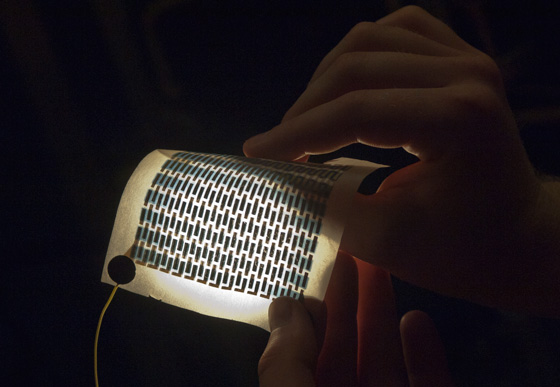
An American- Chinese team of solar developers shows that there is a way that they can develop highly efficient solar cells from cheap wood fiber.

A team of developers from the South China University of Technology teamed up with the University of Nebraska-Lincoln and revealed a report that shows that a new type of paper can be used as a base for the future generation of solar cells. The innovative cells could reach a level of 95% of transparency.

The report underlines the fact that the new wood-based papers has a bigger quality that all the other materials, especially regarding transparency, low-cost, efficiency and eco-friendly performance that can revolutionize the solar PV industry.

As the report shows, the paper constitutes of TEMPO-oxidized wood fibers that dispose of micropores and nanopores instead, so that the transparency values and optical haze reach values above 90%, respectively 60%. The latter is the highest figure among the transparent substrats. Normally, materials that offer a big transparency , a big advantage for the solar transmission, lower the optical haze values to less than 20%.

But the TEMPO treatment undermines the connection between the microfibers that make up generally wood fibers leading them to crash into a structure that dispose of micropores. Usually, the wood fibers in ordinary paper have low transparency because of the microcavities that are a part of the porous structure. The transparency is booted by replacing micropore with nanapores

The representative of the Department of Materials Science and Engineering at the University of Maryland , Liangbing Hu , says that “the papers are made of ribbon-like materials that can stack well without microsize cavities for high transmittance, but with nanopores for high optical haze.”

Trade war between US and China escalates

Solar trade disputes on anti-dumping duties

Solar trade war between US and China

A trade war begun between US and China as politicians argued and it all that started from a misunderstanding between solar manufacturers in China and Taiwan and U.S. Department of Commerce.

The ministry of Commerce in China responded to anti-dumping measures and counter investigations on Chinese solar products as it follows: “China will closely follow the case, assess the impact on the Chinese solar sector and resolutely safeguard our interests through various mechanisms.”

With delegates from China, Hong Kong, Chinese Taipei and the U.S. that participated in Friday’s pledge, the outcome of the U.S. Department of Commerce to begin anti-dumping (AD) and countervailing duty (CVD) investigations into Chinese and Taiwanese-made modules, including Taiwanese cells, will make sure that negotiations at the WTO, World Trade Organization, will not progress.

The list of goods for which it is hoped all tariffs and other trade barriers will be removed includes solar cells and inverters.

The US department of Commerce announced that an investigation started from a complaint that Chinese manufacturers were using alternative regarding import duties for solar imposed in 2012 to continue and sell at very low prices in the American market.

On the other hand, The Solar Energy Industries Association reported that if the US went forward with a new set of import duties regarding solar panels from China and Taiwan, it could lead to the cut off the supply of low-cost equipment that had a major impact in the industry’s boom in the past few years. A spokesman of SEIA announced that “As the conflict escalates, the threat to the industry grows.”

China sets new record in the PV world

China sets new installations record

China installed 12 GW of solar last year

Chinese PV developers reached a new milestone with 12 gigawatts of solar panels installed last year, almost doubling the total amount of solar plants in the U.S, this year they could exceed that as Bloomberg New Energy Finance announced.

The solar PV panels were made in the Chinese provinces of Gansu, Xinjiang and Qinghai and bring China’s state-owned power companies the world’s biggest owners of solar valuables, as the London-based research company reported.

China was the largest solar market in 2013, outweighing the old leader Germany. Chinese solar installations are three times higher than they were two years ago, with a total of 3.6 gigawatts. This year it is said the Asian country will have 14 gigawatts of solar installed, as figures predict.

“The 2013 figures show the astonishing scale of the Chinese market. PV is becoming ever cheaper and simpler to install, and China’s government has been as surprised as European governments by how quickly it can be deployed in response to incentives.” said the lead solar analyst at New Energy Finance Jenny Chase.

Chinese investors completed the projects before the end of the year, until the1-yuan (17 U.S. cents) a kilowatt-hour incentive expired. This may bring maybe 2 gigawatts of late-year additions that are not part of the 12-gigawatt total.

China brought a 28 per cent raise in global solar installations in 2013. All installation may bring another 20 per cent this year, according to announcement. Until last year, no country execeded8 gigawatts of solar power installations in a year.

Solar energy helps India with wildlife conservation

Indian village energy crisis solved by solar panels

Indian Village equiped with solar panels

Tiwaru Gaon, a Mayodia model Village, is one of the many villages that have no connection with electricity. That is the reason why Wildlife trust of India in association with the Department of Environment and Forest, Arunchal Pradesh supported by Europaeische Tierschutzstftung equiped the Indian village with solar energy installations. This comes as a solution for the electricity crises that the villagers are facing.

The action od the Wildlife trust of India comes as a premiere in the Mehao Wildlife Sanctuary area (Mehao WLS) in Arunachal Pradesh in India. The villagers got solar equipment based on a total solar energy lighting system made of one solar panel, one chargeable multipurpose battery unit, one table lamp and an emergency light. The action is part of the “Interaction for Conservation Awareness & Distribution of Solar Equipment” an event organized by Wildlife Trust of India (WTI) in collaboration with Department of Environment & Forest, Arunachal Pradesh with support from Europaeische Tierschutzstftung that took place on Sunday.

Sunil Kyarong, Deputy Director and Regional Head of Wildlife Trust of India says that ”the community living around any protected area is the first layer of the protection shield. In order to consolidate the shield, we need to understand the psychology and the needs of the people. The distribution of solar sets will further bridge the conservation support and confidence for the ongoing Asiatic Black bear rehabilitation project and Hoolock Gibbon Translocation Project in Mehao Wildlife Sanctuary.”

Tiwari gaon is located at the edge if Mehao Wildlife Sanctuary (Mehao WLS), a place for people to sustain the bear conservation and rehabilitation project and Hoolock Gibbon Translocation Project for the safety of the wildlife.

“We do not have power supply since the inception of this village in the Mishmi hill ranges of Arunachal Pradesh. It is a great help to our villagers who has been suffering due to the energy power crisis. Despite such limitations they are actively supporting the wildlife conservation in Mehao Wildlife Sanctuary” as Napi Umpo, the village headman of Tiwari Gaon, announced.