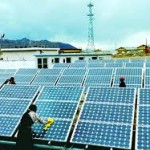
Japan: Prime Minister promote renewable energy

Japanese Prime Minister Naoto Kan said the government will focus more on the development of renewable energy, like solar and wind power.

“Japan needs to review its energy policy while seeking safer ways to secure nuclear power,” Kan told a gathering of reporters on Tuesday.

The Japanese government will promote renewable energy and create a more energy-efficient society.

The country goal is to have renewable power account for 20 percent of the country’s total electricity output by 2030.

China’s goal is 50 GW of solar power by 2020

China, the world’s largest polluter will make more investments in renewable energy.

China has some of the globe’s worst air and water quality but has an economy growing.

China doubled its target for solar power capacity to 50 gigawatts for 2020 because his power requirement is one of the highest in the world.

China vast experience in building solar panels will help her in building the necessary infrastructure for its own solar power needs.

Beijing has ordered safety inspections of the country’s nuclear plants and “temporarily” suspended approval of new and proposed projects following the disasters in Japan, but has said it will continue to develop the technology.

China hopes its installed solar power capacity will reach 10 gigawatts by 2015 and 50 gigawatts by the end of the decade.

Solar Powered Lanterns – donated to Iwate, Miyagi and Fukushima prefectures

Panasonic donated 4,000 pieces Solar Powered Lantern to Iwate, Miyagi and Fukushima prefectures, hoping that they’ll help add a bit of comfort and assistance to those who have been hit hardest by the quake.
Panasonic states, “One of the models also include USB output which can be used to recharge mobile phones. We hope that the products will be able to bring light in midst the situation, especially where electrical supply is still limited. Panasonic Group and its employees sincerely hope for swift recovery of the people and areas affected by the disaster.”
A solar Lantern is produced of three essential elements – the solar cell panel, the battery and the lamp. The procedure is really easy. The solar energy is reformed to electric energy by the solar cell panel and put in a sealed maintenance-free battery for later apply during the night hours. A single charge can work the lamp for around 4-5 hours.
Source: www.treehuger.com

Gujarat, India – ready for solar

The state policy of Gujarat in India, with a population of 50 million, is one of the drivers in Indian solar. Gujarat has the fastest growing economy in the country. Another driver is the Jawaharlal Nehru National Solar Mission with an initial feed-in tariff structure, which is already under fire from opponents. That plan, in three phases, looks for one gigawatt to be commissioned by 2013, half of which will be CSP (see diagram below). The state of Rajasthan proposes 550 megawatts in a reverse bidding process.
Julian Hawkins,Senior VP of Sales and Marketing at Abound Solar, who had just returned from a long trip to India, sees a number of factors in India’s favor: There’s a lot of sun and a market for power in the country. In Abound’s case, India’s hot weather makes thin film’s temperature coefficient a better fit than crystalline silicon. Gujarat is a dusty place, according to Hawkins, and the diffused light in that environment is also better suited for their thin-film modules. Hawkins sees Gujarat as a “very business focused state,” that is “making sure that the grid is ready for solar.”
Gujarat has a target of installing one gigawatt by the end of 2012 and three gigawatts by 2016 under a fixed tariff structure.
Source: www.greentechmedia.com

Japan’s Kyocera to build second solar panel plant in Čzech Republic

Kadan, March 31 (CTK) – Japanese company Kyocera has launched the construction of its second solar panel plant in the industrial zone in Kadan in the Usti nad Labem region, northern Bohemia, Stepanka Filipova of the government agency CzechInvest told CTK Thursday.
Kyocera is going to invest Kc700m in the new plant.
At present it employs around 600 people in the region. In the autumn it is going to hire another 400 employees.
Usti nad Labem is a region with the highest employment in the country. In February it registered 60,612 jobless people.
According to the Kyocera management, the Kadan enterprise is its base for the European market.
The new plant is to have a capacity of 360 MW. Kyocera’s total solar panel production in both Kadan plants should reach 560 MW annually.
The Kadan company supplies solar panels to the entire Europe. Besides the Czech Republic, Kyocera has plants in Japan, China, Mexico and the USA.

Source: http://praguemonitor.com/2011/04/01/japans-kyocera-build-another-solar-panel-plant-%C4%8Dr

Tibet’s largest solar power plant to become operational in May

The largest solar power plant in Southwest China’s Tibet Autonomous Region will become operational in May to help ease the plateau region’s power shortages.
The 30-megawatt solar photovoltaic generation project in Xigaze Prefecture, about 3 km northwest of Tibet’s second largest city Xigaze, is perched at 3,895 meters above sea level, the project’s steering committee said Thursday in a press release.

It said the project would cost 800 million yuan (122 million U.S. dollars), funded solely by Linuo Power Group, a leading provider of solar photovoltaic power generation systems based in east China’s Shandong Province.

Construction of the first phase, costing 249 million yuan and covering an area of 30 hectares, began in May last year. It will generate up to 20.23 million kilowatt-hours of electricity annually, the document said.

German bored piling technology was used to dig through the thick layer of perennial frozen earth on the plateau, said project manager Zhang Daobin. It was the first time such technology had been employed in Tibet.

He said the first phase of the project alone could ease some power shortages in Xigaze Prefecture, by supplying electricity for more than 100,000 farming and herding families.

The clean energy project would help save 7,600 tonnes of coal annually and reduce carbon dioxide emissions by at least 13,800 tonnes, said Zhang.

Last year, a 10-megawatt solar photovoltaic generation project was built in Yangbajing, a town 90 km northwest of Tibet’s capital Lhasa, with a designed power generation capacity of 430 million kwh during its 25-year life span.

Source: http://english.peopledaily.com.cn/90001/90776/90882/7336743.html

WIND POWER INDIA

EVENT PROFILE
Wind Power India is a show that is meant to set stage for major expansion policies in the Indian wind power market. The event provides common grounds for key stake holders to meet collaborate and exchange new ideas and practices in the field of wind energy. The show will not only facilitate trade and business but will also be the best platform for exchange of innovative ideas which will help in tapping the entire market of wind energy.
VISITOR’S PROFILE
Visitors to the show will be top level executives and decision makers of industrial units engaged in the wind energy sector, engineering firms looking for newer business opportunities, researchers and analysts willing to understand the market trends and innovation requirements, motor and turbine industries, renewable energy laboratories, manpower placement agencies and all related to the field of renewable sources of energy.
EXHIBITOR’S PROFILE
Exhibitors in the show will be national and local government officials and regulators, independent power producers, wind farm owners/operators and project developers, wind power integrators and installers, wind technology developers and manufacturers, investment firms, risk management companies, legal experts and consultants, energy analysts and engineering consultants.
Venue: Chennai Trade & Convention Centre
Country: Chennai, India
Start Date: 07-APR-11
End Date: 09-APR-11
Industry: Renewable Energy

Source: www.solar-magazine.com

China boosts solar and cuts nuclear energy

The world’s biggest energy consumer is watering down its policy to boost nuclear energy, but strengthening targets on solar power, in the wake of the nuclear crisis at Japan’s Fukushima power plant.
China is planning to lower its target of building 80GW of nuclear power capacity by 2020, while at the same time raising its target of installing 20GW of solar energy by the same date, according to reports from news agency Bloomberg.
However, Ren Dongmin, head of renewable energy at China’s National Development and Reform Commission, who told reporters of the plans at a conference in Beijing today, failed to provide any details on the new targets for solar and nuclear energy capacity.
Engineers at Fukushima are still working desperately to cool and stabilise the reactors and limit radiation from the site that is said to have reached dangerous levels.
The news of China’s new energy supply targets came as the developer of Tibet’s largest solar power plant said it will switch on the new 30MW installation in May. The 800 million yuan project in western China is funded by Linuo Power Group.
Meanwhile, Reuters has reported that China is planning to increase the price tariff for renewable energy such as wind and solar power in an attempt to boost clean technology investment.
According to the reports, the China Electricity Regulatory Commission (CERC) is planning to increase the additional levy on renewables from 0.004 yuan (£0.0004) to 0.006 yuan per kilowatt-hour either this year or next.
Huang Shaozhong, of the CERC’s price monitoring department, said the current levy covers only about 70 per cent of the subsidies offered to renewable energy producers, at around 10 billion yuan annually.
Source: www.businessgreen.com/bg/news/2039056/china-boosts-solar-cuts-nuclear-following-fukushima-crisis

First floating solar power plant in India

Tata Power is joining hands with the Sunengy Pty Ltd, an Australian solar power company to set up India’s first floating solar plant. It would be a low cost plant as the economic floating solar technology invented by Sunengy is going to be used. According to Mr.Banmali Agrawala, the executive director of Tata Power, India’s private electrical utility provider, Tata Power plans to set this floating solar unit on water that in the company’s quest for providing sustainable energy that is also eco-friendly. As this would be set on water surface land competition can be reduced considerably and it can be used for other purposes.
According to Mr.Phil Connor, executive director and chief technology officer of Sunengy, this plant would be built using their patented Liquid Solar Array (LSA) technology. LSA technology works by converting a large water source like a dam into a battery that can store solar energy. Such a setup would be a better method of water management and does not require acquisition of vast land.
Basically concentrated photovoltaic (CPV) technology will be used to make the solar cells floating on water. This floating reduces the cost of mounting solar cells on costly and strong supporting structures. This also makes the structure cyclone proof. Thus a lens and an array of solar cells would track sunlight throughout the day. In bad weather conditions the lens and cells would get submerged under water. However, this cooling would increase the life and efficiency of the cells and the lens.
The pilot plant in India would be commenced only in August 2011. Meanwhile, Sunengy would establish a larger LSA in the NSW Hunter Valley by mid 2012. Tests for the Indian units would be done at the CSIRO Energy Center in New Castle, New South Wales, Australia.
Thus by setting such a low cost solar plant, Tata Power can make a breakthrough by providing power at a reduced cost. The success of this plant can certainly be an eye-opener for using solar power extensively.
Source: www.ecofriend.com/entry/india-s-first-floating-solar-plant-by-tata-power-and-sunengy/