New York City’s first self-powered residential building

New York City can add a big green feather to its cap as it can soon boast of a self-powered residential building.

On 18th, Voltaic Solaire will unveil the first private building in New York City which will be powered by solar and wind energy only. Dubbed Delta, it is inspired by Mayor Bloomberg’s PlaNYC goal of reducing New York’s carbon emissions by 30 percent by 2030.

With such green steps, we can certainly hope for a clean NYC in the future.

Constructed using eco-friendly and recycled materials, the Delta also houses one grand triplex apartment, a studio residence, as well as a retail or restaurant storefront.

Inhabitat reports about Delta’s green features in details – “The Delta’s solar roof is mounted atop the building like a trellis, giving residents a shaded roof deck below.

A solar skin, solar awning, and panels combined yield a capacity of 10.3 KW. Additionally, the Delta’s solar thermal system creates 140,000 BTUs.

To harness wind power, the roof is outfitted with a vertical axis wind turbine that generates 600W of power.

Each of these components work together and send power back to the grid, making enough energy for the building to power itself and then some.”

Great Britain could become gigawatt market in 2012

If installations keep developing at the same rate, Great Britain could join the ranks of the GW markets in 2012.

According to statistics from the Department of Energy and Climate Change (DECC), PV systems with a peak capacity of 1.15 GW currently produce electricity on British roofs and open land areas. This means that around half a GW (around 128,000 systems) has been added since the start of the year.

The PV specialist Ray Noble of the Solar Trade Association (STA) commented: “The previous ups and downs were obviously not sustainable, but the feedback we are getting from the industry shows that the number of new installations will continue to rise. We need to increase the current level to around 21 MW/week if we want to reach the annual target of 800 to 1000 MW set by the government.”

There are some risks ahead, such as the reduction of the feed-in tariff planned for August, which would, for example, reduce the rate for systems smaller than 4 kW from 21 pence/kWh to 16 pence/kWh. But despite this, STA head Paul Barwell is optimistic: “We are now quite certain that the British PV market is recovering.” He sees the latest rise in installations as a clear sign of the sustainable development of the sector.

After the large reductions in support made in the spring, the STA is focusing its efforts on ensuring that users and investors regain confidence in the feed-in tariff system. “We are working hard on spreading the message that solar power
remains a great investment.” In April of this year, the government halved the tariff to the current level of 21 pence/kWh for small systems under 4 kW.

Vestas decided to close production plant in China

After internal analysis revealed a declining demand for kilowatt-class wind turbines, the Danish manufacturer Vestas has decided to cease production of its V52-850 kW and V60 850 kW turbines and consequently also to close its factory in Hohhot, China.

A total of 300 to 350 workers are affected by this closure.

Vestas plans to cease production in Hohhot “in the course of the summer” and expects annual savings of approx. € 10 million. After that, Vestas will still be represented in China by its production plants in Tianjin and Xuzhou as well as its two offices in Beijing and Shanghai. The total number of Vestas employees will then amount to around 2,600.

Although the Danes are withdrawing from Hohhot, confidence in the long-term outlook for the Chinese Market still exists, the company said. Outstanding supply agreements for the affected turbines will, of course, still be honoured. Maintenance and servicing of the installed turbines is to remain an area of business for Vestas.

CBD Energy awarded first US commercial solar project

CBD Energy, a diversified renewables energy company, has signed its first solar PV installation contract in the United States for a reported $3.8 million.

The project is a design, engineering, procurement and construct (EPC) contract to build a solar system for a school in New Jersey and will be delivered in partnership with Westinghouse Solar, Inc.

In a written statement, CBD said the agreement is the company’s first step toward establishing itself in the US solar market. The project involves installing multiple rooftop and carport solar PV systems, to supply power to the school, and excess power to be sold back into the grid.

“The successful completion of this first solar project will be an important demonstration of CBD’s competitive advantage in a market that has significant renewable energy development,” said James Greer, a Senior Vice President with CBD Energy.

“As CBD solidifies its U.S. market presence by merging with Westinghouse Solar, we are looking forward to increasing project volume and further validating our entrance in the US market,” he said.

Project commencement is anticipated in mid-July and is expected to take approximately three months to complete.

“We are very excited to see CBD secure a market win here in the U.S. and to partner with their EPC division to make the project successful,” said Westinghouse Solar CEO Margaret Randazzo.

“Expansion to capture EPC opportunities such as this project in the U.S., and the development of international distribution opportunities for Westinghouse Solar, such as the agreement we previously announced with CBD for sales of our solar panels to Harvey Norman in Australia, are examples of the new markets and synergies we were looking for from a CBD and Westinghouse Solar business combination,” she said.

CBD Managing Director Gerry McGowan said entering the US commercial market is an important milestone for CBD, and leverages its experience from the projects we are constructing in Europe, Asia and the South Pacific.

“We are able to achieve this expansion by bringing together our engineering expertise, project management capabilities and cost effective supply chain to work with a local workforce to deliver cost efficient renewable energy solutions,” McGowen said. “Over the course of a day, CBD now has continuous operations in delivering renewable energy projects around the globe.”

A new and more efficient airborne wind-power system developed by NASA

Benjamin Franklin uncovered ground-breaking facts about the nature of electricity and lightening by flying a kite in 1752.

Two and half centuries hence, NASA is using the lowly kite yet again albeit this time the purpose of the experiment is to change the way the world approaches wind turbines and sustainable energy generation.

Wind-borne power systems may not yet be viewed with the same level of trust as land-based tower-like wind turbines but they may just prove to be just the viable and ingenious alternative that can bring wind energy to the masses.

Engineers at NASA are currently hard at work trying to develop the model which explores two facets of the technology. The first is a generator based on the ground which the kite is tethered to and is powered by the reeling motion of the kite as it is activated by the wind. The other part of the project focuses on generating electricity via a set of turbines built into the kite itself.

During the reeling phase, the wind-borne wind power system uses 10 percent lesser energy which makes the model almost 90 percent effective. The model generates more  electricity when wind turbine blades are further from its hub and spin faster offer further advantage to the airborne system over the land-based systems. To allow the kites to maintain their orientation and speed, the system comes with a Microsoft Kinect-like pattern recognition software that also helps establish the situation of the kite. The kite is maintained in a figure-eight flying pattern by a flight-control system.

At the moment, NASA is working on a prototype in which the kite will have a wingspan of over 10 feet. The agency is also seeking permission to test the prototype  airborne wind-power system at an altitude of 2,000 feet above sea level which is supposed to be the right elevation for such systems. If perfected, the technology would not only provide clean power to people on the planet but perhaps also to human settlers and exploration probes on Mars and other planets in the solar system.

Q-Cells sells Solibro

The insolvent German PV manufacturer Q-Cells is selling Solibro, its CIGS module manufacturing subsidiary, to Hanergy of Beijing.

This was announced by Q-Cells on June 5th. Solibro produces CIGS thin-film modules. According to Q-Cells, Hanergy plans to maintain the 430 jobs at Solibro and keep the existing management.

Operations and the Solibro customer service are also to be continued. After completion of this transaction, production in Thalheim will be increased to 100 MW per year “in order to serve Hanergy’s European customers”, it was announced.

In their company reports for 2011, Q-Cells quoted the Solibro capacity as 135 MW per year.

“This takeover is not only about strengthening our position on an international and competitive market. We would like to achieve synergies between the two companies in order to offer added value to our customers”, said Li Hejun, Chairman of Hanergy.

According to the Mitteldeutsche Zeitung (MZ), group CEO Nedim Chen initiated this sale at the end of 2011, i. e. before the insolvency. By selling Solibro, the Thalheim manufacturer is also selling 25 years of thin-film technology development. According to a spokesperson, the sale does not affect the insolvency proceedings, but provides liquidity to the company.

A sale price has not been revealed. By the end of 2012, Hanergy wants to build up 3 GW of PV production capacity, reports the MZ.

The largest biaxial photovoltaic system in Italy realized by REGRAN

With over 1.17 MW, 74 dual-axis, high efficiency solar trackers  each with 168 Concentrix ™ photovoltaic modules, together with two central inverters of 500 kW each to  guarantee a reliable power grid; these will produce enough electricity for 300 houses and should compensate the emission of more than 125 tonnes of carbon dioxide per year.

These are the numbers of the photovoltaic system of Santa Lucia, Belpasso, in the province of Catania, installed by REGRAN, the Sicilian company and a leader in both engineering services for large PV systems and the construction of (all inclusive) systems to generate energy from renewable sources.

The realization of the Belpasso plant is, as a matter of fact, the largest biaxial photovoltaic system in Italy, and its installment was carried out by REGRAN. The plant was built using the system of the French company Soitec, who also owns the utility.

“With the installation in Belpasso, REGRAN has confirmed its achievement of important development objectives and partnerships with leading European businesses,” said Marco Anfuso, CEO of the Sicilian company,confirming that the choice of  Soitec for REGRAN represents a starting point.

“The technology in the renewable energy field is evolving rapidly. For this reason, in order to maintain our leadership
position in southern Italy, we must continue to invest in research and development and strengthen partnerships with key players in the market.

Wind farm in the Southern Italy

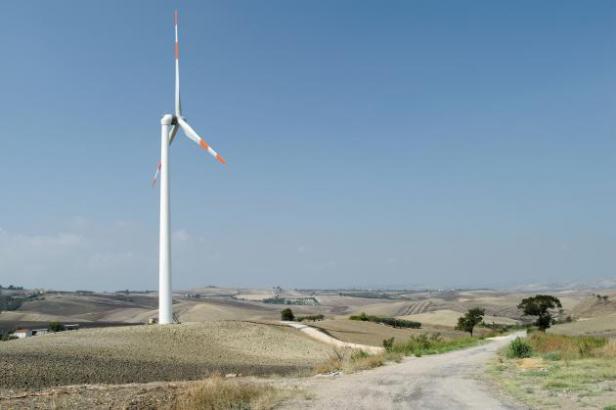
The South Tyrolean wind turbine manufacturer Leitwind will put up a 16 turbine wind farm in the region Apulia in Southern Italy by the end of this year.

Together, the turbines of the type LTW80 (1.5 MW) will produce an estimated 57 GWh of electricity annually.

The wind farm “Deliceto” in the province of Foggia will be operated by the company Elce Energia, which will invest a total of € 45 million in the project. The delivery of the turbines from Sterzing in South Tyrol, Italy, is scheduled for September 2012, and the wind farm will be completed before the end of the year.

“Leitwind is responsible for the transport, installation and commissioning of the wind park. Furthermore, a full-service contract for 15 years has been finalized,  which guarantees efficient production and optimum technical availability”, says Leitwind CEO Anton Seeber.

By the end of 2012, a total of 54 Leitwind turbines in Apulia and 82 in Italy as a whole will be generating electricity .Within a period of just five years up to the  end of 2011, Leitwind had managed to install a total of 200 turbines worldwide. Half of these were delivered in 2011, when 691 members of staff generated a turnover of € 163 million (+19%). For 2012, the management expects a turnover of € 200 million.

Russia launched the first industrial biogas plant

An industrial biogas plant was recently launched in the Belgorod Region in Central Russia.

The new station “Baytsury” is one of the first large scale industrial plants in Russia.

The station owned by the Regional Centre for Biotechnology, one of Russia’s largest companies, specializing in projects in the field of biogas energy.

It is located at a pig complex and is designed to process 38,690 m3 of organic waste and the production of 19,100 m3 of organic fertilizer.

The annual electric power output is estimated at 7.4 million kWh, while heat energy is 3,200 Gcal.

Now, in Russia, the potential of biogas production is estimated at 70 billion m3 per year.The southern regions of Russia have the biggest potential of biogas production and can produce 24.4 billion m³ of biogas from agricultural waste.

The Rostov Region and the Krasnodar Territory are among the most promising regions for the development of biogas technologies in Russia.

Solar powered Siberian Tiger camper unveiled by Tiger Adventures

Tiger Adventures a bespoke firm that turns normal everyday vehicles into campers, has just unveiled its latest discover.

Called the Siberian Tiger, named after the animal hailed to be the largest cat in the world, this camper uses the back of a Ford F450 and uses a three-point mounting system.

It is powered up by solar energy and it has also AMG batteries used to store the juice!

The camper has a stainless steel sink, three-burner recessed stove, convection microwave, refrigerator and freezer along with a porcelain toilet, full-length mirror, bamboo vanity, exhaust fan and separate shower area with a modified king bed to top it off.

The solar system is about 200 watt and it uses LED lighting indoors. The price is $163,000.