Japan looks to ocean for renewable energy

clean power Japan

Marine power generation plan

As an island nation, Japan controls large swaths of ocean territory, about the sixth-greatest expanse of any country in the world, according to government data. That is stark contrast to its relatively meagre land area, which ranks near the middle of list, in 60th place. So it makes sense for Japan to look to the seas for renewable energy — something it hasn’t done so far.

That is about to change, as the government is teaming up with two major industrial conglomerates, IHI Corp. and Toshiba Corp., to start field testing marine power generation in the near future.

“Our goal is to enable large-scale marine energy farms,” said a Toshiba spokeswoman, noting that the nearest site for testing is the area off Japan’s southern Pacific coast, where the Kuroshio current flows northward.

According to The Wall Street Journal, the initiative is an effort to develop new technologies to harness renewable energy and nurture future businesses opportunities as the need for renewable energy grows world-wide amid stricter regulations on coal in the U.S. and Western Europe. The Japanese government’s energy plan put forward in April 2014 called for an increase in use of renewable energy “to the greatest extent possible.”

IHI and Toshiba will spend about two years collecting data on currents at various locations to select the most promising ones. They will then conduct field tests by setting up a power generation system similar to an underwater kite anchored to the ocean floor that “flies” in the current.

The budget for the program is ¥2.75 billion ($23 million) for the current fiscal year through March. The government will subsidize part of the costs, but doesn’t disclose how much.

Marine current power generation technologies have already been developed and used in Europe, although they aren’t widespread. Japan wants to create its own technologies, say officials with the government-financed New Energy and Industrial Technology Development Organization, or NEDO, which works with the private sector on new energy technologies, and chose the two companies for financial support.

“Our marine environment is not the same as Europe’s,” said Yoshinari Takayanagi, an offshore wind and ocean energy project coordinator at NEDO. “There can be more suitable technologies.”

Dutch company uses plants to power streetlights and mobile devices

Plant-e

How Plant-e works

A Dutch company found a way to harvest electricity coming from the most unlikely of sources: plants.

According to Yes Magazine and followed-up by Inquisitr, the Dutch company known as Plant-e initially introduced their new energy project, known as “Starry Sky,” at a demonstration in Hembrug, Netherlands. In it, they were able to power 300 LED lights, a truly marvelous show for anyone in attendance.

The unique part of this project is that the harvested electricity didn’t come from conventional or even traditional green energy sources — it was harvested from living plants.

Marjolein Helder, the co-founder and CEO of Plant-e, believes that the aforementioned method of harvesting electricity can be revolutionary. Using plants to generate clean energy provides an option on the table that has little to no impact on the environment, and may save consumers up to millions as a whole if implemented correctly into society.

Yet, Helder understands to achieve such big dreams, one must take initial steps. For Plant-e, that is done not only through providing light, but by selling Wi-Fi hotspots, mobile chargers, and rooftop electricity modules, all fueled by living plants.

Apparently, the idea for using plants and photosynthesis to extract energy is an old one. Until now, such endeavors have been delegated to middle school projects, mostly in the form of clocks being powered by potatoes. Jim McGowan provided a graphic that gives a general summary of how this is done.

Though such an endeavor is novel, at this moment, it isn’t reliable as a commercial product. Ramaraja Ramasamy, an adjunct professor at the University of Georgia College of Engineering, explains that Plant-e utilizes sediment microbial fuel cells, a method that isn’t advanced enough to compete with more established green technology like solar panels and wind turbines. Also, it is fairly new, thus the research is quite limited.

In conclusion, Plant-e’s way of providing power through plants is interesting but not practical to use, especially in the United States and Japan, countries that use a monumental amount of electricity. Presently, Plant-e and other green technology companies like them are researching if it is possible to get around this situation.

World’s largest solar plant opens in California desert

Desert Sunlight power plant

Desert Sunlight power plant

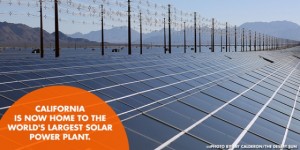
The Southern California desert is now home to the world’s largest solar power plant.

According to the USA Today, U.S. Interior Secretary Sally Jewell joined state officials on Monday to open the 550-megawatt Desert Sunlight solar project in the town of Desert Center, Calif., near Joshua Tree National Park. Built by First Solar, the project generates enough electricity to power 160,000 average California homes.

Desert Sunlight received a federal loan of nearly $1.5 billion, and Jewell called its completion an example of the loan guarantee program’s tremendous importance.

“When you are stepping out with new technology, when you are trying something that has been untested before, a loan guarantee program from an organization like the Department of Energy is what provides you, as a lender, that certainty that you can step up and support the project,” Jewell told The Desert Sun.

Conservative lawmakers have derided the loan guarantee program, arguing that it’s wasted billions of taxpayer dollars. Critics have pointed to the program’s $535 million loan guarantee for Solyndra, a Fremont-based solar panel manufacturer that filed for bankruptcy in 2011.

But the Department of Energy reported last year that it expects to make a profit of $5 billion to $6 billion from the program. The department funded five traditional, large-scale solar farms, and Desert Sunlight marks the last of those projects to go online.

“They’re all rock-solid, money is good, living up to every kind of condition we put in the loan documents in terms of performance, in terms of commercial operation,” Peter Davidson, executive director of the Department of Energy’s loan programs office, said in an interview last week.

The loan guarantee program did more than fund five solar photovoltaic projects, Davidson added: It helped launch the large-scale solar industry. In 2009, there were no traditional solar farms in the United States larger than 100 megawatts. Now, 17 such projects have been financed, according to a Department of Energy report released Monday.

Solar panels “existed before as a technology, but that technology hadn’t been deployed at a large scale,” Davidson said. “Once we’ve done that, the government steps aside to let the private markets take over.”

Desert Sunlight employed an average of 440 people during more than three years of construction, and it now has about 15 full-time employees. Money provided by the project’s owners — as part of an agreement negotiated with Riverside County — is also being used to fund $400,000 in improvements to the community center in nearby Desert Center.

“The debate’s over — we’re going to be moving to more renewable energy,” Riverside County Supervisor John Benoit said.

Power from the plant will go to Southern California Edison and Pacific Gas & Electric Co.

Desert Sunlight is the world’s largest solar power plant, although only by a hair.

The Topaz solar project in San Luis Obispo County, Calif. — which, like Desert Sunlight, was built by Arizona-based First Solar — also has a capacity of 550 megawatts. But the desert has more abundant sunlight than San Luis Obispo County, so Desert Sunlight will actually generate more electricity than Topaz, said Georges Antoun, First Solar’s chief operating officer.

“It’s a beautiful sun here, year-round,” he said.

California as a whole has installed more renewable energy than any other state, noted David Hochschild, a member of the California Energy Commission.

“There were a lot of skeptics who actually didn’t believe that renewables could scale, that this cost reduction could happen, that we could introduce it to the grid,” Hochschild said. “They’ve been proven wrong.”

There’s little doubt that California will get more electricity from clean energy in the coming years. The state’s three major utilities are on track to meet or exceed a 33% renewable energy mandate by 2020, and Gov. Jerry Brown is calling for policymakers to increase that target to 50% by 2030.

It’s an open question, though, whether future solar projects will be anywhere near as big as Desert Sunlight.

Developers have been gravitating toward smaller solar farms, which are easier to build and usually have a smaller impact on species and ecosystems in California’s deserts. Desert Sunlight spans 3,800 acres near Joshua Tree National Park, and it faced vehement opposition from environmental activists during its permitting process.

If legislators adopt a 50% renewable energy mandate, it could incentivize massive projects like Desert Sunlight. But Antoun said he’d be surprised to see many more projects 550 megawatts or larger, in California or elsewhere.

“Can we create a bigger project? Of course,” he said. “But it all has to do with how much appetite (states) have for how much land to utilize, and to be committed for 20-25 years.”

Utilities faced with renewable energy mandates, Antoun said, will more likely turn to projects in the 100-megawatt range, located closer to energy consumers. Projects built near cities require far less transmission infrastructure, which is expensive to build and poses a host of environmental concerns.

Solar power stealing sea slug can be first plant-animal hybrid ever descovered

Elysia chlorotica

Elysia chlorotica

Scientists discovered an animal that rely on sunshine for its nutrition. A new study published in The Biological Bulletin belive that Elysia chlorotica might be the first plant-animal hybrid ever discovered, as the emerald green slug steals its solar power by feeding on algae and storing the algae’s photosynthesis performing plastids in its large transparent digestive glands.

According to the Immortal News, the emerald green elysia acquires its solar power by feeding on algae. In the process of feeding on the submerged vegetation, the slug consumes green organelles which capture energy from the sun, combine it with carbon dioxide and water, and produce food. As the chloroplasts are stored in the slug’s digestive glands, it’s able to adopt the plant-like ability of photosynthesis.

Chloroplasts are tiny capsules inside green leaves which use sunlight to power chemical reactions plants require to survive.

Scientific American’s Ferris Jabr wrote that most slugs digest chloroplasts right away, but some species like the emerald green slugs, store the algal chloroplasts for weeks to months.

This storage turns the sea slugs brilliant shades of green. Jabr goes on to say that the chloroplasts inside an alga depend on a lot of genes in the alga’s own nuclear and the proteins for which they code.

“In order to photosynthesize, the chloroplasts inside an alga depend on many genes in the alga’s own nucleus and the proteins for which they code. Tearing chloroplasts out of algal cells and asking them to make food inside a slug’s gut is like expecting the bottom half of a blender to puree some carrots sans the blade and glass jar.”

The research team used fluorescent DNA markers to illuminate the algal genes in the genetic material of adult and larva slugs, the researchers reported in the Biological Bulletin.

Professor Sidney K. Pierce, the study’s co-author and a biologist at the University of South Florida as well as the University of Maryland, indicated that there’s no way the genes from alga should work inside of an animal cell, yet they do.

” There is no way on earth that genes from an alga should work inside an animal cell […] And yet here, they do. They allow the animal to rely on sunshine for its nutrition. So if something happens to their food source, they have a way of not starving to death until they find more algae to eat.”

If the findings in the study are confirmed, this would be the first case of gene transfer from one multicellular organism to another. The report also notes that bacteria do this all the time, however, the sea slug would be the first plant-animal hybrid ever discovered.

Functional gene transfer between multicullular species is the goal of gene therapy which aims to correct genetically-based human diseases.

According to the Daily Mail, Elysia chlorotica is found in salt marshes and shallow pools along the east of the U.S., particularly in New York, Maryland, Florida, Texas, Connecticut, and Massachusetts.

The solar-powered sea slugs can produce carbohydrates and lipids for itself for up to nine months.

Nepal finally goes solar

solar panels in Nepal

Clean power for Nepal

Sales of solar power systems have grown significantly in the past few years with load-shedding hours ever increasing. The government of Nepal has helped to boost the business further by providing subsidies to promote renewable energy in the country.

According to ekantipur.com, the surge in demand for renewable energy systems has led many companies to enter this niche market. Many companies have been launching various promotional campaigns and educating people on the benefits of installing solar panels for long-lasting energy supply.

More than 70 companies are competing for a share of the market in this segment in the Kathmandu valley, traders said.

“More and more residential houses and official buildings have been turning to alternative energy in recent years as load-shedding has been hampering people’s lives severely,” said Alok Kumar Gupta, head of marketing at Sipradi Energy. Sipradi, which entered this segment in 2010, has been witnessing a 40-50 percent growth in business annually, Gupta added. The company offers solar power systems with capacities starting at 80 watt and prices starting at Rs 45,000.

According to him, solar panels in the range of 120-150 watts and priced between Rs 45,000 and Rs 60,000 are in high demanded among households. “We recently installed a 40 KW solar panel at the Alternative Energy Promotion Office,” said Gupta.

“We are also focusing on expanding our sales and service network to make it easier for customers to avail of our products and services.” The company has 140 dealers across the country.

Meanwhile, an American solar energy equipment supplier Renogy has entered the Nepali market with a wide range of solar panels. “Today’s generation which has a busy schedule and uses technology a lot has been discouraged by the long power cuts. So we see a great market potential,” said Sudeep Chhetri, managing director of Suyash International, the authorised distributor of Renogy solar systems in Nepal.

Renogy solar panels come in the range of 35 to 200 watt and have a starting price of Rs 15,000. “We have sold Rs 700,000 worth of solar panels since launching a month ago,” he said.

Pratik Karki, sales manager of Lotus Energy, said that the government’s subsidy scheme to promote renewable energy was also helping business to grow.

“People have started realising that despite the higher initial cost compared to inverters, the solar panel system is more beneficial in the long run,” he said.

Corporate houses and banks and financial institutions, among other organizations, have been buying solar power systems instead of spending money on generators and inverters, he added.

Power to the people: ‘Fracking village’ goes solar

balcombe solar plant

Residents from Balcombe

A British village made famous after strong anti-fracking protests has installed the first community-owned solar panel project.

According to Engineering and Technology Magazine, local residents from Balcome, West Sussex set up a local energy co-operative REPOWERBalcombe after controversy over fracking by oil and gas company Cuadrilla in the summer of 2013.

The co-op has installed a total of 69 panels on the roof of a cow-shed at the nearby family-run Grange Farm as part of a long-term plan to generate enough power to match the entire electricity use of the village.

“We are delighted to have our first solar panel installation under way, as part of our bigger project to power the equivalent of our entire village’s electricity using clean and renewable energy,” said Joe Nixon, REPOWERBalcombe’s spokesman.

The panels will produce 18,000kWh of electricity each year. Grange Farm will be able to buy the electricity for at least 30 per cent cheaper than the best market-price, while the association will retain the Government feed-in tariff subsidy to pay dividends to their members and to fund local community projects.

“It’s great to be involved in doing something for our community and the environment, and nice to see the cow-shed roof being put to good use, plus we get a reduction on our electricity bills,” said Chris Jarvis, the owner of the Grange Farm.

According to organisers, the panels will produce just over 1 per cent of the community’s electricity needs, but they are negotiating with three local schools to install solar panels on its rooftops, which would account for 10 per cent of the village electricity’s demand. This will be paid for by a community share issue to local residents worth around £300,000.

“Balcombe has come to symbolise the choice Britain faces about our energy future – fracking or clean, renewable energy,” said Leo Murray, community energy campaigner.

“It is particularly apt that the community here have installed their first solar panels in the same week that Parliament has cast fresh doubt over the whole fracking project in the UK.

“Seeing these panels go up is a major milestone on REPOWERBalcombe’s journey and these first steps are blazing a trail for other communities to follow. The people here are part of a fast-growing movement to take back control of Britain’s energy future from giant, fossil-powered energy companies.”

The first installation coincides with a call to suspend fracking for shale gas from a committee of MPS, which was later rejected by Westminster and might be on the cards in Scotland, and Lancashire councillors delaying a decision on Cuadrilla’s fracking proposal.

Planetary Society to launch solar sail test flight in May

solar spacecraft

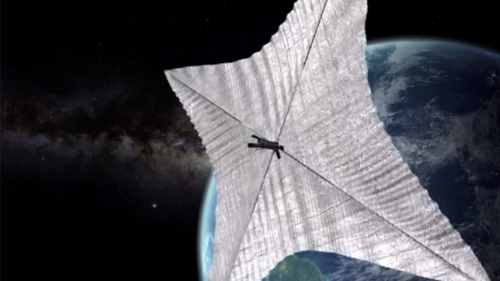
Solar sails are designed to capture the momentum from solar energy photons using large mirrored surfaces.

A tiny spacecraft designed to be pushed through space by ultra-thin “solar sails” will be launched in May by a U.S.-based non-profit group, 10 years after its first failed attempt.

The Planetary Society announced recently that its LightSail spacecraft will blast off on a test flight aboard an Atlas V rocket. The society is a non-profit space advocacy organization co-founded by the late astronomer Carl Sagan and headed by Bill Nye, best known as the Science Guy from his popular TV show.

According to CBC News, the LightSail spacecraft, a tiny cube satellite about the size of a loaf of bread, is expected to unfurl its four solar sails in June. The triangular sails are made of Mylar, about a quarter of the thickness of a garbage bag, and have a combined area of 32 square metres — equivalent to two parking spaces.

Solar sails are designed to capture the momentum from solar energy photons using large, mirrored surfaces. The small, continuous acceleration allows a spacecraft propelled by solar sails to reach high speeds over time.

“As LightSail breezes around the Earth, its shiny sails will be visible from the ground,” the Planetary Society says on its website for the project.

According to a blog post by Jason Davis, the society’s digital editor, the spacecraft won’t fly high enough to escape Earth’s atmospheric drag and demonstrate “true” solar sailing.

But it will gather time-lapse images of the sails’ deployment and engineering data that show how they perform in microgravity.

That, in turn, will be used to prepare for a second flight in 2016, at a higher altitude of 720 kilometres that will demonstrate “true solar sailing.”

The Planetary Society is collaborating on the project with California Polytechnic State University and the Georgia Institute of Technology, which will help collect data from the spacecraft, and two private space technology companies, Stellar Exploration Inc., which built the spacecraft, and Ecliptic Enterprises Corp., which conducted flight testing.

Five years later, the first solar sails were deployed by Japan’s Venus-bound IKAROS spacecraft and NASA’s NanoSail-D satellite in low-Earth orbit.

NASA has two upcoming solar sail missions, one to the moon and the other to an asteroid, scheduled for 2018.

Bacteria discovered that exist on pure energy

electric bacteria microbial nanowires

Electric bacteria connect to form wires

Microbiologists from California have discovered bacteria that survive by eating pure electrons rather than food, bringing an entirely new method of existence to awareness and raising questions about possibilities for alien life.

According to Extreme Tech, the ‘electric bacteria’ – as they have been dubbed by the team that discovered them – take energy from rocks and metal by feasting directly on their electrons. The hair-like filaments the bacteria produce carry electrons between the cells and their environment.

These bacteria yet again prove the almost miraculous tenacity of life — but, from a technology standpoint, they might also prove to be useful in enabling the creation of self-powered nanoscale devices that clean up pollution. Some of these bacteria also have the curious ability to form into ‘biocables,’ microbial nanowires that are centimeters long and conduct electricity as well as copper wires — a capability that might one day be tapped to build long, self-assembling subsurface networks for human use.

As you may recall from high school biology, almost every living organism consumes sugar to survive. When it gets right down to it, everything you eat is ultimately converted or digested into single molecules of glucose. Without going into the complexities of respiration and metabolism (ATP!), these sugars have excess electrons — and the oxygen you breathe in really wants those electrons. By ferrying electrons from sugar to oxygen, a flow of electrons — i.e. energy — is created, which is then used to carry out various vital tasks around your body (triggering electrons, beating your heart, etc.)

These special bacteria, however, don’t need no poxy sugars — instead, they cut out the middleman and feed directly on electrons. To discover these bacteria, and to cultivate them in the lab, the USC biologists quite simply scooped up some sediment from the ocean, took it back to the lab, stuck some electrodes into it, and then turned on the power. When higher voltages are pumped into the water, the bacteria “eats” electrons from the electrode; when a lower voltage is present, the bacteria “exhales” electrons onto the electrode, creating an electrical current (which could be used to power a device, if you were so inclined). The USC study very carefully controlled for other sources of nutrition — these bacteria were definitely eating electrons directly.

 All told, various researchers around the world have now discovered upwards of 10 different kinds of bacteria that feed on electricity — and, interestingly, they’re all pretty different (they’re not from the same family), and none of them are like Shewanella or Geobacter, two well-known bacteria that have interesting electrical properties. Kenneth Nealson of USC, speaking to New Scientist about his team’s discovery, said: “This is huge. What it means is that there’s a whole part of the microbial world that we don’t know about.

As for the repercussions of finding bacteria that eat and excrete electrons, the most obvious use is in the growing fields of molecular motors and nanomachines. These bacteria, at their most basic, are machines that consume raw electricity — and so, with some clever (genetic?) engineering, it stands to reason that we might one day use them to power tiny machines that can perform tasks that are currently carried out by expensive, human-operated machines (cleaning up chemical spills, for example). These bacteria might also allow us to find out exactly how much energy a living cell needs to survive; put them in a test tube, and then slowly dial back the electrode voltage until they die. A cruel experiment, but one that would yield very informative results.

Solar Powered 3D Printers Building Desert Skyscrapers With Sand

Solar-powered Sand Babel Towers

Solar-powered Sand Babel Towers

Sustainable, green construction in areas where people would never dream about living, is something that 3D printers could one day make possible.

According to 3dprint.com, a Chinese team designed the Sand Babel Towers, which are a unique concept group of buildings that can be constructed in the desert, with cranes, and 3D printers.

The actual design was submitted to eVolo’s 9th Annual Skyscraper Competition, and received an honorable mention. The competition challenged artists, architects, and designers worldwide, to imagine future towers that address a dense, energy and water-scarce world.

The technology to build such a set of structures is already available in its infant state. A man named Markus Kayser unveiled a solar powered 3d sand printer last year. This technology would need to be scaled up, of course, and undergo significant testing before it could be used for the construction of large skyscrapers, however that day may not be very far off.

The Sand Babel Towers are constructed in two main sections. The first section is the area above the ground in which people live, or work in. The design of this upper part of the structure mimics the natural phenomena called “tornadoes and mushroom rocks.” It is a duel funnel structure which helps with cross-ventilation, and allows for the condensation of water at the top because by taking advantage of the varying temperature differences.

The second section is a whole array of underground tunnels connecting each tower, as well as acting as a mechanism to slow down the flowing sand dunes. The tunnels also help facilitate communication between each building, and act as a root system for added structural integrity.

Although we are likely a decade or more away from seeing buildings like this actually constructed, the technology is progressing rapidly, and 3D printing will soon become a very important part of large scale construction projects. Discuss Sand Babel at 3D print Board.

This solar-powered chip reminds us to close the windows

solar chip

Solar chip monitors windows

A new kind of radio chip is intended to warn when windows are left open. This way, you can avoid having the heat go out the window on cold days. The sensor also detects break-in attempts early on. The key: This maintenance-free chip powers up with energy supplied by solar power.

Germany’s Fraunhofer Institute for Microelectronic Circuits and Systems developed a tiny chip that is designed to be mounted on the window’s aluminum frame, between the panes of glass. Covered by a solar cell, the chip can store enough power during daylight hours to operate throughout the night.

Using an integrated accelerometer and magnetometer, the chip is able to detect when the window has been opened, and by how much. If the window has been left open “too long” (such as once everyone has left the house for the day, or once the temperature has dropped significantly) it sends a radio signal to a base station in the home. That station in turn alerts the homeowner.

Additionally, if it detects movements that are unique to a locked window being forced open, it will signal the base station to sound an alarm, Gizmag writes.

The chip will be on display at the BAU trade fair in Munich, from January 19 to 24. Fraunhofer previously developed a similar system, in which the window sensor is powered both by a solar cell and a thermoelectric generator.