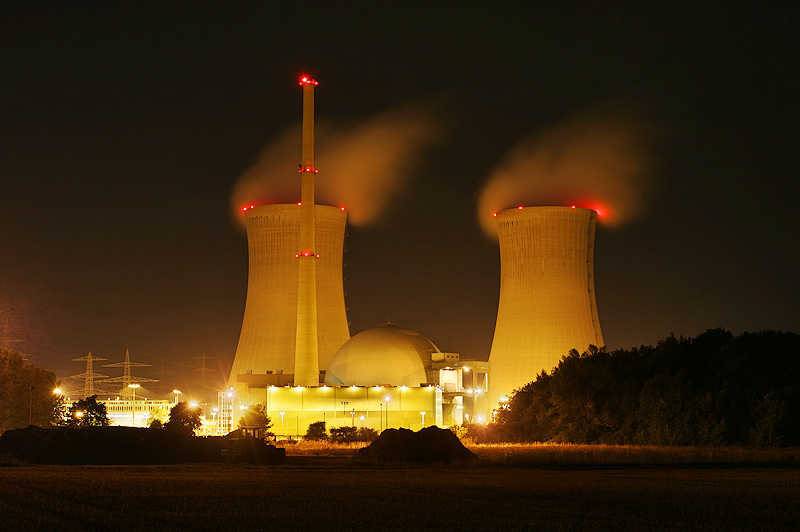
Germany’s Grafenrheinfeld nuclear reactor will be shut down permanently on June 27th

Grafenrheinfeld nuclear reactor

Grafenrheinfeld nuclear reactor. Photo via m8.i.pbase.com

One less nuclear reactor threat to the people of Europe with the early closure of the Grafenrheinfeld nuclear reactor.

According to Greenpeace International, Germany’s 33 year-old Grafenrheinfeld nuclear reactor will be shut down permanently on June 27th as the country’s phase out of nuclear power continues.

It’s the first reactor to close since Germany passed its Atomic Energy Act in July 2011 which requires the closure of all commercial nuclear reactors by the end of 2022.

The reactor is being shut down seven months early as the disastrous economics of nuclear power and Germany’s drive for clean and sustainable energy have made it impossible for its owner E.ON to operate the reactor and make a profit.

E.ON and other large nuclear utilities only have themselves to blame. They failed to anticipate the growth of renewable energy and so they failed to invest in it. At the same time, electricity prices have fallen making their nuclear power plants even less profitable.

That said, even E.ON is waking up to the new energy future of Germany. “The transformation of Europe’s energy system continues to offer us attractive growth opportunities in renewables and distributed energy,” said the company in a report from March this year.

But what are the implications of the closure of Grafenrheinfeld? Won’t it leave an energy gap?

In short: no.

Since 1981, Grafenrheinfeld reactor was the cornerstone of electricity production in Bavaria but that was before the renewables revolution. Now its closure will be barely noticed. There will be no blackouts and the security of supply is guaranteed.

The simple explanation is that over the last 15 years Germany has embraced renewables. The share of renewable energy in electricity generation grew from six percent in 2000 to around 27 percent in 2014, spread across wind, solar, and bioenergy. Germany is a major net exporter of electricity, reaching record levels in 2013 and 2014.

“This is going smoothly… No one, no company, no private citizen will feel that the reactor power is off the grid,” says Bavarian Economy and Energy Minister Ilse Aigner.

So what’s next? It’s clear that Germany doesn’t need nuclear power and that renewables are more than up to the job of leading the country into a future of sustainable, safe electricity.

But the job isn’t finished. At current growth rates, Germany is likely to reach its target of 35 percent by 2020 for renewable electricity. However, the overall share of renewable energy generation remains quite low at 11 percent because the power industry is being left to its own devices.

Germany will probably not reach its target of 20 percent of its total energy provision being renewable by the end of this decade without further government support.

So while it is excellent news from Grafenrheinfeld, there is still much to do. In the meantime, with the closure of this reactor, we see the victory of renewables over nuclear power. Germany is leading the way globally to the safe, clean energy future. The rest of the world needs to follow.

Fund solar panels for Gaza hospitals

solar panels on the roof of Gaza's hospital

Solar panels on the roof of Gaza’s hospital. Photo via middleeastmonitor.com

A group of Canadian doctors hope to make blackouts a thing of the past for Gaza’s hospitals by installing solar panels to provide energy 24/7 for emergency rooms and operating theatres.

The “EmpowerGAZA” project has launched a fundraising drive on Indiegogo to secure the $200,000 required to fund the first hospital, with the ultimate goal being to supply a further three hospitals with the life-saving solar panels.

Power outages are a daily reality in the Gaza Strip, and can last more than 16 hours per day. Hospital patients are especially vulnerable, and insufficient power can be the difference between life and death.

According to Dr Tarek Loubani, an emergency physician and collaborator on the project: “Doctors in Gaza were asking for reliable and green power, and the United Nations Development Programme (UNDP) came on board immediately when they heard about the project.”

“Everyone agreed, this project is urgent. We believe people world over will understand the impact and help its success.”

According to Middle East Monitor, EmpowerGAZA is a joint initiative of the United Nations Development Programme (UNDP) and Islamic Relief Canada to provide a renewable, reliable source of energy for intensive care units (ICUs), operating rooms and emergency departments.

A crowd-funding campaign began on 28 April and will run through to 26 June.

China plans massive solar power plant in space by 2050

solar energy from space

The Chinese solar space station is planned to be much more massive than the International Space Station. Photo: NASA via Instagram

China wants to put up a solar power station bigger than the International Space Station in orbit at 36,000 kms above the ground by 2050.

According to International Bussiness Times, the project would solve the energy crisis on Earth, the Chinese scientists behind the vision say.

An experimental space solar power station is planned to be in place by 2030, with a commercially viable one to be ready by 2050.

Wang Xiji, the 93-year-old academician of the Chinese Academy of Sciences and an International Academy of Astronautics member, who has devoted over 50 years to space technology research, is an advocate for the station.

“An economically viable space power station would be really huge, with the total area of the solar panels reaching 5 to 6 sq km,” he told official media.

Being in orbit the station would be able to harness solar energy 99% of the time.

Space-based solar panels can generate ten times as much electricity as ground-based panels per unit area, say the experts.

The electricity generated would be converted to microwaves or lasers and transmitted to a collector on Earth. The efficiency of the transmission will have to cross 50% before the project becomes economically viable.

The idea was first mooted back in the last century by science fiction writer Isaac Asimov in a short story titled “Reason”.

However, one of the chief hurdles in the realisation of the massive project is the need for a cheap heavy-lift launch vehicle, says Wang, who designed China’s first carrier rocket more than 40 years ago. “We also need to make very thin and light solar panels.”

Chinese space scientists believe the space station planned to be placed in orbit by 2020 will aid the solar project.

China is also expected to develop a new generation heavy-lift launch vehicle.

Besides avoiding the smog and pollution generated by its many fossil fuel power plants, the demand for energy is expected to be met by the space station. China is the world’s largest energy consumer as also the world’s top carbon emitter.

Israel installs solar panels at parliament to save energy

solar panels

Israel’s Knesset unveils world’s largest parliament rooftop solar field. Photo: Courtesy Knesset

Israel has installed solar panels on the roof of its parliament building, creating what it calls the largest solar field of any national assembly in the world.

According to phys.org, the office of the parliament speaker says energy generated from some 1,500 solar panels will provide 10 percent of the electricity used at the Knesset, Israel’s parliament.

The Knesset is also advancing other energy-saving projects, like installing energy-saving lights, automatically shutting down lawmakers’ computers at the end of each workday, and using air conditioning systems to help irrigate the gardens surrounding the building.

The statement says the measures will reduce the Knesset’s energy use by a third.

Scientists will also conduct ecological research on the parliament roof.

JAM IN THE VAN, the solar-powered mobile music studio

solar-powered van

JAM IN THE VAN. Photo: Abran Rubiner

JAM IN THE VAN is a solar-powered mobile music studio and discovery platform that is set to travel over 10,000 miles this year. Housed inside an RV, it greatly differs from typical music studio setups and is able to hit the road in search of music to record.

The one-of-a-kind platform was founded in 2011 by music fans Dave Bell, Jake Cotler, and Louis Peek in Venice, California. The RV was outfitted with a full HD audio/video production suite, enabling it to capture unique live music performances at festivals and other venues across the country.

According to psfk.com, over five hundred sessions have taken place inside the mobile music studio, with a mix of both emerging and already established musical acts including Gary Clark Jr., George Clinton, Matisyahu, Misterwives, Allen Stone, ZZ Ward, Robert DeLong, and The Orwells.

JAM IN THE VAN has helped introduce music fans to some great new acts, putting on shows in Los Angeles, New Orleans, Bonnaroo and SXSW. When not on the road, the bright and colorful RV hosts musicians in its hometown, and all of the performances can be seen on their official YouTube channel.

This year looks set to be a big one for the solar-powered mobile studio, which will be traveling over 10,000 miles to bring music fans more than two hundred sessions from buzzworthy bands at festivals across the U.S. They are taking over SXSW music festival in Austin, Texas this month and have partnered with GQ to showcase over forty bands at the ‘GQ x JAM IN THE VAN HOUSE’. The founders said:

“2015 will be the most prolific year to date for JAM IN THE VAN. We’ll travel more miles and discover more great music than ever before. We plan to expand our content slate and increase our reach to cover a broader fan base than ever before.”

You can get a good look at JAM IN THE VAN and see some musicians performing in the unique studio below:

Natural silk can boost the performance of lithium-ion batteries

natural silk can boost lithium-ion batteries

Natural silk to improve lithium-ion batteries

A green material derived from natural silk can boost the performance of lithium-ion batteries used in portable gadgets and electric cars, scientists say.

Carbon is a key component in commercial lithium-ion energy storage devices including batteries and supercapacitors.

Most commonly, graphite fills that role, but it has a limited energy capacity, researchers said.

To improve the energy storage, manufacturers are looking for an alternative material to replace graphite.

According to Tech First Post, Chuanbao Cao and colleagues at the Beijing Institute of Technology wanted to see if they could develop such a material using a sustainable source.

The researchers found a way to process natural silk to create carbon-based nanosheets that could potentially be used in energy storage devices.

Their material stores five times more lithium than graphite can – a capacity that is critical to improving battery performance.

It also worked for over 10,000 cycles with only a 9 per cent loss in stability.

The researchers successfully incorporated their material in prototype batteries and supercapacitors in a one-step method that could easily be scaled up.

The study is published in the journal ACS Nano.

Solar panels stolen from Gloucestershire energy farm may be sold on

solar farm

Thousands of pounds of solar panels stolen from Cambridge farm

Police have urged people in Gloucestershire to be aware of stolen solar panels being sold door-to-door. Panels worth several thousand pounds were taken from a Gloucestershire farm earlier this week.

According to SouthWest Business, the theft happened in Bristol Road, Cambridge, between 9pm on Monday and 9am on Tuesday.

The thieves gained entry to the site by removing a stile and part of a fence.

Once on the site the raiders removed six or seven pallet-loads of solar panels worth several thousand pounds from a solar panel farm.

Police believe the suspects are now attempting to offload them door-to-door as at around 2.10pm on Tuesday, two men knocked at the door of a number of houses on Upton’s Gardens in Whitminster trying to sell solar panels to the occupants.

Police believe that the two incidents are linked.

Kim Mowday, harm reduction advisor for Gloucestershire police said: “Always be very cautious when buying anything from salespeople turning up at your door unannounced.

“There are lots of reasons why it is dangerous to purchase anything from someone you don’t know or aren’t expecting.

“At best you could be sold faulty items which could leave you significantly out of pocket. At worst you could be breaking the law by handling stolen goods.”

The householder in this instance did the right thing by contacting police immediately, he said.

“If you experience something similar we would advise you to do the same by calling 101.”

The first offender is described as white and around 30-35 years-old.

He was of slim build, with reddish coloured hair and around 5ft 10ins tall.

He was scruffy looking, unshaven and was wearing a navy blue v-neck top, light shirt and baggy, loose trousers.

The second offender was also described as white but smarter in appearance. He was around 5ft 9ins tall, of slim build with dark hair.

He was wearing a grey v-neck jumper and possibly had a Welsh accent.

Anyone who may have any information on either of these incidents is asked to contact Glouces

Unprecedented solar power boom in U.S.

solar power in U.S.

Solar boom in U.S.

U.S. solar power grew by 6.2 gigawatts in 2014, a 30 percent increase over the previous year and representing nearly $18 billion in new investment, according to data released by the Solar Energy Industries Association and GTM Research.

According to Scientific American, the new power systems, comprising tens of thousands of photovoltaic (PV) arrays for homes, schools, businesses and utilities, as well as a handful of large concentrated solar power facilities in places like the Mojave Desert, raised the United States’ profile as one of the world’s leading adopters of solar power, officials said.

But the future for U.S. solar isn’t without its bumps.

New installations of nonresidential solar panels, while accounting for more than 1 GW of power, shrank by 6 percent year over year, a condition caused by a variety of factors “ranging from tight economics to difficulty financing small commercial installations,” GTM analysts said in their latest “U.S. Solar Market Insight Report.”

Meanwhile, the industry’s primary federal support—the 33 percent investment tax credit (ITC)—is set to expire at the end of 2016, effectively shifting the cost burden of solar fully to developers and consumers of clean power. And as with other renewable energy resources, solar’s future will be affected by the status of state renewable portfolio standards that direct rate-based utilities to produce or acquire a percentage of their power sales from clean energy resources.

Yet, even with those caveats, industry officials and analysts forecast a continued boom in U.S. solar markets over the near term, with a projected 31 percent growth target for 2015. The growth will be fueled by falling costs for solar panels and modules, business model innovation that allows for more flexibility in ownership, favorable political and regulatory environments, and increased access to low-cost capital.

Solar beats wind and coal on key metric
Shayle Kann, senior vice president at GTM Research, noted that in just five years, the U.S. PV market—which does not include concentrated solar plants—has witnessed a fourfold expansion, from an estimated $3 billion in 2009 to $13.4 billion last year.

Moreover, solar accounted for 32 percent of the nation’s new generating capacity in 2014, beating out both wind energy and coal for the second consecutive year. Only natural gas constituted a greater share of new generating capacity, according to the report.

“From a high-level national perspective, the market has continued to see really impressive growth,” both in established solar markets like California and Arizona and in regions where solar is a relative newcomer, such as in Virginia, the Carolinas, Georgia and Louisiana.

Some of the growth, especially in emerging solar states, was attributable to state incentives for residential and commercial solar, the growing popularity of third-party leases offered by firms like SolarCity and Sunrun, and a desire on the part of large utilities to diversify their fuel portfolios to include renewable energy.

Cory Honeyman, a GTM solar analyst and lead author of the 2014 market report, further noted that “2014 was the year where the concept of retail rate parity became something that extended beyond California to a growing number of other markets.”

For example, North Carolina for 2014 was the nation’s No. 2 solar state by installations behind California, with 397 megawatts of new solar power coming online. It was followed by Nevada, Massachusetts, Arizona and New Jersey, all of which have well-established solar markets.

Other states rising in the solar ranks include New Mexico, Missouri and Maryland. New Mexico for the first time became a top 10 state for solar development thanks to its 88 MW gain in solar capacity last year.

New York, Texas and Hawaii also each added more than 100 MW of solar capacity in 2014, securing their spots among the nation’s solar leaders. Elsewhere in the Southeast, Georgia and Tennessee saw marked increases in utility-scale solar, while Louisiana and South Carolina experienced sustained growth in the residential solar sector, according to GTM.

The U.S. residential sector added 1.2 GW of capacity in 2014, marking its first time surpassing 1 GW, according to GTM. Residential PV continues to be the fastest-growing market segment in the U.S. solar sector, riding three consecutive years of 50 percent or higher annual growth.

The utility sector also remains very strong, adding nearly 1 GW annually over the past several years. In 2014, 3.9 GW of utility-scale PV projects came online in the United States, with an additional 14 GW of projects under contract.

“Today the U.S. solar industry has more employees than tech giants Google, Apple, Facebook and Twitter combined,” Rhone Resch, SEIA’s president and chief executive officer, said in a statement. That success, he added, has come in part from the 9-year-old investment tax credit for solar power.

“We now have 20 gigawatts of installed solar capacity—enough to power 4 million U.S. homes—and we’re helping to reduce harmful carbon emissions by 20 million metric tons a year,” Resch said. “By any measurement, the ITC has been a huge success for both our economy and environment.”

Traffic cops in Kinshasa? No, they now have solar-powered robocops!

solar-powered robocop

Solar-powered robocops in Kinshasa. Foto: AFP

In Kinshasa, the teeming capital of the Democratic Republic of Congo, where drivers often flout traffic rules, five chunky, arm-waving robots equipped with cameras, lights and solar panels have been set up to watch over the roads.

According to South China Morning Post, the solar-powered aluminium robots are huge, towering over the jammed streets, as cars and motorcycles jostle for road room, their horns blasting.

Each hand on the odd-looking machines – built to withstand the year-round tropical climate – is fitted with green and red lights that regulate the flow of traffic in the sprawling city of nine million.

The robots are also equipped with rotating chests and surveillance cameras that send real-time images to the police station.

Although the humanoids look more like giant toys than real policemen, motorists have given them a thumbs-up.

“There are certain drivers who don’t respect the traffic police. But with the robot it will be different. We should respect the robot,” taxi driver Poro Zidane said.

“We’re very happy about it,” he said, his taxi packed with passengers as drivers around him honked their horns in a desperate bid to cut through the traffic jam.

Of the five robots set up across the capital, two have been regulating traffic since 2013.

On Tuesday, three new and improved robots developed by a Congolese association of women engineers were set up.

The newcomers even have names: Tamuke, Mwaluke and Kisanga. Each cost US$27,500.

Therese Izay, president of Women’s Technology, the group behind the robots, believes the invention will help make it far more difficult for motorists to get away with traffic violations.

“In our city, someone can commit an offence and run away, and say that no one saw him. But now, day or night, we’ll be able to see him in real time and he will pay his fine like in all the serious countries of the world,” she said.

But Kinshasa governor Andre Kimbuta said that while the machines could regulate traffic, they were no match for real human policemen who could chase motorists who jump red lights and raise civic awareness.

“We should congratulate our Congolese engineers, but policemen also need to do their job,” the civic leader said.

Samsung gives a Solar Powered Internet School to learners in Mpumalanga

Solar Powered Internet School

Samsung’s Solar Powered Internet School

Samsung Electronics South Africa has delivered a Solar Powered Internet School (SPIS) to the Chief SW Nhlapho Secondary School in Dundonald, Mpumalanga. The executive mayor of Chief Albert Luthuli Municipality, B.P. Shiba, attended the handover ceremony, along with the Department of Education’s acting district director, P.P. Magagula.

Head of Corporate Citizenship at Samsung Electronics South Africa, Pitso Kekana was also in attendance.
Many communities facing economic and geographic challenges often have little or no access to electricity and Samsung designed the SPIS with these issues in mind.

According to Media Update, the units come completely self-contained with solar generators and wireless communication, providing unlimited access to technology, communication and information as long as there is sunlight to power the solar panels, digital cellular network or satellite connectivity.

This initiative is part of Samsung’s Corporate Citizenship programme, which seeks to provide educational material and connected classrooms to disadvantaged communities.

Chief SW Nhlapo Secondary School was established in 1994 and currently has 643 learners. In 2014 the school obtained an 81.03% pass rate, producing the highest number of matric passes in Dundonald.

The pupils of this school possess an incredible amount of dedication and perseverance and the school is geared towards advancing the surrounding community. The secondary school was crowned as the proud winners of a national competition called the ‘2012 Youth Citizens Action Programme’, where learners were challenged to demonstrate empowered active citizenship.

The Chief SW Nhlapo High School presented a road safety campaign which tackled a number of challenges they faced outside their school. The campaign generated awareness for learners to make use of the pedestrian crossings and have the boundaries of their roads fixed.

In addition, the learners approached local traffic police to assist with taking non-roadworthy vehicles off the road, which is one of the main contributing factors to road accidents. This school demonstrated that hard work and persistence is a reward on its own.

“The school’s drive and enthusiasm displayed in their zeal to make the road safety campaign a collective achievement, further gives us faith that they will indeed make a success of the SPIS,” concludes Kekana.