Gamesa a world leader in wind turbines

During 2011 Gamesa made progress in offshore strategy, technological design and development of the G11X-5.0 MW platform which will be equipped with a 128-metre rotor diameter.

Gamesa has a 15 years experience in the design, manufacture, installation and maintenance of wind turbines, having installed 21,000 MW in over 30 countries across four continents, with over 13,600 MW under maintenance.

All this makes her a world leader.

Recently, in Liverpool Gamesa showcased theG128-5.0 MW offshore wind turbine.

The first prototypes are scheduled for completion in the last quarter of 2012.

The company plans to invest over €150 million between now and 2014 in the UK wind power offshore.

Google invest $55 million in Mojave Desert

The wind power industry of California received a boost when Google Inc. announced its decision to invest $55 million in a large Mojave Desert wind farm.

By this investment the state made an important step to regain its number one position in the world in field of wind power energy production.

Google is involved in many projects related to renewable energy because it needs huge amount of electricity to run its vast datacenters.

The internet search giant has taken up the above mentioned project in partnership with Citibank which is also investing an equal amount, i.e. $55 million.

The wind farm will produce 1.5 gigawatts which will power 450.000 homes.

This initiative will create green jobs in Kern County which is struggling with 17.5 percent unemployment.

Green Home made by Victoria University students

The architecture students designed a home, located at the Wellington waterfront which  packs 28 solar panels, 48 water-collecting tubes on the roof for a solar-powered hot water system, triple glazing and wool insulation.

This house cost 500.000$ to be built.

“We had what must have been two-and-a-half thousand people through, even though the weather was pretty blustery and cold.
The line was stretching back about 30 or 40 metres, and [on Saturday] even though it was pouring with rain, we still had up to 60 people inside the house at a time” said Nick Officer one of the architecture students behind the project.

Now this eco-house is in Frank Kitts Park till May 24 after which it will be dismantled, packed up and moved to Washington DC.

Google invests into solar thermal power plant

Google said it would invest $168 million into the Ivanpah solar thermal power plant being erected by BrightSource Energy.
The Ivanpah plant, rated at 392 megawatts, is slated to be the first in a series of large solar thermal plants from BrightSource. The company has additional power contracts for 1,300 megawatts with Southern California Edison and 1,310 megawatts with Pacific Gas & Electric.
The technology underlying Ivanpah and many of the other new projects differs from conventional solar thermal power plants. At Ivanpah, fields of relatively flat, computer-controlled mirrors will focus the heat of the sun onto a water tank to create steam. The steam ultimately powers a turbine. The architecture, says BrightSource, can more economically and efficiently capture and transfer energy than the traditional systems that use parabolic mirrors to heat oil in tubes. BrightSource should know: It grew out of a parabolic company called Luz that built some of the most successful parabolic fields ever erected.
Google has invested $250 million in alternative power projects, including wind and solar farms.

Source: www.greentechmedia.com

$25 million to a joint solar research effort by Stanford and UC-Berkeley

The U.S. Department of Energy’s SunShot Initiative recently awarded $25 million to a joint research effort by Stanford and UC-Berkeley. The team, called the Bay Area Photovoltaics Consortium (BAPVC), will work to address technical barriers to the solar power industry and reduce the cost of solar installations.
BAPVC will fund research and development that aims to produce cost-effective solar modules in high volume. It will look closely at new materials, device structures and production methods.
BAPVC co-director Yi Cui, an associate professor of materials science and engineering, was optimistic about these efforts.
“The future of solar is clearly in cheaper, better performing photovoltaics,” Cui said to the Stanford News Service. “The SunShot funding and the exciting collaborative approach between the universities and national labs guided by industrial perspectives will advance all the components of solar modules that will bring down the dollar-per-watt cost dramatically.”

Source: www.stanforddaily.com

Renewable energy based on the principle of entropy

In nature, the diffusion of river water into salty seawater leads to a slight rise in temperature, and this energy could be captured to generate electricity. The conventional means of capture has been through osmotic power. Fresh water and salt water are separated by a membrane, and the salt water draws fresh water through the membrane, causing an increase in pressure. The pressure can then be used in a variety of ways, for example to turn a turbine. The Norway-based company Statkraft is testing one such osmotic power facility.
A team of researchers from Stanford University  approached the problem from a different angle and came up with a more compact system. As reported by Andy Extance at the Royal Society of Chemists, the Stanford system uses a battery to draw energy through a crystal lattice made of manganese dioxide nanorods, which pack a large surface area into a small space.

Source: www.cleantechnica.com

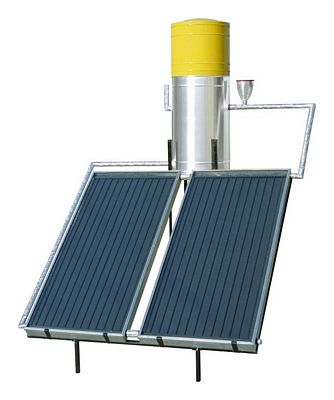
Solar Water Heating is on the Rise for Commercial Applications in the U.S.

AltaTerra Research announced the release of its highly anticipated report today, entitled, “Solar Water Heating on the Rise: Tapping into Commercial Solar Thermal.”  The report is one of the first professional market research studies of how customers are installing solar water heating. It addresses customer-facing issues, including the value proposition and suitability to and rate of adoption in particular industry types. It also profiles how and why current customers are installing solar water heating systems.
Sample findings from the report include:
  • The United States solar water heating market is now growing at about 20 percent per year in the commercial sector—a significant upturn from long-term trends.
  • For most customers, solar heating lowers energy expenditures.
  • Pilot installations are raising market acceptance and triggering follow-on purchases.
In a development that bodes well for the potential of a robust commercial market, solar thermal power purchase agreements are starting to take root in some areas.
“The market for commercial solar water heating systems in the United States is on the rise, growing an estimated twenty percent in 2010.  The U.S. commercial market is benefiting from new incentives programs and an increase in corporate and commercial customers seeking to meet resource efficiency goals and hedge against rising energy prices,” said the report’s lead author Eric Paul.
Source: www.renewableenergyworld.com

New advance in biofuel technology

U.S. Energy Secretary Steven Chu congratulated a team of researchers at the Department’s BioEnergy Science Center who have achieved yet another advance in the drive toward next generation biofuels: using bacteria to convert plant matter directly into isobutanol, which can be burned in regular car engines with a heat value higher than ethanol and similar to gasoline. This research is part of a broad portfolio of work the Department is doing to reduce America’s dependence on foreign oil and create new economic opportunities for rural America.
BACKGROUND ON THE SCIENTIFIC ADVANCE ANNOUNCED TODAY
The work was conducted by researchers at the Department of Energy’s BioEnergy Science Center (BESC), led by Oak Ridge National Laboratory. Using consolidated bioprocessing, a research team led by James Liao of the University of California at Los Angeles for the first time produced isobutanol directly from cellulose. The team’s work, published online in Applied and Environmental Microbiology, represents across-the-board savings in processing costs and time, plus isobutanol is a higher grade of alcohol than ethanol.
“Unlike ethanol, isobutanol can be blended at any ratio with gasoline and should eliminate the need for dedicated infrastructure in tanks or vehicles,” said Liao, chancellor’s professor and vice chair of Chemical and Biomolecular Engineering at the UCLA Henry Samueli School of Engineering and Applied Science and a partner in BESC. “Plus, it may be possible to use isobutanol directly in current engines without modification.”
Source: http://energyportal.eu/latest-green-energy-news/9681-energy-department-announces-new-advance-in-biofuel-technology.html

The new Wave Power Device

Ocean Power Technologies Inc. has announced that it has completed the first of its new generation utility-scale PowerBuoy device, the PB150. The PB150 Powerbuoy has a peak-rated power output of 150 Kw and is the largest, most powerful wave power device build by the company.
Ocean Power Technologies Inc. is a leader in wave energy technology. The PB150 PowerBuoy will have the equivalent to the energy consumption of approximately 150 homes – the PB150 is designed for use in arrays for grid-connected power generation projects worldwide, according to a press release.
The device is currently being prepared for ocean trials at a site approximately 33 nautical miles from Invergordon, off Scotland’s northeast coast. These sea trials are expected to commence as soon as weather conditions permit. The company is seeking additional financing for the commercial utilization of the buoy after the trial phase is completed, including its possible deployment at various potential sites.
A second PB150 is already under construction in the US for a proposed utility-scale project in Oregon, and the company is involved in other planned projects in Australia, Japan and Europe that may utilize the PB150.
Source: http://www.tomorrowisgreener.com/the-next-generation-wave-power-device/

Biodiesel fuel from ‘chicken feather meal’

If we go by the stats, every year 11 billion pounds of poultry industry waste accumulates annually, because we have gigantic appetite for poultry products. They can’t be stuffed into pillows. Mostly they are utilized as low-grade animal feed. Scientists in Nevada have created a new and environmentally friendly process for developing biodiesel fuel from ‘chicken feather meal’. Professor Manoranjan ‘Mano’ Misra and his team members at the University of Nevada discovered that chicken feather meal consists of processed chicken feathers, blood, and innards. Prof. Misra has been honored as the 2010 Regents’ Researcher by the Nevada System of Higher Education Board of Regents.

Chicken feather meal is processed at high temperatures with steam. This feather meal is used as animal feed and also as fertilizer. Chicken feather meal has high percentage of protein and nitrogen. The researchers have paid attention to the 12% fat content of the chicken feather meal. They have arrived at the conclusion that feather meal has potential as an alternative, non-food feedstock for the production of biofuel. They have extracted fat from chicken feather meal using boiling water and processing it into biodiesel. Another advantage of extracting fat from feather meal is it provides both a higher-grade animal feed and a better nitrogen source for fertilizer applications.
Stats tell us that if we take into account the amount of feather meal generated by the poultry industry each year, researchers could produce 153 million gallons of biodiesel annually in the U.S. and 593 million gallons worldwide.

Source: www.alternative-energy-news.info/fuel-from-chicken-feathers/